Your Cart is Empty


TL;DR:
- Rest alone is not sufficient for healing damaged vocal cords; active exercises are essential to retrain muscles and restore function. Consistent, gentle techniques like straw phonation and lip trills reduce strain, promote healing, and improve vocal measures over time. Supporting habits such as hydration, reflux management, and professional voice therapy are vital for optimal recovery and long-term vocal health.
Resting your voice after vocal cord damage feels like the right thing to do. And rest does matter. But if rest alone were enough, most singers, teachers, and speakers would recover fully without ever seeing a voice therapist. The truth is that exercises for damaged vocal cords are not just supplementary. They are the engine of recovery. They retrain neuromuscular patterns, reduce inflammation, and restore the kind of coordinated airflow your vocal folds need to vibrate efficiently again. This article gives you a clear, evidence-based path back to a strong, healthy voice.
| Point | Details |
|---|---|
| Rest alone is insufficient | Active vocal cord recovery requires targeted exercises to retrain muscle coordination and restore function. |
| SOVTEs reduce collision force | Exercises like straw phonation create back pressure that protects healing vocal folds during practice. |
| Technique matters more than effort | Pain or tickling during exercises signals incorrect form; gentle vibration is the goal. |
| Lifestyle supports exercises | Hydration, avoiding whispering, and managing reflux are critical companions to any exercise routine. |
| Consistency drives results | Measurable vocal improvements appear after weeks to months of regular, guided practice. |
Your vocal folds are two small bands of muscle and mucous membrane that vibrate hundreds of times per second to produce sound. When they are damaged, that vibration becomes uneven, strained, or nearly impossible.
The most common types of vocal cord damage include:
Each of these conditions changes how your folds close and vibrate. You may notice hoarseness, a reduced pitch range, voice fatigue after short periods of speaking, or a voice that simply will not project. Vocal nodules are a combined load and technique problem, meaning both the amount you use your voice and the way you use it must be addressed together.
Medical consultation is not optional here. A laryngologist can visualize your folds through a scope and confirm the nature and severity of the damage. That information shapes every decision about which exercises are appropriate for your specific situation.
The instinct to stay silent and wait for healing makes sense on the surface. But voice therapy is a motor learning intervention that retrains how your body produces sound, not a passive rest protocol. Without active retraining, compensatory habits form. Your throat muscles begin overworking to compensate for reduced fold function, and those habits can outlast the original injury.
Semi-occluded vocal tract exercises (SOVTEs) are among the most evidence-backed tools in vocal cord recovery. They work by partially blocking the front of the vocal tract, which creates back pressure that travels down toward the vocal folds. This back pressure reduces fold collision force and gently massages the folds as they vibrate. The result is phonation that requires less mechanical stress, which means your folds can move and heal at the same time.
Here is a concise overview of what consistent exercise practice produces:
| Vocal measure | Effect of SOVTEs |
|---|---|
| Jitter and shimmer | Reduced irregularity in vocal fold vibration |
| Mean pitch | More stable and accessible pitch center |
| Harmonics-to-noise ratio | Improved voice clarity and reduced breathiness |
| Fold collision force | Decreased strain during phonation |
Postmenopausal teachers who practiced SOVTEs for three months showed statistically significant improvement across all of these measures. That group is relevant because age-related vocal changes add a layer of tissue fragility, making it a strong test of exercise effectiveness.

Pro Tip: Think of SOVTEs like training wheels for your folds. They allow you to practice full, vibrant phonation while protecting the tissue that is still recovering.
Before you begin any of these exercises, check in with your physician or speech-language pathologist. The exercises below represent a safe starting point for most forms of vocal cord damage, but your specific condition may require modifications.
Straw phonation. Place a regular drinking straw between your lips and hum a gentle sustained tone through it. The straw creates the semi-occlusion that generates healing back pressure. Start with five repetitions of five to ten seconds each. Keep the tone low and effortless. Do not push volume. This is a foundational tool for recovery and works equally well for singers and speakers.
Lip trills. Bring your lips together lightly and blow a steady stream of air while humming. Your lips should flutter rapidly. If they stick or stop, you are using too much pressure or not enough airflow. Lip trills activate the diaphragm and encourage coordinated breath support without demanding much from the folds themselves. Try gentle glides up and down your comfortable pitch range.
Tongue trills. Roll your tongue against the roof of your mouth while phonating softly. Like lip trills, this exercise creates light resistance at the front of the tract, reducing fold load while encouraging resonance. Not everyone can produce a tongue trill naturally, so if yours is inconsistent, straw phonation or lip trills are fine substitutes.
Humming on “m” or “n”. Close your mouth gently and hum through your nose and lips on a sustained “mmm” or “nnn” sound. Place your fingertips lightly on your lips or nose bridge. You should feel a soft buzzing vibration there. If you feel it only in your throat, ease back and let the sound move forward. This exercise encourages forward resonance placement, which reduces posterior laryngeal strain.
Yawn-sigh. Breathe in with a wide-open yawn posture, then exhale with a soft, breathy “haaah” sound on a falling pitch. This exercise releases laryngeal and pharyngeal tension accumulated from strain or compensatory muscle tightening.
Pro Tip: Pain, tickling, or a strong urge to cough during any of these exercises means the technique needs adjustment. Stop, rest briefly, and restart with less air pressure and a quieter tone. The goal is always gentle vibration, not effort.
Frequency matters. Start with two short sessions per day of ten minutes each. Increase duration only after two to three weeks of comfortable, symptom-free practice. Gradual progression protects healing tissue and builds the kind of neuromuscular memory that sticks. For a structured daily practice reference, the vocal recovery exercises guide at Tmrgsolutions offers useful supplemental programming.
Exercises for voice strain will only carry you so far if the environment surrounding your voice works against you. Recovery depends on getting the supporting conditions right.
Improve vocal cord function at the tissue level by combining exercises with these habits. One without the other produces slower, less durable results.
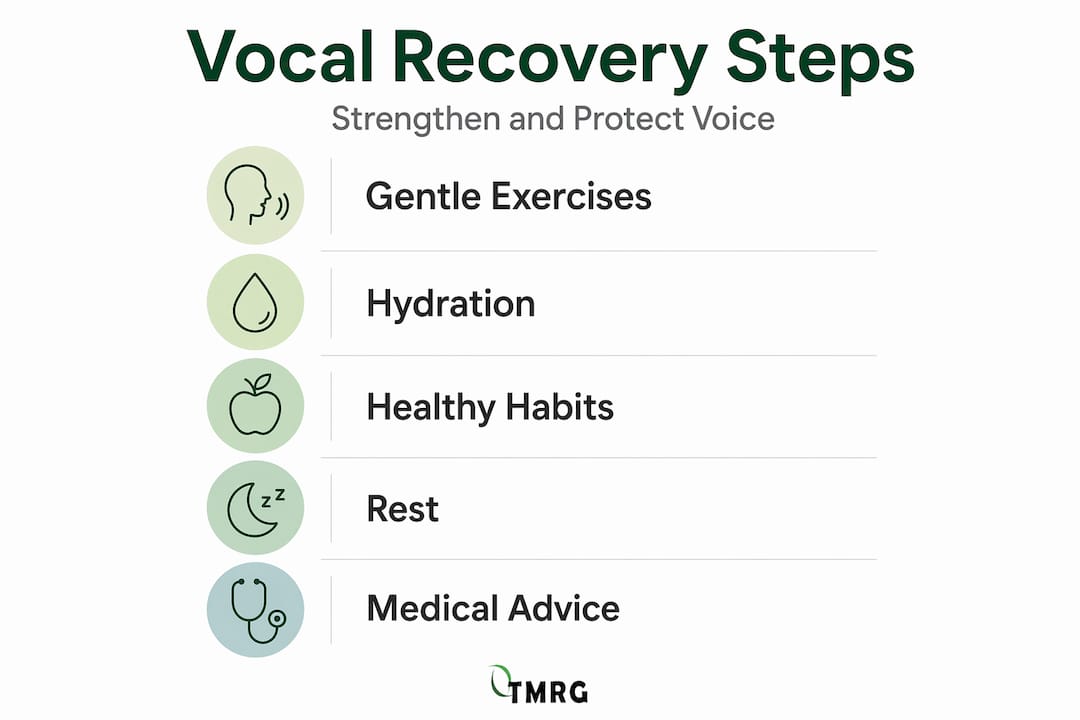
Recovery from vocal cord damage rarely moves in a straight line. Some days your voice feels almost normal. Others it may feel weaker than it did the week before. That is not failure. It is the normal pattern of tissue healing.
The most common setback is returning to full vocal load too quickly. A singer performs well at a rehearsal and interprets that as recovery, then pushes through a full performance the following night. The folds, which were not fully healed, sustain additional micro-trauma. Most individuals with vocal nodules improve within weeks to months with consistent therapy. But that timeline assumes consistent, calibrated practice, not aggressive return to prior habits.
“A strained voice is a signal, not something to push through or avoid entirely. It is asking for attention and adaptation, not silence.”
If you notice increased hoarseness, pain, or voice fatigue after exercises, reduce the duration and intensity of your next session by half. If symptoms persist beyond three to four days, schedule a check-in with your voice care provider. There are also useful preparation strategies for strained vocal effort that help you recognize early warning signs and respond before damage progresses.
Psychologically, voice loss carries a real weight. For singers and professional speakers, the voice is identity. Feeling disconnected from it creates anxiety that can tighten the very muscles you are trying to relax. Treat recovery like physical therapy after a knee injury. Steady, patient effort over time, not heroic effort in a single session.
I have worked with hundreds of voice patients over the years, and the most consistent pattern I see is this: people who recover fully do not just do the exercises. They change their relationship to their voice.
The moment you start treating gentle vocal exercises as empowerment tools rather than restrictions is when real progress begins. I have watched singers spend three weeks on straw phonation every morning and come back with more resonance and control than they had before the injury. Not in spite of slowing down. Because of it.
What I have also learned is that rest without guidance creates its own problems. Patients who simply go silent for two weeks often return with tighter, more guarded vocal production. The muscles stiffen. The habits calcify. Early intervention through professional voice therapy makes a measurable difference in outcomes, and it is the piece most people skip because they are waiting to feel bad enough to act.
My honest advice: do not wait. If your voice feels strained, tired, or unreliable, begin gentle exercises now and get a professional evaluation on your calendar. The window for preventing minor damage from becoming major damage is shorter than most people realize. The voice rewards consistent, intelligent work. Give it that, and it gives you back far more.
— Golan

If you are ready to take your vocal cord recovery beyond individual exercises, Tmrgsolutions has built structured tools specifically for this purpose. The TMRG Voice Therapy Kit Basic provides an accessible starting point for people early in recovery, while the standard singer’s recovery kit offers expanded programming for vocalists and speakers returning to demanding performance schedules. Each kit is designed by vocal health specialists with over 25 years of clinical experience, combining exercise guidance, natural formulations, and monitoring tools so your home routine becomes a real recovery program, not just guesswork.
Straw phonation, lip trills, and gentle humming are among the safest exercises for vocal cord recovery because they reduce fold collision force while still encouraging coordinated phonation. Always perform them at low volume and stop immediately if you feel pain or throat irritation.
Most people with vocal nodules improve within weeks to months with consistent voice therapy and vocal rest. Recovery time depends on the type of damage, how consistently you practice, and whether underlying causes like reflux or vocal overload have been addressed.
No. Whispering creates more strain than gentle conversational speech because it forces the vocal folds into a tense, partially open position. Use written communication or a voice amplifier instead if you need to reduce vocal output.
You should feel a gentle buzzing or vibration in your lips, nose, or chest, with no discomfort in your throat. If you feel pain, tickling, or an urge to cough, your technique needs adjustment. Reduce air pressure, lower your volume, and restart.
See a laryngologist before starting any exercise program if you have had hoarseness lasting more than two to three weeks, voice loss, pain while speaking, or a history of vocal hemorrhage. Professional evaluation is critical for ruling out serious conditions and confirming that exercises are appropriate for your specific diagnosis.
