Your Cart is Empty


TL;DR:
- Vocal exercises like Resonant Voice Therapy and Vocal Function Exercises effectively promote hoarseness recovery.
- Active voice rehabilitation prevents re-injury and strengthens vocal endurance better than rest alone.
- Consistent hydration and avoidance of irritants are essential for long-term vocal health and prevention.
Many singers and voice professionals treat hoarseness the same way: go quiet, wait, and hope the voice returns on its own. But rest alone is rarely the full answer. Research shows that structured vocal cord exercises can accelerate healing, rebuild vocal strength, and significantly reduce the risk of recurring damage. If you rely on your voice professionally, passive waiting is a missed opportunity. This guide walks you through evidence-based exercises, safe practice routines, and supportive daily habits so you can return to full vocal performance with confidence and clarity.
| Point | Details |
|---|---|
| Active recovery aids healing | Doing gentle, evidence-based vocal exercises accelerates hoarseness recovery compared to rest alone. |
| Prevention is ongoing | Proper hydration and avoiding irritants are crucial for keeping your voice healthy long term. |
| Tailored routines work best | Create customized warm-up and cool-down routines for your lifestyle to help maintain vocal strength. |
| Professional support matters | Consult voice therapists or use specialized kits if hoarseness is persistent, for optimal results. |
Hoarseness is more than just a rough-sounding voice. It signals that your vocal folds, the two small bands of muscle tissue that vibrate to produce sound, are not coming together cleanly. When something disrupts that clean contact, your voice can sound scratchy, breathy, strained, or even completely faded.
Common causes include:
For a singer or actor, even mild hoarseness is disruptive. Your range narrows, your tone loses its fullness, and fatigue sets in faster. Chronic problems, such as persistent nodules or scar tissue, can alter your voice permanently if left unaddressed.
Here is where the “just rest” myth becomes costly. Complete silence removes strain, yes. But it does nothing to strengthen the muscles around your folds, correct the technique patterns that caused the injury, or restore the coordination needed for clean phonation. Think of it this way: a runner with a mild knee strain does not heal faster by avoiding all leg movement. Guided, progressive movement is part of recovery.
“Voice therapy is not a passive process. Active rehabilitation gives vocal professionals something rest alone cannot: a rebuilt foundation.”
For lasting vocal health, you need to understand both the cause and the solution. And understanding the relationship between vocal technique and hoarseness is the first step toward making smarter, safer choices for your instrument.
With the cause and impact clear, you can now focus on what research identifies as the most effective vocal exercises to speed your return to performance. Three approaches stand out in the clinical literature.
Resonant Voice Therapy (RVT) centers on forward-focused sound. You produce a gentle hum or voiced consonant such as “mmm” and aim to feel vibration at the lips and front of the face rather than deep in the throat. This forward placement reduces collision force between the vocal folds while still stimulating them gently. Resonant Voice Therapy is particularly effective for hoarseness caused by nodules or polyps, and short sessions of five to ten minutes work well.
Vocal Function Exercises (VFEs) are a four-step protocol designed to strengthen laryngeal muscles and balance airflow with phonation. They involve sustained notes, pitch glides, and specific vowel sounds held at precise durations. Resonant Voice Therapy and VFEs are effective for both healthy and disordered voices, speeding recovery from hoarseness across a range of conditions.
PhoRTE and IMST (Phonation Resistance Training Exercises and Inspiratory Muscle Strength Training) add a resistance component, building endurance and airflow capacity. These suit voice professionals with overuse-related fatigue.
Here is a quick-reference summary:
| Exercise method | Best for | Core technique | Session length |
|---|---|---|---|
| Resonant Voice Therapy | Nodules, polyps | Forward hum, nasal resonance | 5-10 min |
| Vocal Function Exercises | Overuse, fatigue, surgery recovery | Pitch glides, sustained vowels | 10-15 min |
| PhoRTE + IMST | Endurance, aging voice, fatigue | Resistance phonation, breath training | 10-15 min |
To start RVT at home, follow these steps:
For VFEs, begin with a sustained “whee” glide from your lowest comfortable note to your highest, then reverse it. Hold the highest and lowest notes for as long as your breath allows without strain.

Pro Tip: Quality always wins over quantity. Five clean, focused repetitions build more strength than twenty tense, rushed ones. Your voice should feel lighter after practice, not heavier.
For additional support on structured recovery, explore vocal recovery coaching and learn how the soft start vocal technique helps you reintroduce your voice gently after hoarseness.
Learning specific exercises is just the start. Using them safely and effectively is what leads to lasting improvement. Even the best exercise can set you back if the surrounding routine is careless.
Before you begin any session, warm the voice up gradually:
During your exercise session, listen to your body carefully. A voice that tires quickly, cracks repeatedly, or feels strained is telling you to reduce intensity or duration. Never push through pain. Discomfort that builds is a warning, not something to work through.
After each session, cool down with the same gentle hums and lip trills you used to warm up. This helps the vocal folds transition back to a resting state without abrupt changes in muscle activation.
Voice therapy benefits go well beyond the exercises themselves. Structured therapy resolves 90% of vocal nodules when followed consistently, a result that passive rest rarely achieves. For a streamlined approach to recovery, the 3-step hoarseness treatment framework offers a clear starting point.
If you are unsure how to pace your recovery, guidelines from professional voice management recommend gradual increases in vocal demand over several weeks.
Pro Tip: Keep a simple voice journal. Log how your voice felt before and after each session, any pain or fatigue levels, and what you ate or drank. After two weeks, patterns will emerge that help you adjust your routine precisely.
Effective vocal exercises work best alongside everyday habits that support long-term vocal health. Think of your daily routine as the ground your exercises grow in. If that ground is dry, toxic, or unsupportive, even the best technique struggles to take root.
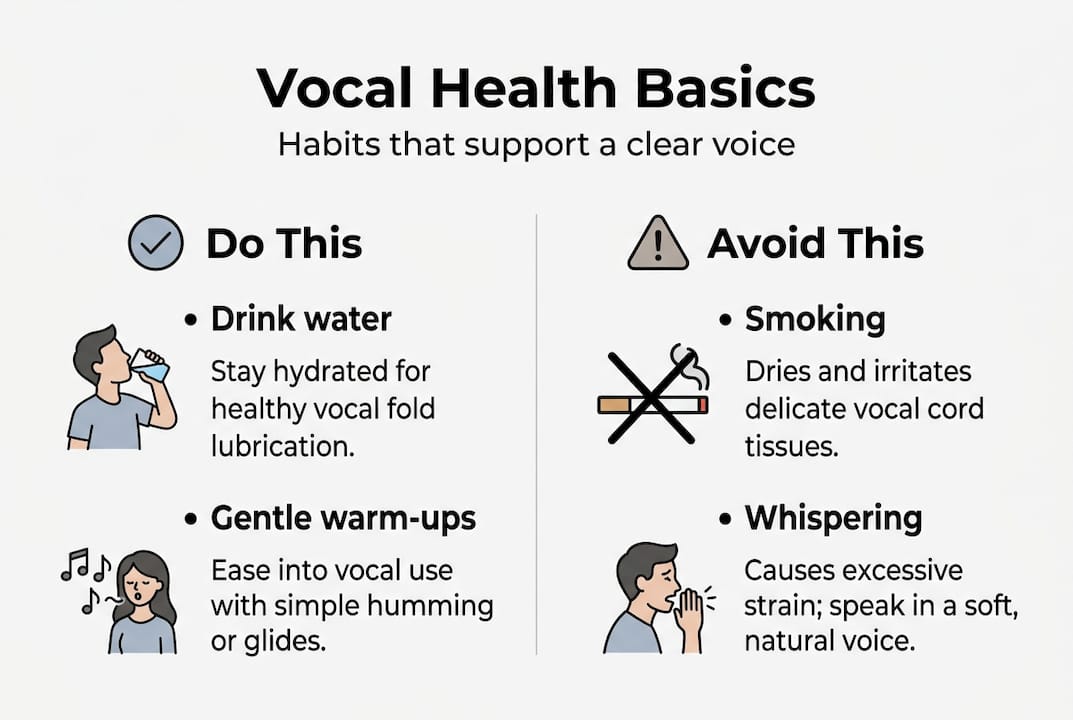
Hydration is the single most important daily habit for vocal professionals. Your vocal folds need a thin film of mucus to vibrate efficiently. When you are dehydrated, that film thickens or dries, increasing friction and the risk of irritation. Aim for at least eight to ten cups of water daily, and increase that when performing, traveling, or in dry climates. Steam inhalation adds surface moisture to the folds directly and is a useful complement to systemic hydration. Explore hydration strategies tailored specifically for vocal professionals.
Irritant avoidance matters just as much. Combining therapy with hydration and avoiding irritants is key to preventing recurrence after nodules or other vocal injuries. The main culprits are:
Here is a practical comparison of daily habits:
| Habit | Supports vocal health | Risks vocal health |
|---|---|---|
| Drinking water regularly | Yes | |
| Smoking or vaping | Yes | |
| Gentle morning warm-up | Yes | |
| Shouting to communicate | Yes | |
| Steam inhalation | Yes | |
| Excessive throat clearing | Yes | |
| Structured cool-down after use | Yes |
For a complete list of vocal hygiene tips and targeted advice for performers, you can also find natural remedies for actors that integrate seamlessly with your exercise routine.
If hoarseness persists beyond two weeks despite consistent exercise and good habits, schedule a checkup with a laryngologist or ENT specialist. Persistent hoarseness can signal conditions that need medical attention, and early intervention always produces better outcomes than delayed care.
After more than 25 years working with singers, actors, and voice professionals, we have seen one pattern repeat itself: the performers who recover fastest are the ones who treat their voice like an athlete treats a muscle, not like a fragile object that needs to be locked away.
Rest has its place. Acute inflammation needs time to settle. But extended silence, without structured rehabilitation, often leaves the voice weaker and more vulnerable to re-injury than before the problem started. Worse, it misses the chance to correct the underlying technique that caused the damage.
The professionals who truly protect their voices understand that active recovery builds endurance, improves coordination, and reduces long-term injury risk. They approach hoarseness as information, not failure. They ask: what technique or habit created this strain, and how do I rebuild smarter?
Read more about our insights on technique and recovery and why the relationship between good technique and vocal injury is more nuanced than most people expect. Your voice is your livelihood. Treat it proactively.
If exercises and daily habits have helped but stubborn hoarseness keeps returning, targeted tools and professional-grade resources can bridge the gap.

At TMRG Solutions, we have spent over 25 years developing natural, clinician-informed products for voice professionals who need reliable support. Our basic voice therapy kit is an excellent starting point for singers and speakers managing mild to moderate hoarseness. For more demanding vocal schedules or persistent strain, the standard kit for singers offers a more complete range of support. Explore the full range of vocal health solutions and find what fits your voice and your goals.
Resonant Voice Therapy and VFEs are both highly effective for hoarseness recovery, with RVT particularly useful for nodule-related cases and VFEs excellent for restoring overall vocal function and endurance.
Gentle exercises like forward humming can help maintain circulation and reduce stiffness, but stop immediately if pain increases. Structured therapy is safer and more effective than rest alone, but pain that worsens always warrants professional consultation.
Many professionals notice meaningful improvement within two to six weeks of consistent practice. Therapy resolves 90% of nodules with structured effort, and RVT has shown measurable short-term reductions in hoarseness severity.
Maintain consistent hydration, avoid smoke and irritants, and always include structured warm-ups and cool-downs before and after heavy voice use. Hydration and avoiding irritants are clinically recognized as key factors in preventing recurrence.
