Your Cart is Empty


TL;DR:
- Rest alone is insufficient; targeted voice therapy with specific exercises corrects underlying issues.
- SOVT and VFE exercises effectively improve vocal quality and prevent hoarseness recurrence.
- Long-term vocal health relies on proper technique, lifestyle habits, and professional support.
Most singers and actors assume that a raspy, strained voice just needs rest. Rest helps, but it rarely solves the problem on its own. Hoarseness often signals something deeper happening at the level of your vocal folds, and without targeted intervention, the issue returns the moment you step back on stage. Over 25 years of working with voice professionals, we’ve seen how the right combination of structured exercises and natural supportive care produces results that rest alone simply cannot match. This article walks you through the evidence-based strategies that actually work, from specific therapy techniques to daily habits that protect your voice for the long term.
| Point | Details |
|---|---|
| Evidence-based exercises | SOVT and VFE voice exercises measurably improve hoarseness when done daily. |
| Essential natural remedies | Proper hydration, humidifiers, and avoiding irritants greatly support vocal recovery. |
| Sustainable vocal health | Long-term therapy and consistent care prevent future episodes for professionals. |
| Rapid fixes vs. prevention | Injections offer quick relief but voice therapy prevents recurrence and supports lasting strength. |
Hoarseness is a change in voice quality. Your voice may sound rough, breathy, strained, or lower in pitch than usual. It happens when your vocal folds, the two small bands of muscle inside your larynx, cannot vibrate smoothly. Swelling, lesions, dryness, or muscle tension can all disrupt that vibration and produce the raspy sound you’re trying to fix.
For singers, actors, and other voice professionals, hoarseness carries a particular risk. Your voice is your instrument and your livelihood. Common causes include:
Here is where most standard advice falls short. Telling a performer to “just rest your voice” ignores the mechanical and neuromuscular retraining that hoarseness often requires. Rest reduces inflammation, but it does not correct the faulty technique or muscle imbalance that caused the problem in the first place. Return to performance without addressing those factors, and hoarseness comes right back.
Long-term risks are real. Untreated nodules can grow and harden. Persistent muscle tension can become a chronic pattern. Repeated inflammation increases the risk of hemorrhage in the vocal fold tissue. The good news is that structured voice therapy works. Voice therapy research confirms measurable improvements in acoustic quality and perceptual voice health for people dealing with nodule-related hoarseness.
Important note: If your hoarseness has lasted more than two to three weeks without improvement, consult a laryngologist before starting any exercise program. Some conditions require medical evaluation first.
With the basics covered, let’s look at the specific exercises that actually make a difference. Two approaches have the strongest evidence behind them: Semi-Occluded Vocal Tract exercises (SOVT) and Vocal Function Exercises (VFE).
SOVT exercises work by partially narrowing the opening of the vocal tract, which creates back pressure that gently cushions the vocal folds during vibration. Think of it as giving your folds a soft landing with every sound you make. Common SOVT methods include lip trills, tongue trills, humming through a straw, and voiced fricatives like a sustained “v” or “z” sound.
How to perform a basic straw phonation (SOVT):
Vocal Function Exercises (VFE) target the coordination between airflow, vocal fold closure, and resonance. They were designed specifically to balance the laryngeal musculature and extend Maximum Phonation Time (MPT), which is how long you can sustain a single tone on one breath.
How to perform a basic VFE sequence:
The results of consistent practice are measurable. Systematic review data shows significant improvements in jitter (pitch irregularity), shimmer (amplitude irregularity), and MPT after SOVT and VFE therapy.
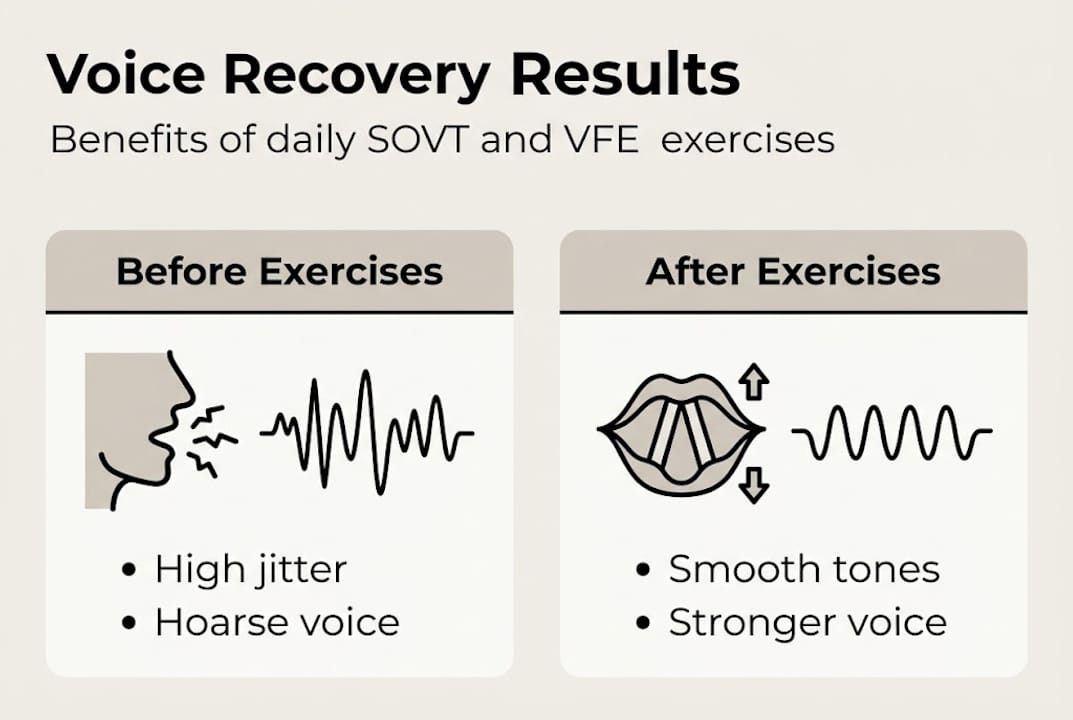
| Acoustic measure | Before therapy | After therapy |
|---|---|---|
| Jitter (%) | 1.8 | 0.9 |
| Shimmer (%) | 5.2 | 2.7 |
| MPT (seconds) | 9.4 | 16.1 |
For a structured daily plan, explore these voice exercise routines or follow the 3-step hoarseness treatment framework we recommend for performers.
Pro Tip: Practice SOVT and VFE for at least 20 to 30 minutes daily. Split the session into two shorter blocks, morning and evening, to reduce fatigue and maximize neuromuscular learning.
Voice exercises work best when paired with the right supportive care and simple, natural remedies. Think of this as the environment your vocal folds need to heal and perform at their best.
Hydration is non-negotiable. Your vocal folds rely on a thin layer of mucus to vibrate efficiently. When you’re dehydrated, that layer thickens and friction increases. Aim for 2.7 to 3.7 liters of water per day, adjusting upward if you perform in dry or air-conditioned environments. Warm water with honey is a time-tested choice because honey coats the throat without causing the rebound dryness that some other remedies produce.

Air quality matters more than most performers realize. Dry air forces your vocal folds to work harder. A humidifier set to 30 to 50% relative humidity in your bedroom or studio creates the ideal environment for overnight vocal recovery. Avoid air fresheners and chemical sprays near your performance or practice space, as these can irritate the laryngeal lining.
Here are the key supportive care habits to build into your daily routine:
For a broader look at what actually works, browse these effective vocal remedies and learn how to recover from hoarseness naturally using a structured approach.
Pro Tip: Add nasal saline rinses to your daily care routine. Clearing post-nasal drip reduces the mucus that drips onto the vocal folds and triggers throat clearing, one of the most damaging habits for vocal health. For more targeted guidance, check these tips for hoarseness.
Once you’ve restored your voice, the real challenge is keeping it strong for the long haul. Hoarseness has a frustrating tendency to return when performers go back to the same habits and demands that caused it in the first place.
The most important comparison to understand is voice therapy versus rapid interventions like vocal fold injections.
| Approach | Speed of results | Recurrence risk | Long-term benefit |
|---|---|---|---|
| Voice therapy (SOVT/VFE) | Gradual (weeks) | Low | High |
| Vocal fold injections | Rapid (days) | Higher | Moderate |
Research comparing these approaches confirms that voice therapy is superior for long-term nodule prevention, while injections offer speed but carry a meaningful recurrence risk. For performers who need to be on stage next week, injections may be tempting. But without the underlying technique correction, you are likely to be back in the same situation within months.
Building a prevention-focused daily routine is the most effective strategy. Here is a checklist of habits that keep your voice performance-ready:
For singers and actors specifically, preventing vocal strain requires attention to both technique and lifestyle. If you perform under high-demand conditions, also read about preparing for strained vocal effort to protect your vocal cord tone before and after demanding performances.
After 25 years of working with singers, actors, and professional speakers, we’ve noticed a pattern. Most guides focus on what to do but skip the harder question: why do so many performers keep getting hoarse despite following the advice?
The uncomfortable truth is that technique quality matters far more than practice quantity. Doing 30 minutes of SOVT exercises with poor posture, shallow breathing, or excessive laryngeal tension produces far less benefit than 15 minutes of focused, well-aligned practice. More is not always better. Better is better.
We also see performers ignore lifestyle factors until a crisis hits. Sleep deprivation, chronic stress, and poor diet all affect the tissue quality of your vocal folds in ways that no exercise can fully compensate for. Recovery is not just about what you do in your practice session. It’s about what you do the other 23 hours of the day.
Finally, rapid fixes are seductive but risky. We understand the pressure to perform. But masking a vocal problem with a quick intervention, without addressing its root cause, is a pattern we’ve seen derail careers. Read more about good vocal technique pitfalls to understand how even well-intentioned habits can work against you.
The strategies in this article give you a strong foundation. For even greater results, combine them with professional-grade support made specifically for your voice challenges.

At TMRG Solutions, we’ve built our product range around the realities of professional vocal life. The TMRG Voice Therapy Kit Basic is designed for performers in the early stages of recovery, offering targeted natural formulations that complement your daily exercises. For more advanced needs, the Voice Therapy Kit Standard provides a fuller toolkit for ongoing vocal protection and performance readiness. Not sure where to start? Visit our Vocal Problems resource to find the right solution for your specific situation and get back to performing at your best.
SOVT and Vocal Function Exercises practiced for 20 to 30 minutes each day significantly improve vocal quality and reduce hoarseness, with measurable gains in jitter, shimmer, and Maximum Phonation Time.
Proper hydration, maintaining 30 to 50% room humidity, nasal saline rinses, and avoiding menthol lozenges all support faster, more complete recovery from hoarseness.
Consistent voice therapy, a proper warm-up routine, and avoiding vocal strain are the core pillars of prevention, with daily 20 to 30 minutes of structured practice being especially critical for long-term results.
Injections may deliver rapid relief, but they carry a higher recurrence risk compared to voice therapy, which builds lasting vocal health through neuromuscular retraining and technique correction.
