Your Cart is Empty


TL;DR:
- Vocal performance depends on the integration of acoustic shaping, breath support, health management, and individual anatomy.
- Tailoring techniques like formant tuning and dynamic support to personal physiology enhances projection, tone, and longevity.
Vocal performance is defined by the interaction of acoustic physics, respiratory coordination, anatomical individuality, and disciplined vocal health management. These are the core factors that shape and refine vocal performance across every genre and performance context. Whether you are a classical singer working on projection, a musical theater actor managing eight shows a week, or a voice-over professional protecting your instrument, understanding these factors gives you a technical foundation that generic practice advice simply cannot provide. Recent 2026 voice science research has sharpened our picture of how the vocal tract, breath system, and tissue health work together to produce a refined, sustainable sound.
The four primary categories are vocal tract acoustics, breath support coordination, vocal health and load management, and individual anatomy. Each one operates independently and in concert with the others. Neglecting any single category creates a ceiling on your development that more practice alone will not break through.
Projection is not about volume. Projection relies on vocal tract shaping into a specific resonance configuration rather than increasing loudness, which means forcing more air pressure is both inefficient and damaging. The mechanism behind this is the singer’s formant, a spectral peak occurring around 2,800 to 3,400 Hz. Physically, it is created by widening the pharynx while simultaneously narrowing the epilarynx, the tube just above the vocal folds. This configuration selectively boosts harmonic energy in a frequency range where orchestral instruments produce relatively little energy, allowing the voice to cut through without competing on raw decibels.

Voice type changes the strategy. High voices use alternate formant tuning compared to low voices because harmonic spacing widens as fundamental frequency rises, requiring sopranos and tenors to tune individual formants directly to harmonics rather than clustering them. Altos use a hybrid approach, sitting between the strategies of a bass-baritone and a soprano. This means a single instruction like “open your throat” lands differently depending on who receives it.
Vowel modification is the practical tool for managing these acoustic demands at higher pitches. As pitch rises, the natural vowel shape becomes acoustically inefficient, so trained singers adjust the vowel toward a neighboring sound that keeps a formant aligned with a strong harmonic. This is not distortion. It is precision engineering of the vocal tract.
Key adjustments that refine vocal tract shaping include:
Pro Tip: Practice sustained vowels on a single pitch while slowly widening the back of your throat, as if fogging a mirror. Notice when the tone suddenly gains ring and carrying power. That moment is your singer’s formant engaging.
Breath support is not a fixed technique. Support is a flexible coordination strategy that varies by singer, genre, physiology, and the specific demands of a phrase. This finding directly challenges the traditional teaching model where students are given one breathing instruction and expected to apply it universally. A dramatic soprano sustaining a long pianissimo phrase uses a fundamentally different respiratory pattern than a gospel belter driving a climactic phrase to the back of a theater.
The mechanics of effective breath management center on controlled braking. Rather than simply inhaling deeply and releasing air freely, the respiratory muscles work against each other to regulate subglottal pressure with precision. The intercostal muscles and diaphragm slow the natural elastic recoil of the lungs, maintaining a steady pressure supply to the vocal folds. This coordination, not the size of the breath, determines whether a phrase stays controlled and resonant from start to finish.
Lung volume management matters as much as the breath itself. Singing at very high or very low lung volumes both create coordination challenges. High volumes generate excess recoil pressure that the singer must actively resist, while low volumes reduce the pressure available to drive phonation cleanly. Skilled singers learn to operate in a mid-range lung volume for most demanding passages, reserving full inhalation for phrases that genuinely require it.
Pro Tip: If your tone becomes breathy or loses focus at the end of phrases, the problem is usually breath management, not breath capacity. Record yourself and listen for where the tone quality shifts. That point marks where your coordination breaks down, not where you run out of air.
Vocal health is not separate from vocal technique. It is the foundation that technique builds on. A 2026 quasi-experimental study found that structured vocal hygiene training significantly improves self-perceived voice quality in professional voice users, with post-training scores notably higher than those of an untrained control group. The implication is direct: learning how to care for your voice produces measurable improvements in how your voice actually sounds and feels.
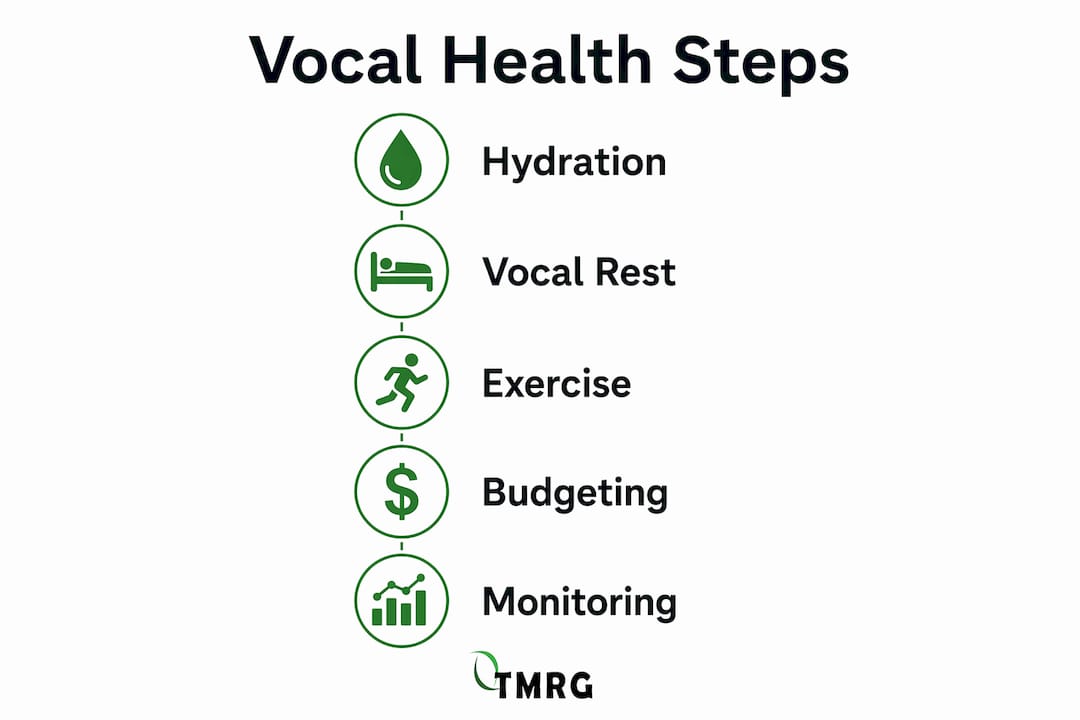
Vocal disorders often reflect a mismatch between vocal demand and tissue capacity rather than poor technique alone. Even skilled singers develop phonotraumatic lesions during intense performance periods. This reframes how you should think about vocal problems. The question is not only “Am I using good technique?” but also “Is my tissue currently capable of handling this demand?” Understanding vocal load management gives you a framework for answering that second question honestly.
The concept of vocal budgeting treats your daily vocal capacity as a finite resource. Every conversation, rehearsal, warm-up, and performance draws from that budget. Professional voice users who work with speech-language pathologists (SLPs) learn to track and distribute their vocal use across the day, protecting tissue during high-demand periods. This is collaborative vocal care in practice, and it is the standard of care for performers with demanding schedules.
| Rest strategy | Approach | Outcome |
|---|---|---|
| Complete voice rest | No phonation for a set period | Reduces acute inflammation but risks coordination loss if prolonged |
| Relative rest | Reduced vocal use with light coordination exercises | Maintains muscle memory while allowing tissue recovery |
| Vocal budgeting | Daily load tracking and distribution | Prevents overuse accumulation across rehearsal and performance periods |
| SOVT warm-up and cool-down | Semi-occluded exercises before and after heavy use | Reduces vocal fold collision forces and resets efficient phonation |
Relative rest combined with coordination exercises consistently outperforms strict complete voice rest for professional singers. Prolonged silence causes deconditioning of the fine motor coordination that singing requires, meaning the voice that returns after two weeks of complete rest is often less coordinated than the one that went on rest. The goal is always to protect tissue while preserving the neuromuscular patterns that define your technique.
Glottal contact patterns vary significantly by sex and dynamic intensity, and this variation has direct implications for how you should approach technique. Closed quotient (CQ) varies strongly by sex and loudness, with males tending to have higher CQ values and increasing CQ as dynamic intensity rises. Females show a different pattern. This means the same instruction to “sing with more contact” or “add more chest voice” will produce different physiological responses in different singers.
The practical consequences for vocal coaching are significant:
The takeaway for performers is that self-monitoring and working with a knowledgeable vocal coach or SLP produces better results than following standardized technique prescriptions. Your anatomy is the starting point, not an obstacle to overcome.
Vocal performance is shaped and refined by the integrated action of acoustic tract shaping, task-specific breath coordination, disciplined health management, and individual anatomical awareness.
| Point | Details |
|---|---|
| Singer’s formant drives projection | Widen the pharynx and narrow the epilarynx to boost resonance without adding vocal force. |
| Breath support is task-specific | Adjust respiratory coordination to the genre, phrase length, and dynamic demand rather than applying one fixed technique. |
| Vocal hygiene training improves voice quality | Structured hygiene education produces measurable improvements in self-perceived voice quality for professional users. |
| Relative rest beats complete silence | Coordination-preserving exercises during recovery prevent deconditioning and maintain technique. |
| Anatomy determines technique response | Glottal contact patterns differ by sex and dynamics, requiring individualized coaching rather than universal cues. |
Most singers I have worked with arrive believing their vocal problems are technique problems. In the majority of cases, they are load problems wearing a technique costume. The voice sounds strained not because the singer is doing something wrong in the moment, but because the tissue arrived at the rehearsal already depleted from three conversations, a commute, and a noisy lunch. No amount of technique correction fixes a tired instrument.
The research on task-specific breath support confirmed something I had observed for years: the singers who improved fastest were not the ones who practiced more. They were the ones who practiced smarter, adjusting their respiratory strategy to the specific demands of each phrase rather than applying a single breath template to everything. That flexibility is a skill, and it takes deliberate attention to develop.
The science on the singer’s formant also reshaped how I think about projection coaching. Telling a singer to “sing louder” is almost always counterproductive. Telling them to “find the ring” and guiding them toward pharyngeal widening produces a voice that carries further with less effort and less tissue stress. That distinction matters enormously over a career.
Collaborative care with SLPs and laryngologists is not a last resort. It is a professional standard that the best performers in every genre have embraced. If you are serious about longevity, build that relationship before you need it urgently.
— Golan

Tmrgsolutions has spent over 25 years developing natural vocal health solutions specifically for singers, actors, and professional voice users. The insights in this article point toward one consistent truth: protecting and refining your voice requires both knowledge and the right tools. The TMRG Voice Therapy Kit Basic gives you a structured starting point for vocal recovery and maintenance, combining natural herbal formulations with targeted therapy resources designed for performers. For those with more demanding schedules, the premium voice therapy kit includes advanced care resources built for serious professional use. Explore the full range at Tmrgsolutions and take the next step toward a voice that performs at its best, consistently.
The singer’s formant is a spectral peak around 2,800 to 3,400 Hz created by widening the pharynx and narrowing the epilarynx. It allows singers to project over orchestras by boosting harmonic energy in a frequency range where instruments produce little competing sound.
Breath support is a task-specific coordination strategy, not a single fixed technique. Effective breath management involves controlled braking of lung recoil to maintain steady subglottal pressure, which directly determines tone consistency and phrase control.
Structured vocal hygiene training, vocal budgeting, and relative rest combined with semi-occluded vocal tract exercises produce the most consistent improvements. A 2026 study confirmed that hygiene training measurably improves self-perceived voice quality in professional voice users.
Prolonged complete voice rest causes neuromuscular deconditioning, meaning the fine motor coordination required for singing deteriorates during extended silence. Relative rest with light coordination exercises preserves technique while allowing tissue to recover.
No. Glottal contact patterns vary significantly by sex and dynamic intensity, meaning the same technical instruction produces different physiological responses in different singers. Individualized coaching based on personal anatomy and vocal behavior produces better results than universal technique prescriptions.
