Your Cart is Empty


TL;DR:
- Voice articulation involves the rapid coordination of the tongue, lips, teeth, jaw, and soft palate to shape airflow into clear speech sounds. Proper pacing, relaxed muscles, and consistent practice improve clarity, especially under physical or emotional stress. Recording and reviewing your speech help identify and correct articulation issues for more effective communication.
Most people assume voice articulation is simply about pronunciation. It is not. Voice articulation is the physical process your tongue, lips, teeth, jaw, and soft palate perform at high speed to shape raw airflow into words your audience can actually understand. When this process breaks down, even a powerful voice becomes muddy and hard to follow. Whether you speak on stage, sing professionally, or want to be clearer in daily conversation, understanding what is voice articulation gives you the foundation to improve every dimension of how you communicate.
| Point | Details |
|---|---|
| Articulation is physical | Five primary articulators coordinate at high speed to produce clear, distinct speech sounds. |
| Speed is the enemy of clarity | Speaking at 70 to 80% of your normal pace gives articulators time to complete each motion fully. |
| Tension blocks precision | Tight jaw, lips, or neck muscles reduce the range of motion your articulators need to function well. |
| Daily short practice beats marathon sessions | Brief, consistent drills build stronger muscle memory than occasional intensive training. |
| Recording reveals what you cannot hear | Your internal hearing masks errors that listeners catch immediately; playback is non-negotiable. |
The definition of voice articulation goes deeper than most tutorials suggest. At its core, articulation is a high-speed mechanical process where the tongue, lips, teeth, jaw, and soft palate work in coordinated sequence to shape the airflow produced by your vocal folds into 44 distinct English phonemes. Each sound requires a specific position and movement from these articulators. The “t” in “time” demands a quick tongue tap behind your upper teeth. The “m” in “morning” requires lip closure while air routes through the nasal passage.
What makes articulation remarkable is the speed involved. In natural conversation, you produce somewhere between 10 and 15 phonemes per second. That means your articulators are repositioning dozens of times each second, all without conscious thought. When any part of that system is stiff, fatigued, or poorly trained, the result is speech that sounds slurred, muffled, or unclear.
The table below shows how each articulator contributes to that process.
| Articulator | Primary function | Example phonemes produced |
|---|---|---|
| Tongue | Shapes oral cavity, touches palate or teeth | /t/, /d/, /l/, /r/, /s/, /z/ |
| Lips | Open, close, or round to modify airflow | /p/, /b/, /m/, /w/, /f/, /v/ |
| Teeth | Provide contact surface for tongue or lips | /f/, /v/, /th/ sounds |
| Jaw | Controls mouth opening and vowel space | Open vowels: /a/, /ae/, /o/ |
| Soft palate | Directs airflow nasally or orally | /n/, /m/, /ng/ vs. all oral consonants |
Understanding this physical map is your first step. Once you know which structure is responsible for which sound, you can pinpoint exactly where your articulation is breaking down.
The biggest confusion people bring to articulation training is the belief that articulation and enunciation are the same thing. They are not. Articulation refers to mechanical sharpness in producing sounds, while enunciation is the deliberate, expressive delivery of words in context. You can have sharp articulation and still communicate with no emotional weight. You need both.
A second widespread misconception involves “nasally” sounding speech. Most people assume a nasal quality is purely anatomical. In reality, lazy articulation and low vocal energy are responsible far more often than physical structure. When you project your voice with intention and engage your chest resonance, nasality typically drops without any anatomical change.
The following pitfalls cause the most articulation problems for speakers and singers:
Pro Tip: Before any speaking or singing session, try chewing an imaginary piece of gum in large, exaggerated circles for 30 seconds. This wakes up the jaw and facial muscles without any strain.
Knowing what affects voice articulation is one thing. Building the physical control to execute it is another. The good news is that daily short drills build muscular coordination more effectively than infrequent long sessions. Ten focused minutes each morning will outperform a single hour-long weekly session every time.
Here is a structured daily practice sequence you can start using today:
For voice clarity and articulation, speaking pace matters enormously. Research shows that speaking at 130 to 150 words per minute gives your articulators enough time to complete each movement cleanly, compared to the 160 to 180 words per minute that most people default to when nervous or excited.
Pro Tip: Record yourself reading a 30-second passage at your natural pace, then again at a deliberately slower pace. Your internal hearing will tell you both sound the same. The recording will show you the difference clearly.

Training articulation in isolation is only half the work. The other half is applying voice articulation techniques under real conditions, where distractions, nerves, and physical demand all compete for the precision you have been building.
One of the subtler points about the importance of voice articulation is how it shapes emotional expression. Crisp consonants create urgency and authority. Elongated, well-shaped vowels convey warmth and connection. A speaker who over-articulates every syllable robotically loses the audience just as quickly as one who mumbles. The goal is control that sounds natural.
Physical fatigue adds a serious layer of difficulty. Physical stress alters pitch, intensity, timing, and pause structure, making speech slower and more segmented. For singers performing long sets or speakers presenting for hours, this means your articulation will degrade if you are not actively managing breath support and hydration. Plan for it rather than being surprised by it.
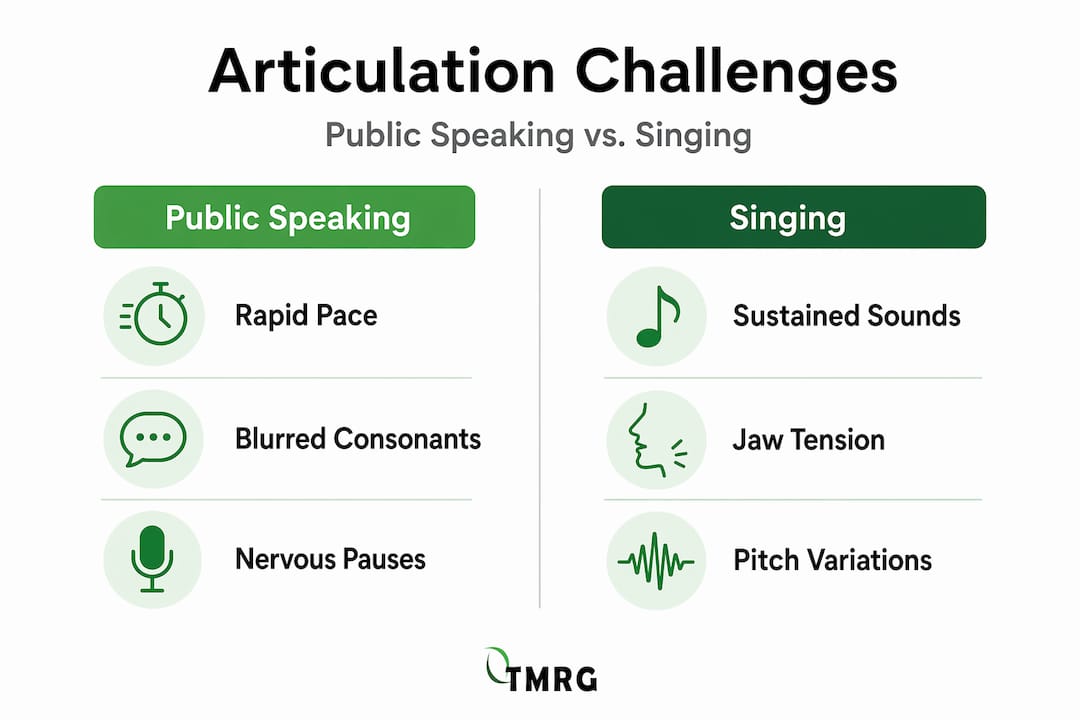
The table below compares common articulation challenges across two contexts and how to address each one.
| Scenario | Challenge | Solution |
|---|---|---|
| Public speaking | Rapid pace from nerves causes blurred consonants | Mark pause points in notes; practice the opening 60 seconds slowly every time |
| Singing performance | Vowel shapes collapse under breath pressure | Train vowel positions with a mirror; over-articulate in rehearsal, then dial back |
| Casual conversation | Habitual mumbling becomes invisible to self | Record and review weekly; set one phoneme to focus on per week |
| Extended presentations | Articulation degrades as fatigue sets in | Hydrate actively; use vocal cord relaxation techniques during breaks |
| Singing under physical exertion | Breath support drops, consonants become muddy | Prioritize diaphragm engagement; reduce phrase length before increasing it again |
Monitoring your progress honestly matters. Because of bone conduction, your internal hearing masks articulation errors that are completely obvious to a listener. Recording yourself and reviewing the playback weekly is not optional. It is the fastest feedback loop available to you.
I have worked with hundreds of speakers and singers over the years, and the pattern I see most consistently is this: people come in focused on the wrong thing. They want more power, more resonance, a deeper tone. What they actually need is relaxation and precision in equal measure.
The speakers who improve fastest are not the ones who practice the longest. They are the ones who practice with attention and do it every day, even for just five minutes. Consistency beats intensity here, without exception. I have seen professional performers with genuinely powerful voices who were nearly impossible to understand because tension had locked their articulators into a narrow range of motion. And I have seen quiet, modest voices that communicated with perfect clarity because every articulator was free and working as it should.
The other thing I want you to hear is this: do not chase crispness at the cost of naturalness. Occasional, casual blending of sounds is a feature of fluent speech, not a flaw. The goal is not to sound like a news anchor reading from a script. The goal is to sound like yourself, with every word landing clearly. That balance takes time to find, and you will overshoot toward stiffness before you find it. Stay with the process.
One more thing I tell every student: stop comparing your recorded voice to what you hear in your head. They will never match. The recording is what your audience hears. Trust it.
— Golan
If you are serious about improving how you sound, structured support makes a real difference. Tmrgsolutions has spent over 25 years developing vocal health solutions specifically for singers, speakers, actors, and professionals who depend on their voices. The approach goes beyond exercises and addresses the underlying vocal health that makes consistent articulation possible.

The Voice Therapy Kit for Singers is built for performers who need articulation clarity alongside sustained vocal endurance. For those at a professional level, the premium voice therapy kit provides advanced tools to support both strength and precision under demanding performance conditions. And if you are just beginning to address vocal challenges, the basic voice therapy kit offers a practical starting point. Every kit is designed to complement the kind of daily practice described in this article, giving your articulators the support they need to stay healthy and responsive over the long term.
Voice articulation is the physical process in which the tongue, lips, teeth, jaw, and soft palate shape airflow into distinct speech sounds. It is what makes words intelligible to a listener rather than just a stream of noise.
Articulation is the mechanical precision of producing individual speech sounds, while enunciation is the deliberate, expressive delivery of words in context. Clear articulation is the foundation; enunciation layers meaning and emotion on top of it.
Muscle tension in the jaw and neck, speaking pace, and insufficient vocal energy are the three biggest factors that reduce articulation clarity, according to speech research. Releasing physical tension and slowing your pace typically produces immediate improvement.
With daily short practice sessions of 5 to 10 minutes, most speakers and singers notice measurable improvement in articulation clarity within two to four weeks. Consistent repetition builds the muscle memory needed for lasting change.
Your internal hearing, carried through bone conduction, makes your voice sound fuller and clearer to you than it does to listeners. Recording yourself and listening back reveals the articulation gaps your ear naturally hides from you.
