Your Cart is Empty


TL;DR:
- Vocal sprays serve as supportive tools for singers to manage throat discomfort, but improper use can harm the vocal folds. Numbing sprays, containing anesthetics, pose significant risks and should rarely be used before performances, while soothing sprays help lubricate and calm tissue safely when chosen correctly. Recognizing when not to use sprays and integrating proper vocal care habits are essential for maintaining long-term vocal health and preventing damage.
Walk into any music store or search online for vocal health products and you will find dozens of throat sprays all promising to protect your voice. Most singers assume that if a spray is labeled “natural” or “herbal,” it is automatically safe to use before every rehearsal and performance. That assumption can lead you straight into trouble. Even well-intentioned products carry real risks when used incorrectly, and the wrong choice at the wrong time could leave your vocal folds (the tissue bands in your larynx that vibrate to produce sound) more irritated than before you started.
| Point | Details |
|---|---|
| Not all sprays are equal | Some vocal sprays can cause side effects and should be chosen with care. |
| Soothing sprays preferred | Non-numbing, soothing/coating sprays are safer for regular vocal health. |
| Seek medical advice for warning signs | Persistent hoarseness or alarming symptoms require laryngology/ENT evaluation. |
| Combine sprays with healthy habits | Hydration, rest, and proper technique are essential alongside vocal sprays. |
Vocal sprays are topical solutions applied to the throat and mouth to address discomfort, dryness, or irritation around the larynx and pharynx (the throat cavity). They are not designed to reach the vocal folds directly. The spray lands on surrounding tissue, and any benefit to the vocal folds comes indirectly through reduced surface irritation, added moisture to the mucous membranes, or relief from surrounding inflammation.
Singers reach for these products for a good reason. Performing under stage lights, traveling in dry airplane cabins, and pushing through long rehearsal sessions all dry out throat tissue and add stress to the vocal mechanism. A well-chosen spray can give you real, practical support. A poorly chosen one can mask pain signals you actually need to hear.
There are two broad categories of vocal sprays:
The distinction matters enormously. Soothing sprays work with your body. Numbing sprays temporarily suppress the feedback your body is trying to give you. If you cannot feel that your throat is strained, you may push your voice well past a safe limit.
There is also a subtler risk that many singers overlook. Even products marketed as “natural” can interact poorly with underlying conditions. Certain ingredients in sprays can disturb the delicate mucosal lining of the larynx, particularly if you already have inflammation.
Medical literature has documented that topical steroid rinses can cause dysphonia (voice impairment) and laryngeal edema (swelling of the larynx) in individuals with inflammatory upper-airway conditions. This is a critical reminder that “therapeutic” products are not automatically neutral.
Pro Tip: Before you buy any vocal spray, check whether you have any known sensitivities to herbal compounds. Some singers react to ingredients like eucalyptus or peppermint oil, both of which appear frequently in “natural” sprays.
Exploring natural throat sprays for singers can give you a clearer picture of which formulations tend to serve performers well. Understanding what is actually in your spray is a foundational step toward protecting your voice rather than accidentally harming it.
Now that you understand the basics, let’s go deeper into how these two categories compare when it comes to real-world use for singers.
| Feature | Numbing sprays | Soothing/coating sprays |
|---|---|---|
| Primary action | Blocks nerve sensation | Lubricates and calms tissue |
| Contains anesthetics | Yes (benzocaine, lidocaine) | No |
| Safe for regular use | No | Generally yes |
| Masks pain signals | Yes | No |
| Suitable before performing | Rarely advisable | Often suitable |
| Long-term vocal safety | Questionable | Supported by evidence |
| Risk of overuse injury | High | Low to moderate |
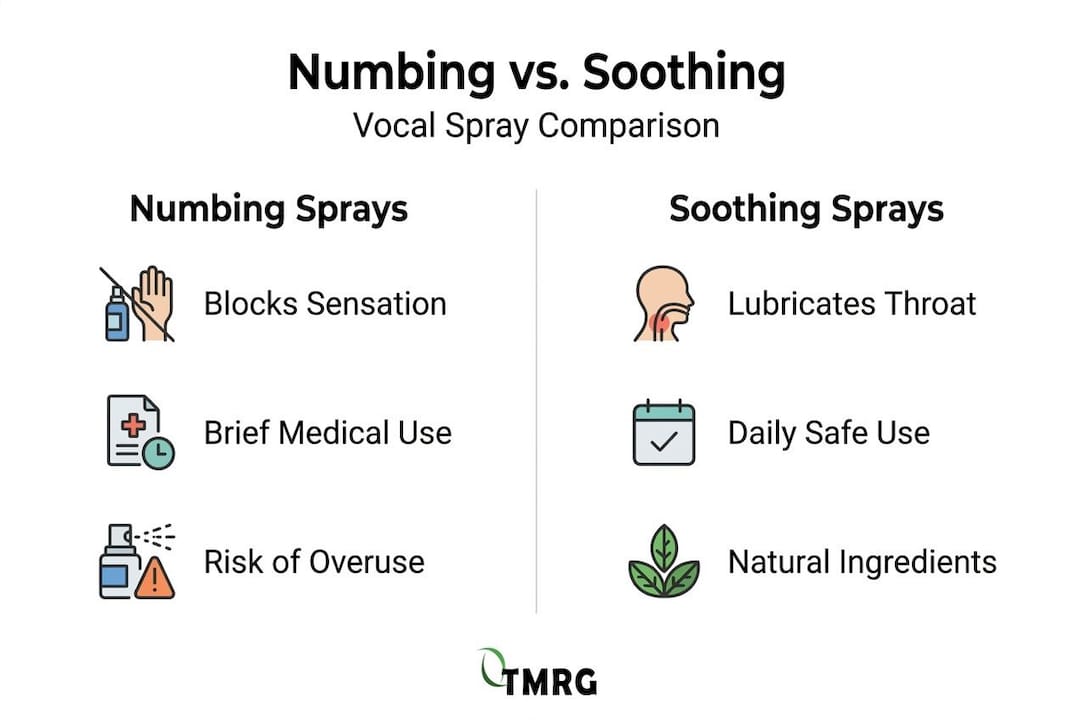
Numbing sprays have a legitimate medical use in clinical settings. For a brief, supervised procedure, a lidocaine-based spray can make a patient more comfortable. But singers are not in a clinical setting. They are on stage or in a studio, making real-time decisions about how hard to push their instrument.
When you apply a numbing agent before a performance, you remove your ability to accurately gauge how much strain your vocal folds are experiencing. You might sail through a set feeling fine, then wake up the next morning with serious vocal damage. That scenario is far more common than most performers realize.
Research from procedural medicine also shows that anesthetic sprays can cause throat irritation and undesired effects in some individuals, even when used for short-term clinical purposes. For everyday vocal maintenance, that risk simply is not justified.
Here is a practical checklist to help you evaluate your options when choosing between spray types:
For a thorough breakdown of formulations and how they compare in practice, the resource on safer throat sprays is worth reviewing carefully. You can also find detailed performance-based assessments through the best throat sprays comparison guide, which evaluates real-world singer experiences with specific products.
Pro Tip: Never apply a numbing spray and then perform unless you are under direct medical advice to do so. The risk of vocal overuse injury in a numbed state is significant and cumulative over time.
Understanding your options is only half the battle. Making the right choice requires you to evaluate your personal vocal health history, the demands of your upcoming performance schedule, and the specific ingredients in any product you consider.
Start with these evaluation steps:
Reading labels carefully is a skill worth developing. “Proprietary blend” language on a supplement label often means you cannot verify individual ingredient concentrations. For performers managing persistent voice issues, knowing exactly what is in your spray matters enormously.
There are also moments when no spray is the right answer and professional help is needed instead. Use this quick reference to guide your decision:
| Warning sign | Recommended action |
|---|---|
| Hoarseness lasting more than 2 to 3 weeks | See an ENT or laryngologist |
| Pain when swallowing or speaking | Stop all self-treatment; seek evaluation |
| Sudden loss of voice | Rest immediately and consult a specialist |
| Blood in mucus after singing | Emergency ENT evaluation |
| Progressive worsening despite sprays | Discontinue products; get professional assessment |
Hoarseness that persists beyond the typical recovery window, or that comes with pain, voice loss, or blood, requires laryngology or ENT assessment rather than continued self-treatment. This is not a point to take lightly. Masking symptoms with sprays while structural damage develops is one of the most preventable causes of long-term vocal decline in professional singers.
The article on hoarseness treatment advice addresses a counterintuitive but important reality: sometimes what you think is helping your voice is actually slowing recovery. Staying informed is part of good vocal stewardship. The updated voice care best practices guide covers 2026-relevant strategies to help you build a sustainable care routine.
No single spray replaces a well-rounded voice care routine. The singers who maintain strong, resilient voices over long careers are the ones who treat sprays as one small piece of a larger system, not as a standalone fix.
Here are the core habits that work in direct support of safe spray use:
Experts in vocal health consistently emphasize that hydration, vocal rest, and informed product selection form the three pillars of ongoing voice care. Sprays that support rather than suppress your body’s signals fit naturally within this framework.
It is also worth revisiting the safety nuance around certain therapeutic products. Research confirms that even topical treatments can have vocal side effects in people with inflammatory upper-airway conditions. If you have allergies, acid reflux, or chronic sinusitis, those conditions affect your throat environment before any spray enters the picture. Managing the underlying condition is always more effective than spraying over its symptoms.
For singers dealing with voice fatigue or hoarseness, combining a well-chosen soothing spray with rest and hydration produces measurably better outcomes than a spray alone. The guide on hoarse voice relief offers specific product recommendations aligned with this combined approach.

After more than 25 years supporting vocal performers across genres and career levels, we have noticed a consistent pattern. Most singers do not misuse vocal sprays out of negligence. They misuse them out of misplaced confidence in the word “natural.”
The health and wellness industry has done an effective job of framing natural ingredients as universally gentle and risk-free. But your vocal folds do not care about marketing language. They respond to chemistry, pressure, and friction. A plant-based compound that irritates your specific mucosal tissue causes exactly as much damage as a synthetic one.
The second mistake we see constantly is timing. Singers reach for a spray when they feel pain, use it to continue performing, and then wonder why the problem keeps returning. Pain is information. When you suppress that information without addressing its source, you are not treating a problem. You are delaying and compounding it.
The most powerful insight we can offer from working with thousands of performers is this: knowing when not to use a spray is more important than knowing which spray to use. That discipline separates the performers who sustain long careers from those who cycle through repeated vocal crises.
The singers who thrive long-term are the ones who treat vocal sprays as supportive tools rather than performance crutches. They use them thoughtfully, they respect their body’s warning signals, and they invest in protecting vocal health as a year-round priority rather than a crisis response.
Common mindset shifts that make a measurable difference:
If you are ready to move beyond guesswork and build a vocal care routine backed by real expertise, we have the resources to help.

At TMRG Solutions, our voice therapy kit bundles evidence-informed products designed specifically for performers experiencing vocal fatigue, hoarseness, or recovery after heavy use. Each kit is built around the same principles covered in this article: support the vocal mechanism, work with your body’s signals, and avoid masking damage. If you are unsure where to start or dealing with persistent symptoms, our vocal problems advice page offers guidance tailored to your specific situation. For fast-acting natural support, the classic voice recovery drops are a trusted option used by singers and speakers who need reliable results without pharmaceutical risk.
Numbing vocal sprays are not recommended for regular use because anesthetic sprays can cause throat irritation and can mask pain signals that indicate vocal strain requiring rest.
If hoarseness persists or is accompanied by pain, voice loss, or blood in mucus, stop self-treatment and seek a specialist laryngology or ENT evaluation immediately.
No. Even natural formulations carry risks for singers with inflammatory upper-airway conditions, as topical treatments can cause dysphonia and laryngeal edema in susceptible individuals.
Singers should avoid anesthetics like benzocaine and lidocaine unless a clinician has specifically recommended them, as research consistently shows that relying on numbing agents compromises long-term vocal safety.
