Your Cart is Empty


TL;DR:
- Most sore throat advice is vague — ‘rest and drink water.’ This guide skips the obvious and gives you 7 specific home remedies that are backed by real evidence, ranked by how fast they work.
For singers, actors, and speakers, a sore throat is more than discomfort. It threatens your livelihood. The good news: seven natural home remedies, validated by medical authorities including the Mayo Clinic, Cleveland Clinic, and CDC, address the root mechanisms of throat irritation, which are inflammation, dryness, and mucosal friction.
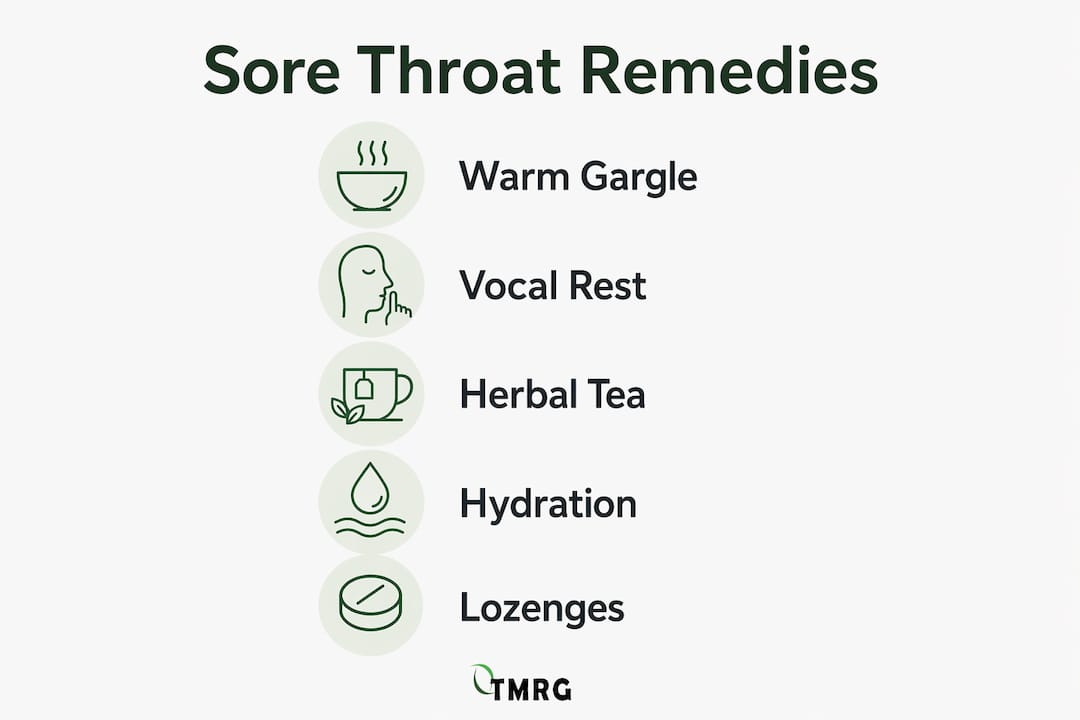
Here are the seven fixes that deliver real relief:
Saltwater gargle — reduces inflammation and loosens mucus
Honey — soothes tissue and suppresses cough
Steam and humidification — restores moisture to irritated mucosal lining
Vocal rest — prevents mechanical trauma to inflamed vocal folds
Hydration with warm and cool fluids — loosens mucus and eases pain
Herbal teas and natural soothing agents — chamomile, slippery elm, marshmallow root
Throat sprays and lozenges — targeted moisture and numbing relief
According to the CDC, 44.2% of sore throats are viral and self-limiting, resolving within about a week. That means your primary job is symptom management and vocal protection while your immune system does the heavy lifting.
Why vocal rest and throat moisture are non-negotiable for voice professionals
How should vocalists use hydration, throat sprays, and lozenges safely?
How long does a sore throat last, and when should you see a doctor?
What exercises protect your vocal cords during sore throat recovery?
Tmrgsolutions has the vocal recovery tools your voice actually needs
The saltwater gargle is the most clinically supported home remedy for sore throat, and it costs almost nothing. The mechanism is straightforward: salt draws fluid from swollen throat tissue through osmosis, reducing inflammation and loosening mucus that coats the vocal folds.
The correct preparation:
Dissolve 1/4 to 1/2 teaspoon of salt in 4 to 8 ounces of warm water
Gargle for 15–30 seconds, then spit. Never swallow the solution
Repeat every three hours, or as needed throughout the day
Warm water matters because it helps the salt dissolve fully and feels less harsh on already-irritated tissue. Cold water can cause the throat muscles to tighten, which is the last thing an inflamed larynx needs.
Pro Tip: After gargling, follow immediately with a few sips of plain warm water. This rinses residual salt from the mucosal surface and keeps your vocal folds hydrated rather than drawing moisture away from them.

Vocal rest is not simply staying quiet. Active voice rest means avoiding speaking, singing, whispering, and throat clearing entirely. Whispering is a particular trap: it actually requires more muscular tension in the vocal folds than normal speech, increasing mechanical trauma to already-inflamed tissue.
Throat clearing is equally damaging. Each time you clear your throat, the vocal folds slam together forcefully. During infection, when the mucosal lining is swollen and fragile, that repeated impact slows healing and can worsen secondary inflammation. Substitute the urge to clear with a firm, silent swallow or a sip of water.
Moisture maintenance is the other half of this equation. The Cleveland Clinic confirms that keeping the throat’s mucosal lining hydrated reduces irritation and mechanical friction, which is especially critical for voice professionals whose vocal folds must return to precise function after recovery.
Practices to protect your voice during a sore throat episode:
Silence your voice completely. Use text messages or a notepad instead of speaking
Run a humidifier in your bedroom overnight, targeting 40–60% relative humidity
Inhale steam for 10–15 minutes twice daily, either from a bowl or a personal steam inhaler
Avoid forced whispering, shouting, or any effortful phonation
Statistic to know: The Mayo Clinic notes that vocal rest is a primary treatment recommendation for voice professionals with sore throat, alongside hydration and moisture therapies, because continued voice use during infection compounds inflammation and delays recovery.
Herbal remedies work by coating and soothing the mucosal lining rather than fighting the underlying infection. That distinction matters for how you use them. Think of them as comfort support, not a cure.
Three herbs with the most consistent evidence for throat symptom relief:
Slippery elm contains mucilage, a gel-like substance that coats the throat and reduces the raw, scratchy sensation vocalists know too well
Marshmallow root works similarly, forming a protective layer over irritated tissue
Chamomile tea has mild anti-inflammatory properties and is gentle enough to drink several times daily
The Mayo Clinic is clear that herbal teas like slippery elm and marshmallow root ease discomfort but lack strong evidence for treating the infection itself. Use them in tea or lozenge form, warm rather than scalding hot, and check for known allergies before trying any new herb. If you are on prescription medications, consult your physician about potential interactions, particularly with echinacea or licorice root.
For vocalists who want natural remedies tailored to voice professionals, combining these herbs with proper hydration and rest produces the most consistent comfort.
Warm and cold fluids both help. Warm liquids like herbal tea or broth loosen mucus and feel immediately soothing. Cold water or ice chips reduce localized swelling. Alternate between the two based on what your throat responds to, and aim to sip consistently throughout the day rather than drinking large amounts infrequently.
Lozenges require more care. Menthol-containing lozenges provide numbing relief, but the Cleveland Clinic cautions that they can dry mucous membranes over time. For vocalists, that dryness is counterproductive. The better approach is to alternate medicinal lozenges with hydrating options like saline sprays or steam sessions.
Practical guidelines:
Sip warm water or herbal tea every 20–30 minutes during waking hours
Use a medicated lozenge for acute pain, then follow with a saline spray or steam within the hour
Avoid alcohol-based mouthwashes, which strip moisture from the mucosal lining
Replace the urge to clear your throat with a sip of water every time
Pro Tip: The TMRG Defense Oils and Saline Voice and Throat Spray is formulated specifically to hydrate and protect the vocal tract without the drying effects of menthol-heavy products. It pairs well with the TMRG Loud & Clear Classic Voice Recovery Drops for sustained moisture between steam sessions.
Viral sore throats typically resolve within about a week. The Mayo Clinic advises that symptoms persisting beyond several days, or accompanied by severe warning signs, require professional medical evaluation.
Seek medical attention if you experience:
Severe throat pain that makes swallowing difficult or painful
High fever (above 101°F / 38.3°C)
Visible white patches or pus on the tonsils
Swollen lymph nodes in the neck that are tender to the touch
Difficulty breathing or opening your mouth fully
Symptoms that worsen after day three or show no improvement by day seven
Bacterial infections, particularly strep throat, require antibiotics. No home remedy replaces that treatment. For vocalists, the additional risk of pushing through a bacterial infection without treatment is chronic vocal damage from prolonged inflammation of the larynx.
Rest your voice completely until all symptoms resolve. Returning to performance before full recovery is one of the most common causes of recurring vocal problems among professional singers and speakers. For guidance on recovering from hoarseness naturally, Tmrgsolutions offers step-by-step resources built specifically for voice professionals.
Recovery is not passive. Gentle, targeted practices protect the vocal folds from stiffness and secondary damage while the throat heals.
Lip trills and humming on breath. A soft lip trill, produced by blowing air through loosely closed lips, keeps the vocal folds vibrating at minimal tension. This maintains circulation in the laryngeal muscles without the full impact of phonation. Do this only when pain is mild and never force it.
Diaphragmatic breathing exercises. Slow, deep breaths that expand the lower ribcage keep the airway open and reduce the tendency to breathe through the mouth, which dries the throat. Inhale for four counts through the nose, hold for two, exhale slowly for six. Repeat five times, twice daily.
Gentle neck and jaw stretches. Tension in the neck and jaw transfers directly to the larynx. Slow head rolls and gentle jaw circles release that tension, reducing the muscular strain that inflamed vocal folds experience during even quiet breathing.
What to avoid entirely during recovery:
Scales, arpeggios, or any pitched singing until symptoms fully clear
Projection exercises or breath-pressure drills
Resonance work that requires sustained phonation
The goal during recovery is to preserve, not train. Think of these practices as maintenance breathing rather than vocal exercise. For a structured approach to restoring your voice naturally, Tmrgsolutions provides expert-guided protocols designed for this exact phase.
Vocalists dealing with a sore throat need more than generic cold remedies. Tmrgsolutions brings 25+ years of vocal health expertise directly to your recovery, with natural herbal formulations endorsed by vocal coaches and medical professionals.

The TMRG Voice Therapy Kit Standard (TVT-S) combines targeted sprays, recovery drops, and expert guidance in one complete package. The TMRG Shine Bright Classic Voice Recovery Spray maintains vocal cord moisture between steam sessions, while the TMRG Powerful Vocal Recovery Kit (N) delivers advanced herbal support for more demanding recovery needs. The TMRG Voice Therapy Kit Basic is a solid starting point for vocalists managing mild symptoms. Every product is built around the same principle: keep the mucosal lining hydrated, reduce inflammation naturally, and protect the vocal folds through every stage of recovery. Browse the full range at tmrgsolutions.com and find the kit that fits your voice.
Saltwater gargle, vocal rest, and consistent hydration form the foundation of effective sore throat recovery for vocalists, with most viral cases resolving within about a week.
| Point | Details |
|---|---|
| Saltwater gargle ratio | Use a small amount of salt dissolved in warm water, repeated periodically throughout the day. |
| Vocal rest definition | Avoid speaking, whispering, and throat clearing entirely until symptoms resolve. |
| Recovery timeline | Viral sore throats typically clear in about a week; symptoms lasting longer need medical evaluation. |
| Lozenges and dryness | Menthol lozenges numb but can dry mucous membranes; alternate with saline sprays or steam. |
| Tmrgsolutions kits | TMRG Voice Therapy Kits combine herbal sprays, recovery drops, and expert guidance for vocalists. |
Gargle with warm saltwater prepared with salt dissolved in warm water, repeated periodically, sip warm herbal tea with honey, and run a humidifier to maintain throat moisture.
No. Singing on an inflamed larynx increases mechanical trauma to the vocal folds and slows healing. Complete vocal rest until symptoms fully clear is the standard recommendation from vocal health professionals.
Most viral sore throats resolve within about a week with symptom management. See a doctor if pain is severe, fever is high, or symptoms persist beyond one week.
Slippery elm and marshmallow root coat the mucosal lining and reduce the raw, scratchy sensation, but they do not treat the underlying infection. Use them for comfort alongside rest and hydration.
A hydrating saline-based spray, such as the TMRG Defense Oils and Saline Voice and Throat Spray, avoids the drying effects of menthol-heavy products and is formulated specifically to protect vocal tract moisture.
