Your Cart is Empty


Straw phonation is a semi-occluded vocal-tract exercise, and it takes 2 to 5 minutes a day to make your voice feel less effortful. You hum or sing through a straw while sealing your lips around it, which builds gentle back-pressure that helps your vocal folds vibrate with less strain. Do it once each morning as a warm-up, or again after a long rehearsal or lecture as recovery.
Here’s what to expect the first time you try it:
Straw phonation works because semi-occlusion raises back-pressure in the vocal tract, letting the vocal folds vibrate with less collision force and less muscular effort.
| Point | Details |
|---|---|
| Practice daily, briefly | Run a 2 to 5 minute session each morning, or after heavy voice use, for recovery. |
| Start wide, progress narrow | Begin with a standard straw and only move to a narrower one once the current size feels effortless. |
| Use bubbles as feedback | The water variant’s bubble rhythm shows instantly whether your airflow is steady or leaking. |
| Watch for tension signals | Neck strain, squeezed tone, or persistent hoarseness mean stop and check technique or see a clinician. |
| Pair with the right tools | Tmrgsolutions kits and its breath strengthener support the hydration and airflow control the exercise depends on. |
Straw phonation belongs to a family of techniques called semi-occluded vocal tract, or SOVT, exercises. You partially block the exit of your vocal tract, either with a straw, your lips (trills), or humming through closed lips, and that partial blockage changes the acoustics of your whole vocal system.
Here’s the mechanic that matters: semi-occlusion raises what voice scientists call inertance and back-pressure inside the vocal tract. Vocology materials developed by Ingo Titze explain this as air pushing back against the vocal folds on each vibratory cycle, almost like the resistance you feel pushing your hand through a pool instead of through open air. That back-pressure cushions the folds as they come together, so they collide with less force and less effort on your part.
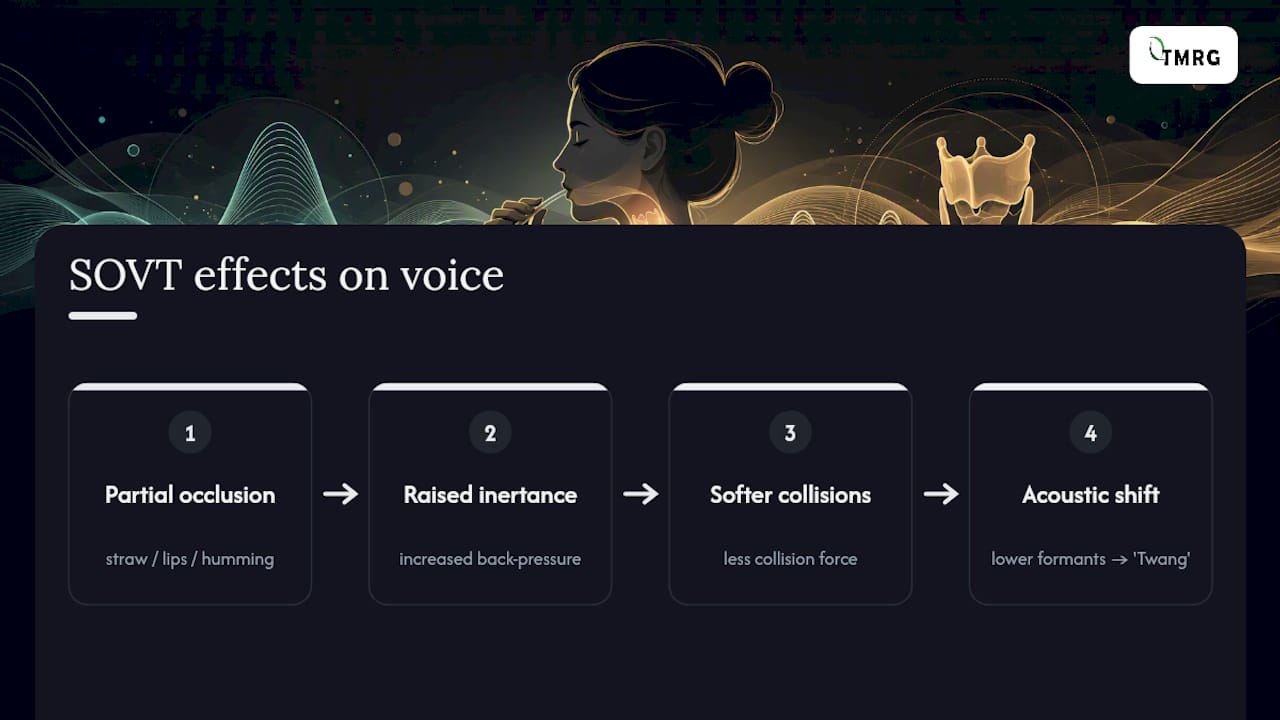
Less collision force means less trauma to the folds over a rehearsal, a lecture, or a long shift of talking. There’s a bonus effect too. Semi-occlusion tends to lower certain resonance frequencies called formants, which can shift your voice toward what singers call the “Twang” region, a bright, forward placement that carries well without extra muscular push. Educational resources on SOVT mechanics point to this formant shift as the reason straw phonation can make your voice feel more powerful even though you’re using less muscle to make it.
Think of the straw as a cushion of air sitting between your vocal folds and the outside world. It doesn’t do the work for you, but it makes the work you do more efficient.
The most immediate benefit shows up within a single session: a clinical study measuring immediate effects of straw phonation found that participants reported easier voice production right after doing the exercise, based on their own self-assessment.
Beyond that same-session effect, regular use of straw exercises appears to build habits that compound:
The water version, often called Lax Vox, deserves its own mention. Submerging the straw tip in water and phonating into it adds gentle resistance and gives you a visual and auditory signal, the bubbles, that tracks your airflow in real time. Practitioner guides on vocal warm-ups recommend it specifically for recovery sessions because it’s quiet enough to do backstage or in a green room.
One honest limit: straw phonation eases effort and supports healthy vibration, but it doesn’t repair nodules, polyps, or other structural damage. It’s a training and recovery tool, not a substitute for a diagnosis from a speech-language pathologist or ENT.
Equipment first. A standard drinking straw works fine when you’re starting out. As your control improves, narrower straws (like coffee-stirrer width) increase resistance and challenge your breath support further. If you’re mindful of waste, paper or reusable metal straws work just as well acoustically as plastic ones.
Setup matters more than most people think:
A 5-minute routine you can run through right now:
Pro Tip: If you catch yourself running out of breath mid-siren, you’re pushing too much air through too narrow a straw. Switch to a wider one and let the tone stay soft. Resistance should feel like gentle support, not a wall.
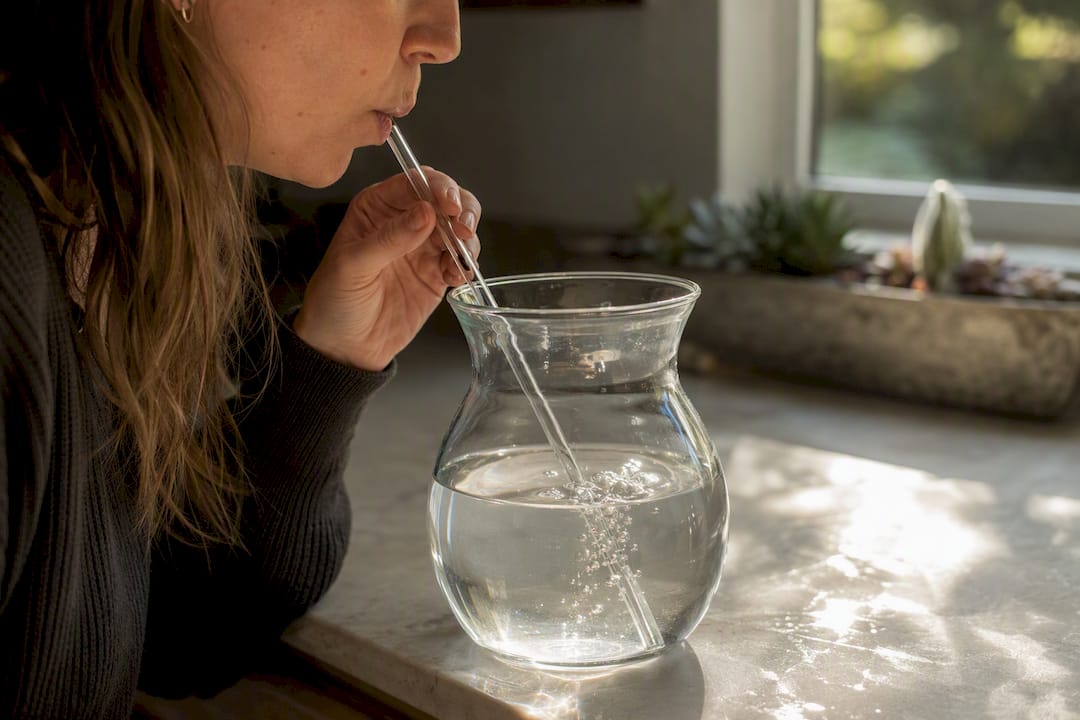
For the water variant, fill a cup or bottle about 2 to 3 centimeters deep, submerge the straw tip, and phonate into it the same way. Watch the bubbles: steady, even bubbling means your airflow is consistent, while sputtering or irregular bubbles usually point back to uneven breath support or air leaking through your nose. Bubble feedback is one of the simplest real-time checks you can give yourself without a mirror or a coach in the room.
A squeezed, effortful tone almost always traces back to one of a few fixable habits. Watch for these signs and their fixes:
If hoarseness or throat pain persists beyond a day or two of gentle practice, stop the exercise and get evaluated by a speech-language pathologist or ENT. Straw phonation should never hurt. Teachers and public speakers can adapt the same routine for spoken-voice recovery after a long lecture day, using shorter, quieter sessions rather than the fuller singer’s routine.
The clinical evidence for straw phonation is modest but consistent in direction. The PMC study on immediate effects found that participants rated their voices as easier to produce right after a session, a self-assessed but repeatable finding that supports using the exercise as a same-day reset rather than only a long-term training tool.
That mechanism comes from foundational vocology work by Ingo Titze, and it’s the theoretical backbone behind why clinicians recommend the exercise at all. On the clinical side, patient guidance from the NHS frames SOVT exercises as a recovery and rehabilitation tool, paired with a reminder that no single drink “clears” your voice. Systemic hydration, drinking water consistently through your day, is what actually supports fold lubrication, and straw phonation works alongside that habit rather than replacing it.
Safety notes worth repeating: keep sessions short and gentle, choose an environmentally sensible straw if that matters to you, and treat persistent hoarseness as a signal to see a professional rather than push through with more exercise.
The right routine depends on what your voice needs that day. Three versions cover most situations:
Progress to a narrower straw only once the current one feels genuinely effortless, not just tolerable. Rushing resistance is the most common reason people quit the exercise after a week.
TMRG Solutions has spent more than 25 years building natural vocal health products for singers, actors, lecturers, and everyday voice users. That experience shapes practical tools that pair well with a straw phonation habit, from guided therapy kits to breath-focused equipment.
Straw phonation gives you the technique. Consistent hydration and support around your routine give you the staying power. For deeper reading, hydration strategies for vocal health and a complete vocal cord hydration guide cover the piece straw exercises don’t: what you put into your body between sessions. If a problem lingers past a few days of gentle practice, see a qualified voice clinician before adding more exercise on top of it.
Voice teachers and clinicians who use straw phonation regularly tend to reach for it as a reset button rather than a cure. A student walks in tight and pressed after a long day of talking, does two minutes of sirens through a straw, and the tone opens up almost immediately, often before any other warm-up has even started.
That quick payoff is exactly why the exercise earns a place in so many pre-show and post-show routines. It doesn’t replace hydration, sleep, or a proper warm-up sequence. It sits alongside them as the fastest lever available when time is short. Try the 5-minute routine today and pay attention to how your voice feels in the first thirty seconds, that’s the signal worth tracking session to session.
A straw and five spare minutes get you started, but a few tools make the habit stick. Tmrgsolutions built its therapy kits with exactly this kind of daily practice in mind, drawing on more than 25 years of work in natural vocal health.
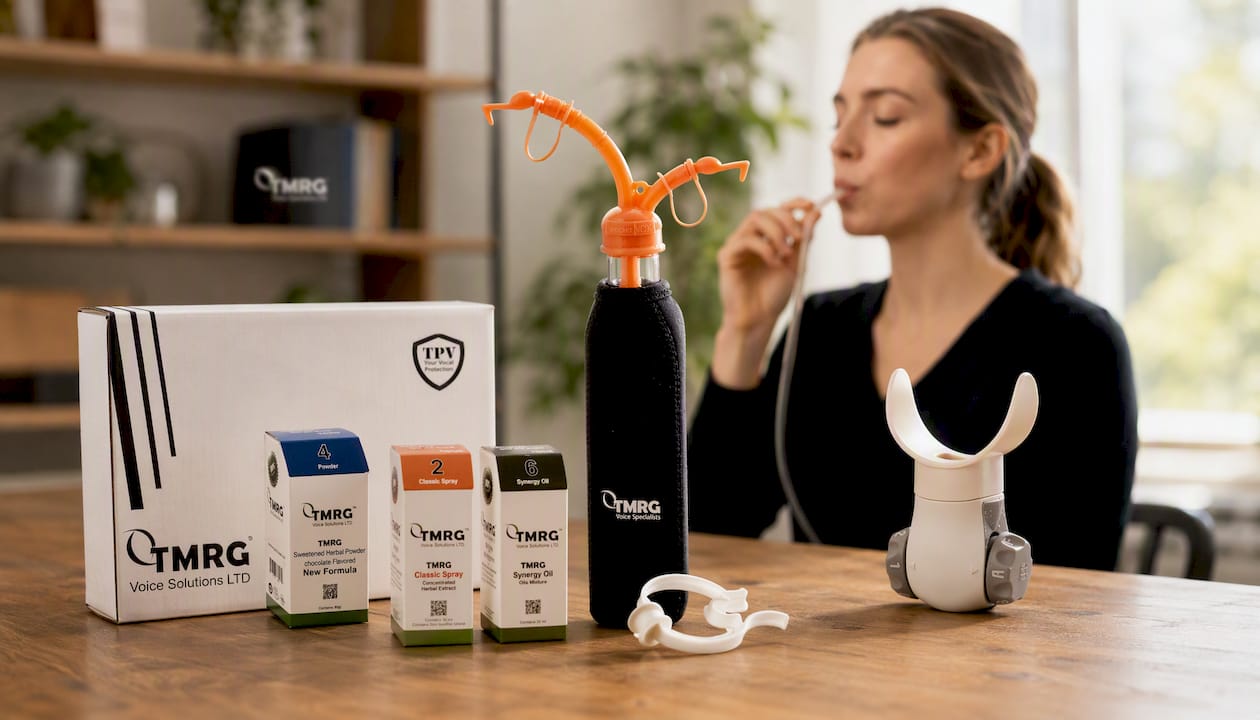
The TMRG Voice Therapy Kit - Standard (TVT-S) is built for performers and voice professionals who want a full recovery and warm-up system alongside their straw routine, combining guided practice tools with the herbal support Tmrgsolutions has refined over decades. If you’re just starting out, the TMRG Voice Therapy Kit - Basic covers the essentials without overwhelming you with extras, a sensible entry point while you build your first two or three weeks of consistent practice.
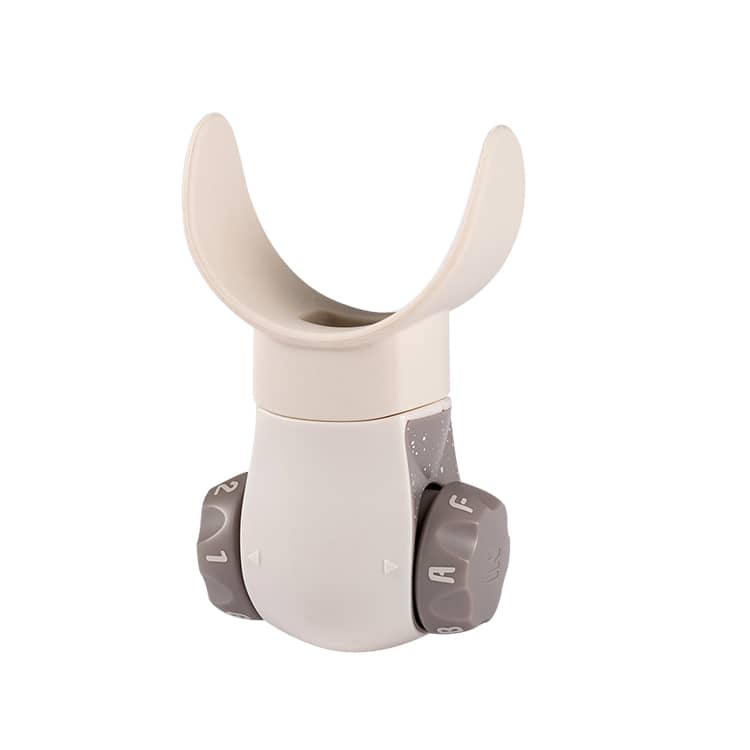
For the breath-control side of the equation, the TMRG BB Breath Strengthener and Enhancer V3 trains the steady airflow that straw phonation depends on, useful if you noticed sputtering bubbles or uneven sirens in your own practice. Browse the full lineup at Tmrgsolutions and pick the kit that matches where your voice is right now.
For deeper study, see the PMC study on immediate effects, Titze’s vocology materials, NHS patient guidance on SOVT exercises, VoiceScienceWorks on straw phonation, and Backstage’s warm-up and cool-down guide. For a wider view of warm-up sequencing, see 7 essential voice exercises.
Once or twice a day works well for most voice users: a short morning session as a warm-up and, if needed, a second short session after heavy voice use for recovery. Each session should run 2 to 5 minutes.
You get easier, less effortful voice production almost immediately, along with reduced vocal fold collision force, smoother pitch transitions, and, with the water variant, real-time feedback on your airflow.
No single drink clears your voice. Consistent hydration through the day supports vocal fold lubrication, and straw phonation exercises help restore ease after strain, but the two work together rather than one replacing the other.
Yes, within their scope. A study on the immediate effects of straw phonation found self-reported improvements in vocal ease right after practice, though the exercise supports healthy voice use rather than treating structural conditions like nodules.
