Your Cart is Empty


TL;DR:
- Vocal cord dysfunction causes abnormal vocal fold closure during breathing, leading to shortness of breath and throat tightness. Managing VCD at home involves rehearsed rescue breathing exercises, vocal hygiene, trigger identification, and environmental adjustments. Professional help is essential if symptoms persist or worsen despite consistent use of these strategies.
Vocal cord dysfunction (VCD), also called inducible laryngeal obstruction or ILO, is a condition where the vocal folds close abnormally during breathing instead of opening, causing sudden shortness of breath, throat tightness, and a high-pitched stridor. The most effective vocal cord dysfunction home remedies center on rescue breathing exercises, vocal rest, hydration, and systematic trigger management. These are not generic wellness tips. They are clinically grounded techniques that retrain your laryngeal muscles to respond correctly during an episode and reduce how often those episodes occur.
Rescue breathing and respiratory retraining are the core at-home strategies for VCD management, helping retrigger proper vocal fold opening during an acute episode. The technique works by interrupting the dysfunctional closure reflex and reminding your body to restore normal airflow. Practicing it correctly and consistently is what separates people who manage their condition well from those who feel helpless every time symptoms strike.
Follow this sequence when symptoms begin:
This sequence is not improvised. A rehearsed rescue breathing script, ideally developed with a speech-language pathologist (SLP), is more effective than freestyle attempts during a stressful episode. The reason is simple: when you are frightened and short of breath, your brain defaults to habit. If the correct sequence is already rehearsed, it runs automatically.
Rescue breathing is not only for acute episodes. Practicing 2 to 3 times daily and weaving short practice sessions throughout your day builds the muscle memory and automatic access you need when symptoms hit fast. Think of it the way a musician practices scales: the goal is not to perform the scale, it is to make the correct movement instinctive.
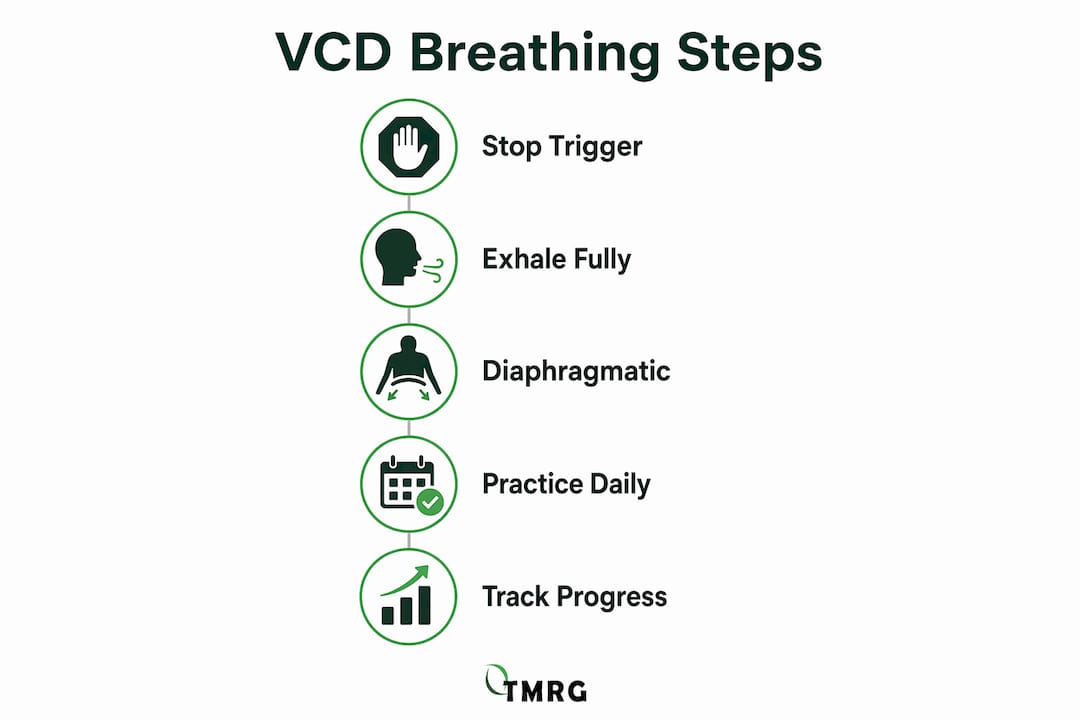
Start with two to three minutes per session. Focus on diaphragmatic breathing, where the belly expands outward on the inhale rather than the chest rising. Pair this with Pilates-style breathing techniques that engage the core and support controlled airflow. Progress gradually. Adding too many techniques at once creates confusion during an actual episode.
Pro Tip: Set three phone reminders per day labeled “VCD practice.” Each session takes under three minutes. After two weeks of consistent practice, the correct breathing pattern begins to feel natural rather than effortful.
Breathing retraining addresses the mechanical dysfunction. Vocal care and environmental control address the inflammation and irritation that lower your laryngeal threshold and make episodes more likely. Voice rest, hydration, and humidifier use effectively reduce laryngeal irritation and support vocal fold healing, particularly when inflammation accompanies VCD symptoms. These measures are not optional add-ons. They are the foundation that makes breathing exercises more effective.
Here are the core vocal care and environmental adjustments to build into your daily routine:
Pro Tip: Keep a daily vocal care log for one week. Track your water intake, sleep quality, reflux symptoms, and voice use. Patterns emerge quickly, and they tell you exactly where your routine needs adjustment.

VCD episodes do not occur randomly. They are triggered. Identifying and managing your personal triggers is one of the most powerful long-term strategies for reducing episode frequency. Systematic management of triggers such as reflux, allergies, and airway irritants reduces overall laryngeal sensitivity and the rate at which episodes occur.
Common triggers include:
Stress management and mindfulness are not soft additions to a VCD management plan. Anxiety directly amplifies laryngeal hyperresponsiveness. Techniques like progressive muscle relaxation, guided breathing meditation, and structured mindfulness practice reduce the baseline tension that makes episodes more likely.
The most practical approach is to keep a trigger journal for two to three weeks. Note the time, location, activity, food consumed, stress level, and environmental conditions surrounding each episode. Within a few weeks, two or three consistent patterns almost always emerge. Once you know your triggers, you can build specific avoidance strategies around them rather than managing VCD reactively.
VCD is frequently mistaken for asthma, and that misidentification leads to a critical management error: relying on bronchodilator inhalers like albuterol that do not address the laryngeal mechanism driving VCD. Understanding the difference protects you from wasted effort and potentially worsening your symptoms.
| Feature | Vocal cord dysfunction (VCD) | Asthma |
|---|---|---|
| Primary site of obstruction | Larynx (vocal folds) | Lower airways (bronchi) |
| Sound during episode | High-pitched stridor on inhale | Wheeze on exhale |
| Response to bronchodilators | Minimal to none | Significant improvement |
| Effective home remedy | Rescue breathing, exhale-first technique | Bronchodilator inhaler |
| Trigger overlap | Reflux, stress, irritants, exercise | Allergens, exercise, cold air |
| Breathing pattern to avoid | Air gulping, rapid inhales | Shallow, uncontrolled breathing |
The key distinction is the breathing sequence. In asthma, the obstruction is in the lower airways and bronchodilators open them. In VCD, the obstruction is at the larynx, and the correct response is to change the breathing pattern, not to medicate the airways. Panic-driven air gulping during a VCD episode worsens laryngeal closure by increasing the negative pressure that pulls the vocal folds together. Slowing down and exhaling first is the counterintuitive but correct response.
If you have been diagnosed with both VCD and asthma, work with your physician and SLP to develop a clear protocol for each condition. The two can coexist, and knowing which one is active during an episode determines which response to use.
Home remedies for vocal cord dysfunction are effective for managing and reducing symptoms, but they are not a substitute for professional evaluation in certain situations. Knowing when to escalate is as important as knowing what to do at home.
Seek medical or speech therapy consultation if you experience:
A speech-language pathologist specializing in voice disorders provides the individualized respiratory retraining and rescue breathing protocol that makes home management genuinely effective. Teletherapy has made SLP access significantly more practical. Many providers now offer remote sessions specifically for VCD management, which means geographic location is no longer a barrier to getting proper guidance. You can also explore vocal cord relaxation exercises as a structured starting point while you arrange professional support.
Effective management of vocal cord dysfunction at home requires a rehearsed rescue breathing sequence, consistent daily practice, targeted vocal hygiene, and systematic trigger identification.
| Point | Details |
|---|---|
| Exhale before inhaling | During an episode, exhale fully first to reduce air hunger and prevent worsening laryngeal closure. |
| Practice rescue breathing daily | Rehearse the technique 2 to 3 times per day to build automatic muscle memory before episodes occur. |
| Vocal hygiene supports recovery | Hydration, humidifier use, voice rest, and reflux management lower laryngeal irritation and episode frequency. |
| VCD is not asthma | Bronchodilator inhalers do not resolve VCD episodes; the correct response is a controlled breathing sequence. |
| Track and manage triggers | Keeping a trigger journal for two to three weeks reveals the specific patterns driving your episodes. |
Most people who struggle with VCD at home are not failing because they lack willpower or effort. They are failing because they are improvising during the worst possible moment. When you are short of breath and frightened, your brain does not generate creative solutions. It runs whatever pattern is most deeply rehearsed.
The single biggest shift I have seen in patients who gain real control over their VCD is the moment they stop treating rescue breathing as something they do during an episode and start treating it as a daily practice. The technique itself is not complicated. The exhale-first sequence, the relaxed posture, the controlled inhale. Any motivated person can learn it in one session. But learning it and owning it are two different things. Ownership comes from repetition when you are calm, so the pattern is available when you are not.
I also want to address something that does not get said enough: the trigger journal is not optional. Patients who skip it spend months managing symptoms reactively. Patients who complete even two weeks of consistent tracking almost always identify one or two dominant triggers they had not consciously connected to their episodes. Reflux is the most common surprise. Many people do not experience classic heartburn, yet their laryngeal tissue is being bathed in acid nightly. Addressing that single trigger can cut episode frequency dramatically.
Combine your daily vocal support exercises with the breathing work and trigger management, and you have a genuinely complete home management system. The goal is not to eliminate every episode overnight. The goal is to build a body that responds correctly, automatically, and calmly.
— Golan

Tmrgsolutions has spent over 25 years developing targeted solutions for vocal health, and that experience directly informs the tools available for people managing vocal cord dysfunction at home. The TMRG Voice Therapy Kit Basic is designed to complement your breathing exercises and vocal care routine with natural herbal formulations, structured guidance, and the practical support that makes home management more consistent and effective. Whether you are a singer, lecturer, or someone dealing with recurring VCD episodes, the kit gives you a structured foundation to work from. Visit the Tmrgsolutions FAQ for answers to common questions about vocal health, product use, and recovery strategies tailored to your situation.
The fastest relief comes from stopping the trigger, relaxing your posture, and exhaling fully before attempting to inhale. Avoiding air gulping during this process is critical, as rapid inhales worsen laryngeal closure and prolong the episode.
Practice 2 to 3 times daily with additional short sessions woven throughout the day. Consistent repetition builds the automatic muscle memory that makes the technique accessible during an actual episode.
Yes. Voice rest and hydration reduce laryngeal inflammation that lowers the threshold for VCD episodes. They do not replace breathing retraining but create a less irritated laryngeal environment that responds better to the techniques.
VCD obstruction occurs at the larynx, not the lower airways, so bronchodilators have no mechanical effect on the vocal folds. The correct intervention is a controlled breathing sequence, not airway medication.
Seek professional evaluation when symptoms persist despite consistent home management, when episodes involve chest pain or fainting, or when you have not yet worked with an SLP to develop an individualized rescue breathing protocol.
