Your Cart is Empty


TL;DR:
- Vocal range defines the full span of notes a singer can produce with control and clarity, influencing voice type and training focus.
- Consistent low-pressure exercises like lip trills and siren glides safely expand range by developing coordination and resonance in the voice.
- Progress is best tracked through regular recordings and self-awareness, with professional guidance needed if persistent fatigue or plateaus occur.
Vocal range is defined as the complete span of notes a singer can produce with control and clarity, from the lowest pitch to the highest. This span determines what songs you can sing, what voice type you belong to, and how your training should be structured. Most untrained adults work within 1.5 to 2 octaves, while trained singers commonly reach 2.5 to 3.5 octaves. Understanding your range is not about chasing extreme notes. It is about building a voice that is consistent, expressive, and healthy across every note you own.
Vocal range is measured in octaves, semitones, and note names using scientific pitch notation, where middle C is labeled C4. A singer who can comfortably produce notes from C3 to C5 has a two-octave range. Apps like Vocal Pitch Monitor and online tools such as the Singing Range Test allow you to map your range quickly without a piano or a teacher present.
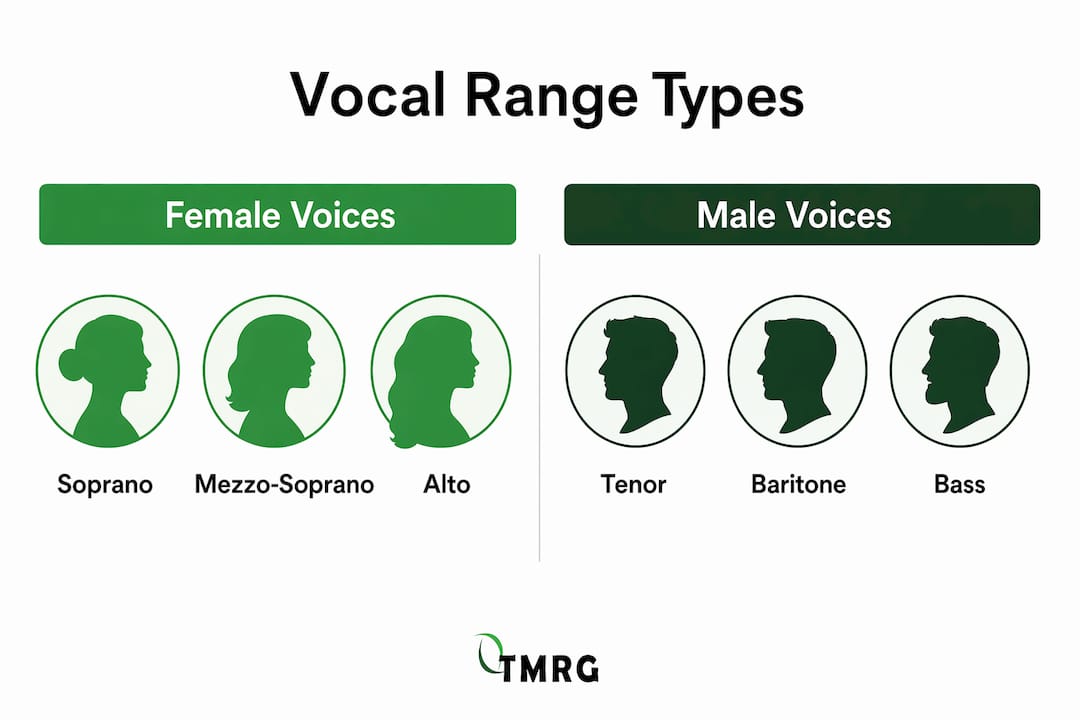
Voice types are the categories used to classify singers based on their range, tone, and where their voice sits most comfortably. The six primary classical voice types are Soprano, Mezzo-Soprano, Contralto, Tenor, Baritone, and Bass. Each carries a distinct pitch range and tonal character.
| Voice Type | Typical Range | Gender |
|---|---|---|
| Soprano | C4 to C6 | Female |
| Mezzo-Soprano | A3 to A5 | Female |
| Contralto | F3 to F5 | Female |
| Tenor | C3 to C5 | Male |
| Baritone | G2 to G4 | Male |
| Bass | E2 to E4 | Male |
One distinction that singers frequently overlook is the difference between range and tessitura. Range marks the outer limits of your voice, including notes that may sound thin or strained. Tessitura is the zone where your voice sounds full, resonant, and effortless. Voice classification depends on tessitura and tone quality, not just the lowest and highest notes you can squeeze out. Knowing your tessitura protects you from singing in registers that cause fatigue or damage over time.
Measuring range accurately also requires tracking dynamic control. A phonetogram-style test measures both pitch and volume across your range, giving a far more complete picture of your singing ability than a simple octave count. This matters because a note you can only produce at full volume is not a note you can use musically.
The benchmarks for vocal range are clearer than most singers realize. Untrained adults average 1.5 to 2 octaves, trained singers reach 2.5 to 3.5 octaves, and exceptional professionals may achieve 3 to 4 or more octaves. These numbers reflect not just physical potential but the result of deliberate, consistent training over months and years.
Several factors shape how much your range can grow:
Vocal range should be treated as a skill that develops through safe practice rather than a fixed genetic limit. This reframing matters because it shifts the focus from frustration to process. Singers who approach range work with patience and method consistently outperform those who push harder without a plan.
Safe, effective range expansion follows a clear sequence. The goal is to develop coordination in the vocal folds and resonance system, not to force the voice into territory it cannot yet access cleanly. Consistent daily practice of 15 to 30 minutes using low-pressure exercises produces measurable improvement within 30 days for most singers.
Follow this sequence to build range without strain:
Pro Tip: If you feel tension in your jaw, tongue, or neck during any exercise, stop immediately and return to a comfortable pitch. Tension in these areas signals that compensatory muscles are taking over, which is the primary cause of vocal strain and injury during range training.
Protecting your voice during intense practice is equally important. The vocal maintenance guide from Tmrgsolutions covers practical strategies for keeping the voice healthy during high-demand training periods.
Several widely repeated ideas about vocal range training actively harm singers who follow them. Recognizing these misconceptions early saves you months of wasted effort and protects your voice from preventable damage.
Quiet, low-pressure exercises strengthen the small intrinsic laryngeal muscles without engaging larger compensatory muscles, which helps avoid injury and promotes sustainable range growth.
Ignoring early warning signs is the most dangerous pitfall of all. Persistent hoarseness after practice, a feeling of effort or squeezing on notes that used to feel easy, and a shrinking range rather than a growing one are all signals that the voice needs rest and possibly professional evaluation. Learn to protect your voice when singing before problems escalate.
Tracking vocal progress requires more than checking whether you can hit a new high note. Consistent self-assessment gives you the data to train smarter and catch problems before they become injuries.
Effective tracking includes these practices:
Seek professional guidance when you notice a persistent plateau lasting more than six weeks, recurring vocal fatigue that does not resolve with rest, pain or discomfort during singing, or a noticeable change in tone quality that does not improve after a few days of rest. A voice teacher provides personalized diagnosis that no article or app can replicate. For singers dealing with vocal fatigue or strain, the vocal support exercises at Tmrgsolutions offer a structured starting point between lessons.
Vocal range grows through coordination and consistent low-pressure training, not through force, volume, or pushing at extremes.
| Point | Details |
|---|---|
| Range vs. tessitura | Tessitura defines your comfortable zone; range marks the outer limits. Train within your tessitura first. |
| Realistic benchmarks | Untrained adults average 1.5 to 2 octaves; trained singers reach 2.5 to 3.5 octaves with consistent work. |
| Safe exercise protocol | Daily 15 to 30 minute sessions using lip trills, siren glides, and VFEs build range without strain. |
| Control over extremes | Dynamic consistency across your range matters more than the highest or lowest note you can force out. |
| When to seek help | Persistent fatigue, plateau beyond six weeks, or pain during singing all require professional evaluation. |
I have worked with singers at every level, from beginners who have never had a lesson to professionals preparing for demanding performance schedules. The pattern I see most often is this: singers who obsess over their highest note make the slowest progress. The ones who focus on making every note in their current range sound full, controlled, and expressive are the ones whose range quietly expands on its own.
The physiology supports this. When you stop straining for notes just outside your reach and instead build coordination and resonance within your comfortable zone, the vocal folds learn to adjust more efficiently. That efficiency is what eventually extends the range upward and downward without the tension that causes injury.
I also see singers underestimate the role of rest. The vocal folds need recovery time just like any other tissue you are training. A singer who practices seven days a week with no rest days will plateau faster and sustain more wear than one who trains five days and rests two.
My honest recommendation is to spend the first month of any range-focused program doing nothing but low-volume coordination exercises. No belting, no pushing, no testing your limits. Just lip trills, siren glides, and VFEs at a volume that feels almost too easy. After 30 days, record yourself and compare to your baseline. The results will convince you more than any argument I could make.
Curiosity and self-awareness are more powerful tools than ambition when it comes to the voice. Learn what your instrument is telling you, and it will reward you with growth that lasts.
— Golan

Training your voice consistently is only half the equation. The other half is keeping your vocal folds healthy enough to train. Tmrgsolutions has spent 25 years developing natural, clinically informed solutions for singers, actors, and voice professionals who need their voice to perform at its best. The TMRG Voice Therapy Kit Basic is designed as an entry-level toolkit for singers working on vocal health and range development, combining herbal formulations and targeted support tools in one package. For singers with more demanding training schedules, the Standard and Premium kits offer expanded resources for deeper vocal maintenance and recovery. Give your training the support it deserves.
Most untrained adults have a natural vocal range of 1.5 to 2 octaves. This span can expand significantly with consistent, structured training over several months.
Measurable improvement is possible within 30 days of daily 15 to 30 minute low-pressure practice sessions. Significant expansion to 2.5 or more octaves typically requires several months of consistent training.
Vocal range covers the full span of notes a voice can produce, including extremes. Tessitura is the narrower zone where the voice sounds most natural, full, and effortless, and it is the primary basis for voice type classification.
Exercises performed at low volume with proper breath support carry minimal risk. Forcing high notes, practicing at high volume without warm-up, or ignoring signs of fatigue are the behaviors that cause vocal damage.
A teacher accelerates progress and reduces injury risk through personalized feedback. Self-directed training using clinically supported exercises like VFEs and siren glides is effective, but professional guidance becomes necessary when progress stalls or strain appears.
