Your Cart is Empty


TL;DR:
- Vocal range encompasses the notes a person can produce with control, shaping their voice classification and repertoire. Accurate assessment involves warm-up, identifying sustainable notes, and considering tessitura, register transitions, and vocal health. Training and proper technique expand usable range, but understanding one’s most resonant and comfortable tessitura is essential for musical effectiveness.
Vocal range is the full span of notes a person can phonate with control, from the lowest comfortable pitch to the highest stable note they can sustain. This span determines your voice classification, shapes the repertoire you can sing confidently, and guides every training decision you make. Whether you are a beginner trying to find your footing or a seasoned performer refining your craft, understanding vocal ranges is the foundation of smart, sustainable vocal development. Tmrgsolutions has worked with singers at every level for over 25 years, and the question we hear most often is simple: “What type of voice do I have?”
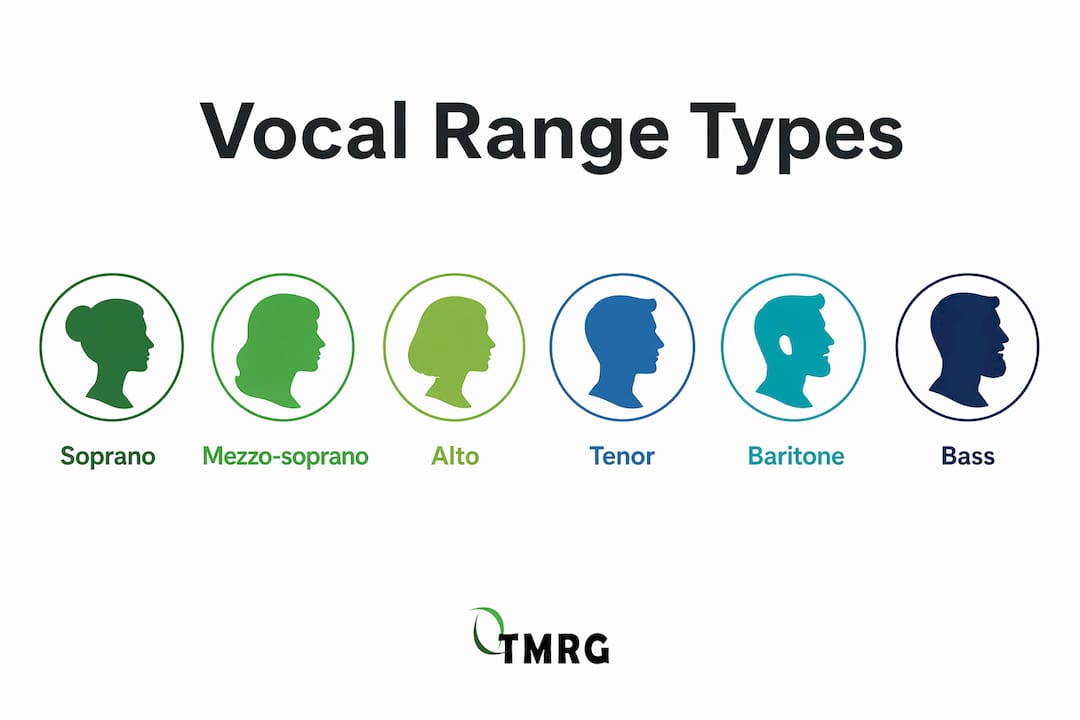
Voice classification is the formal system used in classical and contemporary music to categorize singers by the notes they can produce comfortably and consistently. The six primary voice types recognized by vocal pedagogy are soprano, mezzo-soprano, alto, tenor, baritone, and bass. Each carries a typical note span expressed in scientific pitch notation, where C4 is middle C.
The standard classical voice ranges are as follows:
These ranges represent typical usable spans for classification purposes, not the absolute extremes a singer might hit under strain. Misreading that distinction leads singers to misclassify themselves and choose repertoire that damages their voice over time.
| Voice Type | Note Span | Approximate Octaves | Tonal Character |
|---|---|---|---|
| Soprano | C4 to C6 | 2 octaves | Bright, clear, piercing |
| Mezzo-soprano | A3 to A5 | 2 octaves | Warm, rich, flexible |
| Alto | F3 to F5 | 2 octaves | Deep, resonant, dark |
| Tenor | C3 to C5 | 2 octaves | Brilliant, powerful |
| Baritone | A2 to A4 | 2 octaves | Full, warm, centered |
| Bass | E2 to E4 | 2 octaves | Deep, grave, authoritative |

Beyond these six, extended types like soprano coloratura, bass-baritone, and countertenor exist in specialized repertoire. These classifications matter because they align your voice with music written to suit its natural strengths.
Finding your vocal range requires more than singing up a scale until you crack. Accuracy demands that you distinguish between notes you can sustain cleanly and notes you can barely touch under effort. Distinguishing sustainable notes from absolute extremes is the single most important principle in range assessment.
Follow these steps to conduct a reliable self-test:
For a deeper assessment, vocal scientists use a tool called a phonetogram. A phonetogram maps pitch and loudness across your full range, showing not just which notes you can reach but how much dynamic control you have at each pitch. This method reveals your passaggio points (the register transitions) and identifies where your voice is genuinely strong versus where it is barely functional.
Pro Tip: Dynamic control matters more than raw span. A singer who can produce a pianissimo high note with a steady tone is more musically useful than one who can shout a note two semitones higher with no control.
Common mistakes in self-testing include testing after heavy speaking, testing when dehydrated, and counting falsetto notes as part of the main range without noting the register shift. Each of these errors inflates your apparent range without reflecting your actual singing capability.
Raw range span tells you the outer walls of your voice. Registers and tessitura tell you what is actually happening inside those walls. Vocal classification based on tessitura is more reliable than extremes for predicting voice type and choosing appropriate repertoire.
Vocal registers are distinct modes of vibration in the vocal folds, each producing a different tonal quality:
The transitions between registers are called passaggi (singular: passaggio). Managing passaggio points limits practical performance range far more than raw pitch extension does. A tenor who cannot navigate the passaggio around E4 to F4 smoothly will sound broken and unprepared, even if his absolute top note is G4.
Tessitura is the region of your range where your voice sounds most resonant, projects most easily, and feels most comfortable to sustain. Two singers might both span C3 to C5, but one might have a tessitura centered around F3 to F4 (baritone) while the other sits comfortably at A3 to A4 (tenor). Their ranges overlap, but their voices are built differently.
“Two singers with the same range can sound very different because control and dynamic envelope shape vocal performance more than just span.” — VoiceScience
This is why a voice teacher listens to where you sound best, not just how high you can go. Tessitura, register coordination, and tonal quality together define your voice type far more accurately than any single high note.
The gap between an untrained and a professional singer’s range is measurable and significant. Untrained singers typically span 1.5 to 2 octaves, trained singers reach 2.5 to 3 octaves, and professionals often exceed 3 to 4 octaves. That growth comes from technique, not just time.
| Singer Level | Typical Span | Primary Development Focus |
|---|---|---|
| Beginner | 1.5 to 2 octaves | Breath support, basic pitch accuracy |
| Recreational | 2 to 2.5 octaves | Register awareness, vowel consistency |
| Trained | 2.5 to 3 octaves | Passaggio management, dynamic control |
| Professional | 3 to 4+ octaves | Full register integration, stylistic flexibility |
Genre also shapes how range is used in practice. Classical singers prioritize register purity and tonal projection, often working within a narrower but perfectly controlled span. Contemporary genres like pop, R&B, and musical theater reward register blending and stylistic flexibility. A pop singer like Ariana Grande uses her whistle register as a performance tool, while a classical soprano like Renée Fleming focuses on seamless legato across her full range without register breaks.
Vocal technique and register coordination influence usable range far more than raw pitch extension. A singer who can access three octaves with clean transitions and dynamic variety is more capable than one who can hit four octaves with cracks and strain throughout. Training builds the infrastructure that makes range musically meaningful.
Pro Tip: If you want to expand your range safely, work the edges of your current comfortable zone in short, focused sessions. Pushing to your absolute limit every practice session accelerates fatigue and increases injury risk.
Voice resonance also plays a role that many singers overlook. Vocal formants affect projection and how well certain notes cut through an ensemble or band mix. A singer with a narrower range but strong formant resonance can project more powerfully than one with a wider range and weak resonance. This is why vocal health, hydration, and physical technique all feed directly into how your range sounds in practice.
Vocal range classification depends on sustainable, controlled notes within your tessitura, not the extreme pitches you can barely reach.
| Point | Details |
|---|---|
| Six primary voice types | Soprano, mezzo-soprano, alto, tenor, baritone, and bass each carry defined note spans used for repertoire selection. |
| Tessitura over extremes | Your most resonant, comfortable region predicts voice type more reliably than your highest or lowest possible note. |
| Registers define performance | Chest, mixed, head, and falsetto registers, and the passaggi between them, shape how your range functions in practice. |
| Training expands range | Untrained singers average 1.5 to 2 octaves; professionals reach 3 to 4 or more through technique and register coordination. |
| Accurate testing requires care | Warm up before testing, distinguish sustainable notes from strained extremes, and test across multiple sessions for accuracy. |
After working with hundreds of singers across training levels, I have seen the same pattern repeat itself. Singers obsess over their highest note. They celebrate hitting a C5 once in a warm room after a great night’s sleep, then build their entire self-concept around that number. The problem is that a note you can hit once under ideal conditions is not your range. It is a ceiling you brushed with your fingertips.
The singers who develop fastest are the ones who shift their focus from the ceiling to the floor plan. They ask: “Where does my voice actually live? Where does it sound full and free without effort?” That question leads them to their tessitura, and tessitura is where real vocal identity lives.
I also see singers skip register work entirely and just try to push higher. This is the vocal equivalent of adding a second floor to a house with a cracked foundation. Passaggio management, the ability to move cleanly between chest, mixed, and head voice, is the skill that makes range musically usable. Without it, extra notes at the top are just noise.
My honest advice: get a proper assessment from a qualified voice teacher at least once, even if you primarily train on your own. A teacher can hear your tessitura, identify your passaggi, and tell you things no app or self-test can. Pair that with consistent, patient technique work and your range will grow as a natural byproduct. You can also explore factors affecting vocal range to understand what supports or limits your development between lessons.
— Golan

Expanding your vocal range puts real physical demand on your vocal folds, and that demand requires proper support. Tmrgsolutions has spent over 25 years developing natural, evidence-informed solutions for singers who want to grow their voice without compromising their vocal health. From herbal throat sprays that reduce inflammation after intense practice sessions to structured voice therapy kits for singers, the product line is built specifically for performers who take their instrument seriously. If you are experiencing hoarseness, fatigue, or reduced range after heavy singing, visit the vocal health FAQ to find targeted guidance and the right recovery tools for your situation.
The six primary voice types are soprano, mezzo-soprano, alto, tenor, baritone, and bass. Each is defined by a typical note span, tonal quality, and tessitura used for voice classification and repertoire selection.
Warm up your voice, then sing from your lowest controlled note to your highest sustainable note and identify both pitches using a piano or pitch app. Test across multiple sessions to account for daily variation in vocal condition.
Vocal range is the full span of notes you can produce with control, while tessitura is the narrower region within that span where your voice sounds most resonant and comfortable. Tessitura is the more reliable indicator of your true voice type.
Yes. Trained singers typically reach 2.5 to 3 octaves compared to the 1.5 to 2 octaves common in untrained voices. Technique, register coordination, and consistent practice drive that expansion safely.
Vocal formants and resonance shape tone and projection independently of range span. Two singers with identical ranges can sound completely different based on their register control, dynamic envelope, and resonance characteristics.
