Your Cart is Empty


Many singers and actors believe that singing “from the diaphragm” means pushing more air, but this misconception often worsens vocal strain rather than helping it. The truth is that proper breath support isn’t about force or volume. It’s about balancing air pressure beneath your vocal folds with their natural closure, allowing efficient phonation without exhausting your voice. When you master this coordination, you’ll notice extended range, reduced fatigue, and greater control during long performances. This guide clarifies what breath support truly means and provides actionable exercises and natural remedies to enhance your vocal health and performance safely.
| Point | Details |
|---|---|
| Pressure balance | Proper breath support balances subglottal air pressure with vocal fold closure to enable efficient phonation and prevent strain. |
| Diaphragmatic breathing | Diaphragmatic breathing forms the basis of support, with the diaphragm moving downward, belly expanding, and rib cage lifting rather than pushing air through the throat. |
| One to one ratio | The goal is a 1:1 ratio of air pressure to vocal fold pressure for efficient phonation and effortless tone. |
| Fatigue and instability | Poor breath support leads to fatigue, pitch instability, and hoarseness during long performances. |
Breath support is the foundation of healthy voice production, yet confusion about it leads many voice professionals astray. At its core, breath support balances subglottal air pressure with vocal fold closure for efficient phonation, preventing strain and enabling sustained notes. This isn’t about pushing air harder or tensing your throat. It’s about coordinating your breathing muscles to deliver steady, controlled airflow that your vocal folds can use efficiently.
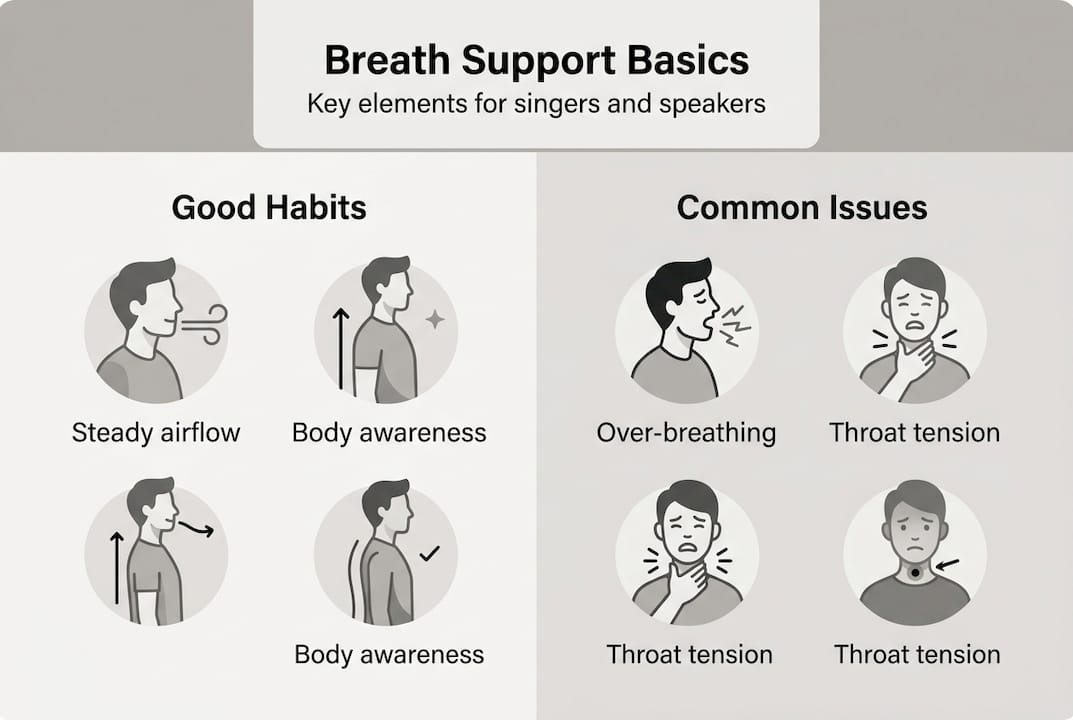
Diaphragmatic breathing forms the basis of proper support. When you inhale, your diaphragm contracts and moves downward, expanding your belly and lifting your rib cage outward. This creates space for your lungs to fill naturally without forcing air in through your throat. Breath support involves diaphragmatic breathing, rib cage expansion, and abdominal engagement, not throat control or pushing air. Your abdominal muscles then engage gently during exhalation to maintain steady pressure, allowing your vocal folds to vibrate smoothly.
The key components of effective breath support include:
Many singers fall victim to the myth that “singing from the diaphragm” means pushing more air through their vocal folds. This over-pushing creates excessive tension, strains your voice, and actually reduces your control. The reality is more subtle. Proper support maintains a 1:1 ratio of air pressure to vocal fold pressure, creating what voice scientists call efficient phonation. When this balance is right, your voice feels effortless and your tone stays clear.
Pro Tip: Focus on coordinating your breath with vocal fold closure rather than trying to increase strength or volume through air pressure alone.
When support is poor, your vocal folds compensate by working harder to resist unbalanced airflow. This leads to fatigue, hoarseness, and instability in your pitch. Understanding the role of breathing in singing helps you avoid these problems and build a sustainable vocal technique. The goal isn’t to breathe more or breathe harder. It’s to breathe smarter, using your body’s natural mechanics to support your voice without strain.
Once you understand what breath support is, the benefits become clear and measurable. Proper support directly reduces vocal fatigue and strain during long performances by distributing the work across your breathing muscles instead of overloading your vocal folds. When your breath is steady and controlled, your voice can operate at peak efficiency for extended periods without wearing out.
Poor breath support causes vocal fatigue, limited range, pitch instability, and strain, while proper support extends range and reduces fatigue. Research shows that singers who develop strong breath support experience measurable improvements in their vocal capabilities. Studies on inspiratory muscle warm-up benefits demonstrate significant gains in phonation time and vocal range when breathing muscles are properly conditioned.
The four key benefits of strong breath support include:
Inspiratory muscle warm-up improves phonation time by 21-32% and expands vocal range significantly in trained singers.
This improvement happens because proper support allows you to control your voice without over-exerting your vocal cords. When air pressure is balanced, your vocal folds can vibrate freely at their optimal frequency. This creates clearer tone quality and allows you to access notes that would otherwise feel strained or out of reach. Your pitch stays stable because the airflow remains consistent, eliminating the wobbles and cracks that come from uneven breath pressure.

Actors benefit equally from these improvements. Long monologues and emotionally demanding scenes require vocal stamina that only proper breath support can provide. When you’re not fighting against poor breathing habits, you can focus on your performance instead of managing vocal discomfort. The 7 essential exercises for vocal recovery build this foundation systematically.
The physiological impact is straightforward. Efficient phonation means your vocal folds close smoothly with each vibration, using minimal muscular effort. This reduces wear and tear on the delicate tissues, preventing the micro-trauma that accumulates into chronic vocal problems. Your voice stays healthy, flexible, and responsive throughout your career. The difference between struggling through performances and sailing through them often comes down to this single technical element.
Even experienced voice professionals make mistakes that undermine their breath support and compromise vocal health. Recognizing these errors is the first step toward correcting them and building sustainable technique. The most common mistake is pushing air forcefully, believing that more air equals more power. This creates excessive pressure that blows your vocal folds apart, producing a breathy, unstable tone instead of the clear sound you want.
Myths include pushing air, tensing abs unnecessarily, or over-breathing leading to vocal tension and cracks. Another frequent error is tensing your abdominal muscles too much, which restricts natural movement and creates rigidity throughout your torso. This tension travels upward, tightening your throat and limiting your vocal flexibility. The third major mistake is using your throat to control breath, which puts strain directly on your larynx instead of distributing the work to your larger breathing muscles.
Five critical mistakes and their effects include:
Over-breathing causes blowing apart vocal folds and breathiness, making it one of the most counterproductive habits singers develop. When you inhale too deeply, you create more pressure than your vocal folds can efficiently manage. The result is wasted air, inconsistent tone, and the need to breathe more frequently during phrases. This disrupts your musical line and makes performances feel labored.
Recognizing shallow or forced breathing patterns requires body awareness. Shallow breathing shows up as chest movement without belly expansion, quick breaths that don’t fill your lower lungs, and the sensation of running out of air quickly. Forced breathing feels effortful, creates tension in your neck and shoulders, and often produces a pushed vocal quality. Both patterns signal that your breath support needs adjustment.
Pro Tip: Practice slow, controlled exhales on a hiss sound and avoid over-filling your lungs to develop smoother phonation and better breath management.
The solution is to feel your rib cage expand outward and your belly move forward during inhalation, without any throat tightness. Your shoulders should stay relaxed and low. During exhalation, maintain that rib cage expansion as long as possible while your abdominal muscles engage gently to control airflow. This creates the steady pressure your voice needs without forcing or straining. Monitoring your breath ratio ensures balanced airflow that matches your vocal fold closure perfectly.
Understanding vocal recovery strategies 2025 helps you correct these mistakes before they cause lasting damage. The key is patient, consistent practice that retrains your breathing habits gradually. Rushing the process or trying to fix everything at once usually backfires, creating new tensions while the old ones persist. Focus on one element at a time until it becomes automatic.
Building effective breath support requires daily practice with specific exercises designed to engage your diaphragm and control airflow. A consistent 5-10 minute routine can transform your vocal stamina and control within weeks. These exercises target the muscles responsible for breath management, strengthening them gradually while teaching your body the coordination patterns that support healthy phonation.
Four essential exercises to practice daily:
Diaphragmatic breathing: Lie on your back with one hand on your chest and one on your belly. Inhale slowly through your nose for 4 counts, feeling your belly rise while your chest stays relatively still. Exhale through pursed lips for 6 counts, feeling your belly fall. Repeat for 2 minutes.
Lip trills: Take a comfortable breath and blow air through loosely closed lips, creating a buzzing trill sound. Sustain this for as long as possible on one breath, then rest. This exercise engages your diaphragm while keeping your throat relaxed. Repeat 5 times.
Hissing exercise: Inhale deeply using diaphragmatic breathing, then exhale on a steady “sss” sound for as long as you can maintain consistent volume. Time yourself and aim to extend your hiss by a few seconds each week. This builds breath control and stamina.
Square breathing: Inhale for 4 counts, hold for 4 counts, exhale for 4 counts, hold empty for 4 counts. This pattern trains breath regulation and increases lung capacity over time. Complete 5-10 cycles.
Breath support exercises include diaphragmatic breathing, lip trills, hissing, square breathing, and drop-in breathing as foundational techniques for voice professionals. The following table compares these exercises to help you choose the right combination for your needs:
| Exercise | Difficulty Level | Primary Benefit | Recommended Frequency |
|---|---|---|---|
| Diaphragmatic breathing | Beginner | Establishes proper breath mechanics | Daily, 2-3 minutes |
| Lip trills | Beginner | Engages diaphragm while relaxing throat | Daily, 5 repetitions |
| Hissing (sss) | Intermediate | Builds sustained breath control | Daily, 5-8 repetitions |
| Square breathing | Intermediate | Improves breath regulation and capacity | Daily, 5-10 cycles |
| Drop-in breathing | Advanced | Develops quick, efficient breath renewal | 3-4 times weekly |
Natural remedies complement these exercises by supporting vocal tissue health and recovery. Natural remedies like hydration, steam, herbal tea, and rest support vocal recovery when paired with breath support training. Proper hydration keeps your vocal folds lubricated, preventing the dryness that leads to irritation and strain. Aim for 8-10 glasses of water daily, and avoid excessive caffeine or alcohol that dehydrate tissues.
Steam inhalation soothes inflamed vocal tissues and adds moisture directly to your respiratory system. Spend 10 minutes inhaling steam from hot water two to three times weekly, especially after heavy voice use. Herbal teas with honey, ginger, or chamomile provide anti-inflammatory benefits and coat your throat gently. Rest is equally critical. Your vocal folds need recovery time after intense use, just like any other muscles in your body.
Pro Tip: Combine breath support exercises with vocal warm-ups before practice and cool-downs afterward for peak efficiency and injury prevention.
The natural vocal remedies guide and step by step vocal recovery process provide detailed protocols for integrating these approaches into your routine. Progress cautiously, especially if you’re recovering from vocal strain. Increase exercise duration and intensity gradually over weeks, not days. This patient approach prevents new strain while your breathing muscles adapt and strengthen. Pairing natural recovery methods with consistent breath support drills creates a comprehensive foundation for long-term vocal health.
While self-directed exercises and natural remedies form the foundation of vocal health, professional voice therapy resources can accelerate your progress and provide targeted support. TMRG Solutions offers specialized voice therapy kits designed specifically for singers, actors, and voice professionals who want to optimize their breath support and recover from vocal strain effectively. These kits combine natural herbal formulations with structured therapy exercises, giving you a comprehensive approach to vocal wellness.

The TMRG voice therapy kit basic provides essential tools for daily vocal care, while the voice therapy kit standard includes expanded resources for more intensive recovery needs. For those dealing with significant vocal fatigue or strain, the herbal vocal recovery kit delivers powerful natural ingredients that support tissue healing and reduce inflammation.
Key features of TMRG voice therapy kits include:
Pro Tip: Using professional therapy kits alongside natural remedies and breath exercises enhances vocal recovery safely and accelerates improvements in breath control and stamina.
These resources bridge the gap between self-care and professional intervention, giving you access to expert-developed protocols without the cost of ongoing therapy sessions. When you combine TMRG’s targeted solutions with the breath support techniques covered in this guide, you create a complete system for maintaining and restoring vocal health throughout your performing career.
Breath support is the coordinated use of your diaphragm and abdominal muscles to regulate airflow during voice production. It balances air pressure beneath your vocal folds with their natural closure, enabling controlled and efficient phonation without straining your throat or larynx. This coordination allows sustained notes, stable pitch, and reduced vocal fatigue.
Common signs include vocal fatigue after short performances, pitch instability or wobbling, limited vocal range, persistent throat tension, and breathiness in your tone. You might also notice shallow chest breathing, quick exhaustion during phrases, and the need to breathe more frequently than other singers. These indicators suggest your breathing muscles aren’t providing adequate support for your vocal folds.
Diaphragmatic breathing, lip trills, and controlled hissing on “sss” are highly effective quick exercises you can practice anywhere. Start with slow inhales through your nose for 4 counts, feeling your belly expand, then exhale through pursed lips for 6-8 counts. Lip trills engage your diaphragm while keeping your throat relaxed. Practice these 7 essential exercises for vocal recovery for 5-10 minutes daily to build strength and coordination.
Yes, natural remedies like proper hydration, steam inhalation, and herbal teas significantly support vocal tissue health when combined with breath support exercises. They maintain moisture in your vocal folds, reduce inflammation, and soothe strain from overuse. Drinking 8-10 glasses of water daily, inhaling steam for 10 minutes after performances, and consuming herbal teas with honey or ginger provide measurable benefits. The natural vocal remedies guide offers detailed protocols for integrating these approaches into your routine.
