Your Cart is Empty


TL;DR:
- Throat pain from singing results from vocal fold trauma, muscle tension, and environmental irritants. Proper technique, hydration, and avoiding irritants help prevent and manage voice strain. Long-term vocal health depends on consistent habits and listening to the body’s signals.
Throat pain from singing is defined as vocal fold strain caused by mechanical overuse, muscle tension, or irritation of the larynx. Your vocal folds collide hundreds of times per second during phonation. That repeated impact creates micro-trauma, inflammation, and soreness. Poor technique amplifies the damage. Conditions like Muscle Tension Dysphonia (MTD) and acid reflux make it worse. Understanding why does singing hurt throat is the first step toward protecting your voice for the long term.

The short answer is mechanical trauma. Your vocal folds are two small bands of muscle and mucous membrane inside the larynx. When you sing, they snap together rapidly to produce sound. That repetitive collision causes swelling and soreness the same way a sprained ankle swells after repeated stress. The harder and longer you push, the more inflammation builds up.
Muscle Tension Dysphonia is the clinical term for what most singers feel as “throat tightness.” MTD occurs when the muscles surrounding the larynx tense excessively to compensate for weak breath support. The result is a voice that feels squeezed, strained, and painful. Singers are essentially vocal athletes, and repeated misuse without rest parallels the kind of overuse injuries seen in sports.
Poor breath support is the root cause behind most cases of MTD. When your diaphragm does not do its job, your throat muscles step in to fill the gap. That compensation creates constriction. Throat pain is often a diagnostic signal of excess muscle tension covering for weak abdominal support.
The key physiological contributors to throat discomfort while singing include:
Pro Tip: Place one hand on your belly when you sing. If your abdomen does not expand outward on the inhale, your throat is likely doing work it should not be doing.
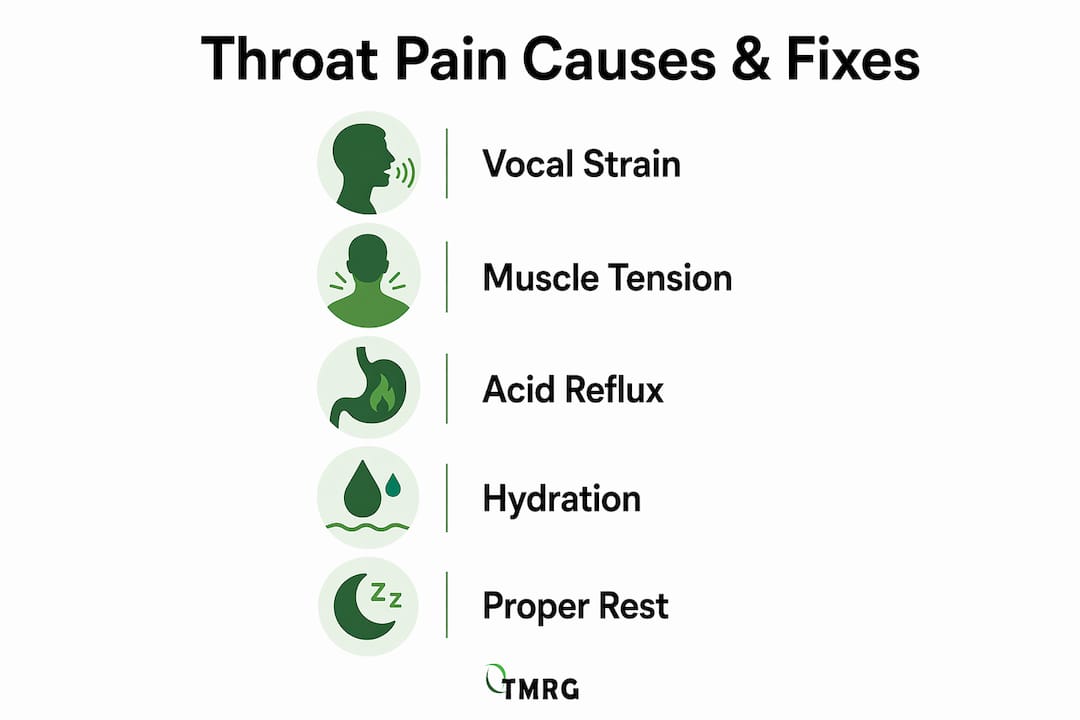
Acid reflux is one of the most overlooked causes of sore throat after singing. Stomach acid travels up the esophagus and irritates the larynx, causing hoarseness, rawness, and a persistent need to clear your throat. This condition is called Laryngopharyngeal Reflux (LPR), and many singers have it without knowing. Acid reflux irritates the vocal cords silently, meaning you may feel no heartburn but still experience significant vocal damage.
Environmental conditions also play a direct role. Dry air causes the vocal fold mucosa to lose moisture, making the folds stiffer and more prone to injury. The industry standard for vocal health is 40%–60% relative humidity. Singing in air-conditioned rooms, heated spaces, or polluted environments drops humidity well below that range.
| Factor | Effect on vocal folds | What to do |
|---|---|---|
| Acid reflux (LPR) | Irritates and inflames larynx | Avoid eating 2–3 hours before singing |
| Low humidity (below 40%) | Dries and stiffens vocal folds | Use a humidifier; target 40%–60% |
| Smoke and pollution | Inflames mucous membranes | Avoid smoky venues; use air purifiers |
| Dehydration | Reduces mucosal lubrication | Drink water consistently throughout the day |
| Spicy or acidic foods | Triggers reflux and irritation | Limit before performances |
Hydration works from the inside out. Drinking water does not directly coat the vocal folds, but it keeps the body’s mucous production healthy, which lubricates the folds naturally. Hydration strategies for singers go beyond just drinking water. They include managing caffeine intake, avoiding alcohol before singing, and using steam inhalation to hydrate the larynx directly.
Pro Tip: Steam inhalation for 10 minutes before a rehearsal delivers moisture directly to the larynx. A simple bowl of hot water with a towel over your head works just as well as a commercial steam inhaler.
Bad habits are responsible for a large share of vocal injuries. Most singers develop them gradually, often without realizing the damage they are doing. The following behaviors are the most common causes of sore throat after singing.
Singing from the throat instead of the diaphragm. When you push sound from your throat rather than driving airflow from your abdomen, the laryngeal muscles bear the full load. This creates the tight, burning sensation many singers describe after a long rehearsal.
Skipping the warm-up. Cold vocal folds are stiff and less pliable. Jumping straight into full-volume singing without a gradual warm-up increases the risk of micro-tears and inflammation. A proper warm-up takes at least 10–15 minutes of gentle glides, lip trills, and humming.
Singing over background noise. Pushing volume beyond safe limits in loud environments causes cumulative vocal fold inflammation. This is called the Lombard Effect. Your brain automatically raises your voice in noisy settings, often past the point of safety.
Forcing an “open throat” manually. Many singers try to create space in the throat by mimicking a yawn or physically widening the jaw. True vocal freedom comes from coordinated internal muscle function between the arytenoid and cricothyroid muscles. Forcing it externally creates constriction, not openness.
Holding tension in the neck and jaw. Tight jaw muscles, raised shoulders, and a forward head posture all transfer tension directly into the larynx. Singers who perform under stress or stage fright often clench without noticing.
Singing through pain. Singing through pain converts acute strain into chronic vocal injury. Pain is a stop signal, not a challenge to push through.
Prevention is built on consistent habits, not occasional fixes. The strategies below address both the mechanical and environmental causes of throat discomfort while singing.
Build real breath support. The diaphragm is your primary vocal tool. Strengthening your breath support through daily exercises reduces the load on your throat muscles. Read more about why breath support matters for singers who want to reduce strain and build endurance.
Warm up and cool down every time. Treat your voice the way a runner treats their legs. Warm up before rehearsal and cool down after with gentle descending scales or humming. This reduces post-performance soreness significantly.
Protect your environment:
Rest your voice correctly. Vocal rest does not mean whispering. Whispering strains vocal folds and delays healing. Choose silence or very gentle conversational speech instead. For detailed guidance on recovery, Tmrgsolutions covers vocal maintenance tips for singers managing heavy performance schedules.
Recognize warning signs early. Pain when swallowing signals vocal system inflammation and is a clear sign to stop singing immediately. Other red flags include a sudden loss of range, persistent hoarseness lasting more than two weeks, and a feeling of something stuck in the throat.
Pro Tip: If your voice feels tired after 20 minutes of singing, the problem is almost always technique, not stamina. A single session with a qualified vocal coach often reveals the exact tension pattern causing your pain.
Throat pain from singing is caused by vocal fold strain, muscle tension dysphonia, and environmental irritants, all of which are preventable with correct technique and consistent vocal care habits.
| Point | Details |
|---|---|
| Vocal fold collision is the root cause | Folds collide hundreds of times per second, creating micro-trauma and inflammation. |
| MTD amplifies pain | Muscle Tension Dysphonia develops when throat muscles compensate for poor breath support. |
| Acid reflux is a hidden factor | LPR irritates the larynx silently and worsens soreness even without heartburn symptoms. |
| Humidity and hydration matter | Maintain 40%–60% relative humidity and drink water consistently to keep folds pliable. |
| Whispering delays recovery | True vocal rest means silence, not whispering, which adds strain to healing folds. |
The most consistent pattern I see is singers who treat throat pain as a willpower problem. They push harder, drink more tea, and hope the soreness disappears by showtime. It rarely does. Pain is not weakness. It is your larynx telling you that something in the system is off.
The second pattern is the misunderstanding around “open throat.” Singers spend years trying to manually create space in their throat, often making the tension worse in the process. The open throat is not a shape you force. It is a byproduct of coordinated breath support and relaxed posture. When the diaphragm works correctly, the throat opens naturally.
What actually changes a singer’s vocal health long-term is not a single technique fix. It is the accumulation of small daily habits: consistent warm-ups, proper hydration, managed reflux, and the discipline to stop when the voice signals distress. Quick fixes feel satisfying but rarely hold. Consistent maintenance builds a voice that lasts.
Mindfulness also plays a bigger role than most singers expect. Stage anxiety, performance pressure, and even daily stress tighten the muscles around the larynx. Singers who add even five minutes of body-scan relaxation before rehearsal report noticeably less throat tension. The voice lives in the body. What the body holds, the voice reflects.
— Golan
Throat pain from singing does not have to sideline your voice. Tmrgsolutions has spent 25+ years developing natural herbal formulations specifically for singers, actors, and voice professionals dealing with soreness, hoarseness, and vocal fatigue.

The TMRG Loud & Clear Classic Voice Recovery Drops are trusted by vocal coaches and performers for soothing irritated vocal cords after heavy use. For on-the-go relief, the TMRG Shine Bright Classic Voice Recovery Spray delivers quick hydration and comfort during or after rehearsal. Singers dealing with recurring soreness can explore the full range of voice therapy kits designed to support both recovery and long-term vocal health. Every product is formulated with professional-grade care and backed by real singer testimonials.
Short-session throat pain usually signals muscle tension dysphonia or poor breath support rather than overuse. Your throat muscles are compensating for weak diaphragm engagement, which fatigues them quickly.
Singing with proper technique and adequate rest is not harmful to your throat. Damage occurs from overuse, poor posture, inadequate warm-ups, and environmental irritants like dry air or acid reflux.
Rest your voice completely (avoid whispering), stay hydrated, maintain room humidity at 40%–60%, and avoid singing until soreness resolves. If hoarseness persists beyond two weeks, consult a laryngologist.
Yes. Laryngopharyngeal Reflux (LPR) irritates the larynx without causing obvious heartburn. Singers with LPR often experience chronic hoarseness, throat clearing, and soreness that worsens during performance.
Consistent warm-ups, diaphragm-driven breath support, proper hydration, controlled humidity, and avoiding singing through pain are the most effective long-term prevention strategies for vocal health.
