Your Cart is Empty


TL;DR:
- A vocal coach enhances performance by focusing on style, interpretation, and stage presence beyond foundational technique. They should be distinguished from singing teachers and voice therapists, with each role suited to different voice issues and career stages. Choosing the right coach involves evaluating credentials, genre expertise, teaching style, and testing compatibility through a trial session.
A vocal coach is a trained professional who refines your singing performance by focusing on style, song interpretation, and stage presence, building on the technical foundation you already have. Whether you are a beginner stepping into your first singing lessons or an experienced performer preparing for a major audition, the right coach accelerates your progress in ways that self-guided practice simply cannot match. Working with a skilled voice instructor means receiving feedback tailored to your specific vocal anatomy, your genre, and your goals. This article explains exactly what a vocal coach does, how to choose one wisely, and when your voice needs more than coaching alone.
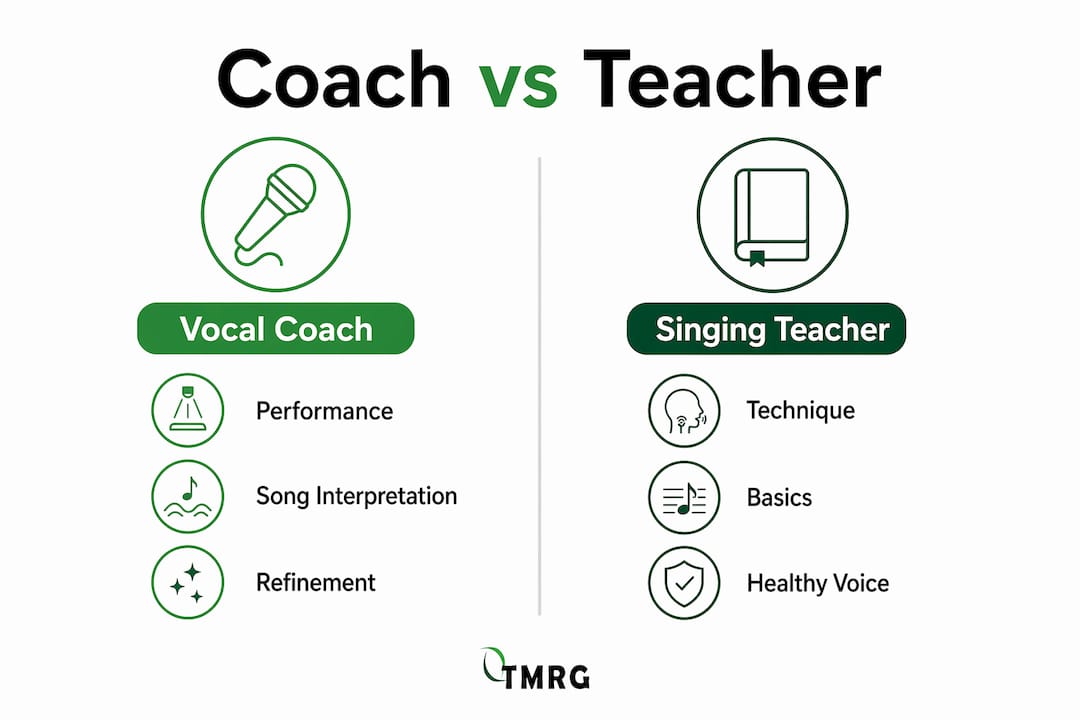
A vocal coach specializes in performance refinement rather than foundational technique. According to the distinction between roles, beginners benefit most from singing teachers who build healthy vocal habits, while advanced singers preparing for performances gain the most from coaches who sharpen interpretation, phrasing, and emotional delivery. This distinction matters because choosing the wrong type of instructor at the wrong stage can slow your development or, worse, reinforce bad habits.
A vocal coach works on the specific demands of a song or performance context. They help you shape a phrase to carry emotional weight, manage your breath across a long melodic line, and adapt your tone to suit a genre from classical to contemporary R&B. They are not voice therapists, and they are not speech-language pathologists. Understanding where each role begins and ends protects both your progress and your vocal health.
These three roles are frequently confused, and the confusion costs singers time and money. Here is how each one differs:
| Role | Primary Focus | Best For |
|---|---|---|
| Singing teacher | Foundational technique, healthy vocal production | Beginners, those building core skills |
| Vocal coach | Performance, style, song interpretation | Intermediate to advanced singers, audition prep |
| Speech-language pathologist (SLP) | Medical voice rehabilitation | Singers with diagnosed voice disorders |
The separation matters clinically, too. Voice therapy by licensed SLPs is integral to dysphonia treatment, and the 2026 AAO-HNS consensus statement confirms it should continue until optimal vocal response is achieved. Mixing up a coaching session with medical rehabilitation puts your vocal folds at risk.
Here is when each professional is the right call:
These roles complement each other. Many professional singers work with all three at different points in their careers, and the most effective outcomes come from interdisciplinary vocal care that coordinates coaching with medical oversight.
Choosing a vocal coach is one of the most personal decisions you will make as a singer. The wrong fit wastes months of practice time. The right fit can reshape your entire relationship with your voice.

Evaluating a coach requires checking four things: their training and credentials, their specialization in your genre, their teaching style, and their track record with students at your level. A coach who excels at musical theater may not serve a singer working in gospel or indie folk. Genre alignment is not a preference. It is a technical requirement, because stylistic conventions differ dramatically across vocal traditions.
Consider these criteria before committing:
Pro Tip: Ask your prospective coach to explain why they are assigning a specific exercise. If they can connect the exercise to your vocal anatomy and your specific challenge, you have found someone who teaches with genuine understanding, not just habit.
A good coaching session is not just singing through songs. It is structured, progressive work on specific vocal functions. Here is the sequence most experienced coaches follow:
Warm-up and breath control. Every session begins with diaphragmatic breathing exercises to activate the primary engine of your voice. Lip trills, humming on a five-note scale, and sustained “ss” or “sh” sounds build airflow control before the vocal folds are asked to do heavier work.
Pitch accuracy and range extension. Coaches use arpeggios, octave leaps, and sirens (a smooth glide from your lowest to highest note) to map your current range and gently push its boundaries. Range extension is a slow process measured in weeks and months, not days.
Resonance and tone shaping. Exercises targeting the chest, head, and mixed registers teach you to move sound through different resonance cavities. A “thin” tone in the upper register often signals too much tension in the larynx, and a coach will use specific vowel modifications to open and warm that sound.
Articulation and diction. Tongue twisters, consonant drills, and exaggerated vowel shaping sharpen the clarity of your text delivery, which matters as much in a recording studio as it does on a stage.
Muscle relaxation and tension release. Jaw releases, neck rolls, and yawn-sigh exercises offload tension from the extrinsic laryngeal muscles. Chronic tension in these muscles is one of the most common causes of a strained or “pressed” vocal quality.
Pro Tip: Record every coaching session on your phone. Listening back 48 hours later, when your ear is fresh, reveals patterns in your voice that are impossible to hear in the moment.
Coaches tailor all of these techniques to your individual anatomy and goals. A singer with a naturally bright, forward tone needs different resonance work than one whose voice sits deep and dark. Personalized voice training is what separates coaching from a generic YouTube tutorial.
Coaching builds performance. It does not treat medical conditions. Recognizing the boundary between the two protects your voice long-term.
Watch for these warning signs that require medical evaluation, not more practice:
Warning: Persistent hoarseness lasting over four weeks, or any hoarseness accompanied by pain, bleeding, or breathing difficulty, requires an ENT consultation to rule out serious conditions including polyps, cysts, or laryngeal pathology. Do not ask a vocal coach to manage these symptoms.
Muscle tension dysphonia, one of the most common functional voice disorders in singers, responds well to voice therapy with a licensed SLP. Mild cases often improve within weeks; more severe presentations require months of consistent therapy combined with at-home voice exercises. Research also shows that intensive therapy programs for structural issues like vocal nodules produce better outcomes than standard weekly sessions alone. The takeaway is clear: when a structural or functional disorder is present, the intensity and clinical precision of your care directly affects how fully you recover.
Professional singers who cannot afford complete voice rest benefit from vocal load management, a strategy that budgets daily vocal use across rehearsals, performances, and social speaking. This interdisciplinary approach, coordinated between a coach, an SLP, and sometimes an otolaryngologist, keeps working singers performing safely while healing progresses.
A vocal coach improves your singing performance through personalized technique refinement, but lasting vocal health requires knowing when to involve a singing teacher, a speech-language pathologist, or a medical specialist.
| Point | Details |
|---|---|
| Coaches vs. teachers | Singing teachers build technique; vocal coaches refine performance and style for prepared singers. |
| Choosing wisely | Evaluate credentials, genre fit, teaching style, and always book a trial session before committing. |
| Exercises that work | Structured warm-ups, resonance work, and tension release form the core of effective voice training. |
| Medical red flags | Hoarseness lasting over two to four weeks requires ENT evaluation, not additional coaching. |
| Interdisciplinary care | Coordinating coaching with SLP therapy and medical oversight produces the best long-term vocal outcomes. |
Working alongside singers and vocal health professionals for over two decades has taught me one thing above all others: the singers who improve fastest are not the most talented. They are the most consistent and the most honest with themselves.
I have watched gifted performers plateau for years because they refused to acknowledge that their hoarseness was a medical issue, not a technique problem. They kept booking coaching sessions when what they needed was an ENT referral and a course of voice therapy. The coaching was not wrong. The sequence was. Separating performance coaching from medical rehabilitation is not bureaucratic. It is how you protect the instrument you are trying to develop.
I have also seen the opposite mistake: singers so focused on medical caution that they never push their voice hard enough to grow. A vocal coach’s job is to challenge you, and that challenge should feel slightly uncomfortable. If every session feels easy, you are not progressing.
The most productive coaching relationships I have observed share three qualities: the singer practices consistently between sessions, communicates openly about fatigue or discomfort, and treats the process as a long-term investment rather than a quick fix. Your voice responds to patience the way a muscle responds to progressive training. Expect gradual, compounding gains, and you will not be disappointed.
— Golan
Vocal coaching builds your performance skills, but your voice also needs physical support between sessions. Tmrgsolutions has spent 25+ years developing natural, clinician-endorsed solutions for singers managing hoarseness, vocal fatigue, and recovery challenges.

Whether you are working through a demanding rehearsal schedule or recovering from vocal strain, the TMRG Voice Therapy Kit Basic gives you a structured, at-home support system that complements what your coach is building in the studio. For performers with more intensive needs, the Standard and Premium kits provide advanced tools and guidance developed specifically for coached singers and professional voice users. Explore the full range at Tmrgsolutions and give your voice the care it deserves.
A singing teacher focuses on foundational technique and healthy vocal production, making them ideal for beginners. A vocal coach refines performance, style, and song interpretation for singers who already have a technical base.
Evaluate coaches on their credentials, genre specialization, and teaching style, then book a trial session before committing. Online vocal coaching platforms also give you access to top coaches regardless of your location.
Most coaches start with diaphragmatic breathing, lip trills, and five-note scale warm-ups to build breath control and pitch accuracy before moving to range extension or resonance work.
Hoarseness persisting beyond two to four weeks, or any voice change accompanied by pain, breathing difficulty, or sudden range loss, requires an ENT consultation rather than additional coaching sessions.
Yes. Real-time video platforms deliver immediate, accurate feedback comparable to in-person sessions and remove geographic barriers to finding a coach who matches your genre and goals.
