Your Cart is Empty


TL;DR:
- Vocal clarity depends on balanced airflow, vocal fold vibration, and resonance, which singers and speakers must master. Proper warm-up routines prepare the voice by increasing blood flow and lubricating folds, enhancing tone and articulation. In recording, removing conflicting frequencies and subtle processing preserve natural clarity, while technique and consistent practice improve tone and diction over time.
Vocal clarity is defined as stable, efficient tone produced through balanced airflow, coordinated vocal fold vibration, and controlled resonance. Singers, speakers, and content creators all depend on it. Knowing how to get clearer vocals means understanding that clarity is not about volume or brightness. It comes from functional harmony among three systems: breath, vibration, and resonance. Miss any one of them, and your voice sounds thin, strained, or muddy. The good news is that targeted warm-up routines, smart mixing practices, and precise diction training can correct all three.
A structured warm-up is the single most reliable way to prepare your vocal folds for clear, efficient sound. Cold vocal folds are stiff. Stiff folds vibrate unevenly, which produces a rough, unclear tone. A proper warm-up increases blood flow, lubricates the folds, and trains your airflow before you demand anything from your voice.
A complete 10-minute routine covers every essential element of vocal preparation without overloading the voice:
Drink room-temperature water before and during your warm-up. Cold water tightens the folds. Avoid pushing for volume during this phase. The goal is activation, not performance.
Pro Tip: Instead of listening only to how you sound, pay attention to where you feel vibration. Sensations in your upper teeth, sinuses, or the bridge of your nose signal forward placement. Forward placement consistently produces clearer, more projected tone.

Vocal clarity in a recording is not about adding more. It is about removing what competes with the voice. Vocal clarity improves when mixing engineers remove competing frequencies rather than stacking aggressive boosts or effects.
Here are the core processing steps used in professional vocal mixing:
| Processing step | Setting | Purpose |
|---|---|---|
| High-pass filter | 80–120 Hz | Removes low-frequency rumble |
| Compression ratio | 4:1 | Controls dynamics without killing tone |
| Attack time | 20–40 ms | Preserves consonant transients |
| EQ presence boost | 1–3 kHz, 1–3 dB | Adds intelligibility and edge |
| Reverb pre-delay | 15–30 ms | Keeps dry vocal audible before reverb |
Pro Tip: Apply reverb and delay on send channels, not as inserts directly on the vocal track. This gives you precise control over the wet-to-dry ratio and prevents the reverb from smearing the vocal’s attack.
Excessive processing is the most common mistake in vocal mixing. Over-compression flattens emotion. Too much reverb buries the voice. Subtle, intentional adjustments preserve the natural character that makes a vocal worth hearing.
Clear singing and speaking both require functional harmony among airflow, vocal fold action, and resonance. No single element does the job alone. When airflow is too weak, the voice sounds breathy. When it is too forceful, the folds tighten and the tone becomes strained and shrill.
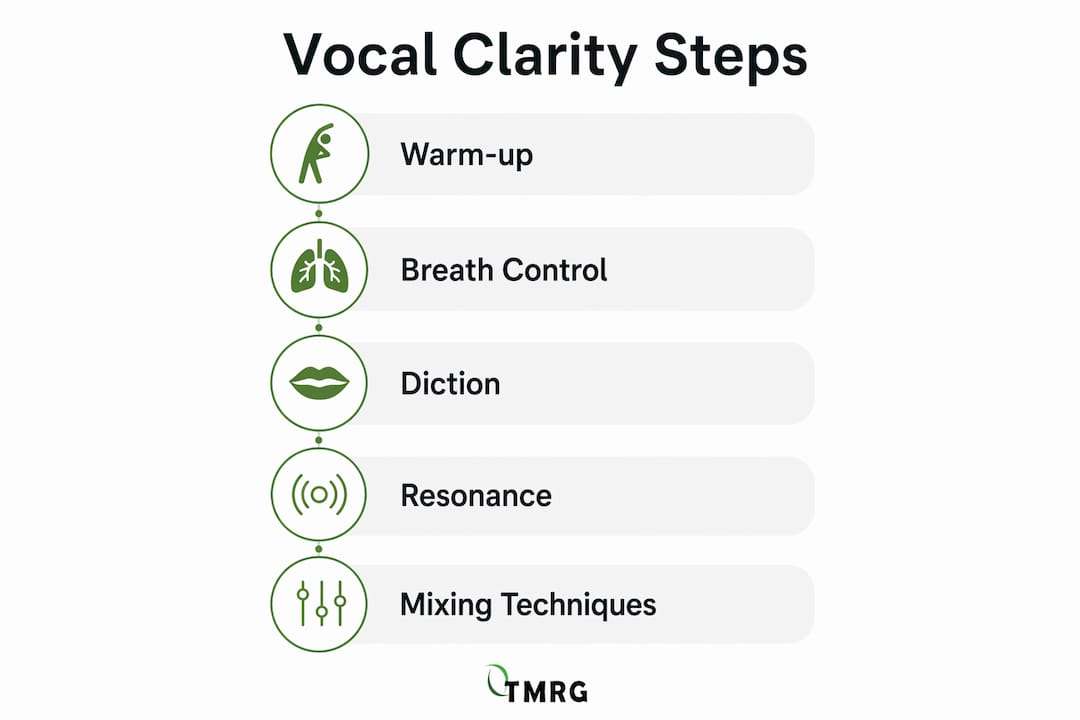
Diction is the physical skill that shapes how clearly your words land. Diction shapes message clarity beyond just sounding correct. It determines whether your audience connects emotionally with what you are saying. Poor diction breaks that connection even when your pitch and tone are perfect.
These techniques build both tone quality and articulation:
Pro Tip: Record yourself reading a paragraph aloud, then listen back with headphones. You will hear consonant smearing, swallowed vowels, and pitch instability that you cannot detect while speaking. This feedback loop accelerates improvement faster than any single exercise.
Vocal clarity looks different depending on your genre, voice type, and current vocal condition. A classical soprano shapes vowels with a high, arched soft palate to maximize resonance in the upper register. A contemporary pop singer uses a lower larynx and more chest resonance for a warmer, more intimate sound. Both approaches can produce clear vocals. The technique simply changes.
When you are dealing with vocal fatigue or recovering from a cold, clarity suffers because the folds are swollen or dehydrated. The priority in those moments is not performance. It is protection. Reduce your speaking and singing volume. Stick to gentle humming and lip trills. Avoid whispering, which actually strains the folds more than soft phonation.
Environmental factors also affect your vocal health directly. Dry air, air conditioning, and dusty spaces dehydrate the vocal folds and thicken mucus. Both conditions reduce clarity. Environmental conditions create measurable strain on the voice. Use a humidifier in dry rooms and drink water consistently throughout the day, not just before you sing.
Speakers benefit from the same exercises as singers. Sustained notes build breath control for long sentences. Staccato trains the precise breath pulses that make spoken consonants crisp. Sirens loosen the range of pitch variation that makes speech engaging rather than monotone. The top voice care tips for singers apply equally to actors and lecturers.
Consistency matters more than session length. A focused 15-minute daily practice produces better results than a two-hour session once a week. Your vocal folds are muscle tissue. They respond to regular, graduated training the same way any other muscle does.
Clearer vocals require coordinated breath control, efficient vocal fold vibration, precise diction, and intentional mixing practices applied consistently over time.
| Point | Details |
|---|---|
| Warm up daily | A structured 10-minute routine with humming, lip trills, and scales prepares the folds for clear tone. |
| Mix with subtraction | Remove competing frequencies with a high-pass filter and gentle EQ cuts before adding any boosts. |
| Control compression | Use a 4:1 ratio with a 20–40 ms attack to preserve consonant transients and natural dynamics. |
| Train diction deliberately | Over-pronounce in practice, use tongue twisters, and monitor internal vibration for forward placement. |
| Protect during fatigue | Reduce volume, avoid whispering, and prioritize hydration when the voice is tired or recovering. |
By Golan
The most common mistake I see is confusing loudness with clarity. Singers push harder when they feel unheard. Speakers raise their volume when they think they are not connecting. Both responses make the problem worse. Forcing more air through a tense larynx produces a louder but muddier sound, not a clearer one.
What actually works is the opposite. Ease the pressure. Soften the grip. Let the resonance do the work that the muscles are trying to do by force. When I shifted my own practice toward monitoring internal sensation rather than external sound, my placement became more consistent and my tone opened up noticeably.
The same principle applies to mixing. I have heard tracks where the engineer added layer after layer of processing trying to fix a dull vocal. The vocal got worse with every plugin. The fix was removing a 300 Hz buildup and pulling back the reverb send. Two moves. The vocal sat forward in the mix immediately.
Clarity is not something you add. It is something you uncover by removing what blocks it. That applies to technique, to mixing, and honestly to how you think about your voice. Trust the subtle adjustments. They are almost always the right ones.
— Golan
Technique and training build the foundation. Vocal health products support the recovery and maintenance that keep that foundation solid.

Tmrgsolutions has spent 25+ years developing natural formulations for singers, actors, and speakers dealing with hoarseness, fatigue, and loss of clarity. The TMRG Loud & Clear Drops are designed to soothe the vocal folds and support recovery after heavy use. For a complete approach, the TMRG Voice Therapy Kit combines targeted remedies with a structured care protocol that complements your daily warm-up and technique work. These products are not a substitute for good vocal habits. They are the support system that helps your voice recover faster and perform more consistently.
The fastest results come from combining a daily warm-up routine with proper hydration and forward vocal placement. Humming and lip trills activate the vocal folds gently and improve resonance within a single session.
Consistent daily practice of 10–15 minutes produces noticeable improvement in tone and articulation within two to four weeks. Significant changes in resonance and stamina typically develop over two to three months.
Compression helps when set correctly. A 4:1 ratio with a 20–40 ms attack time controls dynamics while preserving consonant transients. Over-compression flattens the voice and removes the natural variation that makes lyrics intelligible.
Recordings reveal placement issues, consonant smearing, and pitch instability that self-hearing masks. Monitoring internal vibration sensations in the sinuses and upper teeth during practice helps correct placement before you record.
Singers’ warm-up exercises directly benefit speakers. Sustained notes build breath control for long sentences, staccato trains precise breath pulses for crisp consonants, and sirens expand pitch range for more expressive speech.
