Your Cart is Empty


TL;DR:
- Vocal clarity is the quality of a singing voice that allows listeners to hear tone, pitch, and lyrics clearly. Improving clarity requires training resonance, diction, and breath management through exercises like humming, lip trills, and open vowel practice. Consistent vocal health habits such as hydration, rest, anatomy control, and vowel modification are crucial for maintaining a clear voice.
Vocal clarity is defined as the quality of a singing voice that allows listeners to hear tone, pitch, and lyrics without strain or distortion. To improve singing voice clarity, you need to address three core systems: resonance, diction, and breath management. Exercises like humming, lip trills, and open vowel practice form the foundation of any serious vocal training program. Voice science frameworks such as Estill Voice Training go further, teaching singers to control individual anatomical structures for repeatable, reliable results. Hydration, rest, and consistent daily practice are not optional extras. They are the conditions that make every other technique work.
The most direct path to clearer singing runs through a small set of exercises that target resonance, fold coordination, and tone control. Each one addresses a specific weakness that muddies the voice.
Humming on different pitches stimulates vibrations in the nasal and chest cavities. Resonant vibrations are the physical foundation of a clear, full tone. Start on a comfortable mid-range pitch, then slide slowly up and down your range while keeping the hum steady and forward in your face.
Lip trills require you to blow air through loosely closed lips while phonating. Lip trills reduce tension and promote gentle vocal fold engagement, which is exactly what you need before demanding repertoire. If your lips won’t trill, place two fingers lightly on your cheeks to reduce resistance.
Open vowel practice trains your mouth and throat to stay wide and free. Sing through the vowel sequence AH, EH, EE, OH, OO on a single pitch, then on a five-note scale. Focus on keeping your jaw dropped and your tongue flat on the lower vowels.
Tongue trills (rolling an R sound while singing) relax the tongue root, which is a common source of muffled tone. A tight tongue root pulls the larynx up and narrows the vocal tract, which kills projection.
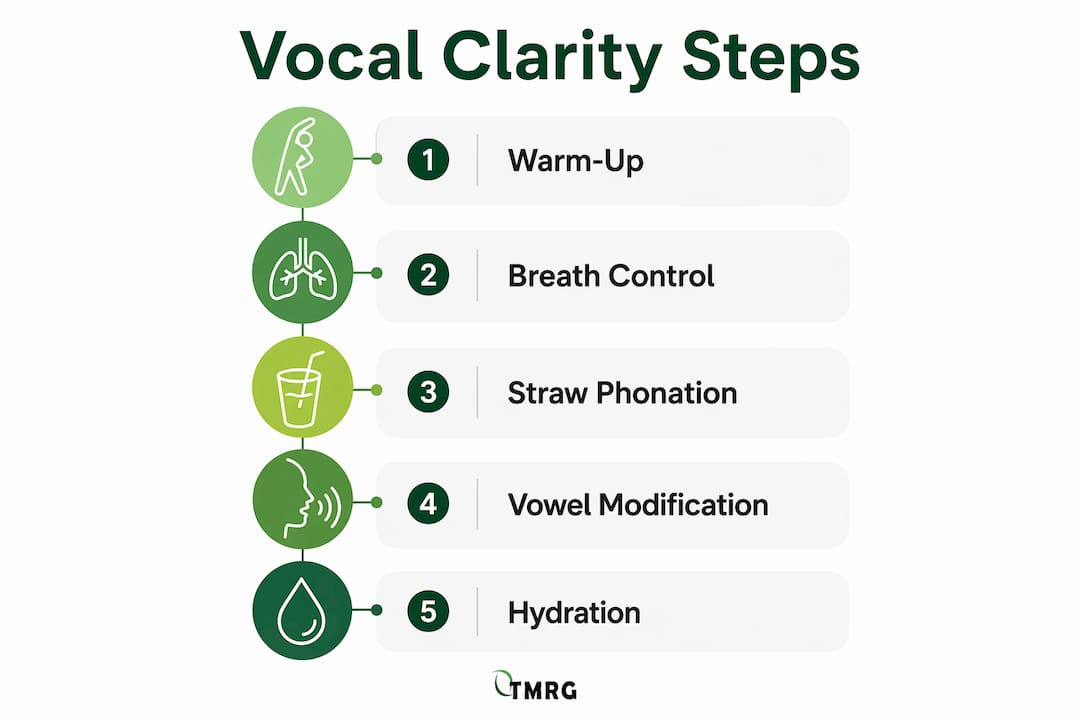
Semi-Occluded Vocal Tract (SOVT) exercises, particularly straw phonation, are among the most effective tools available. SOVT exercises create gentle back pressure against the vocal folds, reducing the collision force between them. This warms up the voice, builds strength, and supports recovery with minimal strain.
Pro Tip: Use straw phonation for 5 minutes before any singing session. Sing a simple melody through a standard drinking straw. Your voice will feel more free and balanced immediately, and the technique doubles as a recovery tool after heavy vocal use.

Vocal clarity is not just a feeling. It is a measurable acoustic event, and understanding the science behind it gives you real control over your sound.
The vocal tract acts as a filter. When you sing, your vocal folds produce a raw sound that contains many frequencies. The shape of your throat, mouth, and nasal cavity amplifies certain frequencies and dampens others. These amplified frequency peaks are called formants. The two most important are F1 (the first formant, shaped mainly by jaw opening and tongue height) and F2 (the second formant, shaped mainly by tongue position front to back).
“Singers modify vowels to align F1 with the fundamental frequency to preserve intensity and projection.” — Voice Science
This is why vowel modification is an acoustic necessity, not a technique failure. As you ascend into your upper range, the fundamental frequency of your voice rises. If F1 stays fixed at its speech-vowel position, the formant and the fundamental no longer align. The result is a thin, strained sound with poor projection. Modifying the vowel, typically by opening it slightly toward AH, raises F1 to match the rising pitch and restores resonant intensity.
A critical detail that most singers miss: you need to begin vowel modification well before the pitch where instability appears. Start modifying roughly an octave below the pitch where your voice typically breaks or thins out. This gives the acoustic system time to adjust gradually rather than scrambling at the last moment.
| Anatomical structure | Function in vocal clarity | How to control it |
|---|---|---|
| Soft palate | Reduces nasal tone; opens resonance space | Use a half-yawn sensation to lift it |
| Tongue | Shapes F2; affects vowel color and clarity | Keep the tip forward and body low |
| Larynx | Affects overall resonance tube length | Avoid excessive raising on high notes |
| Jaw | Opens F1; allows vowel modification | Drop it freely, especially on upper pitches |
Estill Voice Training teaches singers to isolate and control each of these structures independently. That kind of discrete anatomical control replaces vague sensations with repeatable technique. Lifting the soft palate through a half-yawn sensation, for example, opens the throat and reduces nasal tone by redirecting sound energy into the oral cavity rather than the nasal passages.
Technique alone cannot produce clear singing if the vocal folds are swollen, dry, or fatigued. Vocal health habits are the infrastructure that keeps your instrument functional.
Front-load your hydration. Hydrating laryngeal tissues takes time. Drinking water an hour before a performance does almost nothing for the vocal folds. Drink steadily throughout the day, aiming for at least 8 glasses of water in the hours before you sing. Caffeinated drinks and alcohol dehydrate tissue, so offset them with extra water. For more on this, the Tmrgsolutions guide on vocal hydration strategies is worth reading in full.
Practice true vocal rest. True vocal rest means complete silence: no talking, no singing, no whispering, and no throat clearing. Whispering actually creates more vocal fold tension than normal speech. After heavy use, schedule vocal naps of 30–60 minutes of total silence during the day.
Use steam and humidity. A long, hot shower before rehearsal delivers direct moisture to the upper airway. A personal steam inhaler provides the same benefit with more control. Dry indoor air, especially in winter, accelerates vocal fold dehydration.
Track your vocal patterns. Keep a simple log of how your voice feels each day, what you sang, how much you slept, and what you ate. Patterns emerge quickly. You will start to recognize which conditions produce your clearest sound and which ones signal strain before it becomes injury.
Pro Tip: Make a long, hot shower part of your pre-rehearsal routine. The steam loosens mucus, warms the tissue, and gives you a low-pressure environment to do gentle humming and SOVT exercises before you face a full room.
Tmrgsolutions also recommends reviewing expert strategies for preventing vocal fatigue to build a complete daily care plan around your singing schedule.
Clear diction is the difference between a performance that moves people and one that leaves them guessing at the lyrics. The mechanics are specific and trainable.
Explode your consonants. Crisp, brief consonants are the engine of lyric clarity. Consonants like P, T, K, B, D, and G need a small burst of air and muscle energy to cut through musical texture. Practice speaking a lyric in an exaggerated, almost percussive way, then transfer that crispness into your singing. Dropping final consonants is one of the most common causes of muddy singing.
Maintain wide, open vowels. Vowels carry the tone and the pitch. If you close a vowel too early or let the jaw creep up, the sound becomes pinched and the lyric blurs. Sing through a phrase and freeze on each vowel. Check that your jaw is dropped, your tongue is low, and your lips are not pursed unless the vowel demands it.
Use mirror work. Stand in front of a mirror and sing a phrase slowly. Watch your jaw, lips, and tongue. You will quickly spot habits like a rising jaw on high notes, a bunched tongue on EE vowels, or lips that barely move on consonants. The mirror gives you visual feedback that your ear alone cannot provide.
Practice the IPA vowel chart. The International Phonetic Alphabet gives every vowel a precise mouth shape. Singers who study IPA, even briefly, gain a concrete map of where each vowel lives in the mouth. This removes guesswork and makes vowel modification much easier to apply in real time.
Slow down difficult passages. Take any phrase where the lyrics feel unclear and sing it at half tempo. Exaggerate every consonant and hold every vowel open. Speed it back up gradually. The muscle memory for clear diction builds faster through slow, deliberate repetition than through repeated full-speed runs.
Vocal clarity is a skill built through consistent, science-informed practice of resonance exercises, anatomical control, diction technique, and daily vocal health habits.
| Point | Details |
|---|---|
| Start with SOVT exercises | Straw phonation warms up the voice and reduces vocal fold strain before any session. |
| Modify vowels early | Begin vowel modification an octave below your break point to maintain resonance and projection. |
| Front-load hydration | Drink water steadily throughout the day; last-minute hydration does not reach the vocal folds in time. |
| Control anatomy deliberately | Lifting the soft palate and managing tongue position directly shapes resonance and reduces nasal tone. |
| Explode consonants | Crisp, brief consonants prevent lyric blur and are the most trainable element of diction clarity. |
Most singers I work with arrive thinking clarity is something you either have or you develop through sheer repetition. That belief costs them years. Clarity is an acoustic outcome. It results from specific physical conditions inside the vocal tract, and those conditions are measurable and reproducible.
The shift that changes everything is moving from sensation-based singing to anatomy-based singing. When you know that a thin, nasal tone means your soft palate is low, you fix the soft palate. You do not just “try to sound fuller.” When you know that a strained upper note means F1 and your fundamental have diverged, you open the vowel. You do not push harder.
Vowel modification is the concept singers resist most. It feels like cheating. It feels like you are not singing the right word anymore. Push through that discomfort. Progressive vowel modification is not a compromise. It is how efficient, resonant upper-range singing actually works.
Daily vocal care is where I see the most neglect. Singers will spend an hour on technique and skip hydration, skip rest, and sing through fatigue. The vocal folds are tissue. They respond to the same basic care principles as any other muscle in your body. Build the care routine first. The technique will land on a healthier instrument and stick faster.
Clarity is not a gift. It is a daily practice built from intentional exercises, real anatomical knowledge, and consistent vocal health. Start there.
— Golan
Technique and health habits carry you far. The right support products carry you further, especially during heavy performance periods or recovery from strain.

Tmrgsolutions has spent 25+ years developing natural vocal health solutions for singers, actors, and speakers. The TMRG Loud & Clear Classic Voice Recovery Drops are formulated to soothe vocal fold tissue and support clarity restoration after demanding use. The TMRG Classic Voice Recovery Spray delivers targeted relief directly to the throat. For singers who want a complete approach, the TMRG Voice Therapy Kit Standard combines recovery tools into a single, structured program. These products work alongside your exercises, not instead of them.
SOVT exercises like straw phonation produce noticeable results within a single session by reducing vocal fold tension and improving resonance. Combine them with open vowel practice for the fastest short-term gain.
A low soft palate redirects sound into the nasal cavity, producing a muffled or nasal tone. Lifting the soft palate through a half-yawn sensation opens the oral resonance space and corrects this immediately.
Dehydrated vocal folds vibrate less freely, producing a rough, unclear tone. Front-loading hydration throughout the day, rather than drinking water right before singing, is the practice that actually reaches the laryngeal tissue in time.
Vowel modification is the deliberate adjustment of a vowel shape to maintain resonance as pitch rises. Every singer needs it in the upper range. Resisting it produces strain and a thin sound; applying it preserves projection and clarity.
Daily practice of 15–20 minutes produces the most consistent results. Short, focused sessions beat infrequent long ones because vocal fold coordination builds through repetition over time, not through occasional marathon sessions.
