Your Cart is Empty


TL;DR:
- A daily routine of semi-occluded vocal tract exercises like straw phonation and lip trills effectively strengthens vocal cords without strain. Proper warm-up, hydration, posture, and gradual progression are essential to avoid injury and enhance endurance. Medical evaluation should follow persistent hoarseness or pain to ensure vocal health.
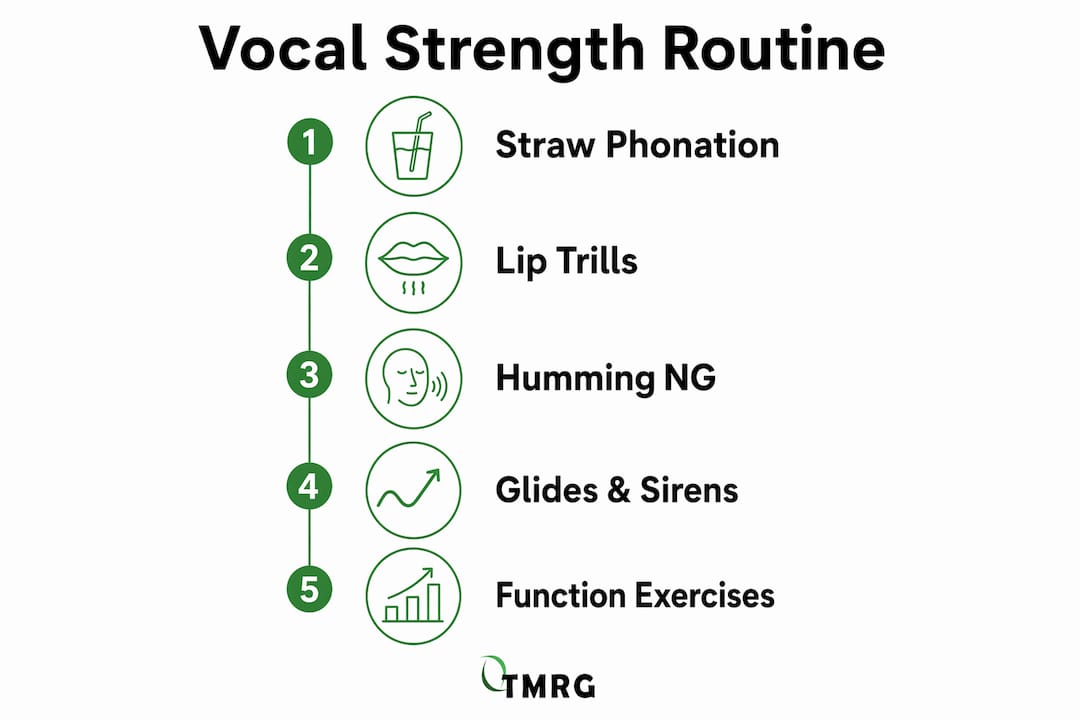
The fastest way to strengthen your vocal cords is a short daily routine built on Semi-Occluded Vocal Tract (SOVT) exercises like straw phonation, lip trills, and gentle pitch glides. These three techniques reduce the collision force on your vocal folds, build coordination, and improve endurance without straining the tissue. The one safety rule that overrides everything else: stop immediately if you feel pain, and see an ENT or laryngologist if hoarseness persists.
Start right now with these two steps:
The NIDCD recommends staying well hydrated, managing reflux, and seeking medical evaluation if hoarseness persists. Dr. Edie Hapner at the UAB Voice Center adds that only direct visualization of the vocal folds can accurately diagnose what is happening inside the larynx, which is why self-guided training works best alongside, not instead of, professional monitoring. Tmrgsolutions offers at-home voice-care kits and recovery products that fit naturally into this kind of routine.
The correct order is body first, then breath, then voice. Skipping that sequence and jumping straight into singing or speaking drills is one of the most common causes of early-session micro-trauma. Starting with heavy vocalizations on cold cords raises the risk of swelling and tissue stress.
A two-to-five-minute warm-up that follows this hierarchy looks like this:
Pro Tip: A “ready” voice feels easy and resonant even at a soft volume. A “cold” voice sounds thin, cracks on higher pitches, or feels tight in the throat. If those signs are present after two minutes of humming, spend another minute on breath work before adding any range exercises.
For a detailed vocal warm-up sequence that walks through each stage, Tmrgsolutions has a step-by-step guide built specifically for this hierarchy.
SOVT exercises work by creating backpressure in the vocal tract that reduces the collision force between the folds on every vibration cycle. The result is better coordination and endurance, built through efficiency rather than brute effort. Think of it as training your voice the way a physical therapist trains a recovering knee: controlled load, not maximum load.
Straw phonation. Phonate through a narrow drinking straw while sliding up and down in pitch. The straw’s resistance creates the backpressure that makes this exercise so effective. Begin on a comfortable mid-range pitch, then add a gentle glide up and back down. Two minutes per session is a solid starting point.

Lip trills. Blow air through loosely pressed lips while voicing. The vibration keeps the sound resonant without forcing the folds together hard. If the lips stop buzzing, reduce your air pressure. This exercise is especially useful for singers and actors who need to warm up quickly before a performance.
Humming with “ng.” Sustain the “ng” sound (as in “sing”) on a comfortable pitch. The nasal consonant keeps the resonance forward and bright, reducing tension in the throat. Hold for five to eight seconds, rest, and repeat four to six times.
Glides and sirens. Slide your pitch from the bottom of your comfortable range to the top and back down, like a slow siren. Keep the volume soft. The goal is a smooth, unbroken line with no cracks or sudden jumps. Glides build coordination across the full pitch range.
Vocal Function Exercises (Stemple protocol). This structured sequence, developed by voice researcher Joseph Stemple, works like weight training for the laryngeal muscles. The four-part protocol includes sustaining a high /i/ vowel as long as possible on a single breath, gliding from your lowest to highest pitch on the word “knoll,” gliding from highest to lowest on “knoll,” and then sustaining the word “old” at your lowest, middle, and highest comfortable pitches. Measurable progress, such as longer sustained notes over weeks of practice, is the benchmark.
| Exercise | Duration per set | Sets per session | Weekly progression |
|---|---|---|---|
| Straw phonation | 90 seconds | 2 | Add 30 seconds per week |
| Lip trills | 60 seconds | 2–3 | Widen pitch range after week 2 |
| “Ng” hum | 5 seconds per hold | 4 | Increase holds to 10 seconds by week 3 |
| Glides/sirens | 30 seconds | 3–4 | Extend range gradually each week |
| Vocal Function Exercises | Per protocol | 1 full set | Track sustained note length weekly |
Beginners should start with straw phonation and lip trills only, keeping total practice time under ten minutes. Those returning from vocal fatigue should reduce duration by half and avoid glides until the voice feels stable on sustained tones. For a deeper look at expert vocal techniques and clinical perspectives on progression, Tmrgsolutions has a dedicated resource worth bookmarking.
Breath is the fuel, and posture is the engine housing. When either is off, the vocal folds compensate by working harder than they need to, which accelerates fatigue and raises injury risk. Getting both right reduces the effort required to produce a full, clear sound.
Here is a three-step breathing drill to practice daily:
Posture cues matter just as much. Keep your head neutral, with your ears directly over your shoulders. A forward head position, common with phone use and desk work, compresses the airway and creates tension in the muscles surrounding the larynx. Research on how poor head alignment impacts throat muscles shows that even modest forward head posture increases the muscular effort needed for clear vocalization. Relax your jaw, let your shoulders drop away from your ears, and allow your rib cage to expand freely on each inhale.
For video calls, teaching sessions, and rehearsals, set a reminder to check your posture every 20 minutes. Cradling a phone between your ear and shoulder creates neck tension that directly affects voice quality, as the NIDCD notes in its practical voice-care guidance.

Small, consistent habits do more for vocal health than any single exercise session. The tissue covering your vocal folds, called the mucosal layer, needs to stay supple and well-hydrated to vibrate efficiently. When it dries out or becomes irritated, even well-designed exercises produce less benefit.
One important clarification: sprays and lozenges cannot directly hydrate the vocal folds. The anatomy prevents it. Systemic hydration and humidified inhaled air are the two mechanisms that actually keep the mucosal layer functional. Drink water consistently throughout the day, and use a room humidifier if you live in a dry climate or spend time in air-conditioned spaces.
Daily dos:
What to avoid before practice or performance:
“It is always recommended to avoid smoking or vaping, as the inhalation of smoke may further irritate the lining of the vocal folds, which can contribute to voice changes. Quitting smoking is one of the best things you can do for your overall health.” — Dr. Breanne Schiffer, MD, MPH, Laryngologist, University of Utah Health
For recovery after heavy use, vocal naps (short periods of complete silence) are more effective than whispering. Whispering can actually strain the folds more than soft, relaxed speech, because it requires the folds to hold a partially closed position under tension. If you need to speak quietly, use what voice therapists call a “confidential voice”: soft, relaxed, and fully voiced.
Stop practicing immediately if you feel pain, a burning sensation in the throat, or notice a sudden change in your voice quality. These are not signs to push through. They are signals that the tissue is under stress.
“We rely on our voice for communication with friends, family, and acquaintances. We may even rely on our voice for our jobs. It’s important to protect your vocal cords because they are so important in how we interact with our world.” — Dr. Breanne Schiffer, MD, MPH, University of Utah Health
Red-flag symptoms that require you to stop and seek care:
The most common training mistakes:
For a full breakdown of early signs of vocal damage and when to act on them, Tmrgsolutions has a dedicated resource that covers the warning signs in detail.
The routine below combines every element covered so far into a single, time-efficient session. Follow it daily for consistent results, and shorten it on heavy-use days rather than skipping it entirely.
| Step | Activity | Duration | Notes |
|---|---|---|---|
| 1 | Body warm-up (shoulder rolls, head tilts, jaw release) | 90 seconds | Slow and deliberate |
| 2 | Diaphragmatic breathing drill | 90 seconds | Rib expansion + controlled exhale |
| 3 | Lip trills (single pitch, then gentle glide) | 2 minutes | Ease back if lips stop buzzing |
| 4 | Straw phonation (glides up and down) | 2 minutes | Narrow straw, soft volume |
| 5 | “Ng” hum (sustained holds) | 2 minutes | 5 seconds per hold, 4 reps |
| 4 | Vocal Function Exercises (Stemple protocol) | 3–4 minutes | One full set, track progress weekly |
| 7 | Cooldown hum (descending glide, soft) | 60–90 seconds | Finish lower than you started |
Modifications by situation:
For performers who need a complete vocal warm-up checklist tailored to pre-show preparation, Tmrgsolutions has a seven-step guide that maps directly onto this structure.
The short answer: see an ENT (specifically a laryngologist) for structural or medical concerns, and see a speech-language pathologist (SLP) or voice therapist for technique, rehabilitation, and habit-based issues. In practice, the two often work together, with the ENT diagnosing and the SLP treating.
See an ENT now if you have:
The ENT will likely perform a laryngoscopy, a procedure where a small camera is passed to the level of the larynx to visualize the vocal folds directly. As Dr. Edie Hapner at the UAB Voice Center emphasizes, only a specialist can examine the folds accurately enough to diagnose nodules, polyps, paralysis, or other structural changes.
Start with an SLP or voice therapist if you have:
Questions to bring to your first appointment:
The referral timeline is straightforward: persistent hoarseness warrants an ENT referral, per University of Utah Health guidance. Do not wait for symptoms to resolve on their own when they have already lasted that long.
Consistent short daily practice built on SOVT exercises, proper warm-up sequencing, and systemic hydration is the most effective approach to strengthening your vocal cords safely.
| Point | Details |
|---|---|
| Core routine | Daily straw phonation, lip trills, and gentle glides build coordination and endurance without overloading the folds. |
| Warm-up order | Always progress body first, then breath, then voice to reduce the risk of micro-trauma on cold cords. |
| Hydration and hygiene | Systemic hydration and humidified air keep the mucosal layer functional; sprays and lozenges cannot directly reach the vocal folds. |
| Stop-if-pain rule | Pain, sudden voice change, or hoarseness lasting more than two weeks requires stopping practice and seeing an ENT. |
| Tmrgsolutions support | Tmrgsolutions voice-care kits and recovery products, including TMRG Loud & Clear drops and TMRG Shine Bright spray, complement a daily training routine with at-home soothing and recovery support. |
Most people who set out to strengthen their voice expect fast, dramatic results. What actually happens is more interesting and more useful: you start to hear your voice differently. You notice when it feels tight before you even open your mouth. You catch yourself running out of breath mid-sentence and correct it in real time. That kind of body awareness is not a side effect of training. It is the training.
The conventional wisdom says that a stronger voice comes from doing more: more exercises, more repetitions, more range. The evidence points in a different direction. Short, consistent sessions done with attention to quality outperform long, effortful ones done on autopilot. The Stemple Vocal Function Exercises, for example, are not demanding in terms of volume or range. They are demanding in terms of precision and patience, which is exactly why they work.
Patience is the part most guides skip over. Vocal tissue adapts slowly, on a timeline closer to tendon rehabilitation than cardiovascular fitness. Expecting week-one results leads to overuse, which sets progress back further than if you had started more conservatively. The clients who make the most consistent gains are not the ones who practice the hardest. They are the ones who practice every day, listen carefully, and stop before they feel tired rather than after.
One practical habit worth building early: end every session by asking whether your voice feels better or worse than when you started. Better, or the same, means the session was appropriate. Worse means you did too much. That single check-in, done honestly, prevents most of the overuse injuries that derail vocal training.
Your exercises build the strength. Recovery is what lets that strength accumulate.

Tmrgsolutions has spent over 25 years developing natural vocal health products for singers, actors, lecturers, and voice professionals who need reliable at-home support between sessions and after heavy use. Three products fit directly into the routine described in this guide.
TMRG Loud & Clear Classic Voice Recovery Drops are formulated for post-performance or post-practice soothing, supporting the throat tissue after a demanding session. TMRG Shine Bright Classic Voice Recovery Spray is a portable option for between-practice care, useful for performers who need quick, on-the-go throat support during rehearsals or long teaching days. TMRG Defense Oils and Saline Voice and Throat Spray combines saline and botanical oils for protective lubrication, fitting naturally into a pre-practice or post-performance hygiene routine.
For readers who want a complete starting point, the TMRG Voice Therapy Kit Basic bundles the core tools for at-home practice into a single set. Professionals with heavier schedules may find the Standard or Premium kits a better fit for their volume of use.
These products support hygiene and recovery. They are not a substitute for ENT evaluation when symptoms persist. If hoarseness or pain has lasted more than two weeks, book an appointment with a laryngologist first, then use these products as part of your recovery plan.
The following sources informed this guide and are worth consulting directly for deeper reading:
Yes. Targeted exercises like straw phonation, lip trills, and the Stemple Vocal Function Exercises build coordination and endurance in the laryngeal muscles, much the way physical therapy strengthens other muscle groups. Consistent daily practice produces measurable improvement over weeks.
Common signs include a voice that tires quickly during speaking or singing, reduced pitch range, breathiness or a thin tone, difficulty projecting without strain, and a voice that cracks or cuts out under moderate demand. Persistent hoarseness lasting more than two weeks warrants an ENT evaluation.
Systemic hydration, humidified air, scheduled vocal rest, and avoiding irritants like smoking and excessive caffeine are the most effective natural recovery supports. Vocal naps (short periods of complete silence) help more than whispering, which can strain the folds rather than rest them.
Weak singing voice usually traces to one or more of three causes: insufficient breath support, poor posture that restricts airflow, or underdeveloped coordination in the laryngeal muscles. Starting with diaphragmatic breathing drills and SOVT exercises like straw phonation addresses all three progressively. If weakness is sudden or accompanied by pain, see an ENT before continuing to train.
