Your Cart is Empty


TL;DR:
- Vocal cord strengthening uses targeted exercises like SOVT training, daily warm-ups, and good hygiene to improve voice endurance. Consistent practice combined with hydration, rest, and careful technique builds a fuller, more controlled, and resilient voice. Pushing volume or practicing irregularly can cause strain, so patience and deliberate routines are essential for safe vocal improvement.
Strengthening your vocal cords is defined as improving the coordination, closure efficiency, and endurance of the vocal folds through targeted exercises and consistent care. The technical term for this process is vocal fold conditioning, though “vocal cord strengthening” is the phrase most singers, speakers, and voice professionals use in practice. If you want to know how do you strengthen your vocal cords without risking strain or injury, the answer rests on three pillars: Semi-Occluded Vocal Tract (SOVT) exercises, daily vocal warm-up routines, and disciplined vocal hygiene. These methods work together to build a voice that is fuller, more controlled, and far more resilient under pressure.
The most proven method for building vocal fold strength is SOVT training. SOVT exercises create acoustic back-pressure inside the vocal tract that balances phonation, reduces strain, and improves vocal fold closure. That back-pressure acts like a cushion, letting the folds vibrate efficiently without forcing them together under tension.
Here are the core exercises, in the order you should practice them:
Pro Tip: Never press or push your voice to get louder during these exercises. True vocal strength comes from efficient fold closure and minimal physical effort for maximum acoustic output, not from muscular force.
Vocal hygiene is the set of daily habits that keep the vocal fold membranes healthy enough to respond to training. Without it, even the best exercises lose their effect. Hydration lubricates the vocal folds so they vibrate freely. Dehydration causes friction between the folds, which leads to irritation and, over time, chronic strain.
The habits that most directly protect your vocal cord health are:
Pro Tip: Steam inhalation, such as breathing over a bowl of hot water or using a personal steam inhaler, delivers moisture directly to the vocal fold surface. It is one of the fastest ways to soothe irritated folds before a performance.
A daily vocal warm-up of 5–15 minutes improves vocal tone and stamina more reliably than any other single practice. The key word is “daily.” Consistency matters far more than duration.
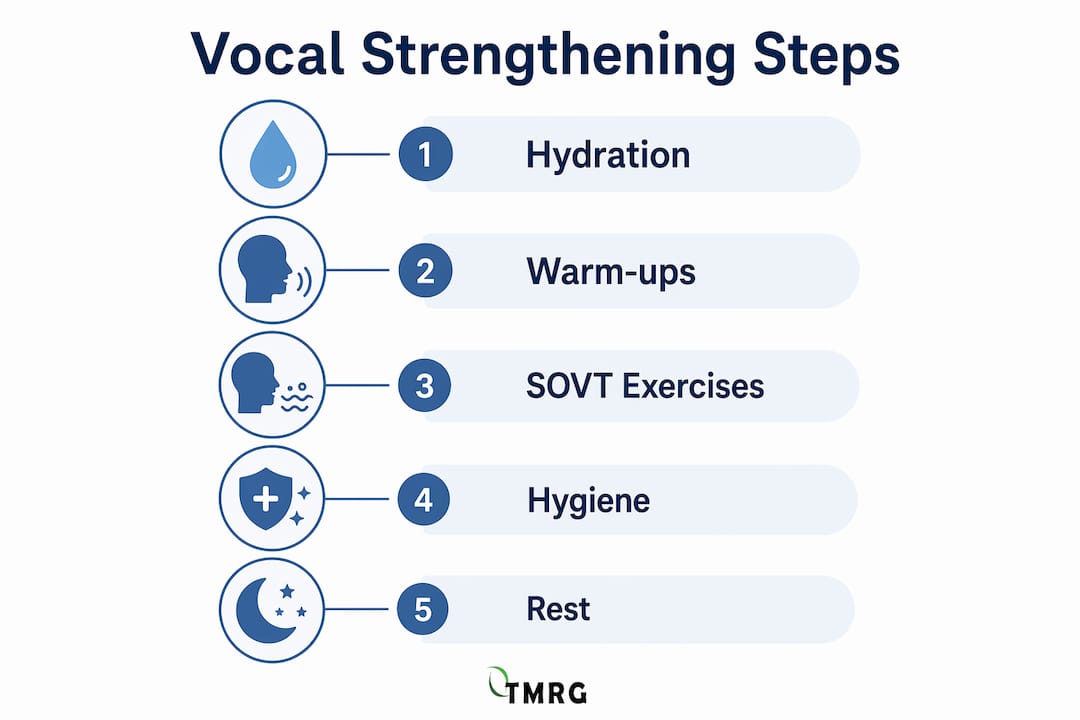
Effective warm-ups build efficient voice habits. They target breath pressure, vocal fold closure, resonance, and jaw and tongue freedom, not just looseness in the throat. The table below shows a practical 10-minute daily structure.

| Time | Exercise | Purpose |
|---|---|---|
| 0–2 min | Diaphragmatic breathing | Activate breath support and relax the body |
| 2–4 min | Lip trills on a gentle siren | Warm folds with minimal contact stress |
| 4–6 min | Humming on scales | Build resonance and fold closure |
| 6–8 min | Straw phonation through pitch range | Reinforce SOVT back-pressure benefits |
| 8–10 min | Five-note scales on open vowels | Coordinate breath, closure, and resonance |
Common mistakes that undercut warm-up results:
Short daily sessions of 5–10 minutes yield better vocal strength than sporadic longer sessions. The folds respond to regular, gentle conditioning the same way any other muscle group does: frequent low-stress repetition builds endurance, while infrequent high-stress sessions cause fatigue and micro-injury.
For a structured approach to your daily preparation, Tmrgsolutions offers a detailed vocal warm-up guide built around these same principles.
Vocal training produces results only when you can recognize the warning signs that something is going wrong. Catching problems early prevents minor strain from becoming a serious injury.
Signs that you are overworking your voice:
Pushing volume without proper fold closure weakens vocal control rather than building it. Volume should be a byproduct of efficient technique, not a goal you chase by pressing harder.
“Overuse or misuse of the vocal cords leads to fatigue or strain. Scheduled vocal rest prevents long-term damage.” — Tmrgsolutions vocal health guidance
When you notice strain, reduce your session length by half and return to SOVT exercises only. Avoid any exercise that requires you to push or squeeze. Monitor your breath support: if your neck muscles are working harder than your abdominal muscles, your breath foundation is failing and the folds are compensating.
Seek professional guidance from a speech-language pathologist or laryngologist if hoarseness persists beyond two weeks, if you feel pain during phonation, or if your range has noticeably narrowed. These are signs that require clinical assessment, not just a modified routine. Tmrgsolutions also provides resources on vocal cord fatigue relief for those managing early-stage strain at home.
Vocal cord strength comes from consistent, efficient training combined with disciplined daily hygiene, not from pushing volume or practicing longer.
| Point | Details |
|---|---|
| SOVT exercises are foundational | Straw phonation and lip trills build fold closure without strain or tension. |
| Hydration is non-negotiable | Drink water throughout the day to keep vocal fold membranes lubricated and vibrating freely. |
| Daily short sessions outperform sporadic long ones | Five to ten minutes every day builds stamina more safely than occasional intense practice. |
| Pushing volume causes damage | True strength comes from efficient fold closure, not muscular force or increased air pressure. |
| Rest is part of the training | Scheduled vocal rest each day allows the folds to recover and respond to conditioning. |
After working in vocal health for years, the single most persistent misconception I encounter is this: people believe a stronger voice is a louder voice. It is not. Vocal strength is optimized when you achieve maximum acoustic output with minimal physical effort and tension. A voice that sounds full and powerful in a large room is almost always the product of efficient resonance and clean fold closure, not raw muscular force.
The singers and speakers who plateau fastest are the ones who practice by pushing. They add volume when they feel weak, they sing through fatigue, and they skip rest days because they believe more time equals more progress. The opposite is true. The folds are delicate tissue. They respond to gentle, consistent conditioning the way tendons respond to physical therapy: slowly, incrementally, and only when given adequate recovery time.
What I tell every person who asks how to improve vocal strength is this: tone quality results from coordinated habits involving breath pressure and vocal fold closure, not from innate ability or sheer volume of practice. You can build a genuinely strong voice in 10 minutes a day. The condition is that those 10 minutes must be deliberate, technically sound, and followed by rest. Patience and consistency are not soft advice. They are the actual mechanism of improvement.
— Golan
Exercises and hygiene habits form the foundation of vocal cord health. Targeted products can accelerate recovery and support the folds between training sessions.

Tmrgsolutions has spent 25+ years developing natural vocal health solutions for singers, actors, lecturers, and voice professionals. The TMRG Voice Clarity Trio combines herbal formulations designed to soothe, lubricate, and protect the vocal fold tissue that your daily exercises depend on. For those managing vocal fatigue or recovering from strain, the TMRG Voice Therapy Kit Standard provides a structured set of tools built around the same principles covered in this guide. Both options are backed by vocal coach endorsements and client results from professional performers worldwide.
SOVT exercises like straw phonation and lip trills produce the fastest safe gains because they build fold closure and resonance without strain. Pair them with daily hydration and 5–10 minutes of consistent practice for the quickest results.
Most people notice measurable improvement in tone and stamina within two to four weeks of daily practice. Results depend on consistency, technique accuracy, and adequate vocal rest between sessions.
Yes, but the approach changes. Start with quiet SOVT exercises only, reduce session length, and prioritize vocal rest and hydration. If hoarseness or pain persists beyond two weeks, consult a speech-language pathologist before continuing.
Water does not touch the vocal folds when you swallow. It hydrates the body systemically, which in turn keeps the mucosal lining of the folds moist. Consistent hydration throughout the day is more effective than drinking large amounts right before you sing.
Warm-ups prepare the folds for use by increasing blood flow and pliability. Strengthening exercises build fold closure, breath coordination, and range over time. A complete daily vocal care routine includes both, with warm-ups always coming first.
