Your Cart is Empty


TL;DR:
- Vocal cord strengthening involves targeted exercises that improve endurance, control, and fold closure. Consistent vocal hygiene, proper hydration, and careful practice build long-term voice durability and prevent damage. Regular short exercises and rest are essential for safe, effective vocal development.
Vocal cord strengthening is the process of building endurance, control, and closure in the vocal folds through targeted exercises and consistent vocal hygiene. If you’ve ever asked how do I strengthen my vocal cords, the answer starts with understanding that your vocal folds are muscle tissue. They respond to training just like any other muscle in your body. Singers, actors, and public speakers who commit to structured voice training techniques see measurable gains in tone, stamina, and projection. Skipping this foundation leads to vocal fatigue, strain, and in serious cases, nodules or polyps.
Daily vocal hygiene is the foundation every performer builds on before adding exercises. Without it, even the best voice training techniques produce diminishing returns.
Hydration is the single most direct factor in vocal cord health. Your vocal folds vibrate hundreds of times per second during speech and singing. They need a thin, even layer of mucus to do that efficiently. Drink water consistently throughout the day rather than gulping large amounts before a performance.
Beyond water, several habits actively damage vocal tissue:
Proper breath support and posture are equally critical. Diaphragmatic breathing drives airflow evenly across the vocal folds, reducing the muscular tension that causes fatigue. Stand or sit tall with your shoulders relaxed and your sternum lifted. That alignment alone reduces the effort your larynx needs to produce a full, clear sound.
Pro Tip: If you speak or teach in large rooms, use a microphone. Amplification reduces vocal load and prevents the kind of chronic strain that builds up invisibly over weeks.
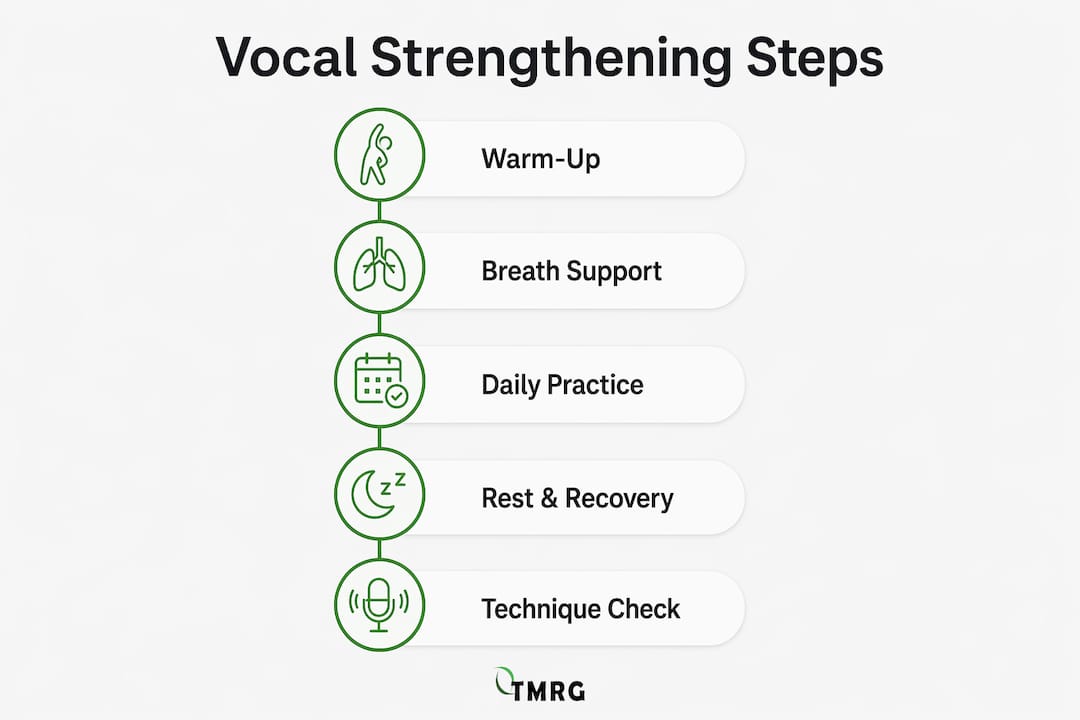
The most effective exercises for vocal strength work by improving vocal fold closure and vibration efficiency, not by pushing volume or range to extremes. The clinical term for this approach is vocal fold adduction training, and it sits at the core of every evidence-based voice therapy program.
Here are the exercises that deliver the most consistent results:
Straw phonation (SOVT exercise). Place a thin straw between your lips and hum or sing through it at a comfortable pitch. Semi-occluded vocal tract exercises create back-pressure that helps the vocal folds vibrate more efficiently. This builds strength without strain. Practice for 3–5 minutes daily.
Lip trills. Blow air through loosely closed lips while voicing a pitch. The vibration massages the vocal tract and warms up the folds gently. Slide up and down your pitch range slowly. This is one of the best ways to strengthen voice without overloading it.
Pitch glides. Start at the bottom of your comfortable range and glide smoothly to the top, then back down. Keep the tone connected and avoid breaks. Pitch glides train the muscles that control fold tension, which directly improves control and endurance.
Vocal fold adduction exercises. Produce a firm, clear “ee” vowel at a moderate volume. Hold it for 5 seconds, release, and repeat. This targets the muscles responsible for bringing the folds together cleanly, which is the core of a strong, full voice.
Humming with resonance focus. Hum at a comfortable pitch and feel the vibration move into your lips and face. A voice that resonates forward feels “full” rather than “thin.” This technique trains you to place sound efficiently, reducing laryngeal effort.
Consistent 5–10 minute daily practice builds vocal endurance far better than occasional long sessions. Think of it the same way you would physical conditioning. Brief, regular effort compounds over weeks and months. You can find detailed relaxation and contraction exercises at Tmrgsolutions to complement this routine.
Pro Tip: If you feel tension in your throat or notice your pitch breaking during exercises, stop and rest. Correct technique feels easy, not effortful. Pain is always a signal to pause.

The most damaging mistake performers make is confusing effort with progress. Pushing harder does not build a stronger voice. It builds scar tissue.
Warning: Hoarseness or vocal fatigue lasting beyond 2–3 weeks requires medical assessment. Persistent symptoms may indicate nodules, polyps, or other structural issues that no exercise program can resolve on its own. See an ENT or laryngologist before continuing training.
Ignoring early warning signs is the most common reason performers end up needing surgery. A voice that feels “off” for more than a few days deserves attention. Tmrgsolutions has a detailed resource on treating hoarseness safely that addresses when technique alone is not enough.
The balance between airflow and vocal fold adduction underpins long-term vocal strength. Too much air pressure with insufficient fold closure produces a breathy, weak tone. Too much closure with too little airflow creates a tight, strained sound. Finding that balance is the real skill.
Sustainable vocal strength comes from consistent, low-impact habits woven into your day, not from isolated practice sessions. Vocal warm-ups are not just pre-performance rituals. They are short training sessions that build control and endurance every time you do them.
A practical daily structure looks like this:
The table below maps common vocal demands to the protective habits that offset them:
| Vocal demand | Protective habit |
|---|---|
| Long rehearsal or performance | Micro-rest breaks every 45–60 minutes |
| Teaching or lecturing | Microphone use and hydration between sessions |
| Outdoor speaking or loud environments | Amplification and post-event vocal rest |
| Early morning speaking or singing | 5-minute warm-up before first use |
| Travel in dry cabin air | Portable humidifier or steam inhalation |
Tools matter too. A personal humidifier in your bedroom keeps nighttime air moist, which directly supports vocal fold health. A quality microphone removes the temptation to push volume in large spaces. These are not luxuries for professionals. They are practical investments in your vocal longevity. Tmrgsolutions covers strategies for preventing vocal fatigue in depth for performers who need a structured approach.
Strengthening your vocal cords requires daily low-impact exercises, consistent vocal hygiene, and smart management of your vocal load to build lasting endurance.
| Point | Details |
|---|---|
| SOVT exercises build strength safely | Straw phonation creates back-pressure that improves fold vibration without strain. |
| Whispering is not vocal rest | Whispering increases fold friction; true rest means silence. |
| Daily short practice beats occasional long sessions | Consistent 5–10 minute routines build endurance more effectively over time. |
| Hoarseness beyond 2–3 weeks needs medical review | Persistent symptoms may signal nodules or polyps requiring professional evaluation. |
| Micro-rests prevent cumulative fatigue | Brief silent intervals throughout the day protect vocal tissue from overuse. |
I’ve worked with performers at every level, from weekend choir singers to professional stage actors, and the pattern I see most often is the same. People train hard for a week, feel some improvement, then push too far and spend two weeks recovering. They repeat this cycle and wonder why their voice never gets consistently stronger.
The performers who develop genuinely strong, reliable voices do something different. They practice gently and consistently. They treat their voice the way a serious athlete treats a recovering joint: with respect, patience, and a clear plan. They warm up every single day, not just before performances. They rest when they feel the first sign of fatigue, not after the damage is done.
What I find most undervalued is the role of professional voice assessment. Many singers and speakers go years without ever having a laryngoscopy. They have no idea what their vocal folds actually look like or how they function. A single assessment with a laryngologist or speech-language pathologist can reveal patterns that no amount of self-guided practice will fix. That knowledge is worth far more than any exercise routine.
The role of medical professionals in vocal health for performers is something Tmrgsolutions takes seriously. Getting that expert input early prevents the kind of structural damage that ends careers. Train smart, rest intentionally, and get your voice checked before problems become serious.
— Golan
Exercises and habits build the foundation, but recovery and protection matter just as much for performers who use their voice daily.

Tmrgsolutions has supported singers, actors, and speakers for over 25 years with natural formulations designed specifically for vocal health. The TMRG Loud & Clear Voice Recovery Drops soothe and support the vocal folds between performances and practice sessions. For a complete approach, the TMRG Voice Therapy Kit for singers combines targeted products into one structured program. Whether you’re managing vocal fatigue, recovering from strain, or building long-term vocal strength, Tmrgsolutions offers solutions grounded in clinical expertise and real performer needs.
Practice semi-occluded vocal tract exercises like straw phonation and lip trills for 5–10 minutes daily. Pair this with consistent hydration and micro-rest breaks to build endurance safely over time.
Consistent daily practice produces noticeable improvement in vocal control and endurance within several weeks. Significant strength gains typically develop over 2–3 months of structured training.
Whispering is not a safe form of vocal rest. It forces the vocal folds into an inefficient position that increases friction and strain, which can worsen existing irritation.
Persistent hoarseness, a rough or breathy tone, pain when speaking, and vocal fatigue that does not resolve with rest are key warning signs. Symptoms lasting beyond 2–3 weeks require evaluation by an ENT or laryngologist.
Yes. Exercises like pitch glides, straw phonation, and vocal fold adduction training benefit both singers and speakers. The underlying mechanics of fold closure and breath support apply equally to all voice professionals.
