Your Cart is Empty


Whispering can strain your voice, but the risk depends on how you whisper and what condition your vocal folds are already in. The evidence isn’t unanimous, but caution wins out.
TL;DR:
- Most people experience increased throat tension during whispering, especially when forcing the air through a nearly closed throat, which can cause strain.
- Whispering doubles or triples airflow compared to normal speech, increasing muscular effort around the vocal folds and raising injury risks during inflammation.
- Whispering is generally safer only when your vocal cords are healthy and you produce a relaxed, breathy whisper; otherwise, it may exacerbate existing irritation.
- Avoid whispering during active laryngitis, recent vocal surgery, or severe fatigue; instead, opt for soft, voiced speech or complete vocal rest.
- Supportive products like voice recovery drops can aid healing but should supplement rest, hydration, and medical advice for persistent voice problems.
The most cited study on this question comes from Rubin and colleagues, who used fiberoptic scoping to watch the larynx of 100 patients as they switched between normal speech and whispering. Their finding: 69% of participants showed increased supraglottic hyperfunction during whispering compared to normal voice. That’s the muscular squeezing around the voice box that speech-language pathologists associate with strain and fatigue.
The same study is also why this topic isn’t as settled as most advice columns suggest. Not everyone squeezed harder. That’s roughly a third of the group who whispered without the classic warning-sign muscle pattern showing up.
A 2026 review from researchers at the Katz School revisited this mixed picture and argued that clinicians should stop treating “never whisper” as gospel. Their analysis suggests the blanket ban oversimplifies a genuinely variable physiological response, and that individualized guidance serves patients better than a universal rule.
Despite that nuance, most working clinicians still lean cautious. ENT guidance from clinics like UT Southwestern notes that whispering is fine in theory, but that most people don’t whisper cleanly. They force air through a nearly closed throat, and that forced pattern is what does the damage, not the concept of a quiet voice itself. The practical result: when someone’s voice is already irritated, clinicians default to recommending soft, voiced speech over whispering, because it’s harder to get wrong.
Pro Tip: If you’re not sure whether you’re whispering “cleanly,” record yourself. A breathy, airy whisper sounds different from a strained, hissing one, and the strained version is the one to avoid.
Normal speech relies on your vocal folds vibrating together, cycling open and closed hundreds of times per second to produce sound. Whispering skips that vibration. Instead, your vocal folds partially open, and air rushes through the gap in a turbulent stream that generates a hissing, non-vibratory sound.
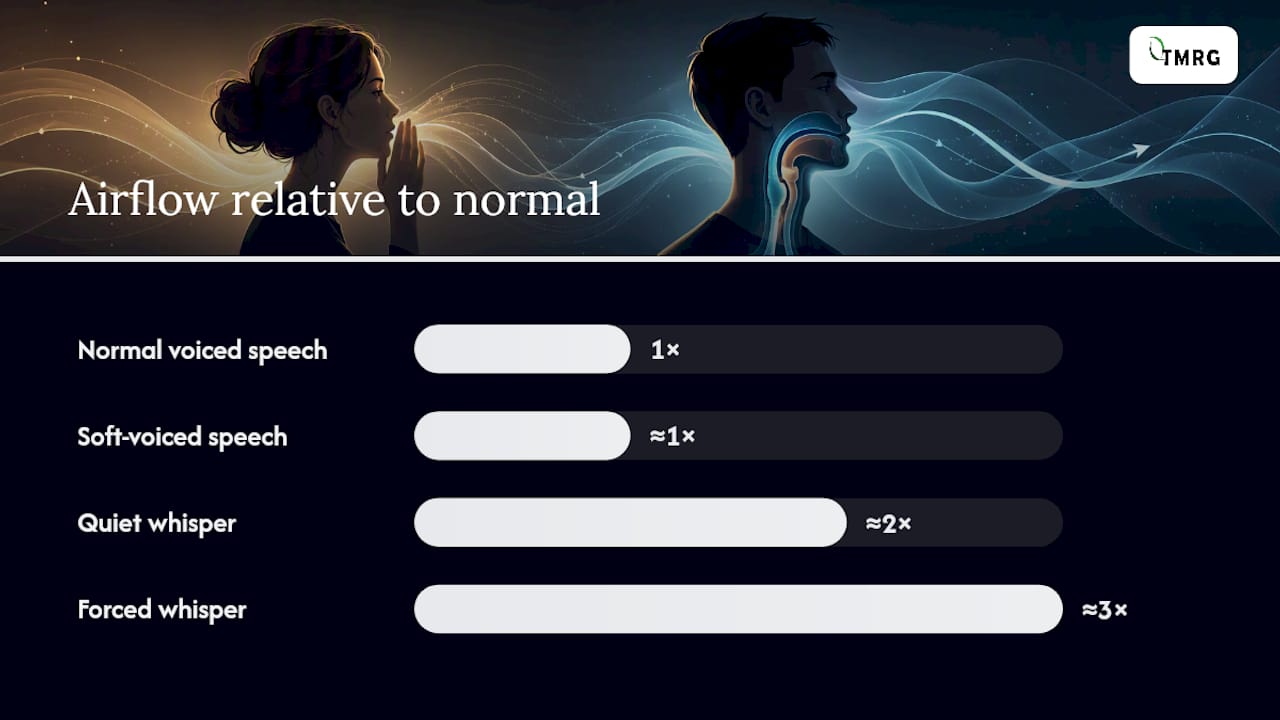
That turbulence has a measurable cost. Airflow studies referenced in the original Rubin research found that a quiet whisper roughly doubles airflow compared to normal speech, and a forced whisper triples it. Moving that much extra air through a narrowed space forces the surrounding throat muscles to compensate, often by clamping down harder around the voice box, which is the mechanical root of supraglottic hyperfunction.
Here’s how the demand stacks up across common speaking modes:
The variability matters here more than the averages. Laryngeal configuration differs from person to person, and some people can produce a whisper with minimal extra squeeze while others clamp down hard every time. That’s part of why the clinical evidence looks inconsistent from study to study. It isn’t that the mechanism is a mystery. It’s that the same instruction, “whisper,” produces different physical behaviors depending on who’s doing it.
The safest rule of thumb: treat whispering as risky whenever your vocal folds are already inflamed, and treat it as low-stakes when your voice is healthy and you’re only whispering briefly.
Avoid whispering in these situations:
Whispering is more defensible when your voice is otherwise healthy, you’re doing it briefly (a quick aside backstage, not an hour-long conversation), and you’re producing a genuinely breathy whisper rather than a strained one. Even then, most voice specialists would still rather you use soft, voiced speech, since it’s more consistent and doesn’t rely on getting the technique right every time.
Watch for red flags that mean it’s time to stop self-managing: pain when speaking, a voice that doesn’t recover after a full day of rest, or hoarseness that persists well beyond what a normal cold would cause.
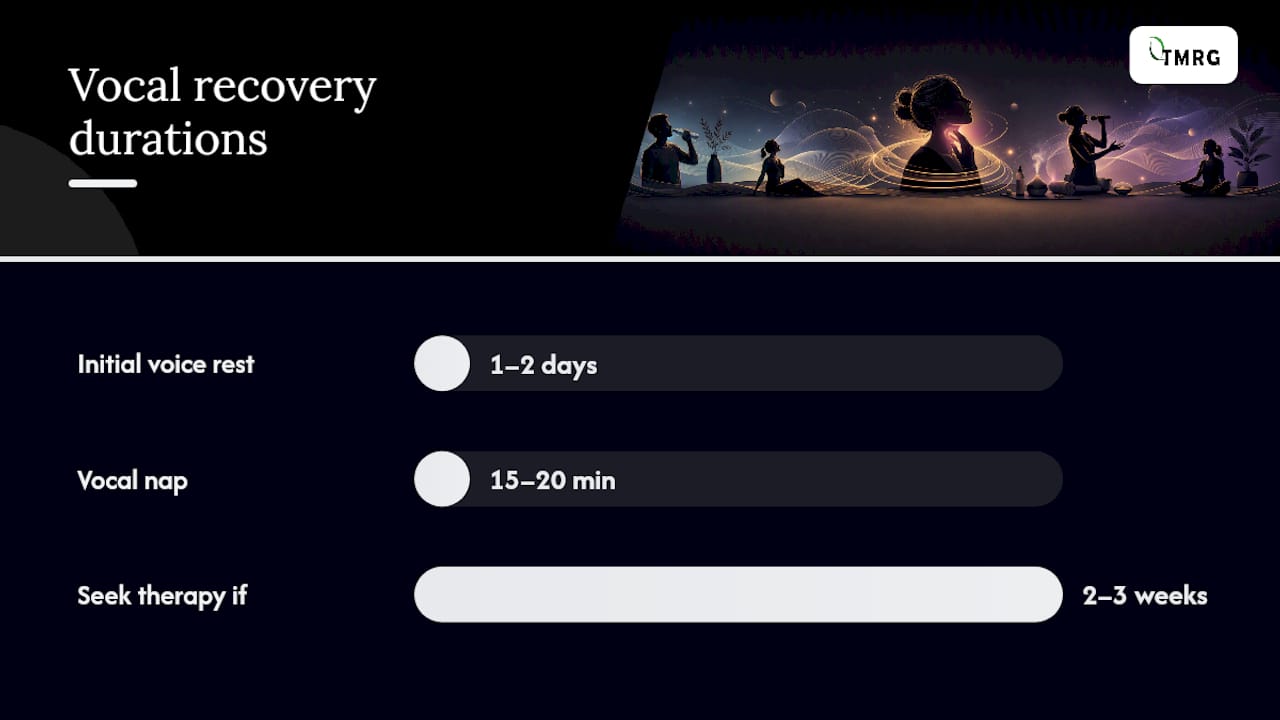
Ordinary hoarseness after a loud concert or a cold usually clears up within a week or two of rest. If it doesn’t, that’s the line where self-care should turn into a professional evaluation.
Symptoms that warrant an ENT or speech-language pathology visit include:
Clinical guidance on acute laryngitis generally treats symptoms lasting under two weeks as self-limiting, manageable with rest and hydration. Beyond that window, an ENT will typically start with a history and a laryngoscopy, a scope exam that lets them see your vocal folds directly. In more complex cases involving suspected nerve involvement, they may add laryngeal electromyography (LEMG) to check how the muscles are firing. Waiting two to three weeks before seeking care is reasonable for garden-variety hoarseness. Waiting through pain, breathing trouble, or blood is not.
Recovery from vocal strain follows a fairly consistent sequence, whether the cause was a rough performance, a loud weekend, or a cold that settled into your throat.
If hoarseness or fatigue persists past two to three weeks despite these steps, that’s the point to bring in a speech-language pathologist. A structured voice therapy program typically walks you through resonance and breath-support exercises tailored to your specific pattern of strain, rather than generic advice.
Pro Tip: A vocal nap works best when it’s actually scheduled, not just “whenever I remember.” Performers who build in a midday silent block recover faster than those who only rest at night.
The honest read on the research is that whispering sits in a gray zone, not a clear red or green light. Rubin’s fiberoptic data shows a real majority tendency toward increased throat tension, but the meaningful minority who showed no change or even less tension proves this isn’t a universal law of physiology. Individual laryngeal habits matter as much as the act of whispering itself.
That’s exactly why blanket advice fails performers. A singer who’s spent years training breath control may whisper more cleanly than someone who’s never thought about their throat muscles. But when you’re already hoarse and can’t easily tell which category you fall into, the safer bet is soft, voiced speech and real rest, not a whisper you’re hoping is the “good” kind.
Tmrgsolutions has spent more than 25 years working with singers, actors, and public speakers through exactly this kind of uncertainty, and the pattern holds up: people recover faster when they pair genuine rest with supportive care rather than betting on a technique they can’t verify in the moment.
— Golan
Voice rest and soft speech do the heavy lifting during recovery, but the right supportive products can make that window more comfortable and help your voice bounce back with less friction. Tmrgsolutions built its formulas around that exact gap between clinical advice and day-to-day performer needs.
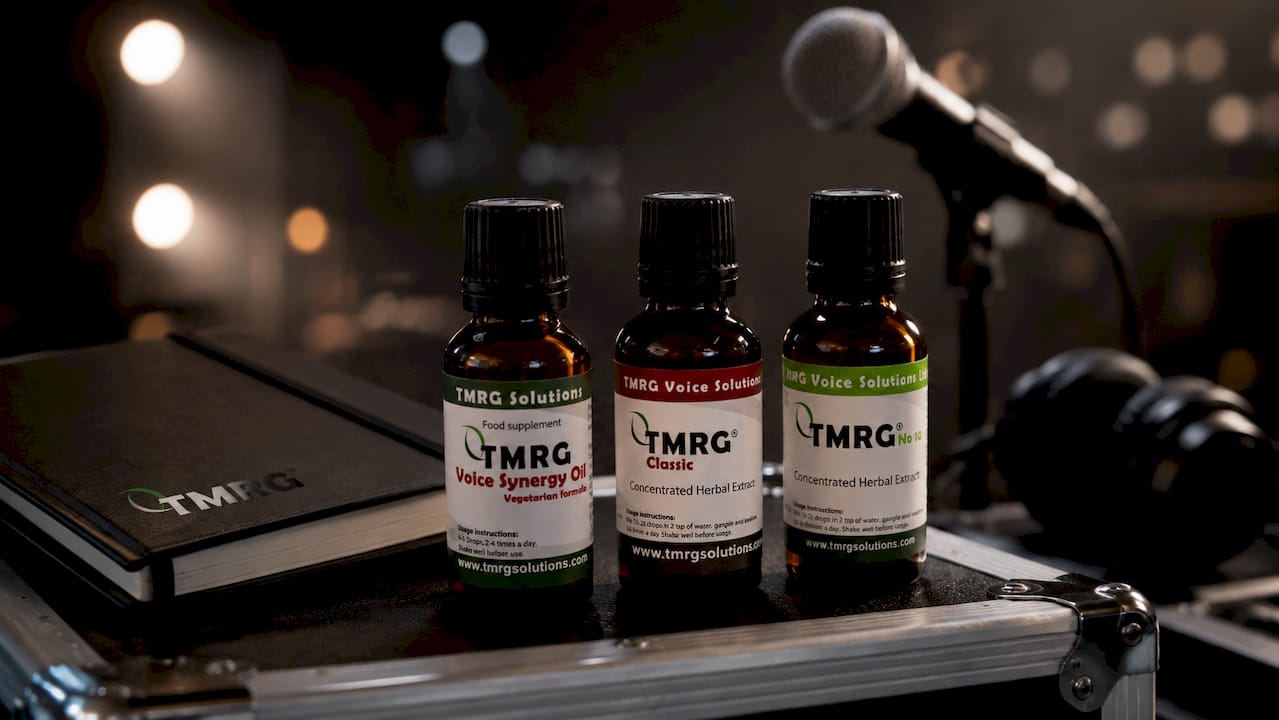
For active strain or a voice that feels raw after overuse, TMRG Loud & Clear Classic Voice Recovery Drops are formulated as a first-line symptomatic support option, the kind of thing to reach for during the same days you’re prioritizing rest and soft speech. If inflammation and tissue discomfort are the bigger issue, the TMRG Protection Voice Synergy Oil targets vocal tissue comfort directly and works well alongside hydration and humidification routines. Once you’re past acute recovery and back to regular use, the TMRG Impact Voice Enhancement Drops support routine maintenance and performance prep rather than acute treatment.
None of these replace rest, hydration, or an ENT visit when your symptoms call for one. They’re built to work alongside those fundamentals. If your voice hasn’t bounced back after following the recovery steps above, start with supportive vocal cord exercises and consider adding one of these drops to your daily routine while you rebuild vocal stamina.
This article is general information, not a substitute for advice from a qualified doctor. Consult a qualified healthcare professional about your own circumstances before acting on anything here.
Persistent hoarseness lasting more than two to three weeks, pain when speaking, a voice that won’t recover with rest, or blood in your saliva are all signs to get an ENT evaluation rather than waiting it out.
Some singers feel more vocal fold contact and resonance control during a properly produced breathy whisper, but that sensation doesn’t mean it’s safe. It often reflects individual laryngeal configuration rather than a technique to rely on regularly.
Both loud talking and whispering can strain an already inflamed voice, and NHS guidance recommends minimizing both. Soft, voiced speech or full voice rest is the safer choice until symptoms ease.
Yes. A whisper doesn’t require vocal fold vibration, since it’s produced by turbulent airflow through a partially open glottis rather than vibratory sound, which is why people who’ve had certain laryngeal surgeries can still produce a whisper-like sound.
