Your Cart is Empty


TL;DR:
- Hoarseness results from inflammation, muscle tension dysphonia, vocal fold damage, or neurological issues, each requiring specific therapy. Voice exercises like SOVT, breathing, and vocal function training actively rebuild muscle coordination and reduce strain for recovery. Consulting a licensed SLP and following personalized protocols accelerate healing and prevent re-injury.
Hoarseness is rarely just a minor annoyance. It changes how you communicate, strips confidence from your voice, and can stall an entire career for singers, teachers, and speakers. Many people assume that voice rest alone is the answer. The truth is, passive rest addresses symptoms without rebuilding the muscle coordination your vocal folds need to function well. Voice therapy exercises for hoarseness are the active, evidence-supported path back to a clear, strong voice. This guide covers what actually causes hoarseness, which exercise categories produce real results, and how to practice safely without making things worse.
| Point | Details |
|---|---|
| Rest alone is not enough | Active voice therapy exercises rebuild muscle coordination that passive rest cannot restore. |
| Diagnosis guides exercise selection | Different causes of hoarseness require different exercises; the wrong approach can delay recovery. |
| SOVT exercises are low-risk starting points | Lip trills, humming, and straw phonation reduce vocal fold stress during early recovery. |
| Hoarseness beyond 4 weeks needs evaluation | Persistent hoarseness is a red flag that warrants laryngeal examination before continuing exercises. |
| Lifestyle habits multiply exercise results | Hydration, irritant avoidance, and reflux management directly amplify the gains from vocal exercises. |
Your vocal folds are muscular tissue. When they become inflamed, overworked, or poorly coordinated, the resulting hoarseness is your body signaling that something in the system is off. Understanding what is off determines which exercises will actually help.
The four most common drivers of hoarseness are:
Each of these requires a different therapeutic response. That is exactly why voice therapy for vocal strain focuses on targeted muscle retraining rather than generic exercises. A speech-language pathologist (SLP) who specializes in voice will assess your specific dysphonia pattern before prescribing an exercise plan.
The science behind therapy is clear. Voice therapy is endorsed by the American Academy of Otolaryngology as a critical, effective intervention for dysphonia, often reducing the chance of recurrence and improving outcomes even after surgery. It is not a soft alternative to medical treatment. It is a first-line clinical tool.
Not all exercises serve the same purpose. Knowing the category of an exercise helps you understand what it is doing inside your larynx and how to use it correctly.
Your voice runs on airflow from the diaphragm. Poor posture collapses the thoracic cavity, reduces lung capacity, and forces the vocal folds to work harder to produce sound. Diaphragmatic breathing exercises teach you to draw breath from the lower lungs rather than the chest, providing a steady and efficient air supply that reduces strain on the vocal folds.
A simple starting exercise: stand tall, place one hand on your abdomen, inhale slowly for four counts, and feel your hand rise. Exhale evenly for six counts while sustaining a quiet “sss” sound. Repeat eight to ten times. This builds breath support without demanding anything from a fatigued voice.

SOVT exercises are among the most clinically valuable tools available for early-stage hoarseness. They work by partially narrowing the vocal tract exit point, which lowers the pressure against which the vocal folds must vibrate. The result is reduced collision force and less strain.
The most accessible SOVT exercises include:
These exercises are particularly effective as warm-ups before speaking or singing. They are not substitutes for medical evaluation, but they are excellent low-impact tools for a voice in recovery.
Pro Tip: When doing straw phonation, use the narrowest straw you can find. A coffee stirrer creates more back pressure than a standard drinking straw, which intensifies the therapeutic effect without increasing vocal fold effort.
Vocal function exercises (VFEs) are a structured four-exercise protocol designed to improve the coordination and endurance of the laryngeal muscles. You sustain the word “knoll” from your lowest comfortable pitch to your highest, then slide from high to low. You hold specific pitches for as long as possible on a sustained “ol” vowel.
These exercises strengthen the muscle coordination that keeps your voice consistent and reduces the fatigue that leads to compensatory tension. VFEs are typically prescribed by an SLP and done twice daily, with specific pitch and duration targets that increase progressively.
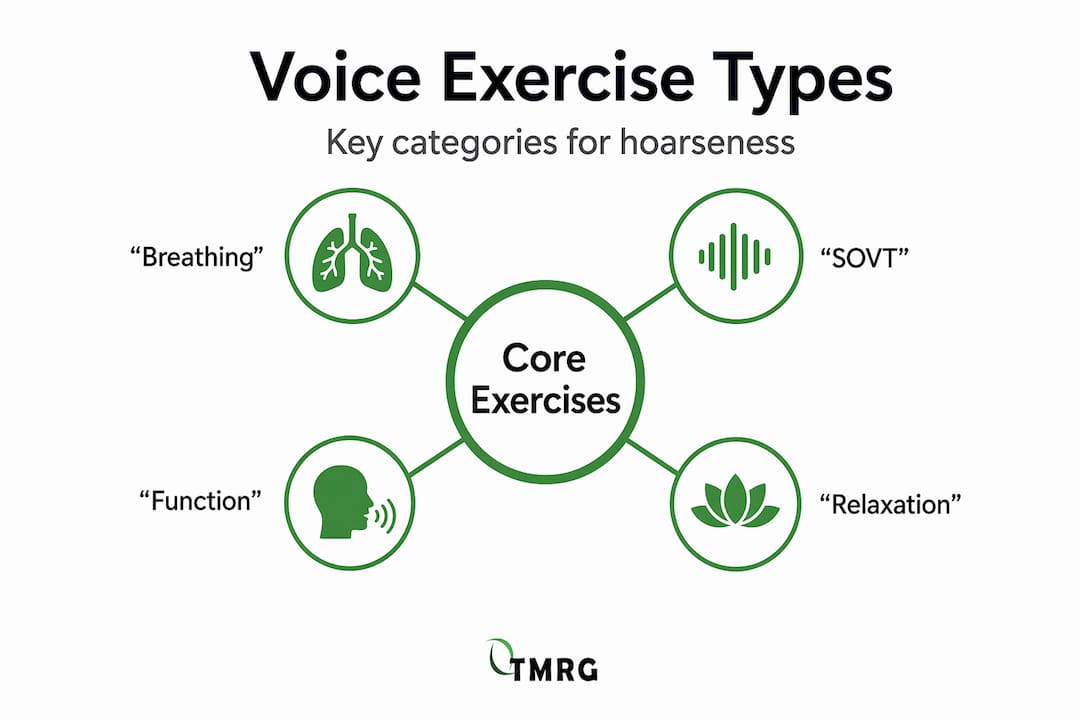
When the extrinsic laryngeal muscles grip too tightly around the larynx, the voice becomes strained and thin. Manual circumlaryngeal therapy involves gentle massage around the hyoid bone and thyroid cartilage to release this tension. You will not perform this on yourself without guidance, but you can practice gentle neck stretches, shoulder rolls, and yawning to reduce peripheral tension that feeds into laryngeal tightness.
Starting exercises without a plan is where most people go wrong. Here is how to approach home practice in a way that supports recovery rather than undermining it.
Pro Tip: Keep a voice journal. Rate your hoarseness on a scale of one to ten each morning and note which exercises you did the day before. Patterns in this data will tell you more about your progress than any single session ever could.
Voice therapy is not a one-size-fits-all program. The table below outlines common causes of hoarseness, the exercise approaches most suited to each, and what to avoid.
| Cause of hoarseness | Best-suited exercises | Approaches to avoid |
|---|---|---|
| Muscle tension dysphonia | Relaxation techniques, manual therapy, SOVT, posture and breathing | Forceful projection, pushing through tension |
| Acute laryngitis or inflammation | SOVT exercises (light), hydration, voice rest | Singing exercises for hoarseness at high intensity, strenuous phonation |
| Vocal fold nodules or polyps | VFEs, gentle SOVT, SLP-guided therapy | Untrained high-pitch exercises, excessive range work |
| Vocal fold paresis | Pushing exercises, glottal closure drills, SLP-supervised only | SOVT-only programs, which may be insufficient |
| Reflux-related hoarseness | Voice rest, dietary changes, hydration combined with light SOVT | Exercises without addressing the reflux trigger first |
Notice that vocal fold structure in MTD is often entirely normal. The problem is muscle coordination, which means the focus must be on relaxation and retraining rather than strengthening. Applying strengthening exercises to an MTD voice can worsen tension patterns significantly.
Combined approaches produce better results than exercises alone. Reflux management, for example, eliminates a major source of ongoing inflammation. Addressing that alongside exercises is far more effective than exercises in isolation.
Exercises are the core of your recovery plan, but the environment you give your voice outside of practice sessions determines how fast and fully you heal.
If you want a broader view of what natural recovery can look like for performers, Tmrgsolutions has a detailed resource on recovering hoarseness naturally worth reading alongside this guide.
I have worked in vocal health for a long time, and the pattern I see most often is this: someone gets hoarse, rests for a week, feels slightly better, and then goes right back to whatever caused the hoarseness in the first place. The cycle repeats, sometimes for months, until something more serious develops.
What I have learned is that patience is not passive. It is an active commitment to doing the right exercises at the right intensity, even when your voice feels almost normal. That “almost normal” window is when most re-injuries happen, because people treat it as fully recovered.
I have also seen how much tension patterns are underestimated. MTD in particular sneaks up on people who speak or sing under high-pressure conditions regularly. Teachers, performers, and public speakers often have no idea how much chronic laryngeal gripping they are carrying. A few sessions of manual therapy combined with SOVT exercises can shift years of accumulated tension.
My honest recommendation: do not wait four weeks to see a professional if something feels wrong. Get a laryngeal exam, understand what you are dealing with, and then commit to a personalized exercise plan with a qualified SLP. Generic exercises from the internet, including mine, are starting points. They are not substitutes for a real diagnosis. The combination of informed self-practice and professional guidance is what delivers lasting results.
— Golan
If you are serious about recovering your voice, Tmrgsolutions has built therapy kits specifically designed to support the kind of at-home vocal work described in this guide.

Whether you are a singer, teacher, or speaker, the right kit puts the core tools of voice rehabilitation in your hands, aligned with what licensed SLPs actually recommend. The TMRG Voice Therapy Kit Basic is the right starting point for most people beginning recovery. If your vocal demands are higher, the Standard Kit for singers covers more ground with a wider range of recovery tools. For professionals managing complex or recurring vocal issues, Tmrgsolutions also offers the Premium Voice Therapy Kit, designed for advanced and sustained vocal rehabilitation. Pair any kit with the guidance of a qualified SLP for the best outcomes.
SOVT exercises like lip trills, humming, and straw phonation are the most accessible and low-risk starting points. Vocal function exercises and diaphragmatic breathing add coordination and endurance as recovery progresses.
Most hoarseness improves within two to four weeks with consistent conservative care and exercises. Chronic or complex cases may take longer and benefit significantly from guided SLP-supervised therapy.
Yes, if the exercises are poorly matched to the underlying cause. High-intensity singing without proper diagnosis can worsen inflammation or increase tension in muscle tension dysphonia.
Stop independent practice and seek evaluation if hoarseness lasts more than four weeks, or if you experience throat pain, difficulty swallowing, or any sensation of a lump in the throat. These may signal a condition requiring medical treatment before therapy continues.
An SLP assessment is strongly recommended before starting a structured exercise program. Personalized exercise plans based on your specific dysphonia pattern produce significantly better outcomes than self-directed or generic approaches.
