Your Cart is Empty


Yes, long COVID can cause persistent voice hoarseness, and it’s more common than most people realize. A 2023 systematic review found that about a fifth of people who had acute dysphonia during COVID-19 still had voice problems months later. If your hoarseness has lasted longer than eight weeks, or you’re noticing breathlessness alongside it, that’s your cue to get evaluated by a doctor or an ear, nose, and throat specialist rather than waiting it out.
TL;DR:
- Persistent hoarseness often involves inflammatory damage to vocal folds, trauma from intubation, or breathing pattern changes that require professional diagnosis.
- Structured voice therapy with a speech-language therapist is the most effective treatment, often combined with anti-inflammatory medications for severe cases.
- Daily self-care habits such as hydration, diaphragmatic breathing, and voice pacing support recovery and should complement, not replace, clinical treatment.
Doctors use the term dysphonia to describe any change in how your voice sounds or feels when you talk. It’s a broader, more clinical label than “hoarse voice,” and it covers a range of sensations you might not think to connect to one diagnosis.
You might notice your voice sounds rougher than usual, or it comes out breathy, like air is escaping before the sound forms. Some people describe it as a weak voice that used to project fine but now gives out halfway through a sentence. Others feel vocal fatigue: your voice starts the day sounding normal and deteriorates by the afternoon, especially after a phone call or a meeting.
These symptoms rarely show up alone. Long-COVID voice issues tend to travel with a cluster of related complaints:
Here’s the distinction that matters most for figuring out what’s happening to you. Acute COVID-related laryngitis, the raspy voice you get during the infection itself, typically clears up within one to two weeks as inflammation in the throat settles down. Persistent post-COVID dysphonia is a different animal. It sticks around well past the point where a normal viral laryngitis would have resolved, and it often reflects something more specific than surface-level inflammation, like changes in how your vocal folds move or close. If your voice hasn’t bounced back in the timeframe you’d expect from an ordinary cold, that gap is meaningful information, not just bad luck.
Dysphonia is a genuinely frequent complication of COVID-19, not a rare side effect. The same systematic review that tracked recovery rates found a weighted prevalence of about 25.1% for acute dysphonia during infection, meaning roughly one in four people with COVID-19 experienced some voice change while they were sick.
By the Numbers: Of the people who developed acute voice problems during COVID-19, about one in five still had measurable voice sequelae after they’d otherwise recovered, according to the same 2023 meta-analysis. That’s not a small tail end. It’s a substantial fraction of people whose voice simply never reset to baseline.
Certain patterns show up again and again in who ends up with lingering symptoms. Research from 2025 found that female sex, persistent cough, and dyspnea are linked to a higher risk of developing long-COVID dysphonia specifically. In that study, those three factors together explained more than half of the variance in reported voice symptoms, which is a striking amount of explanatory power for just three variables.
What does that mean if you’re the one dealing with it?
None of this means your case is fixed in stone. It means your risk profile helps explain why the voice change happened, and that same information helps a clinician decide how aggressively to investigate it.
Several distinct mechanisms can produce a hoarse voice after COVID-19, and they don’t all call for the same treatment. Understanding which one applies to you is exactly why a proper evaluation matters more than guessing based on symptoms alone.
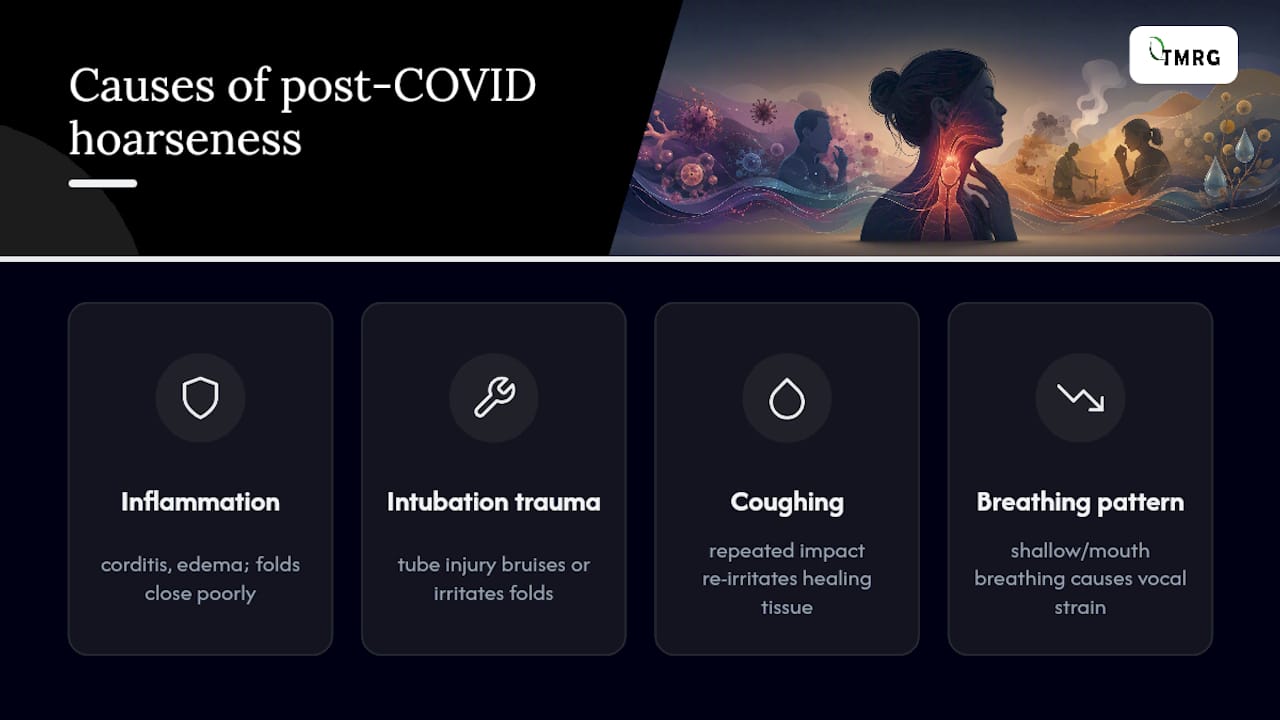
Inflammatory changes in the larynx are the most direct culprit. COVID-19 can cause corditis (inflammation of the vocal folds themselves) and edema, or swelling, of the tissue lining the voice box. When the folds are swollen, they don’t close as cleanly during speech, which produces that breathy, effortful quality many people describe. In some cases, the virus or the inflammatory response leaves the vocal folds moving asymmetrically or with reduced motion on one side, a condition sometimes called glottal insufficiency, where the folds can’t come together fully to create a clean, efficient sound.
For people who were hospitalized and intubated during severe COVID-19, there’s a separate and important cause: physical trauma from the breathing tube itself. Intubation can bruise or irritate the vocal folds directly, and that mechanical injury takes its own healing timeline, often independent of how quickly the rest of the respiratory infection resolved.
Chronic coughing and habitual throat clearing make all of this worse, not better. Both actions slam the vocal folds together with force, which re-irritates tissue that’s already inflamed or healing. It’s a frustrating loop: the cough is a symptom, but the coughing itself becomes an obstacle to recovery.
There’s also a mechanism people rarely connect to their voice: breathing pattern changes. Long COVID frequently leaves people breathing shallowly from the chest or through the mouth instead of using the diaphragm efficiently. Your voice runs on airflow from your lungs, so when your breathing support weakens, your vocal folds compensate by working harder to produce sound. That compensation is exhausting, and over time it can create the very muscle tension and fatigue that keeps hoarseness going long after the initial infection is gone.
Pro Tip: If you notice your voice gets noticeably worse after a coughing fit or a long conversation, try a slow test: place a hand on your belly and take five deep breaths, letting your stomach expand outward rather than lifting your shoulders. If that feels foreign or difficult, dysfunctional breathing is likely playing a role in your hoarseness, and a speech and language therapist can retrain it.
Timing matters here more than most people assume. Clinical guidance points to seeking a GP or ENT/speech and language therapy referral once hoarseness persists beyond several weeks after you’ve otherwise recovered from COVID-19. If you’re still hoarse at the twelve-week mark, that crosses into the window clinicians use to define long COVID, and it’s a strong signal that a multidisciplinary assessment, meaning both ENT and speech and language therapy input, is warranted rather than optional.
What actually happens at that evaluation follows a fairly predictable sequence:
Walking in prepared makes a real difference. Bring a simple symptom log noting when your voice is worse or better, any voice recordings you’ve made comparing your current sound to your pre-COVID voice, a list of current medications, and a clear note of whether you were intubated during your illness. That last detail in particular changes how a clinician interprets what they see on the scope.
Structured voice therapy delivered by a speech and language therapist is the first-line treatment most clinicians reach for, and it’s the one with the most consistent backing. A typical course involves targeted vocal exercises, breathing retraining, and guided changes to how you use your voice day to day, usually run over several weeks with a therapist tracking your progress at each session. It’s not a passive fix. It works because it retrains the coordination between your breath support and your vocal folds, which is exactly the system that COVID-19 tends to disrupt.
For more persistent or complex cases, ENT specialists sometimes layer in a multimodal approach. This can include short courses of systemic or inhaled corticosteroids to bring down laryngeal inflammation, alongside hyaluronic-acid inhalations intended to support tissue healing.
Treatment Outcomes: A pre-post study using high-speed videoendoscopy tracked patients through a short multimodal treatment combining corticosteroids, hyaluronic-acid inhalations, and structured voice therapy. The result was measurable improvement in objective laryngeal parameters, including reduced jitter and shimmer (two markers of vocal fold irregularity) and better amplitude and regularity, alongside real gains on patient-reported Voice Handicap Index scores.
That combination of objective and subjective improvement matters because it means the treatment isn’t just making people feel better while the underlying tissue stays the same. The scope findings backed up what patients were reporting.
Here’s a realistic rundown of what to expect from each approach:
The honest caveat: this evidence base is still young. Sample sizes in these studies are modest, and researchers are still working out exactly which patients benefit most from which combination. What’s clear is that a coherent, monitored plan beats waiting passively, and that a related insight on breathing pattern changes keeps surfacing as a factor clinicians shouldn’t skip when they’re deciding on treatment.
Clinical guidance from NHS-affiliated voice clinics converges on a short list of foundational self-care measures that cost nothing and genuinely help. None of these replace professional treatment, but they create the conditions your voice needs to heal.
Pro Tip: Build a two-minute vocal warm-up into your morning routine before your first real conversation of the day: gentle humming on a comfortable pitch, followed by a few soft “mm-hmm” glides up and down. It signals to your vocal folds to ease into use rather than jumping straight from silence to a demanding phone call.
For a fuller breakdown of exercises that rebuild vocal strength specifically, a resource like voice exercises for hoarseness walks through routines you can layer onto these daily habits.
Most people see real improvement within six to eight weeks, according to NHS-style patient guidance on post-COVID voice recovery. That’s the window where inflammation typically settles and voice therapy exercises, if you’re doing them, start producing noticeable change.
Improvement tends to show up gradually rather than all at once. You’ll likely notice it takes less effort to talk, your voice holds up longer before fatiguing, and the perceptual quality, how rough or breathy you sound to yourself and others, starts to smooth out.
If you’re still symptomatic beyond twelve weeks, that’s the marker clinicians use to classify the issue as long-COVID dysphonia rather than a slow but ordinary recovery. At that point, a comprehensive laryngeal workup, and pulmonary input if breathlessness persists too, becomes the appropriate next step rather than more waiting. Slower recovery isn’t a personal failing. It’s information that points toward a more structural or multifactorial cause that self-care alone won’t resolve.
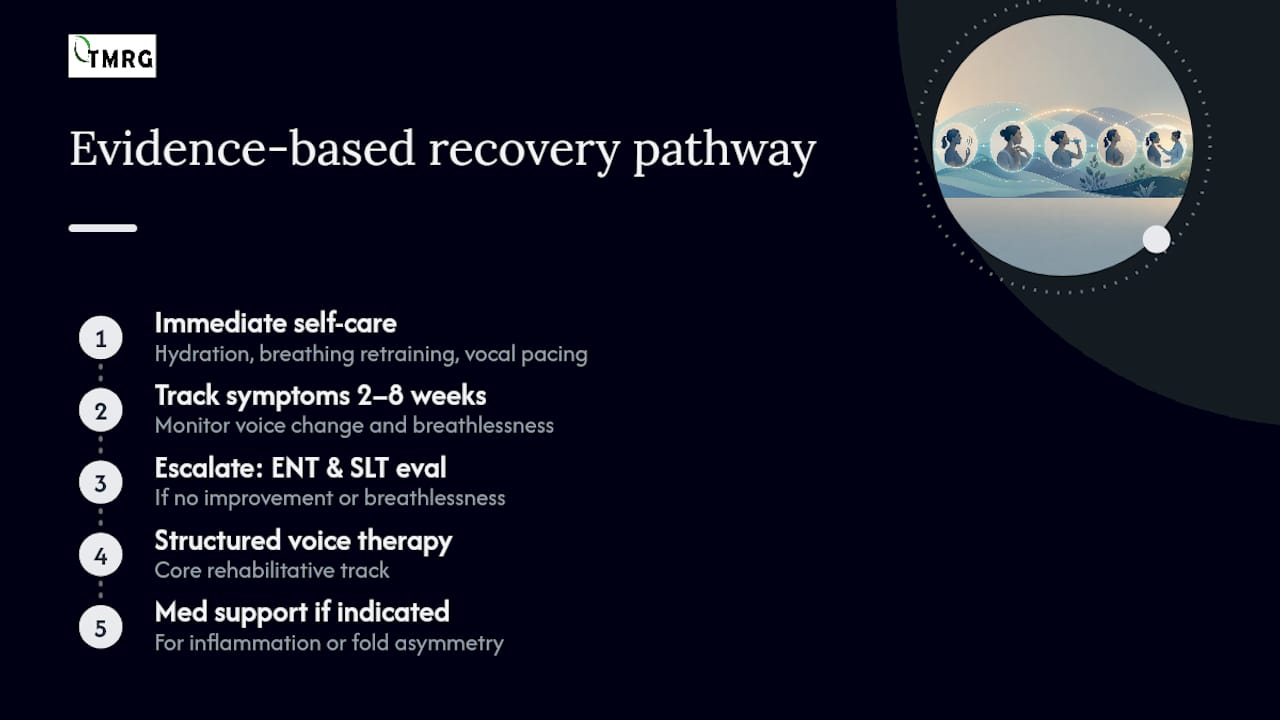
The stepwise approach that holds up best against the current evidence looks like this: start self-care measures immediately (hydration, breathing retraining, vocal pacing), track your symptoms for two to eight weeks, and escalate to ENT and speech and language therapy evaluation if hoarseness hasn’t meaningfully improved in that window or if you notice breathlessness alongside it. From there, structured voice therapy becomes your core rehabilitative track, with multimodal pharmacological support layered in if a clinician identifies visible inflammation or fold asymmetry on exam.
A company with long experience in vocal health works alongside daily habits and symptomatic support that complement, rather than substitute for, clinical treatment. That distinction matters here. Voice therapy kits, hydration-focused routines, and targeted vocal-care products can support the tissue-level healing your clinician is treating, but they work best as an adjunct to a diagnosed, monitored plan, not a replacement for one.
Recovery pacing is the piece people get wrong most often. Voices don’t heal on a straight line, and pushing through fatigue to “test” your voice usually sets healing back rather than speeding it up. The earlier you get a proper assessment, the sooner you know whether you’re dealing with simple inflammation or something like fold asymmetry that needs a different plan entirely.
Daily vocal hygiene and clinical care aren’t competing priorities. Hydration, breathing retraining, and pacing create the conditions where therapy actually works. Skipping either half slows you down.
— Golan
Vocal recovery after COVID-19 often benefits from consistent daily support alongside whatever clinical plan your ENT or speech therapist sets. Tmrgsolutions builds its formulations around that exact gap, giving you natural, non-prescriptive options to use between therapy sessions or during flare-ups when your voice feels particularly strained.
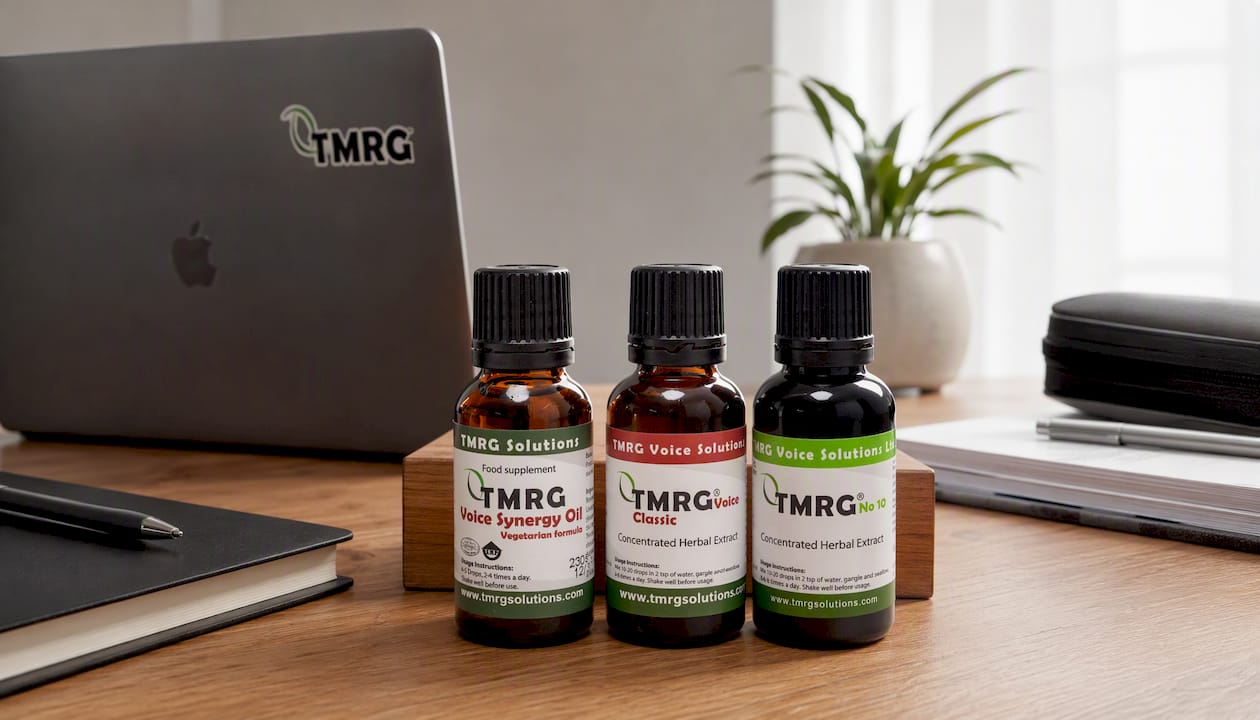
TMRG Loud & Clear - Classic Voice Recovery Drops are formulated as a foundational recovery aid, designed for daily symptomatic support when your voice feels rough or fatigued after extended talking. TMRG Protection - Voice Synergy Oil Lost Vocal Drops target moments when your voice feels especially depleted, offering a topical option to use as part of your evening wind-down routine. TMRG Impact - Voice Enhancement Drops are built for days when you need extra vocal conditioning support, whether that’s before an important call or during a stretch of heavier voice use as you’re rebuilding stamina.
None of these products are meant to replace ENT or speech therapy. Think of them as ritual support you layer around your clinical plan, the same way hydration and pacing support it. If you want a more complete approach, the TMRG Voice Therapy Kits combine educational guidance with supportive products in one package. Browse the voice synergy oil, the classic recovery drops, or the voice enhancement drops to find the fit for where you are in recovery, and pair whichever you choose with the self-care steps outlined above.
The 2023 systematic review and meta-analysis supplies the core prevalence figures for acute and persistent dysphonia used throughout this article. A 2025 study on gender and clinical correlates supports the risk-factor breakdown for who develops lingering voice problems. The high-speed videoendoscopy pre-post study backs the treatment outcomes described for multimodal care. NHS-affiliated guidance on post-COVID syndrome and your voice informs the recovery timeline and self-care recommendations.
This article is general information, not a substitute for advice from a qualified doctor. Consult a qualified healthcare professional about your own circumstances before acting on anything here.
Hoarseness paired with excess mucus after COVID-19 usually points to lingering laryngeal inflammation, sometimes called corditis, which irritates the vocal folds and increases mucus production as the tissue tries to heal.
A sudden raspy voice after COVID-19 typically reflects swelling or irregular closure of the vocal folds rather than a new infection, and it’s worth tracking whether it resolves within a few weeks or lingers.
Acute COVID-related laryngitis generally clears within one to two weeks, but persistent long-COVID dysphonia can continue for months in about one in five people who had voice symptoms during infection.
Yes. Long COVID is linked to persistent dysphonia, chronic cough, and throat irritation, often tied to lingering inflammation, vocal fold motion changes, or dysfunctional breathing patterns that keep straining the voice.
A variety of voice therapy kits and individual products designed for adjunctive daily support alongside clinical treatment rather than a replacement for ENT or speech therapy care are available. Current prices are listed on the product pages.
