Your Cart is Empty


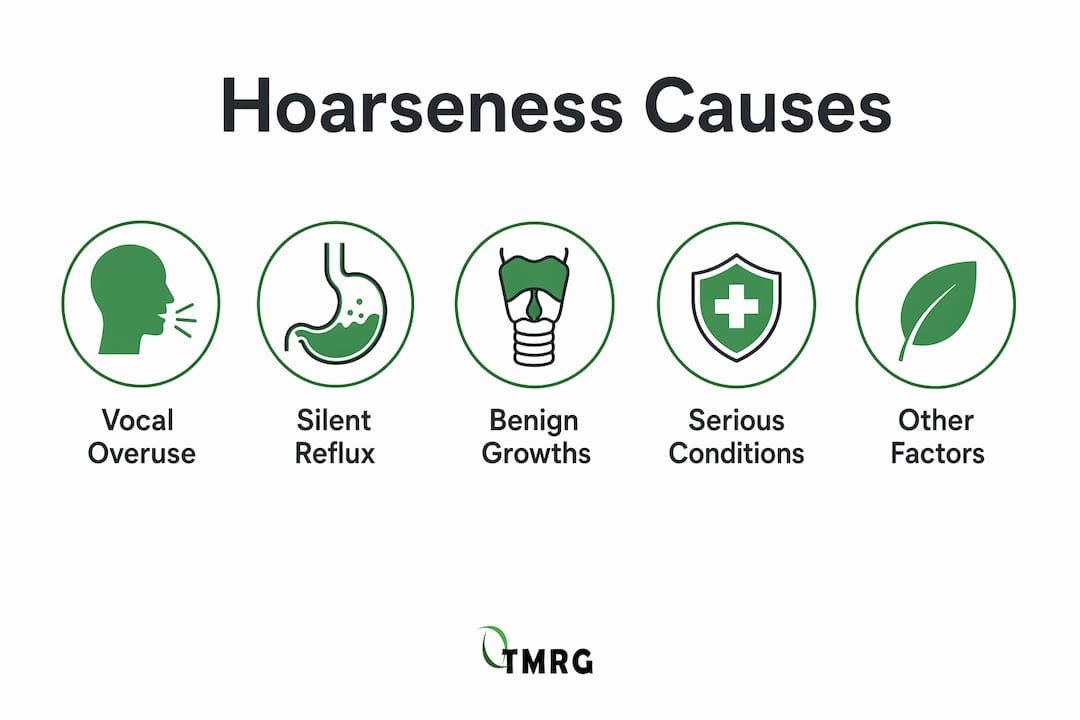
Your voice is raspy, strained, or barely there, yet your throat feels completely fine. This specific pattern, a hoarse voice without throat pain, points away from the typical viral infection and toward three more likely culprits: vocal overuse, laryngopharyngeal reflux (LPR), or benign growths on the vocal folds such as nodules, polyps, or cysts.
Key distinctions to keep in mind:
The absence of pain does not mean the issue is minor. Silent reflux can damage vocal cords over time without any soreness, and structural changes like nodules will not resolve on their own without proper care.
Several distinct mechanisms can produce hoarseness while leaving your throat feeling perfectly normal.
Most hoarseness from voice overuse clears within a few days of rest. When it does not, the timeline and accompanying signs tell you how urgently to act.
Laryngeal cancer is rare, but hoarseness is its most common early symptom. Early detection changes outcomes dramatically, which is why the three-week rule from the Mayo Clinic and the NIDCD exists.
True vocal rest is the foundation of recovery, and most people misunderstand what it means.
Pro Tip: Real vocal rest means minimal to no phonation. According to Cleveland Clinic, quiet speech and whispering both increase strain on the vocal folds. If you must communicate, write it down or use text-to-speech on your phone.
For a deeper look at vocal rest principles, Tmrgsolutions has published clinical guidance on what true recovery actually requires.

Some causes of hoarseness without throat pain require more than rest and hydration to resolve.
Hoarseness is always a symptom, never a diagnosis. These conditions share the same presenting sign but require entirely different treatments, which is why a specialist examination matters when the voice does not recover on schedule.
Preventing recurring hoarseness takes consistent habits, not occasional fixes.
Vocal overuse, silent reflux, and benign growths each demand a different recovery path. What they share is the need for consistent, targeted care during the healing window.

Tmrgsolutions brings 25 years of specialized vocal health expertise to exactly this situation. The product line includes herbal recovery drops, hydrating throat sprays, and complete voice therapy kits formulated for singers, actors, speakers, and anyone whose voice is their livelihood. The TMRG Powerful Vocal Recovery Kit combines drops, sprays, and structured vocal care guidance in one package, designed for people who need their voice back and cannot afford a slow recovery. If you are dealing with hoarseness that has lasted more than a few days, this is a practical next step while you monitor whether medical evaluation is needed.
Yes. Vocal overuse, laryngopharyngeal reflux, and benign vocal fold growths all commonly cause hoarseness without throat soreness, as the irritation affects the vocal folds rather than the throat lining.
See a doctor if hoarseness persists beyond 3 weeks in an adult, or sooner if you have difficulty breathing, swallowing, a neck lump, or blood when coughing.
No. Whispering places more strain on the vocal folds than normal speech and can slow recovery. True vocal rest means minimal to no phonation of any kind.
Silent reflux (LPR) occurs when stomach acid reaches the larynx without producing heartburn. It irritates the vocal folds directly, causing chronic hoarseness and throat clearing, often worse in the morning.
Tmrgsolutions offers herbal drops, sprays, and voice therapy kits formulated to support vocal fold recovery from strain, reflux irritation, and overuse, complementing vocal rest and hydration during the healing process.
Hoarseness without throat pain most often signals vocal overuse, silent reflux, or benign vocal fold growths, each requiring a different but manageable approach.
| Point | Details |
|---|---|
| Pain-free hoarseness has specific causes | Vocal overuse, LPR, and benign growths are the primary culprits when throat pain is absent. |
| The 3-week rule applies | Hoarseness lasting more than 3 weeks in an adult requires professional evaluation to rule out serious conditions. |
| Whispering worsens recovery | True vocal rest means silence, not quiet speech. Whispering strains the vocal folds more than normal conversation. |
| Menthol lozenges can backfire | They dry the throat lining. Consistent hydration and a humidifier are more effective during recovery. |
| Tmrgsolutions supports recovery | The TMRG Powerful Vocal Recovery Kit provides herbal drops, sprays, and structured care for singers, speakers, and voice professionals. |
