Your Cart is Empty


TL;DR:
- A vocal recovery spray works best when used correctly and consistently. This guide walks singers through exactly when to spray, how often, what to combine it with, and how to build it into a daily voice care routine for lasting results.
A singer vocal recovery spray is a specially formulated throat spray designed to soothe, hydrate, and lubricate the vocal folds for faster voice recovery and improved performance. Voice professionals call these products demulcent sprays, a term from speech-language pathology that describes any preparation coating and protecting irritated mucous membranes. Whether you perform eight shows a week or teach voice lessons daily, understanding what these sprays actually do, and what they cannot do, determines how well you protect your most important instrument.
A vocal recovery spray works by depositing a thin, lubricating layer directly onto the mucosa of the throat and upper larynx. That layer reduces friction between the vocal folds during vibration, which is the root cause of the raw, tired feeling singers know too well. The spray does not reach the vocal folds themselves during swallowing, but the moisture and coating agents do reduce surface irritation and lower the effort required to phonate.
Most quality formulas rely on glycerin as their base. Glycerin-based sprays mimic natural mucosal secretions and lubricate the vocal folds more effectively than alcohol-based alternatives, which dry the throat. Alongside glycerin, you will typically find aloe vera, botanical extracts, and saline, each contributing to surface hydration without stripping the mucosa.
Standard application is straightforward:
Direct the nozzle toward the back of the throat, not the tongue.
Apply 1–3 sprays per session, up to 4–5 times daily depending on the formulation.
Avoid eating or drinking for several minutes after application so the coating has time to settle.
Do not exceed the recommended daily frequency, as oversaturation does not speed healing.
Pro Tip: Apply your throat soothing spray about 15 minutes before a performance or rehearsal, not immediately before. That short window lets the coating adhere properly and gives you a fuller, more supported sound from the first note.
Sprays provide immediate comfort, but they do not cure underlying vocal pathologies. Laryngitis resolves with rest and self-care over 1–2 weeks. A spray manages the discomfort during that window; it does not shorten the healing timeline on its own.
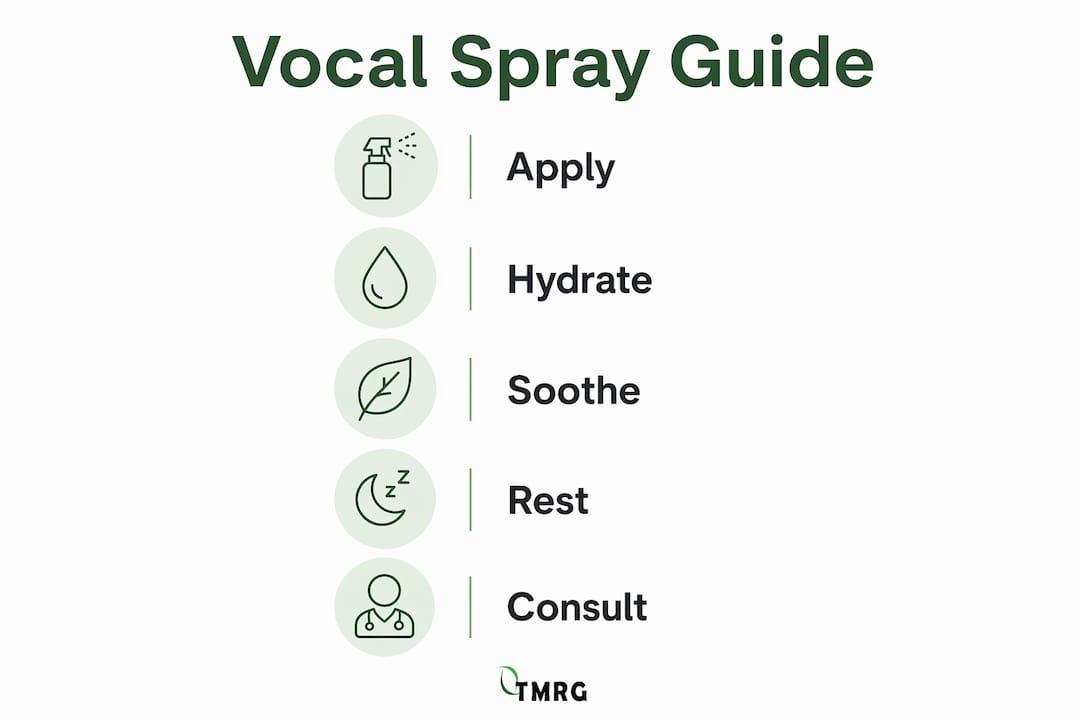
The formulation of a throat soothing spray determines whether it helps or quietly makes things worse. Singers often reach for the most familiar product on the shelf without checking the ingredient list, and that habit can backfire.
| Ingredient | Benefit | Caution |
|---|---|---|
| Glycerin | Coats and hydrates vocal fold mucosa | Use water-based formulas; avoid high concentrations |
| Aloe vera | Soothes inflammation, gentle on tissue | Confirm food-grade quality for throat use |
| Manuka honey | Coats the larynx, antimicrobial properties | High sugar content; rinse teeth after use |
| Propolis | Natural antibacterial, supports tissue health | Possible allergy in those sensitive to bee products |
| Echinacea | Immune support during illness-related hoarseness | Not recommended for long-term daily use |
| Menthol | Creates a cooling sensation | Dries out throat mucosa; speech-language pathologists advise against it |
| Alcohol | Preservative in some formulas | Significantly dries the throat; avoid in vocal sprays |
The menthol finding surprises many performers. Menthol feels soothing, but that sensation is neurological, not physiological. The mucosa actually loses moisture. Speech-language pathologists recommend pectin-based or honey-based demulcents instead, because these genuinely coat and hydrate the larynx without the drying rebound effect.
Alcohol-based sprays present the same problem at a higher intensity. If you see ethanol or isopropyl alcohol listed in the first five ingredients, put the bottle down. A well-formulated natural throat spray relies on water, glycerin, and botanical extracts, not preservative-heavy alcohol bases.
A vocal health spray works best as one layer in a broader recovery plan. Voice therapists consistently report that singers who rely on sprays alone recover more slowly than those who combine topical relief with systemic care. The spray addresses the surface. Everything else addresses the cause.

Vocal rest is the foundation of any recovery plan. Structured rest breaks reduce vocal fold inflammation and prevent chronic damage. The practical model recommended by voice therapists is approximately 10 minutes of silence per hour of voice use. That ratio keeps the folds from accumulating strain across a long rehearsal day.
Hydration operates on two levels. Systemic hydration, meaning consistent water intake throughout the day, lowers phonation threshold pressure. That is the minimum airflow your body needs to set the vocal folds vibrating. Lower phonation threshold pressure means easier, less effortful singing. Topical hydration from sprays and nebulizers adds surface moisture but does not replace the systemic benefit of drinking water regularly.
Gentle vocal exercises speed recovery better than rest alone, according to voice therapists. Think of light humming or lip trills as a massage for fatigued vocal folds. They promote circulation without the impact of full-voice singing.
Here is a practical daily recovery plan that integrates spray use with evidence-based vocal hygiene:
Morning hydration first. Drink 8–12 oz of room-temperature water before speaking or singing. Cold water constricts the laryngeal muscles.
Gentle warm-up. Spend 5–10 minutes on lip trills or humming at a comfortable pitch. Never force range during recovery.
Apply your spray. Use 1–3 sprays 15 minutes before any voice use. This is your surface preparation, not your warm-up.
Rest intervals. Take 10 minutes of vocal silence per hour of active voice use throughout the day.
Avoid throat clearing. Each forceful throat clear slams the vocal folds together. Sip water or swallow gently instead.
Avoid smoking and secondhand smoke. Smoke inflames the vocal fold mucosa directly and undoes any benefit from your spray or hydration routine.
Evening spray application. Apply one final round before sleep to keep the throat moist overnight, especially in dry climates or air-conditioned spaces.
Pro Tip: Run a cool-mist humidifier in your bedroom during recovery. Ambient humidity above 40% measurably reduces overnight mucosal dryness, so you wake up with a fuller, less strained voice.
Vocal hygiene habits like these are what clinical voice therapy experts prioritize above any topical product. Sprays support the process. They do not replace it.
A throat soothing spray is appropriate for short-term, performance-related vocal fatigue. It is not appropriate as a long-term substitute for medical evaluation. Knowing the difference protects your voice from permanent damage.
Watch for these warning signs:
Hoarseness lasting longer than two weeks. Persistent vocal changes warrant evaluation by an ENT specialist experienced in voice disorders. Chronic hoarseness can indicate vocal nodules, paralysis, or other serious pathology.
Pain when swallowing or speaking. Surface irritation from overuse does not typically cause pain. Pain suggests deeper tissue involvement.
Complete voice loss that does not improve with 48 hours of rest. Acute laryngitis usually responds to rest within two days. If it does not, a physician needs to assess the cause.
Visible swelling or a lump sensation in the throat. These symptoms require imaging or laryngoscopy, not a spray.
Recurring hoarseness across multiple performance cycles. Repeated strain without full recovery between events is the primary pathway to vocal nodules.
Overreliance on quick fixes like sprays without adequate rest prolongs vocal injury and increases the risk of chronic voice disorders. The spray numbs the discomfort signal that your body uses to tell you to stop. Performers who push through that signal repeatedly are the ones who end up in a voice surgeon’s office.
ENT specialists and certified voice therapists use laryngoscopy to visualize the vocal folds directly. That single procedure reveals nodules, polyps, hemorrhage, or paralysis that no amount of spray use would ever resolve. If you have any doubt, book the appointment. Your voice is worth the visit.
A singer vocal recovery spray provides real but surface-level relief, and its value depends entirely on how well it is paired with vocal rest, systemic hydration, and professional care when symptoms persist.
| Point | Details |
|---|---|
| Sprays soothe, not cure | Demulcent sprays coat and hydrate the mucosa but do not resolve underlying pathology like laryngitis or nodules. |
| Glycerin beats alcohol | Glycerin-based formulas mimic natural mucosal secretions; alcohol-based sprays dry the throat and worsen irritation. |
| Avoid menthol | Menthol creates a cooling sensation but dries the mucosa; honey-based and pectin-based alternatives hydrate more effectively. |
| Rest intervals matter | Ten minutes of vocal silence per hour of voice use reduces inflammation and prevents chronic damage. |
| Two-week rule | Hoarseness lasting longer than two weeks requires ENT evaluation, not more spray applications. |
After working in vocal health for over two decades, the pattern I see most often is this: a performer discovers a throat spray that provides real, immediate relief, and then quietly starts treating it as a substitute for rest. The spray becomes a permission slip to keep performing when the body is asking for silence.
The sprays themselves are not the problem. A well-formulated vocal recovery solution with glycerin, aloe, and botanical extracts genuinely helps. What concerns me is the psychology around them. Singers are trained to push through discomfort. A spray that mutes the discomfort signal makes it easier to push past the point where real damage begins.
My honest advice: use the spray, but treat it as a signal to slow down, not speed up. If you need it before every rehearsal just to get through the session, your voice is telling you something the spray cannot fix. That is the moment to call a voice therapist, not reach for another bottle.
The performers who maintain long, healthy careers are not the ones with the best sprays. They are the ones who built recovery into their schedule before they needed it.
— Golan
Tmrgsolutions has spent 25+ years formulating vocal care products specifically for performers who cannot afford to lose their voice.

The TMRG Shine Bright Classic Voice Recovery Spray is built around the glycerin and botanical base that speech-language pathologists recommend, without alcohol or menthol. For performers who want a complete system, the TMRG Voice Therapy Kit Standard combines sprays, recovery drops, and therapy guides into one structured program. Both products reflect the same principle this article is built on: surface relief works best when it is part of a full recovery plan, not a replacement for one. Visit Tmrgsolutions to find the right fit for your voice and performance schedule.
A singer vocal recovery spray deposits a lubricating, hydrating layer on the throat and upper larynx to reduce friction and surface irritation during vocal fold vibration. It provides immediate comfort but does not treat underlying conditions like laryngitis or vocal nodules.
Most therapeutic formulas recommend 1–3 sprays per application, repeated up to 4–5 times daily. Exceeding that frequency does not accelerate healing and may interfere with the throat’s natural mucosal balance.
For vocal performers, glycerin-based and honey-based natural sprays outperform menthol or alcohol-based medicated options. Menthol and alcohol both dry the mucosa, which worsens the very condition singers are trying to relieve.
Hoarseness or vocal changes lasting longer than two weeks require evaluation by an ENT specialist. Persistent symptoms can indicate vocal nodules, paralysis, or chronic laryngitis, none of which a spray can resolve.
Yes, used correctly, a pre-performance spray is a reasonable part of your vocal routine. Apply it 10–15 minutes before you sing, not immediately before, and pair it with a proper warm-up and adequate hydration throughout the day.
