Your Cart is Empty


Yes, vaping compromises singing performance. It dries and irritates the vocal tract, thickens mucus, and reduces the breath support you need to sustain phrases and hit your top notes. Vapor exposure has been shown to injure vocal fold tissue at the cellular level, and daily users report more voice and cough symptoms than nonusers. If a show is coming up, stop vaping now, hydrate the vocal folds directly, and treat quitting as the long-term fix.
TL;DR:
- Vaping causes cellular injury to vocal fold tissue, leading to hoarseness, pitch instability, and increased cough symptoms in daily users.
- Ingredients like propylene glycol, vegetable glycerin, and nicotine dry and inflame the vocal tract, impairing flexibility and support while increasing mucus viscosity.
- Long-term exposure may cause tissue remodeling that can take weeks to months to reverse, although acute symptoms often improve within days with proper care.
- Immediate steps include stopping vaping before performances, humidifying environments, avoiding throat clearing, and using nebulized saline to support recovery.
- Vaping also worsens allergy symptoms, stacking inflammation and extending recovery time, especially for singers with existing environmental sensitivities.
Your vocal folds are lined with a thin, delicate mucosal layer that has to stay lubricated and flexible to vibrate hundreds of times per second. Vapor exposure attacks that layer directly. Lab research using engineered human vocal fold tissue found that even brief exposure to e-cigarette vapor extract caused epithelial erosion and early signs of mucosal remodeling, meaning the surface cells break down and the underlying structure starts to change shape under repeated stress. That kind of injury shows up on stage as hoarseness, breathiness, and pitch instability, especially in the upper range where the folds need to close cleanly and quickly.
There’s a mechanical piece to this too. Healthy folds need a certain amount of air pressure built up beneath them before they’ll snap open and start vibrating. Clinicians call this phonation threshold pressure. When the mucosal surface is dry or swollen, that threshold climbs, so you have to push harder from the diaphragm just to get sound started. Push harder night after night and you’re training compensatory habits that strain the whole instrument.
Vapor exposure also increases mucus viscosity and slows mucociliary clearance, the process that normally sweeps debris and thickened secretions out of the airway. Thicker mucus means more throat clearing, more coughing, and more irritation layered on top of the original injury.
What this looks like in a rehearsal or a set:
Pro Tip: If your voice feels “stuck” in the lower register before a show, that’s often phonation threshold pressure talking. Don’t push through it with volume. Nebulized saline and gentle vocal warm-ups do more than force ever will.
Every e-liquid is built on a small set of ingredients, and each one has a distinct effect on the vocal mechanism. Understanding vaping’s effects on vocal health starts with knowing what’s actually hitting your throat with every draw.
None of these components work in isolation. A dry, vasoconstricted, inflamed airway is a much harder instrument to control than a hydrated one.
The research splits cleanly into two timeframes, and singers need to understand both. Short-term exposure produces measurable cellular injury fast. The engineered-tissue study behind much of this evidence found epithelial erosion and mucosal remodeling after just one week of vapor extract exposure at concentrations comparable to regular use.
The evidence gap singers should know: a comparison of 26 daily e-cigarette users against 39 nonusers found significantly more voice and cough symptoms and subtle changes in laryngeal kinematics in the vaping group. That’s a real signal from human subjects, not just cultured cells.
The honest caveat: most of the strongest cellular evidence comes from lab tissue models and small clinical comparisons, not large-scale longitudinal studies tracking singers over years. Researchers studying cultured vocal fold fibroblasts exposed to e-cigarette vapor have documented inflammatory changes and increased phonation effort, but the field still lacks long-term data on career vocalists specifically.
Practical timeline to expect:
Reversible irritation and structural remodeling are not the same risk. One resolves with rest. The other may not.
Treat this as triage, not theory. Here’s the order of operations if a performance is on the calendar or your voice already feels off.
Quitting changes the recovery math entirely. Continued exposure keeps reinjuring tissue faster than it can heal, while cessation lets remodeling begin to reverse, though expect that process to run over weeks, not days.
Pro Tip: Book vocal rest into your calendar the same way you’d block rehearsal time. A voice that never gets scheduled recovery never fully recovers.
Topical sprays and hydration kits address comfort and surface mucus, not structural injury. If epithelial erosion or vocal fold swelling is present, that requires a clinician, not a spray. What targeted hydration support can do is work alongside rest and therapy, not instead of it.
Herbal formulations have been developed to support singers navigating exactly this kind of irritation. Safe combinations look like this:
TMRG Singer’s Super Power was formulated as a supportive product for exactly this window: singers managing dryness and fatigue while working a real recovery plan, not a replacement for that plan.
Vaping doesn’t just irritate the vocal folds directly. It also aggravates upper respiratory allergies, and that creates a second, quieter pathway to vocal trouble. Chronic airway inflammation from vapor exposure can heighten sensitivity to existing allergens, whether that’s dust, pollen, or mold in a venue’s ventilation system.
Once allergic inflammation flares, postnasal drip follows. That drip lands directly on the vocal folds, adding another layer of irritation on top of whatever vaping has already caused. Singers who already manage seasonal allergies often notice their symptoms feel sharper and longer lasting during periods of regular vaping, even when pollen counts haven’t changed.
This matters practically because the two conditions get mistaken for one another constantly. A singer battling both may write off worsening hoarseness as “just allergy season” when vapor exposure is quietly extending every flare-up. The inflammation doesn’t reset between triggers. It stacks.
If you already carry seasonal or environmental allergies, vaping removes your margin for error. A vocal tract managing allergic inflammation and vapor irritation at the same time has far less reserve capacity heading into a demanding set, and recovery between shows takes longer than it would for either issue alone.
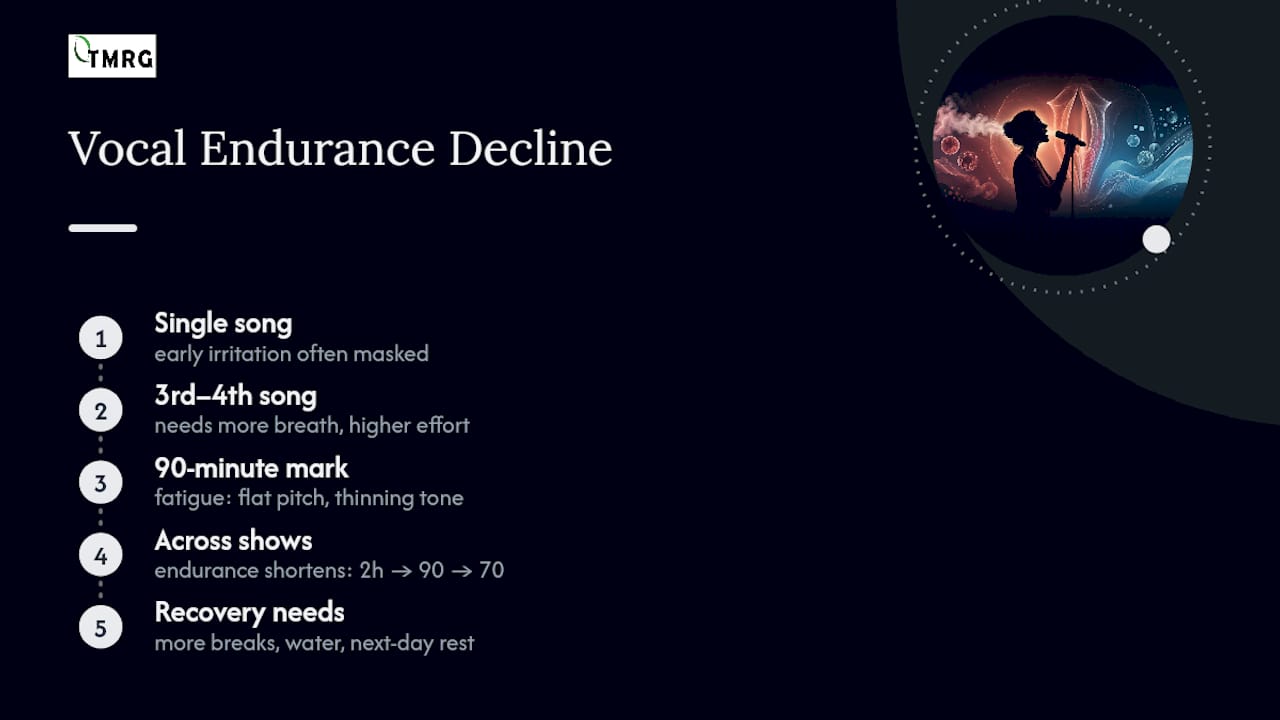
Endurance is where vaping’s effects compound the most visibly. A single song might mask early irritation. A ninety-minute set will not.
Higher phonation threshold pressure means every phrase costs more effort than it should, and that cost adds up across a set list. By the third or fourth song, a singer working around vapor-related dryness is often driving harder from the breath to compensate for folds that aren’t closing as efficiently. That’s a fast track to fatigue, and fatigue shows up as flat pitch, thinning tone, and a voice that simply gives out earlier than it used to.
Reduced breath support compounds the problem. Ultrafine particles triggering airway inflammation mean less efficient oxygen exchange and less elastic lung capacity to draw on during long, sustained phrases. Singers who used to comfortably hold a set together start needing more breaks between songs, more water, more recovery time the next day.
The pattern tends to show up gradually rather than all at once. A singer might not notice reduced endurance during a single rehearsal, but across a tour or a run of shows, the cumulative fatigue becomes the story. Vocal stamina that used to carry through a two-hour show starts running out at ninety minutes, then seventy, and the singer often blames sleep or stress before considering vaping as the variable that actually changed.
Plenty of performers reach for a vape as a stress ritual, not a nicotine habit. It’s fast, it’s portable, and it feels like it takes the edge off preshow nerves. That’s exactly what makes it risky for singers specifically: the behavior most tied to performance anxiety is the one most likely to sabotage the voice that anxiety is already working against.
The timing compounds the damage. Vaping right before a set means the drying and irritant effects are at their peak exactly when the vocal folds need to be at their most flexible and hydrated. A singer using vaping as an anxiety coping tool is, without realizing it, choosing the worst possible moment to introduce the irritant.
There’s also a habit-loop problem. Vaping backstage becomes tied to the ritual of getting ready, so the association strengthens over time even as the vocal cost quietly climbs. Breaking that link usually requires swapping in a different physical ritual, something like a specific warm-up sequence, a breathing pattern, or steam inhalation, that delivers the same calming, hands-busy effect without the tissue damage.
Recognizing that the habit is doing emotional work, not just chemical work, is often the first real step toward replacing it with something that actually supports the voice instead of undermining it.
Every study reviewed here points the same direction: vapor exposure and reliable vocal performance don’t coexist comfortably. If a show is close, stop now and hydrate hard. If symptoms persist past two weeks, see an ENT before assuming it will resolve on its own.
— Golan
If you’re cutting back on vaping or working through a full recovery plan, targeted hydration support can make the process more comfortable while your body does the real healing. TMRG Singer’s Super Power was built for singers managing exactly this kind of dryness and vocal fatigue, offering herbal support that pairs naturally with rest, nebulizing, and warm-up adjustments.
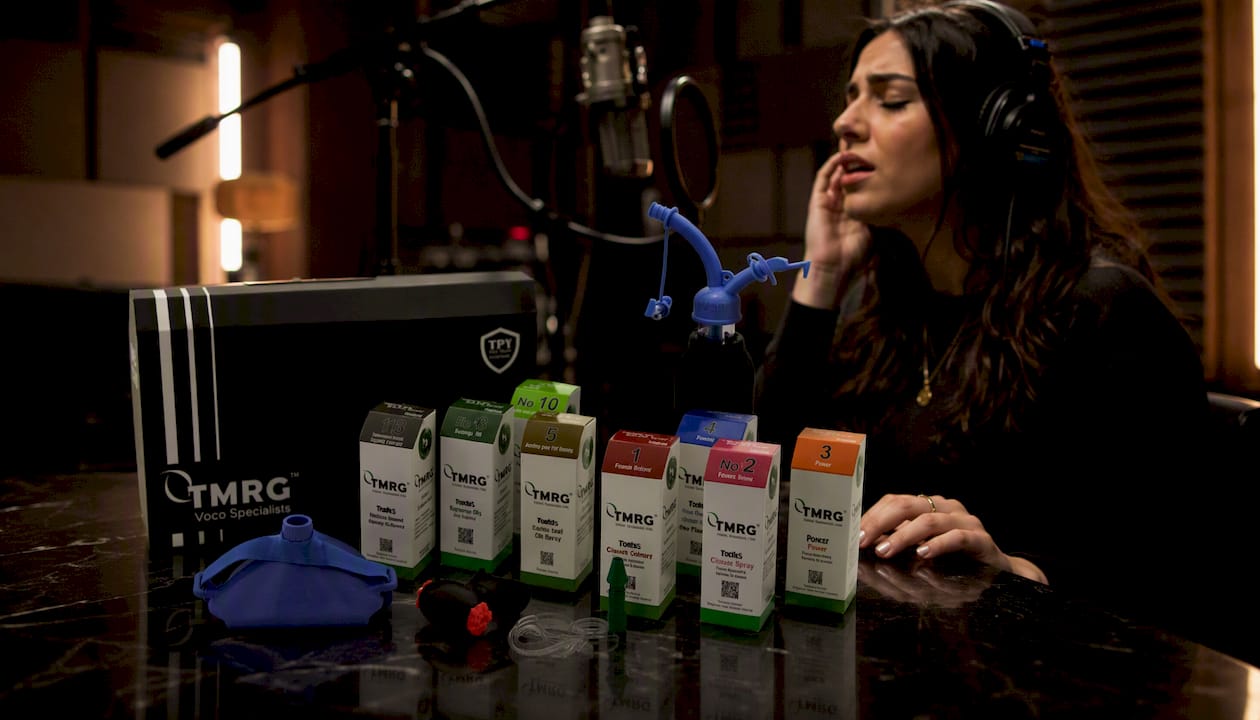
It’s not a substitute for vocal rest or clinical care. Think of it as backup for the days you need your voice to perform anyway, whether that’s a rehearsal you can’t skip or a gig already on the books. This formulation is designed to sit alongside a nebulized saline routine, not replace one.
If hoarseness or range loss lasts more than two weeks, see an ENT first. Otherwise, check out Singer’s Super Power as a next step in your recovery kit.
Most acute irritation improves within days to weeks of quitting, but tissue remodeling from longer-term exposure can take weeks to months to resolve, and guided voice therapy often speeds that recovery.
Vaping is common across many professions, including performing artists, but the research on daily e-cigarette users consistently links the habit to more voice and cough symptoms regardless of who is using it.
Smoking and vaping harm the voice through different mechanisms, smoking through combustion byproducts and tar, vaping through drying agents and ultrafine particles, but neither is safe for a singer relying on flexible, well hydrated vocal folds.
Start with strict vocal rest, nebulized sterile saline, and a humidified environment, then see an ENT or speech-language pathologist if hoarseness or range loss persists beyond two weeks.
