Your Cart is Empty


TL;DR:
- Vocal protection involves daily habits like hydration, avoiding irritants, and using correct technique to maintain vocal health and longevity. Proper warm-up, cool-down, and scheduled rest are essential habits that prevent long-term damage and improve voice quality over time. Consistent self-care, including professional support when needed, helps singers preserve a clear, responsive voice throughout their careers.
Vocal protection for singers is defined as the daily practice of managing vocal load, maintaining tissue hydration, applying correct technique, and scheduling adequate rest to preserve the health of the vocal folds. How singers protect their voice determines not just the quality of a single performance, but the length of an entire career. Structured vocal hygiene training measurably improves self-perceived voice quality and reduces vocal complaints among professional singers. That finding means the habits you build today directly shape the voice you will have in ten years. This guide covers the core practices, backed by 2026 research, that keep vocal folds healthy, responsive, and durable.
Vocal hygiene is the recognized clinical term for the daily behaviors that protect the vocal folds from damage. It covers hydration, irritant avoidance, vocal load management, and environmental control. Think of it as the vocal equivalent of sleep hygiene: consistency matters far more than any single heroic effort.
Hydration works cumulatively, not as a last-minute fix. Water takes several hours to reach laryngeal tissues after ingestion, which means drinking a bottle of water backstage does almost nothing for your vocal folds during that night’s show. The habit that actually works is sipping water steadily throughout the entire day, every day.

Room-temperature water is the standard recommendation. Cold water can temporarily tighten laryngeal muscles, and caffeinated or alcoholic drinks act as diuretics, pulling moisture away from the tissues you are trying to protect. A personal water bottle kept visible during rehearsals and meetings is one of the simplest vocal care tips you can adopt right now.
Pro Tip: Use a humidifier in your bedroom overnight, especially during winter or in air-conditioned environments. Breathing humidified air while you sleep delivers moisture directly to the laryngeal mucosa, complementing your daytime hydration.
Smoking and vaping inflame the vocal fold mucosa and reduce its natural lubrication. The damage is cumulative and often irreversible over time. Avoiding reflux triggers such as acidic foods, dairy, and alcohol around performance time also protects the mucosal lining that keeps vocal folds vibrating smoothly.
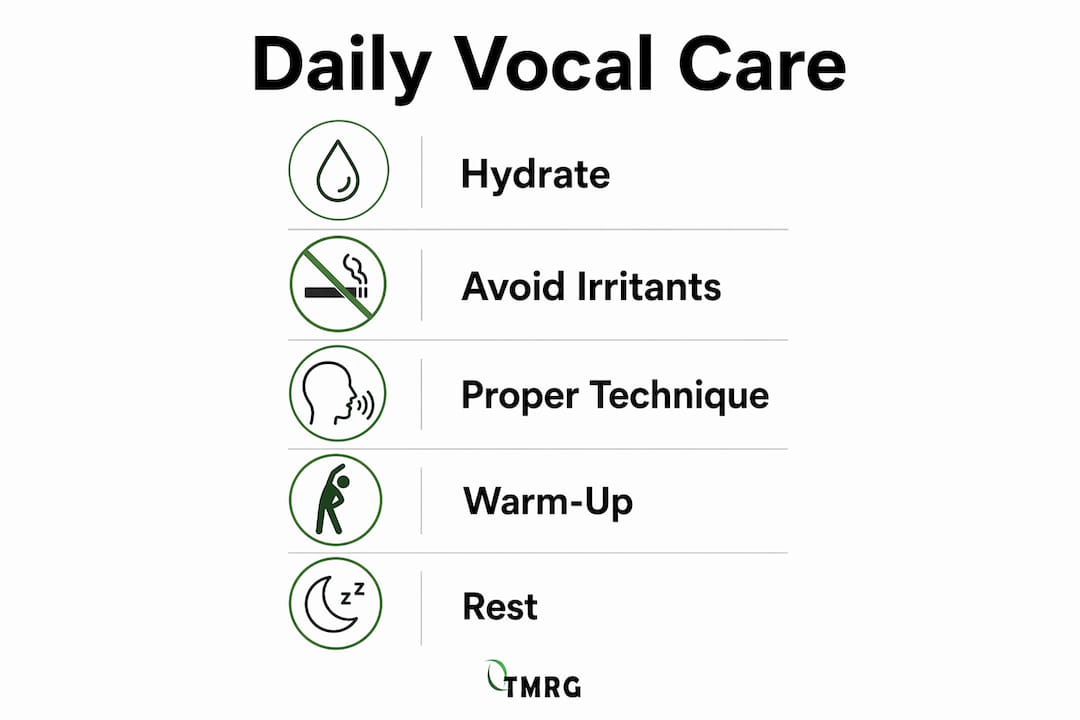
Gastroesophageal reflux is a common but underdiagnosed threat to singers. Stomach acid that reaches the larynx causes chronic irritation, hoarseness, and a persistent need to clear the throat. Managing meal timing, avoiding late-night eating, and limiting spicy or fatty foods before a show are practical steps that protect your voice from below. For a deeper look at nutrition’s role, Tmrgsolutions covers dietary strategies for singers in detail.
Throat clearing is one of the most damaging reflexive habits a singer can have. Each forceful clear slams the vocal folds together with high collision force. Replace it with a gentle, silent swallow or a soft, breathy cough. Whispering is equally harmful: it forces the vocal folds into a strained, open configuration that causes more fatigue than speaking softly in a supported voice. When your voice needs rest, choose true silence, not a whisper.
Correct singing technique is the single most powerful long-term protection a singer has. Sustainable vocal technique relies on respiratory support from the diaphragm and intercostal muscles, not on squeezing or gripping with the throat. When breath pressure drives the sound, the vocal folds vibrate with less collision force and less muscular strain.
Balanced vocal onset means the breath and the vocal fold closure happen simultaneously. An overly hard onset, where the folds slam shut before the breath arrives, creates a glottal attack that stresses the tissue with every note. An overly breathy onset wastes air and forces the folds to work harder to sustain phonation. Training a balanced onset through exercises like lip trills and humming builds the coordination that protects the voice during long performances.
Speaking loudly over noise and shouting cause excessive vocal fold collision forces. Using a microphone and amplification system rather than projecting over a loud band or crowd is not a sign of weakness. It is a professional decision that extends your vocal career. Singers who perform in loud venues without amplification accumulate tissue wear that shows up as nodules, polyps, or chronic hoarseness over months and years.
Posture directly affects breath capacity and voice production. A neutral spine and relaxed shoulders open the airway and reduce tension in the muscles surrounding the larynx. Collapsed posture compresses the diaphragm, restricts airflow, and forces the throat to compensate with muscular tension. Stand tall, release the shoulders down and back, and let the breath drop into the lower ribcage before you sing.
Pro Tip: Before any rehearsal or performance, spend two minutes in a standing position with your back against a wall. This resets spinal alignment and reminds your body of the posture that supports free, efficient voice production.
Tmrgsolutions outlines efficient vocal techniques for performers who want to build these habits systematically.
A structured warm-up prepares the vocal folds for the physical demands of singing. Skipping it is the equivalent of sprinting without stretching: the tissue is cold, stiff, and far more vulnerable to strain. A productive warm-up takes a minimum of 15–20 minutes and follows a specific sequence.
The cool-down is the most underused tool in a singer’s routine. Post-performance cool-down exercises reduce the swelling and inflammation that accumulate in the vocal folds during a show. Singers who cool down consistently report clearer, more responsive voices the morning after a performance.
Vocal load is the total amount of phonation your vocal folds experience in a given period. It includes singing, speaking, teaching, socializing, and any other voice use. Managing that load is as important as managing the quality of your technique.
Micro-rest breaks of about 60 seconds between vocal segments reduce vocal fold collision stress and improve long-term tissue health. That means stepping away from conversation between sets, staying silent during sound checks when possible, and building quiet time into your rehearsal schedule.
Hoarseness that lasts more than a few days after a performance is a warning sign. Hoarseness persisting beyond 2–3 weeks requires professional ENT evaluation to rule out vocal fold lesions or other structural changes. Waiting longer risks permanent damage. A voice therapist can also assess your vocal habits and identify patterns that are silently wearing down your instrument. For guidance on avoiding vocal damage, Tmrgsolutions provides a dedicated resource for performers.
Singers who consistently apply balanced technique, hydration, and recovery practices build more durable careers and maintain clearer, more responsive voices over time. That is not an accident. It is the direct result of treating the voice as a physical instrument that requires the same care as any other high-performance tool.
Protecting your voice requires consistent daily habits across hydration, technique, rest, and recovery, not reactive care after damage has already occurred.
| Point | Details |
|---|---|
| Hydrate all day | Water needs hours to reach vocal fold tissue, so sipping consistently throughout the day is the only effective strategy. |
| Use correct technique | Diaphragmatic breath support and balanced onset reduce vocal fold collision force and prevent cumulative tissue damage. |
| Warm up and cool down | A 15–20 minute warm-up and 10 minutes of post-performance cool-down exercises protect the voice before and after every use. |
| Manage total vocal load | Micro-rest breaks, post-show silence, and scheduled rest days reduce the cumulative strain that leads to chronic hoarseness. |
| Seek help early | Hoarseness lasting more than 2–3 weeks signals a need for ENT evaluation to prevent permanent vocal fold injury. |
After years of working with singers and vocal performers, the pattern I see most often is reactive care. A singer pushes through a heavy tour, loses their voice, and then scrambles for solutions. The habits that actually preserve a voice long-term are built during the quiet weeks, not the crisis ones.
The most counterintuitive thing I tell singers is this: whispering feels like rest, but it is not. It places the vocal folds in a strained open position that creates more fatigue than speaking softly with proper support. True vocal rest means silence. If you need to communicate, write it down or use a notes app.
Nutrition and environment are also underestimated. Reflux, dry air, and inflammatory foods do their damage quietly, over months. Singers who pay attention to what they eat before a show and how they sleep the night before consistently outperform those who focus only on technique. Vocal health is a daily self-care regimen that requires the same consistency as sleep hygiene. You cannot bank it or borrow against it.
The singers I have seen maintain strong, clear voices into their 40s and 50s share one trait: they treat recovery as part of the performance, not an afterthought. The cool-down, the post-show silence, the early bedtime before a run of shows. These are not luxuries. They are the work. For performers who want to understand how post-show vocal management fits into a broader performance wellness routine, the principles translate directly across disciplines.
— Golan
Your daily vocal protection routine deserves products formulated specifically for the demands of professional singing.

Tmrgsolutions has spent 25+ years developing natural vocal health solutions for singers, actors, and speakers. The TMRG Voice Therapy Kit Standard combines targeted recovery tools in one kit, designed to support your warm-up, performance, and cool-down routine. For singers dealing with hoarseness or post-performance fatigue, the TMRG Loud & Clear Voice Recovery Drops deliver soothing, hydrating support directly to the vocal folds. Every formulation is grounded in vocal science and endorsed by vocal coaches and medical professionals who understand what your voice goes through.
Consistent hydration throughout the day, correct diaphragmatic technique, and structured warm-up and cool-down routines form the foundation of vocal protection. No single habit works in isolation.
Whispering actually causes more vocal fold fatigue than speaking softly in a supported voice. True vocal rest means complete silence, not whispering.
A productive vocal warm-up takes a minimum of 15–20 minutes, beginning with tension release and breath work before moving to gentle phonation and range exercises.
Hoarseness or voice loss that persists beyond 2–3 weeks requires professional ENT evaluation to rule out structural damage to the vocal folds.
Acidic foods, dairy, alcohol, and late-night meals can trigger reflux that irritates the laryngeal mucosa, causing hoarseness and reduced vocal fold function around performance time.
