Your Cart is Empty


TL;DR:
- When it comes to vocal recovery, professional singers and coaches have tried everything. This guide compiles what working vocalists and certified vocal coaches genuinely recommend — the specific kits, tools, and routines they trust when their voice needs serious recovery.
A vocal recovery kit is a structured collection of tools, remedies, and therapy protocols designed to protect, soothe, and restore the vocal folds after intensive use. Professional singers and coaches who ask what vocal recovery kits do professional singers and vocal coaches recommend consistently point to the same core categories: hydration aids, voice therapy tools, natural throat remedies, and structured rest protocols. UT Southwestern Medical Center guidelines recommend a ratio of 10 minutes of vocal rest for every 60 minutes of intensive voice use. That standard forms the backbone of every credible recovery kit on the market. Tmrgsolutions has built its product line around exactly these principles, drawing on 25+ years of vocal health expertise.
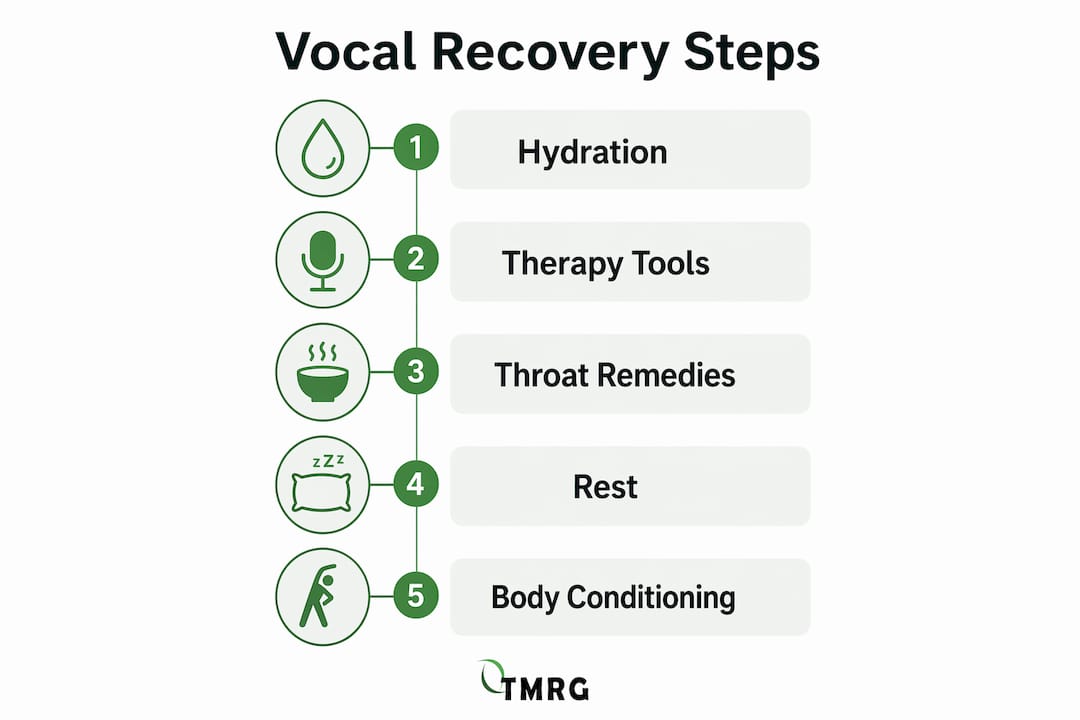
The tools inside a professional recovery kit fall into four clear categories: hydration aids, voice therapy tools, throat remedies, and rest protocols. Each category targets a different stage of the recovery cycle.
Saline nebulizers and portable vocal sprays deliver moisture directly to the mucosal lining of the vocal folds. This matters because dry folds vibrate with more friction, which accelerates tissue fatigue. Singers who tour frequently rely on personal steam inhalers and saline mists before and after shows to keep the folds pliable. Tmrgsolutions’ TMRG Defense spray combines oils and saline in one portable formula, addressing both lubrication and surface hydration in a single application.
A voice therapy kit typically includes guided exercise protocols, resonance training tools, and straw phonation devices. These tools retrain the coordination between breath support, vocal fold closure, and resonance placement. Effective voice therapy runs one session per week for 4–6 weeks, with each session lasting about 45 minutes. That structure is not arbitrary. It matches the tissue repair cycle of the vocal folds and prevents overloading the system before it has healed.
Throat drops and voice synergy oils round out the kit by reducing surface inflammation and supporting mucosal health. The key distinction here is ingredient quality. Menthol-containing lozenges can dry and irritate the vocal folds, which is the opposite of what recovery requires. Yale Medicine and Cleveland Clinic both flag menthol products as a common mistake among singers.
Pro Tip: Skip menthol lozenges entirely during recovery. Choose glycerin-based or herbal throat drops instead, and pair them with a saline spray for genuine mucosal support.
| Product category | Primary function | When to use |
|---|---|---|
| Saline nebulizer or spray | Direct mucosal hydration | Before and after vocal demand |
| Voice therapy tools | Coordination and fold rebalancing | Daily, in structured sessions |
| Herbal throat drops | Surface inflammation reduction | During and after performance |
| Voice synergy oils | Deep mucosal lubrication | Post-performance recovery |
| Humidifier | Ambient air moisture | Overnight and in hotel rooms |
The science behind vocal recovery kits connects three systems: the laryngeal mechanism, the respiratory system, and the body’s overall energy metabolism. Understanding all three explains why a kit with only one product type will always fall short.
The vocal folds are mucous membrane tissue stretched across the larynx. Intensive singing causes micro-trauma to that tissue, which triggers localized inflammation. Rest allows the inflammatory cycle to complete without compounding the damage. Whispering during vocal rest actually increases tension on inflamed folds more than quiet normal speech does. That finding from Cleveland Clinic surprises most singers, but it changes how you approach rest days.
The bioenergetic angle is equally important. Research from the National Center for Voice and Speech shows that cardiovascular conditioning directly correlates with lower vocal effort and faster recovery. A singer with strong aerobic fitness produces voice with less muscular strain. That means vocal care extends well beyond the larynx.
“Viewing vocal fatigue as a systemic bioenergetic issue opens new prevention and rehabilitation pathways beyond voice therapy alone. Singers who treat recovery as a whole-body process recover faster and sustain longer performance runs than those who focus only on laryngeal techniques.” — NCVS bioenergetic research
Post-performance aspirated exercises add another layer. Practicing aspirated ‘ee’ exercises for 10 minutes immediately after singing reduces inflammation and improves vocal resilience more than passive rest alone. The gentle airflow through a slightly open glottis encourages blood circulation without creating the tension of full phonation.
Key physiological reasons these kits work:
Hydration reduces friction between the vocal fold surfaces during vibration.
Structured therapy rebalances the three vocal subsystems: breath, fold closure, and resonance.
Herbal remedies reduce mucosal surface inflammation without suppressing the healing response.
Systemic conditioning lowers the baseline effort required to produce sound.
Strategic rest allows the inflammatory cycle to complete before the next vocal demand.
Professional performers treat vocal recovery as a scheduled activity, not a reaction to a problem. The structure looks different before, during, and after a show, but the logic is consistent: protect the folds before demand, support them during demand, and restore them after.
Here is the routine structure that vocal coaches and experienced performers use most consistently:
Before the show: Run a 10-minute warm-up using straw phonation or lip trills to bring blood flow to the folds without straining them. Apply a saline spray or use a personal steam inhaler for 5 minutes. Avoid caffeine and dairy for at least two hours before performing.
During the show: Sip room-temperature water between sets. Avoid ice water, which constricts the laryngeal muscles. If your throat feels tight, use a herbal throat drop rather than clearing your throat, which creates a sharp impact between the folds.
Immediately after the show: Practice aspirated ‘ee’ exercises for 10 minutes. This is the single most underused recovery tool in professional singing. Apply a voice synergy oil or herbal spray before sleeping.
The day after: Observe strategic silence for the first few hours. Avoid loud conversation, shouting, or social environments that require you to project. This is when the folds do most of their repair work.
Recovery days: Run one structured voice therapy session using your kit’s guided protocols. Focus on resonance placement and breath coordination rather than volume or range.
Pro Tip: The post-show social environment is one of the biggest threats to vocal health. Loud bars and backstage conversations undo the recovery you worked for during the show. Protect your silence like you protect your warm-up.
Many professional voice users rely on structured recovery routines that combine hydration, therapy, rest, and body conditioning to sustain vocal longevity across long performance runs.

Singers at every level carry assumptions about recovery products that the research does not support. Clearing up these misconceptions protects both your voice and your investment in a quality kit.
Menthol sprays feel soothing, so they must help. The cooling sensation is real, but the drying effect is also real. Menthol products reduce mucosal moisture, which is the opposite of what inflamed folds need. A 2023 study on vocal habits found statistically significant differences between professionals and amateurs on exactly this point. Professionals avoid menthol; amateurs reach for it.
Whispering protects the voice during rest. Whispering creates more laryngeal tension than quiet conversational speech. If you need to communicate during vocal rest, speak softly at your natural pitch rather than whispering.
More rest is always better. Complete voice rest for extended periods can cause the folds to lose coordination. Structured therapy exercises during recovery maintain neuromuscular patterns while allowing tissue repair.
A recovery kit is only for when something goes wrong. The most effective use of a recovery kit is preventive. Singers who use hydration aids and therapy tools consistently between shows experience fewer acute vocal problems than those who reach for the kit only in a crisis.
Amateur and professional kits are interchangeable. Professional voice users face higher vocal loads, longer performance runs, and less recovery time between shows. Their kits need to address systemic fatigue, not just surface symptoms. The advanced vocal recovery guide from Tmrgsolutions addresses this distinction directly.
Professional vocal recovery requires a structured combination of hydration, therapy tools, herbal remedies, and strategic rest to protect vocal folds and sustain performance longevity.
| Point | Details |
|---|---|
| Rest ratio matters | Follow the 10-minutes-of-rest-per-60-minutes-of-use standard to prevent tissue damage. |
| Avoid menthol products | Menthol dries and irritates vocal folds; choose glycerin or herbal alternatives instead. |
| Whispering is not rest | Quiet normal speech strains the folds less than whispering during recovery periods. |
| Aspirated exercises work | Ten minutes of aspirated ‘ee’ exercises post-performance outperform passive rest for recovery. |
| Systemic fitness counts | Aerobic conditioning reduces vocal effort and accelerates recovery between performances. |
Working with professional singers across long performance runs has taught me one thing above all: the performers who last are not the ones with the strongest voices. They are the ones who manage their vocal resources most carefully.
The biggest mistake I see is treating recovery as passive. Singers assume that silence alone heals the voice. It helps, but structured recovery rituals that combine gentle aspirated exercises with silence are measurably more effective. The folds need circulation, not just stillness.
The second pattern I see consistently is underestimating the systemic load of performance. A three-week run does not just tire the larynx. It depletes the whole body. Performers who manage vocal effort by using head-dominant production and conserving their chest voice for key moments last longer than those who push full voice through every rehearsal.
The practical advice I give every serious singer is this: build your recovery kit before you need it, use it consistently between shows, and treat the post-show hour as sacred recovery time. The voice that shows up on closing night is built in the hours between performances, not on stage.
— Golan

Tmrgsolutions has developed its product line specifically for professional voice users who cannot afford vocal downtime. The TMRG Powerful Vocal Recovery Kit combines natural herbal formulations, saline-based sprays, and structured therapy protocols in one complete system. It aligns directly with the rest ratios, hydration standards, and therapy structures that medical guidelines and vocal coaches endorse. For singers who want targeted support, the TMRG Voice Synergy Oil addresses deep mucosal lubrication, while the Premium Voice Therapy Kit provides the full range of tools for coordination retraining and long-term vocal health. Each product reflects Tmrgsolutions’ 25+ years of expertise working with singers, actors, and speakers who depend on their voice professionally.
A vocal recovery kit is a curated set of tools and remedies, including hydration sprays, throat drops, therapy protocols, and rest guidelines, designed to restore vocal fold health after intensive use.
Medical guidance from Yale Medicine and Cleveland Clinic advises against menthol lozenges during vocal recovery because they dry and irritate the vocal folds. Glycerin-based or herbal alternatives are the better choice.
Recovery timelines vary, but structured voice therapy typically runs 4–6 weeks at one session per week. Post-show recovery begins immediately with aspirated exercises and strategic silence in the first few hours.
Whispering is not safe during vocal rest. It creates more laryngeal tension than quiet normal speech and can worsen inflammation on already strained vocal folds.
Professionals use recovery kits preventively and consistently, not just reactively. A 2023 study on vocal habits found that professionals and amateurs differ significantly in their approach to menthol products, belting techniques, and structured rest, with professionals following more medically aligned practices.
