Your Cart is Empty


Most singers have heard it at least once: push more air and you’ll get more power. It sounds logical. But it’s one of the most damaging myths in vocal training. The truth is that forcing extra air through your vocal cords creates tension, fatigue, and long-term damage. Real vocal power comes from controlled airflow and coordinated muscle effort, not brute force. Understanding the importance of breath support is what separates singers who last decades from those who burn out in a few years.
| Point | Details |
|---|---|
| Proper support preserves voice | Managing breath protects vocal folds, helping prevent strain and vocal injury. |
| Enhances vocal artistry | Developed support lets you sustain notes, control dynamics, and sing or speak with ease. |
| Evidence-based methods work best | Modern techniques and exercises measurably improve stamina and vocal health. |
| Tailor techniques to your voice | Genres and individual voices call for different breath strategies; no universal method fits all. |
Breath support is not about how much air you take in. It’s about how you manage that air while you sing. The goal is to regulate what voice scientists call subglottal air pressure, which is the pressure that builds beneath your vocal cords during phonation (sound production). When that pressure is steady and controlled, your cords vibrate efficiently and your tone stays consistent.
Breath support regulates subglottal pressure for efficient phonation, providing steady airflow to your vocal cords without excess pushing. That’s the whole game. Not more air. Smarter air.
Here are the most common myths that trip singers up:
The reality is that muscular antagonism, known in classical training as la lotta vocale (the vocal struggle), is what creates true support. It’s a coordinated balance between muscles that want to exhale and muscles that resist that urge, creating a controlled, pressurized stream of air.
“The voice is not a wind instrument. It’s a pressure instrument. Control the pressure, and you control the sound.”
Exploring the role of breathing in singing reveals just how much technique, not effort, drives vocal quality.
Now that you understand what breath support really is, let’s explore why it is the foundation for vocal health and endurance.
Think of breath support as a shock absorber. When your airflow is controlled and your muscles are working together, your vocal folds don’t have to work overtime to compensate. That cushioning effect is what keeps your voice healthy over time.

Proper breath support prevents vocal strain, fatigue, and injury by cushioning the vocal cords and reducing throat tension. Without it, your throat muscles pick up the slack, and that’s where chronic problems begin.
Here’s what poor breath support can lead to:
Poor breath support contributes to vocal nodules through a process called phonotrauma. The good news is that breath-focused therapy measurably improves key vocal health markers like maximum phonation time (MPT) and the S/Z ratio (a simple test that compares how long you can sustain an “s” versus a “z” sound).
Pro Tip: If your “s” sustain is significantly longer than your “z” sustain, it’s a red flag for vocal fold issues. A healthy ratio is close to 1:1. Work on your vocal health basics before pushing performance demands.
For singers already dealing with strain, preventing vocal nodules starts with correcting breath habits, not just resting your voice. Rest helps, but technique is what stops the cycle.
Beyond safeguarding your vocal health, breath support directly shapes what you can achieve artistically on stage or in the studio.
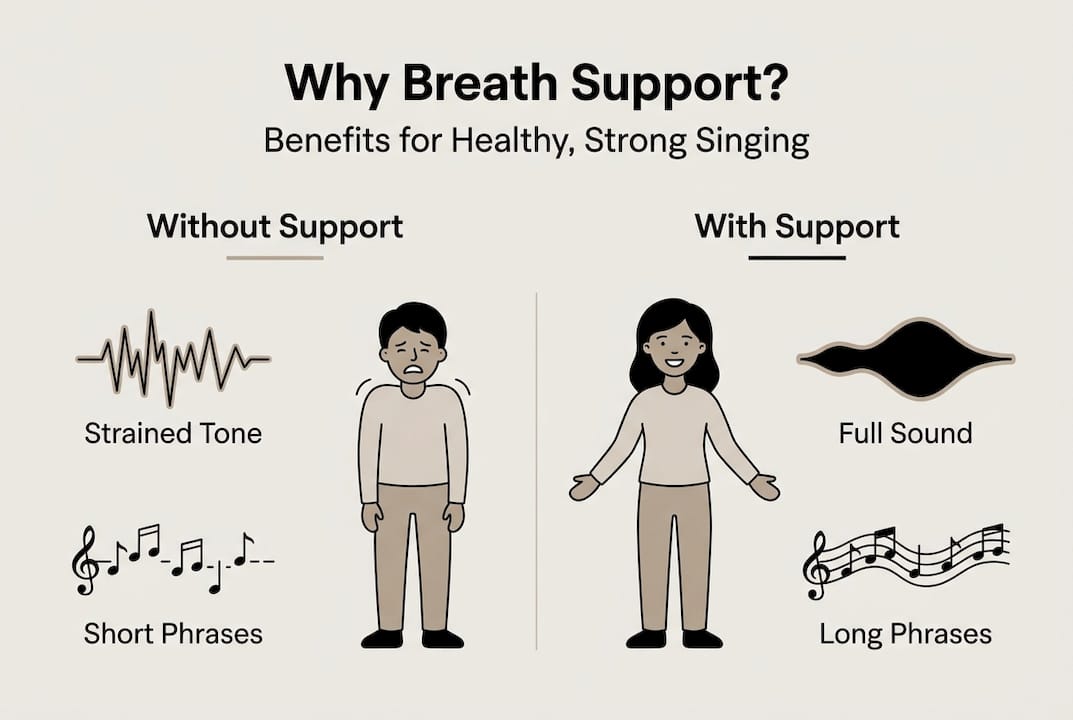
When your breath support clicks into place, the improvements are immediate and measurable. Phrases that used to feel like a sprint become manageable. Your dynamics (the shifts between soft and loud) become intentional rather than accidental. Your tone evens out across your full range.
Breath support enables sustained phrases, dynamic control, extended range, and consistent tone across all registers. These aren’t abstract benefits. They show up in auditions, recordings, and live performances.
Here’s what the research actually shows:
| Benefit | Without support | With proper support |
|---|---|---|
| Phrase length | Short, choppy | Long, sustained |
| Dynamic control | Inconsistent | Precise and intentional |
| Pitch range | Limited, strained at extremes | Expanded, even tone |
| Vocal stamina | Fatigues quickly | Lasts full rehearsals |
| Recovery time | Slow | Faster with less strain |
The numbers back this up. Inspiratory muscle warm-up improves maximum phonation time by 27 to 32% and expands pitch range in singers. That’s a significant jump from a targeted warm-up routine alone.
Key performance improvements from proper breath support:
For a deeper look at how this translates to the stage, explore improving vocal performance and the art of mastering breath control.
Understanding the benefits is only the first step. Here’s how to start on your own breath support journey immediately.
Diaphragmatic breathing, often called belly breathing, is the starting point. You breathe in and your belly expands outward. Your chest stays relatively still. This engages the diaphragm fully and sets up the pressure system your voice needs.
But belly breathing alone isn’t enough. Appoggio breathing engages the diaphragm, intercostals, and abdominals for coordinated inhalation and exhalation control. The intercostals are the muscles between your ribs. When all three muscle groups work together, you get the kind of support that professional singers rely on.
Step-by-step breath support training routine:
Pro Tip: Maximum phonation time is one of the best at-home metrics for tracking breath support progress. Aim to increase your sustained tone by 2 to 3 seconds over four weeks. Consistent gains signal real improvement in muscle coordination. Check out targeted breath support exercises to build a structured routine.
With a foundation in the basics, you can now explore how leading experts refine breath support for both art and science.
Breath support is foundational across genres from opera to pop for vocal health, efficiency, and artistry. The core principles don’t change. What changes is how you apply them.
| Genre | Breath support style | Key emphasis |
|---|---|---|
| Classical/Opera | Appoggio (leaning into the breath) | Sustained pressure, full resonance |
| Musical theater | Hybrid support | Mix of chest resonance and projection |
| Pop/Contemporary | Flexible, stylistic | Breathy tone options, dynamic range |
| Jazz | Phrasing-focused | Nuanced control for improvisation |
| Gospel/R&B | High-energy support | Power with emotional expression |
The classical Italian appoggio and the German Stütze (meaning “prop” or “support”) are often compared. Classical appoggio vs. German Stütze differ in emphasis, with appoggio focusing on leaning into the breath and Stütze on damming or holding back airflow. Both balance inspiratory and expiratory forces. Neither is wrong. They’re different tools for different artistic goals.
“There is no single correct way to support the voice. The best technique is the one that serves your voice, your genre, and your long-term health.”
This is why cookie-cutter advice fails so many singers. Your breath support strategy should be built around your specific voice type, musical style, and any existing vocal health concerns.
Finally, it’s essential to confront lingering myths and highlight the latest science so you can make informed decisions about your vocal development.
Let’s clear the air on a few stubborn misconceptions:
The science keeps evolving. What we know now is that muscular antagonism, not raw air volume, is the engine behind lasting vocal power. Old-school advice to “just breathe deeper” misses the point entirely.
Pro Tip: If a teacher tells you to push harder or take more air, ask them to explain why. Good vocal pedagogy is always rooted in physiology, not just tradition. Staying current with evidence-based breath support facts protects you from outdated methods that can cause real harm.
The bottom line is that breath support is a skill, a science, and a practice. It requires patience, consistency, and the right guidance.
You now have a clear action plan to improve your breath support and protect your voice for the long haul. The next step is making sure you have the right tools to back up your training.

At TMRG Solutions, we’ve spent 25+ years working with singers, voice professionals, and anyone who depends on their voice. Our products are built around the same principles you’ve read about here: reducing strain, supporting recovery, and helping your voice perform at its best. Whether you’re building endurance, recovering from vocal fatigue, or just want to stay ahead of potential issues, the basic voice therapy kit is a smart starting point. For more intensive needs, the standard therapy kit for singers offers a broader range of targeted support. And if your voice needs fast, natural relief, our vocal recovery drops are a go-to for professionals who can’t afford downtime.
Not at all. Breath support benefits anyone who relies on their voice regularly, including public speakers, teachers, actors, and people recovering from vocal injuries or illness.
Yes. Correcting breath technique reduces the phonotrauma that causes nodules. Breath-focused therapy improves MPT and S/Z ratio, which are key markers of vocal fold health and recovery.
Steady tone, no throat tension, and lasting stamina are good signs. If you feel tightness in your throat or run out of breath quickly, your subglottal pressure regulation likely needs work.
Structured exercises can deliver real results quickly. Inspiratory muscle training improves phonation time by 27 to 32% and expands pitch range, often within just a few weeks of consistent practice.
