Your Cart is Empty


TL;DR:
- Voice cracks are natural occurrences caused by temporary loss of muscle coordination in the larynx during pitch transitions. Even professional singers experience them, and proper training focuses on smoothing these transitions rather than eliminating every crack. Recognizing and addressing underlying muscular, physiological, or health issues can improve vocal stability and mastery over time.
Even the most seasoned opera soprano or Broadway actor has experienced that jarring, unexpected shift in tone mid-phrase. Voice cracks are not a sign of poor training or lack of talent. They are a natural product of how your vocal instrument works, and understanding them is the first step toward genuine vocal mastery. This guide covers the science behind voice cracks, what your muscles are actually doing when a crack occurs, what research says about professional singers, when a crack might signal a medical concern, and what you can do today to build smoother, more reliable transitions.
| Point | Details |
|---|---|
| Voice cracks are normal | Even professionals experience cracks due to natural vocal transitions. |
| Muscle coordination is key | Improving the balance of laryngeal muscles helps reduce sudden breaks. |
| Not all cracks signal problems | Occasional cracks are harmless, but persistent ones may need medical attention. |
| Training smooths transitions | Targeted exercises and therapy support more consistent vocal performance. |
Let’s start by understanding exactly what a “voice crack” is before jumping into causes or cures.
A voice crack is a sudden, audible break in sound quality or pitch during phonation (the production of vocal sound). Physically, it happens when the muscles controlling your larynx (voice box) momentarily lose coordination. According to vocal science, a voice crack is a momentary loss of laryngeal muscle control, particularly around transitions in pitch and register.
Your vocal folds (the two bands of muscle and tissue inside the larynx) must adjust in length, thickness, and tension as pitch changes. Two primary muscles manage this process: the cricothyroid (CT), which stretches and thins the folds to raise pitch, and the thyroarytenoid (TA), which thickens and shortens the folds for lower registers. When these muscles fail to hand off smoothly, the result is a crack.
Voice cracks are especially common in the following situations:
“The vocal instrument is not a machine. It responds to fatigue, emotion, hormonal changes, and hydration levels, all of which influence the reliability of muscular coordination.”
Understanding natural prevention tips starts with this foundation: a crack is a coordination failure, not a character flaw.
| Register | Dominant muscle | Typical pitch range |
|---|---|---|
| Chest voice | Thyroarytenoid (TA) | Lower pitches |
| Mixed/middle | CT and TA share load | Mid-range |
| Head/falsetto | Cricothyroid (CT) | Higher pitches |
Problems like incomplete vocal fold closure can also contribute to instability in any of these registers, making cracks more frequent and harder to control.
Having defined a voice crack, let’s get more technical about how the muscles cause these audible breaks.
As you climb in pitch, your brain sends increasingly urgent signals to the CT to elongate and thin your vocal folds. At the same time, it must reduce the TA’s dominance so the folds can stretch fully. This is a delicate, real-time negotiation. When it goes wrong, you hear a crack.
The cricothyroid vs. thyroarytenoid tension can fail to maintain the necessary balance, causing an abrupt snap between registers. Think of it like a gear shift in a car without a clutch: if the timing is off, the whole system lurches.
Researcher Ingo Titze, one of the world’s leading voice scientists, proposed several explanations. Titze’s hypotheses include sudden relaxation of the TA muscle at critical pitch thresholds and the influence of subglottal resonance (air pressure vibrations below the vocal folds) at specific frequencies. Both of these forces can tip the balance and cause an abrupt register change.
Here is a step-by-step breakdown of what typically happens:
Comparison of muscle dominance across registers:
| Condition | CT activity | TA activity | Result |
|---|---|---|---|
| Smooth transition | Gradually increasing | Gradually decreasing | Seamless register blend |
| Abrupt crack | Suddenly dominant | Suddenly drops off | Audible register snap |
| Falsetto stabilized | High | Very low | Consistent thin tone |
Pro Tip: Incorporating vocal support exercises into your daily practice specifically targets the breath pressure and fold tension balance that prevents cracks during transitions.
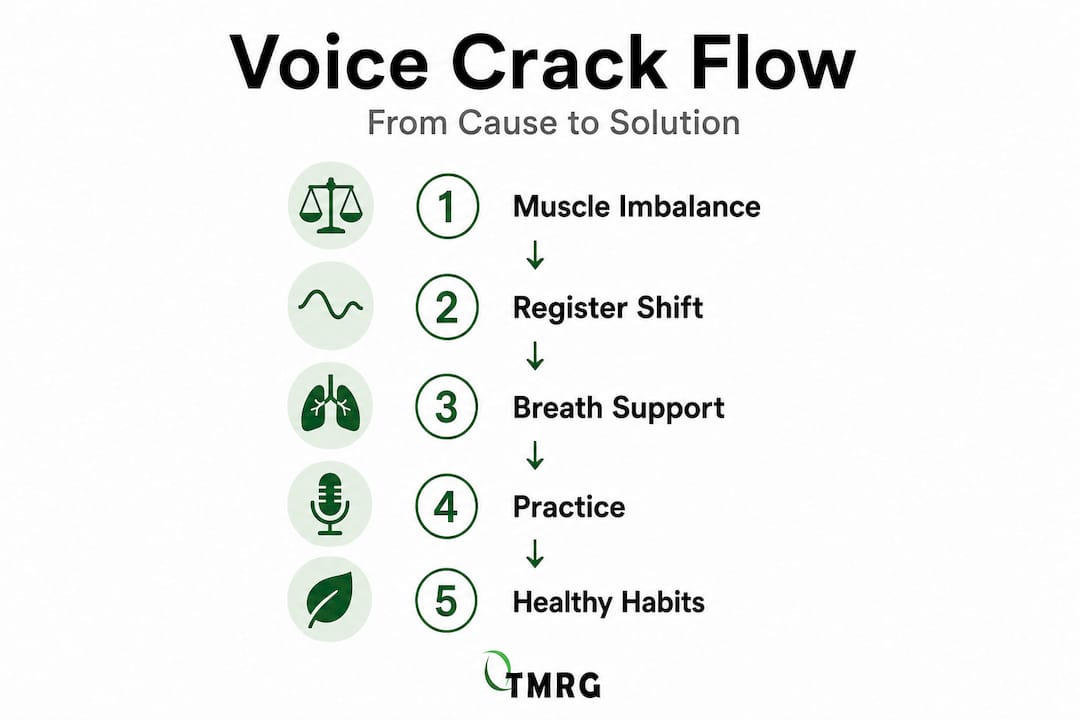
Breath support plays a critical role here. Without consistent subglottal air pressure, the vocal folds cannot maintain steady vibration through a transition. Practicing relaxation and contraction exercises trains the TA and CT to communicate more efficiently, reducing the likelihood of abrupt muscular failure.
Understanding muscles helps you see why cracks happen, but what about the world’s most highly trained voices?
The assumption that professional singers never crack is simply false. Research using high-speed endoscopy (a camera technique that films the vocal folds at thousands of frames per second) has overturned this myth entirely. Professional sopranos show multiple vibratory strategies, with audible register transitions still present even at the highest levels of training. The difference between a professional and an amateur is not the absence of transitions but the speed, smoothness, and artistic intention behind them.
In classical singing, register transitions are referred to as passaggi (plural of passaggio, meaning “passage” in Italian). Rather than hiding these passages, many singers learn to use them artistically. A slight brightening of tone or a subtle color shift at a transition point can add emotional texture to a performance.
Key truths about professional voice cracks:
“The goal of vocal training is not to manufacture a frictionless machine. It is to build a responsive, resilient instrument that can navigate transitions with grace and intention.”
Developing better vocal cord control is fundamentally about building neuromuscular communication, not chasing an unrealistic standard of zero audible variation.
Since occasional cracks are normal, let’s discuss signs that indicate a more serious medical issue.

Most voice cracks are benign and temporary. However, some cracks signal that something more significant is happening inside the larynx. Knowing the difference is essential for anyone who relies professionally on their voice.
Watch for these warning signs:
These symptoms may point to structural changes in the vocal folds. Vocal pathologies such as nodules, polyps, and laryngitis can alter the mass, stiffness, and vibration pattern of the folds, causing instability and increased cracking. The good news is that early intervention through voice therapy often produces significant improvement, and in many cases surgery is not required.
Nodules (small callous-like growths) tend to develop from chronic vocal overuse or poor technique. Polyps (fluid-filled lesions) can form from a single traumatic vocal event, such as screaming at a concert or singing through illness. Laryngitis causes temporary swelling that makes fold coordination inconsistent.
Pro Tip: If you notice any sudden change in your voice quality that persists beyond a week, consult an ENT (ear, nose, and throat) specialist or laryngologist before resuming heavy vocal use. Early diagnosis saves careers.
Addressing your vocal health issues proactively rather than waiting until the damage is significant is always the wiser path. Most vocal professionals who lose their voices to pathology report that early warning signs were present months before the crisis point.
Ready to take action? Here’s what you can do to smooth out transitions and stay vocally healthy.
Building smooth, reliable transitions is not about drilling the crack out of your voice. It is about teaching your muscles to communicate better. Voice therapy and targeted exercises improve acoustic stability and perceptual ratings in singers dealing with recurrent or pathological voice cracks. Even if your cracks are purely a training issue, these strategies will accelerate your progress.
Follow these steps consistently:
Learning to treat stiff vocal cords is often part of the same process, because stiffness in the folds makes the hand-off between registers less fluid. Similarly, work to improve vocal strength in the supporting muscles, including the respiratory and resonance systems, because a strong foundation reduces the demand placed on the folds themselves.
Pro Tip: Exploring music and pronunciation strategies can also sharpen your awareness of resonance placement and airflow, which directly supports cleaner register transitions.
Most guides on voice cracks present them as problems to be fixed and eliminated. After 25+ years of working with singers, actors, and vocal professionals at TMRG Solutions, we see them differently.
The pursuit of zero cracks is not only unrealistic, it is artistically limiting. When a singer becomes obsessed with never cracking, they often begin to constrict and over-control the voice. They avoid high notes, soften passages that should be bold, and unconsciously narrow their range. The result is a technically “cleaner” voice that is emotionally flatter and physically tighter.
A crack, in many cases, is simply your voice telling you something. It might be telling you that your breath dropped, that your warm-up was too short, or that the tension you are carrying in your neck is interfering with the larynx. These are useful signals. Singers who learn to read their cracks rather than fear them often make faster progress than those who simply practice harder to suppress them.
True mastery comes from understanding your instrument at a physical and acoustic level, knowing what each sensation means, and responding intelligently. If a crack appears during a practice session, treat it as data rather than failure. Identify the condition that caused it, adjust one variable (breath, vowel, posture, support), and try again.
This is also why addressing the physical root cause matters so much. Learning how to handle treating vocal stiffness is not just a mechanical fix. It is part of the larger process of listening to your body and building a healthier, more expressive relationship with your voice.
The singers and professionals who come to us with the most progress are not the ones who never cracked. They are the ones who got curious about their cracks.
If voice stability matters to you, specialized resources can make your path easier, and here is how to get started.
At TMRG Solutions, we have spent 25+ years developing targeted solutions for exactly the kind of vocal challenges described in this article. Whether you are dealing with persistent register breaks, vocal fatigue after performances, or early signs of vocal strain, our range of natural herbal formulations, voice therapy kits, and educational resources is designed to meet you where you are.

Our products are formulated with vocal professionals in mind, drawing on clinical insights and real-world feedback from singers, actors, and voice coaches. From daily care sprays that support hydration and tissue health to structured therapy guides that walk you through register blending exercises, every solution at tmrgsolutions.com is built around one goal: giving your voice what it needs to perform reliably, night after night.
Voice cracks in adults are often caused by sudden changes in laryngeal muscle coordination, transitions between vocal registers, or medical issues such as nodules or laryngitis. Sudden muscle relaxation and laryngeal pathology are two of the most frequently identified triggers.
No, even professional singers experience occasional cracks; the goal is smoother transitions and better coordination rather than total elimination. Expert singers still produce audible register breaks under clinical observation, confirming that training refines rather than erases this physiological reality.
Persistent, painful, or rapidly worsening cracks may indicate underlying vocal pathologies that require professional diagnosis and treatment. Laryngeal pathology can worsen cracking, and early voice therapy has been shown to produce meaningful improvement.
Consistent warm-ups, diaphragmatic breath support, register blending exercises, adequate hydration, and professional voice therapy all help reduce the frequency of voice cracks. Voice therapy and targeted exercises improve vocal stability and reduce cracking over time with sustained practice.
