Your Cart is Empty


TL;DR:
- Voice cracks result from muscle coordination failure during register transitions, not just poor technique.
- Medical issues like nodules, reflux, dehydration, and inflammation significantly contribute to vocal instability.
- Consistent vocal health habits like hydration, warm-ups, and lifestyle changes are crucial for prevention and recovery.
Voice cracks catch performers off guard at the worst moments. You’re mid-phrase in a performance, reaching for a note that’s well within your range, and suddenly your voice snaps into an uncontrolled squeak or drops out entirely. Most singers and speakers assume this means their technique is failing them. The truth is more nuanced, and understanding it can change how you care for your voice permanently. Voice cracks are rooted in physiology, lifestyle, and health factors that no amount of technique work alone can fully address.
| Point | Details |
|---|---|
| Voice cracks are complex | They result from both muscular miscoordination and medical or lifestyle factors, not just poor technique. |
| Medical issues can trigger cracks | Nodules, polyps, reflux, or dehydration are common culprits behind persistent or frequent cracking. |
| Hydration and reflux are key | Drinking enough water and controlling acid reflux prevents sticky mucus and vocal fold irritation. |
| Natural habits help prevention | Gentle warm-ups, humidification, and vocal rest are effective, science-backed ways to reduce cracks. |
| Holistic care works best | Combining technique with vocal health and self-care gives long-term resilience and performance quality. |
Voice cracks are not random. They follow a specific physiological pattern that, once you understand it, becomes much easier to manage and prevent.
Your vocal folds (the two bands of muscle and tissue inside your larynx) produce sound by vibrating together as air passes through them. Two key muscle groups control their tension and thickness. The cricothyroid muscle stretches the folds to produce higher pitches, while the thyroarytenoid muscle shortens and thickens them for lower, fuller tones. When you move between vocal registers, your brain signals these muscles to shift their balance of tension. If that coordination fails even slightly, the folds snap from one configuration to another instead of transitioning smoothly. That snap is what you hear as a crack.
Understanding how vocal fold mechanics work is the foundation for preventing cracks. You cannot fix what you don’t fully understand.
Vocal registers are distinct zones of vibration. Chest voice uses full fold contact and produces rich, powerful sound. Head voice thins the folds and engages more of the upper resonance cavities. Falsetto is an even lighter configuration where the folds barely touch. Moving between these zones, especially under pressure or fatigue, is where most cracks happen.
As vocal fold research confirms, voice cracks in vocal performers result from vocal fold muscles failing to coordinate tension, causing snaps between registers like chest and falsetto. This is not a character flaw or a sign of poor musicianship. It is a neuromuscular coordination challenge.
| Register | Primary muscle | Typical pitch range | When cracks most often occur |
|---|---|---|---|
| Chest voice | Thyroarytenoid | Low to mid range | Transitioning upward under fatigue |
| Head voice | Cricothyroid | Mid to upper range | Shifting downward too quickly |
| Falsetto | Cricothyroid (extreme) | Upper range | Sudden dynamic changes |
| Mixed/blend | Both muscles | Mid range | Inconsistent breath support |
Common situations where voice cracks occur:
Understanding the physical mechanism is just the beginning. Medical and lifestyle factors also play a huge role in vocal stability, and many performers overlook these entirely.

When your vocal folds are irritated, swollen, or coated in thick mucus, even perfect technique cannot prevent cracks. The folds simply cannot vibrate evenly when their surface is compromised. This is why two singers with identical technique can have vastly different experiences with vocal stability: one maintains excellent vocal health habits, and the other does not.
Vocal nodules and cracks are closely connected. Nodules are small, callus-like growths that form on the folds from chronic overuse, yelling, or poor vocal technique sustained over time. Polyps and vocal issues share a similar relationship, though polyps often develop from a single traumatic vocal event or from chronic acid reflux. Both conditions disrupt the smooth, even vibration that your voice needs to move cleanly between registers.
According to Merck Manuals, pathologies cause cracks through nodules and polyps acting as calluses from overuse, inflammation from laryngitis or colds, reflux irritating the folds, and dehydration producing sticky mucus. Each of these disrupts the fold surface in a different way, but the result is the same: unpredictable, unstable vibration.
Importantly, over 90% of vocal nodules resolve with proper voice therapy, meaning surgery is rarely necessary if you catch the problem early and commit to rehabilitation. That statistic should be both reassuring and motivating.
Medical and lifestyle causes to watch for:
Acid reflux and your voice deserve particular attention. LPR is often called “silent reflux” because many sufferers never feel the classic heartburn sensation. Instead, acid reaches the larynx during sleep or after meals, depositing irritants directly on the vocal fold surface. The result is chronic hoarseness, mucus buildup, and a voice that cracks unpredictably even when you feel otherwise healthy.
Signs that a voice crack may be medical rather than technical:
If you recognize these signs, review tips for hoarseness and consider consulting a laryngologist for a professional evaluation.
Pro Tip: If you notice increased cracking after meals or in the morning, LPR may be the culprit. Elevating your head during sleep and avoiding eating within two hours of bedtime can reduce nighttime acid exposure to your folds significantly.
With medical and lifestyle risks in mind, let’s focus on the two factors that most performers underestimate: hydration and reflux management.
Hydration is not just about drinking water. It is about maintaining the thin, slippery mucus layer that coats your vocal folds and allows them to vibrate smoothly thousands of times per second. When you are dehydrated, this mucus becomes thick and sticky, as noted in clinical vocal pathology literature. Thick mucus creates uneven resistance across the fold surface, which makes clean register transitions nearly impossible. Think of it like trying to slide two surfaces together when there is friction instead of lubrication. The voice catches and snaps instead of gliding.
Hydration and vocal health are inseparable for performers. The folds themselves cannot be hydrated instantly by drinking water. Systemic hydration, meaning water absorbed through your digestive system and delivered to tissues throughout your body, takes time. This is why you need to stay consistently hydrated throughout the day, not just before a performance.
Reflux management is equally critical. LPR creates a cycle of irritation that is difficult to break without deliberate lifestyle changes. Acid deposits cause swelling, swelling disrupts vibration, disrupted vibration causes cracks, and the stress of cracking can lead to compensatory vocal tension that makes everything worse.
Daily steps for hydration and reflux prevention:
Proven hydration strategies go beyond simply drinking more water. Steam inhalation, for example, provides surface hydration directly to the laryngeal lining and can offer immediate relief when your voice feels dry and tight before a performance.
The effects of heartburn on the voice are often underestimated because the connection is not always obvious. Many performers treat their cracks with vocal exercises for months without improvement, not realizing that chronic acid exposure is the root cause.
Pro Tip: Warm water, not hot, is optimal for mucosal function. Very hot liquids can temporarily inflame the laryngeal lining, while cold water can cause the muscles around the larynx to tighten. Sip warm water consistently throughout rehearsals and performances for the best results.
With the big triggers mapped out, how can you safeguard your voice every day? Here are habits and interventions that work.
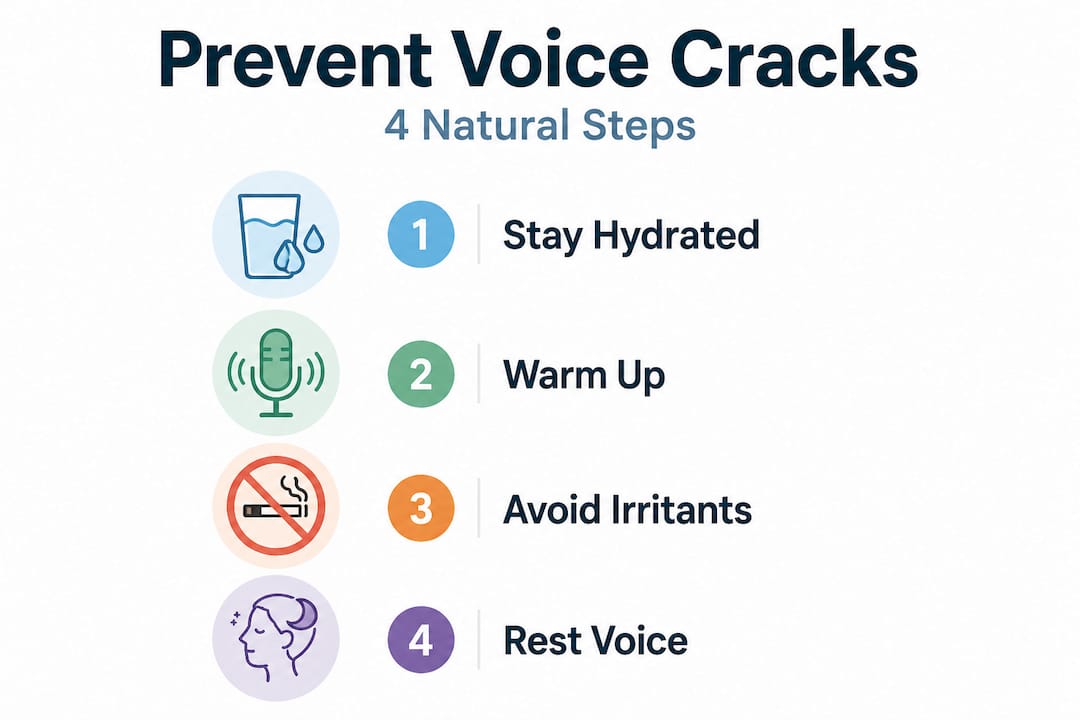
Prevention is not a single action. It is a system of daily choices that collectively protect the folds from the stresses of performance life. The performers who maintain the most stable, reliable voices are not necessarily the most talented. They are the most consistent in their vocal care routines.
Science-backed natural habits for vocal resilience:
Many other reasons for hoarseness overlap with voice crack triggers. Addressing hoarseness and cracks together through consistent natural habits is far more effective than treating each symptom in isolation.
| Natural remedy | Effectiveness | Effort required | Evidence level |
|---|---|---|---|
| Consistent hydration | High | Low | Strong clinical support |
| Steam inhalation | Moderate to high | Low to moderate | Good anecdotal and clinical support |
| Saline nasal rinse | Moderate | Low | Moderate clinical support |
| Herbal throat sprays | Moderate | Very low | Growing evidence, widely used |
| Vocal warm-ups | High | Moderate | Strong performance evidence |
| Humidification | High | Low | Strong clinical support |
| Dietary reflux control | High | Moderate to high | Strong clinical support |
| Voice rest | Very high | Low (willpower required) | Strong clinical support |
The Merck Manuals consistently highlight that the most effective interventions for vocal pathologies combine behavioral changes, hydration, and professional therapy rather than relying on any single remedy. Natural approaches work best when they are layered and maintained daily.
Daily consistency is the key word here. A single day of perfect hydration will not undo weeks of vocal overuse. But two to three weeks of disciplined vocal care habits can produce noticeable improvements in register stability, fold resilience, and overall voice quality.
Here is an uncomfortable truth that we have observed over 25 years of working with vocal performers: most mainstream advice about voice cracks is incomplete. Not wrong, necessarily, but dangerously incomplete.
The dominant narrative is simple: if your voice cracks, you need more technique work. Practice your passaggio (the transition zone between registers). Strengthen your mixed voice. Work with a coach. And yes, all of that is valuable. But it treats voice cracks as a purely mechanical problem, like a car that needs a tune-up.
What this narrative misses is that the engine itself may be damaged. A performer can have excellent technique and still crack constantly if they have undiagnosed LPR eating away at their fold surface every night. A singer can practice register transitions for hours and still crack if they are chronically dehydrated or performing in dry air without humidification. Technique is the ceiling of what your voice can do. But your physical health is the floor it stands on.
We also see performers who are so focused on voice function in performance that they ignore warning signs their body is sending. Persistent cracking is not just a technical inconvenience. It is your voice telling you that something needs attention. Ignoring it and pushing through with more practice often accelerates damage rather than resolving it.
The best outcomes we have seen come from performers who treat vocal health as a complete system: technique, medical self-care, hydration, diet, rest, and honest reflection on lifestyle habits. Not one or two of these, but all of them, working together. A voice crack is rarely just one thing. It is usually several small problems compounding each other until the system breaks down.
The performers who recover fastest are the ones who stop asking “what exercise will fix this?” and start asking “what is my body trying to tell me?” That shift in perspective is more valuable than any single remedy.
For those ready to combine natural habits with trusted support, consider solutions designed for the unique needs of performers.
At TMRG, we have spent over 25 years developing natural, evidence-informed products specifically for singers, actors, and speakers dealing with vocal instability, cracks, and recovery from overuse. Our therapy kits bring together herbal formulations, hydration support, and vocal care tools in one targeted package.

Whether you are recovering from nodules, managing reflux-related hoarseness, or simply want to build a stronger daily vocal care routine, our basic voice therapy kit offers an accessible starting point. For more intensive support, the standard voice therapy kit includes additional formulations suited for performers with ongoing vocal challenges. Explore our full vocal problems resource to find the right solution for your specific situation. Your voice deserves targeted care, not generic advice.
Occasional cracks are normal, but persistent or painful cracking may indicate nodules, polyps, or other vocal fold injury requiring a doctor’s evaluation.
High notes require precise muscle coordination between the cricothyroid and thyroarytenoid muscles; if the vocal folds can’t adjust smoothly between registers, cracks are most likely to occur at the upper range.
Hydration keeps vocal fold mucus thin and vibration smooth, which is critical for avoiding cracks; dehydration produces sticky mucus that makes even simple register transitions unstable.
Over 90% of vocal nodules resolve with proper therapy, and recovery typically takes several weeks to a few months depending on severity and consistency of treatment.
