Your Cart is Empty


Even seasoned singers and professional actors deal with hoarseness, vocal fatigue, and loss of range far more often than most people admit. 3-9% of US adults experience voice disorders at any given time, and vocal professionals face even higher exposure due to heavy daily use. The difference between a short setback and a career-threatening problem often comes down to one thing: whether you have a science-backed system in place, or whether you are relying on guesswork and old habits. This guide covers the mechanics, the daily routines, and the remedies that actually move the needle.
| Point | Details |
|---|---|
| Routines matter most | Consistent hydration, warm-ups, and avoiding irritants are your best daily defenses. |
| Natural remedies work for many | Steam, herbal teas, honey, and saltwater can often ease hoarseness and fatigue naturally. |
| Know when to seek help | If voice issues persist over two weeks, involve an ENT or SLP for a thorough assessment. |
| Evidence trumps myths | Scientific routines and multidisciplinary support outperform shortcuts and unsupported remedies. |
With the scale of voice disorders clear, it is vital to define what true professional care actually means. Professional voice care involves systematic protection, maintenance, and optimization of the vocal instrument. It is not a single product or a one-time fix. It is a structured approach that combines anatomical awareness, consistent daily habits, and timely interventions when problems arise.
Your voice is produced by the vibration of the vocal folds, two small muscular bands inside the larynx. Sound is then shaped by resonance cavities in your throat, mouth, and nasal passages. When any part of this system is strained, dehydrated, or inflamed, the quality and reliability of your voice suffers. Understanding this chain of events is the first step toward protecting it.
Professional voice care applies to singers, actors, lecturers, broadcasters, and anyone whose livelihood depends on vocal output. The core elements include:
Exploring vital voice care strategies and understanding the role of medical professionals in your care team can significantly extend your vocal longevity.
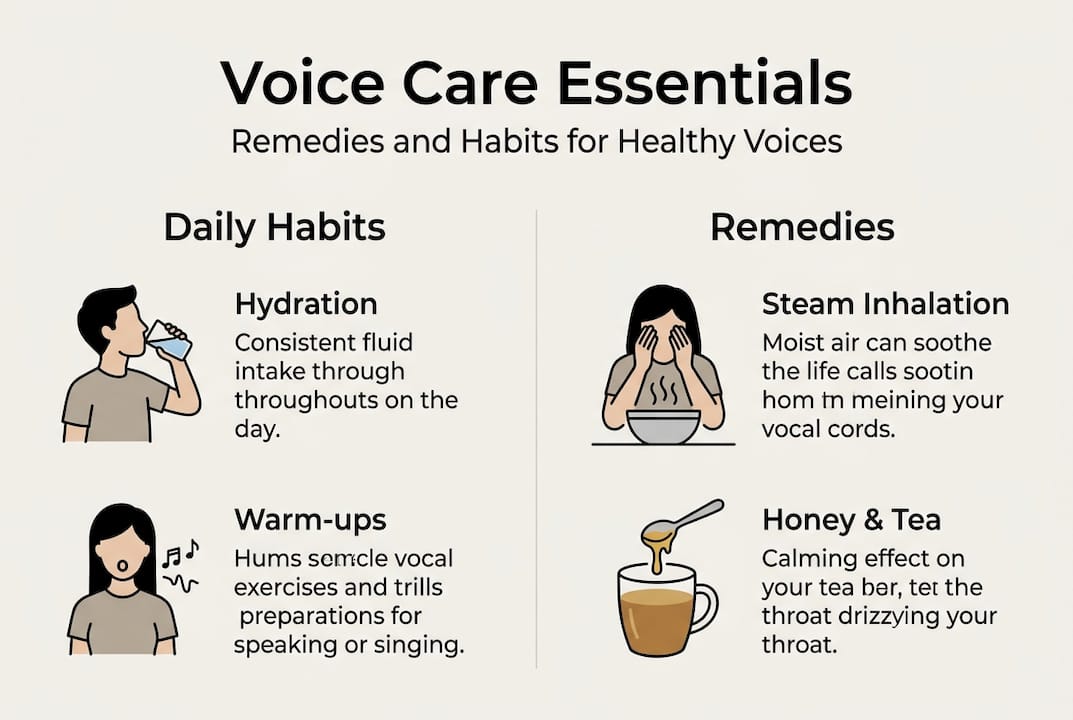
Having set the conceptual foundation, let us move to the practical day-to-day methods that build resilient voices. Key practices include hydration, warm-ups, diaphragmatic breathing, posture, humidification, avoiding irritants, vocal rest, and a balanced diet. Each of these works together as a system, not in isolation.
Hydration and humidification are your first line of defense. Aim for 8-10 glasses of water daily to keep your vocal folds lubricated and pliable. Dry air, especially in heated or air-conditioned spaces, pulls moisture away from the mucous membranes that protect your folds. A room humidifier set between 40-50% humidity makes a measurable difference, particularly during heavy performance schedules.
Warm-ups and cool-downs are non-negotiable. Research shows that an inspiratory muscle warm-up improves maximum phonation time by 21%. That is a significant gain from a 10-minute routine. Follow this sequence before any demanding vocal session:
Our warm-up guide and detailed breakdown of the role of warm-ups explain the physiology behind each step.
Diaphragmatic breathing supports both stamina and tone. When you breathe from the diaphragm rather than the chest, you generate consistent, controlled airflow that reduces strain on the vocal folds. Pair this with upright posture and a relaxed jaw to allow your resonance cavities to work at full capacity.
Pro Tip: Avoid caffeine, alcohol, and smoking in the 24 hours before a major performance. All three dehydrate the vocal folds and increase inflammation, making your voice less predictable under pressure.
| Habit | Measurable impact |
|---|---|
| 8-10 glasses of water daily | Improved fold lubrication and reduced friction |
| Inspiratory warm-up routine | Up to 21% increase in max phonation time |
| Diaphragmatic breathing practice | Greater stamina and reduced vocal fatigue |
| Humidifier use (40-50% humidity) | Reduced mucosal dryness during performance |
| Eliminating caffeine before shows | Lower inflammation and more consistent tone |
Strong vocal habits are crucial, but issues still arise. Here is what works when problems strike. Steam inhalation, herbal teas, salt water gargles, and avoiding whispering are among the most effective first-response strategies for hoarseness and fatigue.

Steam inhalation delivers moisture directly to the larynx and upper airway, reducing inflammation and loosening mucus. Use a bowl of hot water with a towel over your head, or a personal steam inhaler, for 10-15 minutes. Do this twice daily when your voice feels strained.
Ginger tea and honey are a powerful combination. Ginger has natural anti-inflammatory properties, and honey outperforms placebo for cough relief and throat soothing. Add a teaspoon of raw honey to warm (not boiling) ginger tea and sip slowly. Avoid adding lemon if your throat is already irritated, as the acidity can worsen inflammation.
Salt water gargles reduce swelling and clear irritants from the throat. Dissolve half a teaspoon of salt in a glass of warm water and gargle for 30 seconds, two to three times a day.
Pro Tip: Hydration amplifies every remedy on this list. If you are dehydrated, steam and herbal teas will have a fraction of their potential effect. Drink water consistently throughout the day, not just when your throat feels dry.
Here is what to avoid:
| Remedy | Evidence level | Safety | When to see a pro |
|---|---|---|---|
| Steam inhalation | Moderate | High | If no improvement in 5-7 days |
| Honey | Strong for cough | High | If swallowing is painful |
| Salt water gargle | Moderate | High | If throat is visibly swollen |
| Herbal teas (slippery elm, licorice) | Mixed | Generally safe | If symptoms persist beyond 2 weeks |
| Menthol/alcohol-based sprays | Low | Moderate risk | Avoid during acute episodes |
For a broader look at your options, our guides on effective vocal remedies, tips for hoarseness, voice loss remedies, and recovering from hoarseness naturally cover each approach in depth.
Natural solutions serve most needs, but knowing when and how to seek expert advice is vital. Professional singers often need dynamic assessment, and chronic hoarseness should be evaluated if it lasts longer than two weeks. This is not a guideline to take lightly.
Some vocal issues have underlying causes that no amount of honey or steam will resolve. Acid reflux, for example, sends stomach acid up to the larynx during sleep, causing chronic inflammation that mimics overuse injury. Allergies create post-nasal drip that irritates the folds constantly. Understanding the link between reflux and vocal cords is essential if you experience recurring morning hoarseness or a persistent need to clear your throat.
When you do see a specialist, they may use acoustic analysis to measure specific voice quality metrics:
These numbers give your care team an objective baseline and allow them to track your progress over time. It is far more precise than simply asking, “Does your voice feel better?”
Warning: Seek immediate evaluation if you experience hoarseness lasting more than two weeks, a sudden loss of vocal range, pain during speaking or singing, or any unexplained change in voice quality. These are red flags that require professional assessment, not more home remedies.
Annual checkups with an ENT, combined with regular sessions with an SLP and your vocal coach, form the most complete safety net available. If you are unsure where to start, a voice solution assessment can help you identify the right level of support for your specific situation.
For readers ready to take action, specialized solutions can complement the daily and emergency practices detailed above. At TMRG Solutions, we have spent 25+ years formulating natural remedies and therapy tools specifically for singers, actors, and public speakers. Our products are designed to work alongside the habits and routines in this guide, not replace them.

If you are dealing with ongoing vocal issues, the Voice Therapy Kit Basic gives you a structured starting point with everything you need for daily care and acute recovery. For performance support and maintenance, our voice enhancement drops are formulated to keep your voice responsive and full under pressure. You can also browse our full range of solutions for addressing vocal problems to find the right fit for your voice type and schedule.
Aim for 8-10 glasses of water a day to keep your vocal folds lubricated and your mucous membranes functioning well. Consistent hydration throughout the day is more effective than drinking large amounts at once.
Yes. Steam inhalation and herbal teas like slippery elm or licorice root, combined with honey and salt water gargles, are among the most evidence-backed options for soothing and restoring your voice. Always pair them with adequate rest and hydration.
See an ENT or SLP if your hoarseness lasts longer than 2 weeks or is accompanied by pain, difficulty swallowing, or a sudden change in your vocal range. Early evaluation prevents minor issues from becoming chronic ones.
Whispering actually increases tension in the vocal folds and can worsen strain, making it counterproductive during recovery. Gentle, supported speech at a moderate volume is far less damaging than a forced whisper.
Honey outperforms placebo for cough relief and has genuine soothing properties for the throat, but it works best as part of a broader care routine. It is not a standalone cure, but it is one of the most reliable natural tools you have.
