Your Cart is Empty


Vocal loss can follow heavy voice use, respiratory irritation, reflux, dehydration, allergies, mucus buildup, poor sleep, shouting, or technique habits that create extra throat effort. The fastest useful step is to reduce load and identify what changed before symptoms appeared.
Use conservative recovery basics first: rest the voice, hydrate, avoid smoke and irritants, limit throat clearing, use gentle warmups only when comfortable, and avoid forcing volume or range. TMRG products can support throat comfort and voice-care routines, but they do not diagnose, treat, or cure medical conditions.
Helpful TMRG next steps: compare Hoarseness Voice Support, Vocal Load Support, and Lost Voice Support.
Sudden voice loss, breathing difficulty, bleeding, severe pain, fever, or symptoms that persist or recur should be evaluated by a qualified clinician or voice professional.
Vocal loss can turn a promising performance into a source of worry for any professional singer or actor. When your career relies on vocal strength, subtle changes in your voice become more than a minor inconvenience. Misunderstandings about what truly causes vocal loss and how to address it can delay recovery and worsen your condition. Discover the truth behind common myths and learn practical, natural approaches for restoring your voice, all grounded in what performers need most—reliable, sustainable vocal health.
| Point | Details |
|---|---|
| Understanding Vocal Loss | Vocal loss ranges from quality changes to inability to produce sound, affecting performers’ reliability and requiring immediate attention. |
| Myths About Vocal Loss | Vocal loss can arise from multiple factors, not just overuse, and rest alone won’t heal structural damage. |
| Importance of Medical Evaluation | Persistent voice changes warrant medical evaluation to identify underlying issues before they escalate. |
| Prevention Strategies | Hydration, proper vocal technique, and strategic rest are critical in maintaining vocal health and preventing damage. |
Vocal loss isn’t simply waking up one morning unable to speak. It’s a spectrum that ranges from subtle changes in your vocal quality to complete inability to produce sound. For professional singers and actors, understanding what vocal loss actually means separates informed prevention from panic-driven mistakes.
Vocal loss occurs when the quality, pitch, and loudness of your voice become different or inappropriate for your individual needs as a performer. This differs from hoarseness, which is typically a roughness in tone quality. You might experience vocal cord disorders ranging from temporary inflammation to structural damage. The key distinction is that vocal loss affects your ability to control, sustain, or produce your voice reliably, whereas hoarseness describes a specific sound quality change. Many performers confuse the two conditions, delaying proper intervention because they assume “rough voice equals I just need rest.” That’s not accurate. A hoarse voice can be the first warning sign of deeper structural or functional problems.
Common myths about vocal loss often do more harm than good. One pervasive myth suggests that vocal loss only happens to singers who scream or perform excessively. Reality? Voice disorders stem from multiple causes simultaneously. According to voice disorder research, most cases involve more than one contributing factor. You might develop vocal loss from a combination of vocal misuse (talking too loudly in rehearsals), environmental irritation (dry air in theater dressing rooms), and inefficient vocal technique. Addressing just one factor won’t resolve the issue.
Another dangerous myth claims that rest alone heals vocal loss. While rest helps acute inflammation, it does nothing for structural damage like nodules or polyps, and it can actually worsen functional problems caused by poor vocal habits. Your voice behaves differently than a sprained ankle. You can’t simply immobilize it and expect healing. Worst of all, complete voice rest without professional guidance can lead to deconditioning, making vocal recovery slower when you resume speaking or singing.
Third, many performers believe vocal loss happens suddenly and without warning. In truth, most vocal loss develops gradually through accumulated stress on your vocal mechanism. You might notice subtle changes: your high notes feel strained, your voice fatigues faster than usual, or you’re clearing your throat more frequently. These are your nervous system’s way of signaling trouble. Ignoring these early indicators is like driving with your check engine light on for months.
Pro tip: Start tracking subtle vocal changes immediately: note when your voice feels different, what activity triggered it, and whether rest improves it within 24 hours. This information proves invaluable when consulting voice professionals and helps you identify patterns before they become serious problems.
Your vocal loss rarely appears in isolation. Behind most cases of voice problems lies a specific medical condition or environmental factor—sometimes multiple factors working together. As a professional performer, recognizing these triggers gives you the power to prevent them rather than scramble for solutions after damage occurs.
Medical triggers form the foundation of many vocal problems. Infections like laryngitis inflame your vocal cords, causing temporary loss of control and quality. Allergies trigger similar swelling and mucus buildup that impairs vocal cord movement. Acid reflux disease burns the delicate tissues surrounding your vocal mechanism, creating chronic irritation that builds over time. Neurological conditions like spasmodic dysphonia cause involuntary muscle contractions in your larynx, making voice production feel erratic and exhausting. Aging affects vocal cord elasticity naturally, requiring different techniques as you progress through your career. Voice disorders from infections and neurological problems deserve immediate medical attention because they worsen without intervention.
Structural growths represent another category of medical triggers. Nodules develop from repeated vocal trauma, forming small calluses on your vocal cords. Polyps appear as fluid-filled sacs, usually from one-time intense vocal abuse or chronic irritation. Both conditions prevent your vocal cords from closing completely, resulting in breathy, strained sound. The difference matters: nodules typically appear in pairs (one on each cord) and develop gradually, while polyps often appear singly and can develop suddenly. Without proper intervention, both can progress from treatable to requiring surgical removal.
Environmental factors often combine with medical triggers to accelerate vocal damage. Smoking irritates your respiratory system and thickens mucus, forcing your vocal cords to work harder. Dry air strips moisture from your throat, making tissues more susceptible to injury during performance. Allergens like dust in theater spaces trigger inflammation that compromises your voice for days. Prolonged exposure to environmental irritants—pollution, secondhand smoke, dry heated rooms—creates chronic stress on your vocal mechanism. Smoking and environmental irritants accelerate structural damage when combined with vocal misuse, making prevention exponentially more important than treatment after the fact.
The dangerous part? These triggers compound each other. A performer with untreated acid reflux who smokes and practices in a dry environment isn’t facing three separate problems—they’re facing one accelerated spiral toward vocal damage. Your vocal cords become inflamed from reflux, then irritated by smoke, then further stressed by dry air, then pushed beyond safe limits during rehearsal. Each factor magnifies the others’ effects.
Pro tip: If you experience persistent hoarseness, throat pain, or voice changes lasting more than two weeks, schedule medical evaluation before assuming it’s routine vocal fatigue. Early identification of medical triggers like reflux or infections prevents them from evolving into structural damage requiring months of recovery.
Vocal dysfunction isn’t a single condition. The way your voice breaks down depends entirely on what’s causing the problem. Understanding which category your vocal issue falls into shapes your recovery strategy and timeline, especially as a professional performer whose livelihood depends on vocal reliability.
Organic disorders involve actual physical or neurological damage. Structural problems include nodules, polyps, scarring, or inflammation of the vocal cords themselves. These are things a laryngologist can see during examination. Neurological disorders like vocal cord paralysis or spasmodic dysphonia involve problems with the nerves controlling your vocal mechanism. Vocal cord paralysis impacts voice recovery differently than other organic disorders because it affects muscle control rather than tissue integrity. With organic disorders, your voice quality typically deteriorates in specific ways: breathiness from incomplete cord closure, strain from swelling, or tremor from neurological dysfunction. Recovery often requires medical intervention, not just technique adjustment. A polyp won’t disappear through vocal rest or therapy alone. Organic disorders demand a medical diagnosis first, then targeted treatment.
Functional disorders stem from how you use your intact vocal mechanism. Poor vocal technique, throat tension, inadequate breath support, and vocal misuse fall into this category. Your vocal cords are structurally normal, but you’re using them inefficiently. Think of it like driving a perfectly fine car with the parking brake engaged—the car works, but something is preventing optimal performance. Many performers develop functional disorders after years of compensating for other problems or pushing through fatigue. Symptoms include vocal fatigue that worsens throughout the day, difficulty reaching your normal range, and persistent hoarseness without visible structural damage. The good news? Functional disorders often respond well to voice therapy and technique retraining. You’re not fighting tissue damage; you’re relearning how to use what you have.
Psychogenic disorders involve psychological factors affecting voice production. Stress, anxiety, or trauma can cause voice loss despite normal vocal cord anatomy and function. Some performers experience voice changes during high-stress periods that disappear once stress decreases. Vocal cord dysfunction can present as abnormal cord closure during breathing, mimicking other conditions but requiring identification of psychological triggers. While less common in professional singers, understanding this category prevents misdiagnosis and inappropriate treatment.
The impact of each type differs dramatically. Organic disorders typically require longer recovery periods and may involve permanent changes requiring technique adaptation. Functional disorders respond faster to intervention but demand consistent practice and habit change. Psychogenic issues resolve when underlying stress factors improve. Accurate diagnosis determines whether your path forward involves surgery, therapy, technique training, or stress management.
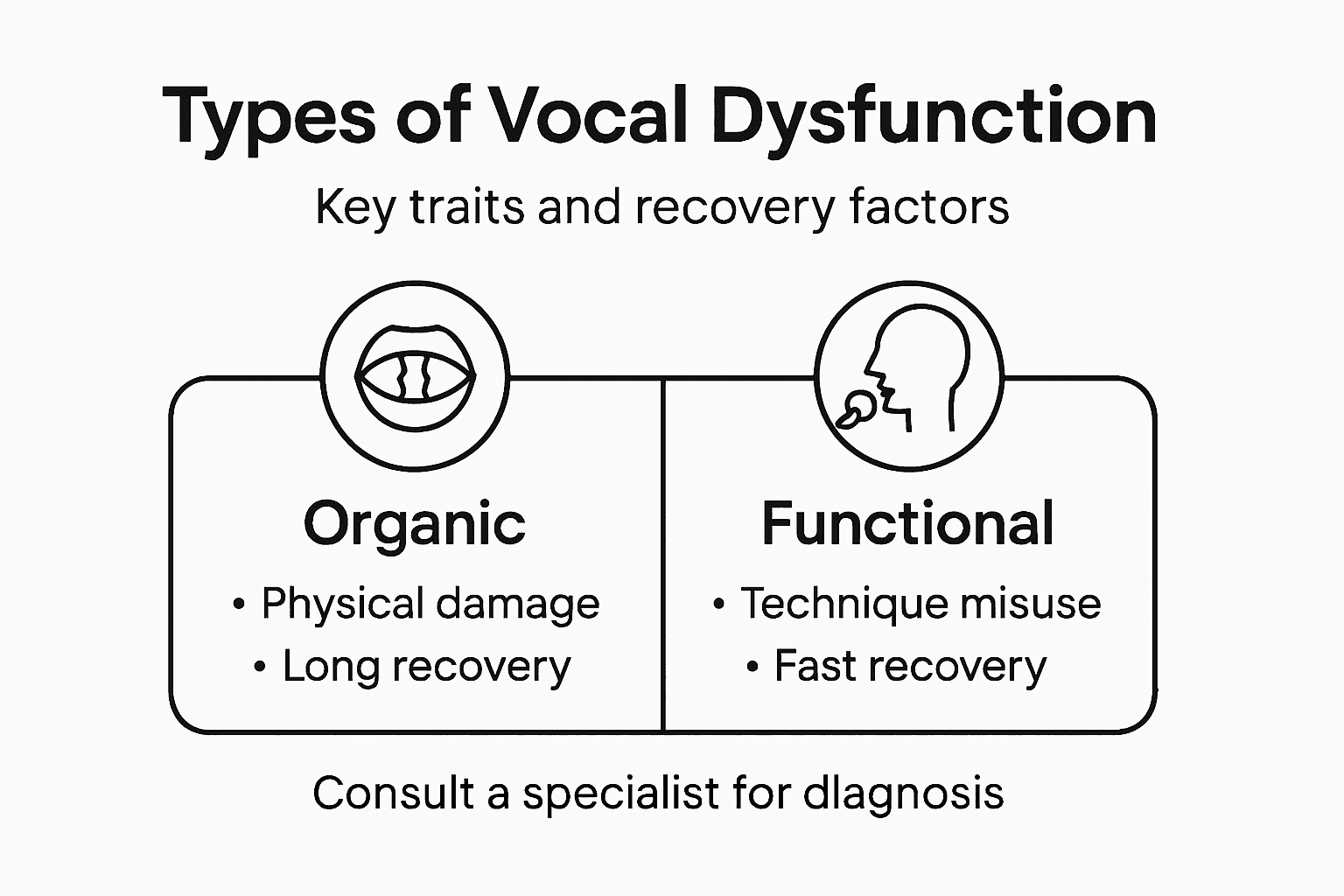
Here is a comparison of the three main types of vocal dysfunction and their unique implications:
| Type of Dysfunction | Underlying Cause | Key Symptoms | Recovery Approach |
|---|---|---|---|
| Organic | Physical or neurological damage | Breathiness, strain, tremor | Medical intervention often needed |
| Functional | Inefficient voice use or technique | Fatigue, loss of range, hoarseness | Therapy and training effective |
| Psychogenic | Psychological stress or trauma | Sudden voice loss, normal anatomy | Stress management resolves symptoms |
Pro tip: Before pursuing any vocal recovery program, get a clear diagnosis from a laryngologist who specializes in performer health. Treating a functional disorder with rest won’t help, and treating an organic disorder with technique alone wastes time. The correct diagnosis accelerates your path back to performance.
Your voice isn’t just how you communicate. It’s your instrument, your career, your competitive advantage. This reality creates a distinct set of risks that casual speakers never face. The demands you place on your voice daily accumulate in ways most people never experience, making prevention and early intervention non-negotiable.
Voice professionals face occupational risks most people ignore. Singers performing multiple shows weekly subject their vocal cords to repetitive stress that builds cumulatively. Actors doing extensive rehearsals and performances push their voices beyond casual speaking limits. Teachers lecturing for hours daily, nurses communicating in loud hospital environments, and public speakers presenting repeatedly all share a common vulnerability: voice strain from repetitive vocal demand accumulates faster than most realize. Your vocal cords aren’t designed for eight hours of continuous heavy use. Unlike muscles that adapt to training, vocal cords handle repeated stress through inflammation and tissue breakdown. Nodules develop from repeated trauma. Polyps emerge from chronic irritation. Muscle tension dysphonia results from compensating for vocal fatigue by gripping your throat tighter. These aren’t acute injuries from one bad performance; they’re cumulative consequences of years of inadequate recovery.

The psychological dimension compounds physical risks. Performance anxiety triggers throat tension, restricting airflow and forcing you to work harder for the same vocal output. This creates a vicious cycle: anxiety causes tension, tension causes vocal strain, vocal strain triggers anxiety about upcoming performances. Perfectionism drives many performers to push through fatigue instead of resting, accelerating vocal damage. You might notice your voice failing during critical moments, triggering panic that makes the problem worse. The irony is devastating: the same dedication that makes you successful as a performer can destroy your voice if not managed carefully.
Environmental exposures unique to performance venues compound these risks. Theater air is often dry from stage lighting and climate control. Concert venues expose you to secondhand smoke and poor air quality. Dressing rooms lack humidity. These conditions dry your vocal cords, making them more susceptible to injury during performance. Add travel fatigue, irregular sleep patterns, and hotel room air quality to the mix, and your vocal recovery mechanisms struggle to keep pace with your vocal demands.
Prevention requires acknowledging your elevated risk. Professional voice care strategies differ fundamentally from what non-professionals need. You can’t recover from vocal fatigue the way a casual speaker can. Your schedule doesn’t allow weeks of voice rest. Your career depends on consistent vocal reliability. This means your prevention and recovery protocols must be more rigorous, more intentional, and started earlier than you might think necessary.
Pro tip: Document your vocal symptoms weekly using a simple tracking system: note voice quality changes, what triggered them, and how long recovery took. Share this data with a voice specialist who understands performer demands. Patterns emerge over time that reveal exactly which activities or conditions harm your voice most, allowing you to modify your routine before damage becomes serious.
Prevention beats recovery every single time. The vocal damage you avoid is infinitely easier than recovering from damage already done. Yet most performers wait until their voice fails before taking action. This reactive approach costs you performances, income, and sometimes years of recovery. Strategic prevention built into your daily routine protects your instrument while you’re still performing at your peak.
Hydration forms the foundation of vocal health. Your vocal cords are living tissue that requires consistent moisture to function optimally. Dry vocal cords become brittle and susceptible to injury. Water intake throughout your day maintains the mucous membranes protecting your vocal mechanism. But not all hydration is equal. Caffeine and alcohol dehydrate you, counteracting water benefits. Warm water with honey soothes inflammation. Herbal teas provide both hydration and targeted support. Many performers notice their voice quality improves within days of prioritizing consistent hydration, particularly during performance seasons. Vocal rest and hydration strategies protect your voice during heavy use periods. Beyond drinking water, use a humidifier in your bedroom and dressing room. Theater dressing rooms are notoriously dry, making supplemental humidity critical during performance runs.
Vocal technique directly prevents injury. Improper technique forces you to work harder for the same output, accelerating fatigue and damage. Efficient technique uses proper breath support, avoiding throat tension that creates strain. Many singers compensate for inadequate breath support by gripping their throat, which creates exactly the kind of muscle tension dysphonia that damages voices. Working with a voice coach experienced in your genre helps you identify technical inefficiencies before they become problems. Warm ups aren’t optional before performance or rehearsal. They prepare your vocal cords for the demands ahead, exactly like stretching prevents muscle injuries in athletics. Proper cool downs afterward help your voice transition back to rest state.
Natural recovery emphasizes voice conservation. This doesn’t mean complete silence, which can actually worsen recovery. Voice conservation means using your voice intentionally and resting strategically. During recovery periods, avoid whispering (which strains vocal cords more than speaking), screaming, and prolonged talking. Speak in your comfortable middle register rather than reaching for high or low notes. When you do speak, use proper technique with adequate breath support rather than throat tension. Managing underlying conditions like acid reflux and allergies prevents ongoing irritation that interferes with recovery. If you experience reflux, avoid eating within three hours of bedtime and avoid trigger foods before performances.
Strategic rest accelerates recovery. Full voice rest for extended periods can cause vocal deconditioning, but strategic rest between performances or rehearsals allows inflammation to subside. Even 24 hours of significantly reduced voice use gives your vocal cords remarkable recovery capacity. Many performers reserve certain days as lower-voice-demand days, using those periods for recovery while maintaining other performance commitments. Vocal recovery importance for voice health cannot be overstated when your career depends on consistent vocal reliability.
The table below summarizes how different prevention strategies support vocal health for professionals:
| Strategy | Main Benefit | How It Protects the Voice |
|---|---|---|
| Consistent hydration | Maintains tissue moisture | Reduces injury risk and irritants |
| Proper vocal technique | Minimizes strain and fatigue | Prevents chronic overuse damage |
| Voice conservation | Allows inflammation to subside | Shortens recovery from heavy use |
| Strategic environmental control | Reduces exposure to irritants | Limits compounding stress factors |
Quick prevention checklist:
Pro tip: Create a “vocal health kit” to carry with you: throat lozenges (sugar-free), a small humidifier for hotel rooms, herbal throat spray, and a personal water bottle you refill constantly. Having these tools accessible removes friction from prevention habits, making it easier to maintain consistent vocal care during touring or intensive performance seasons.
If you are facing vocal loss triggered by nodules, vocal strain, or recurring hoarseness this article highlights the crucial need for prevention and targeted recovery. Vocal challenges like inefficient technique, environmental irritants, and medical factors can wear down your voice—your most important instrument as a singer, actor, or voice professional. Understanding these risks allows you to take proactive steps to maintain vocal health and confidence.

Explore our specialized Singer Enhancements designed to support natural voice recovery and boost stamina. If nodules are impacting your voice, our focused solutions in the nodules category offer natural remedies crafted with 25+ years of vocal health expertise. Don’t wait until voice issues stop your career. Visit TMRG Solutions now to take control of your vocal well-being with trusted products and expert guidance built specifically for performers like you.
Common medical triggers for vocal loss include infections like laryngitis, allergies causing inflammation and mucus buildup, acid reflux disease, and neurological conditions such as spasmodic dysphonia. Each of these can impair vocal cord function and lead to changes in voice quality.
Environmental factors like smoking, dry air, and exposure to allergens can irritate the vocal cords and exacerbate existing vocal issues. Prolonged exposure to such irritants can lead to chronic vocal stress, making it crucial for performers to manage their environments carefully.
To prevent vocal loss, performers should maintain consistent hydration, use proper vocal technique, rest strategically, and manage environmental conditions. Regular vocal warm-ups and cool-downs also play a significant role in protecting the voice from injury.
Organic disorders involve physical or neurological damage to the vocal cords, affecting voice quality significantly, while functional disorders stem from inefficient voice use with no visible structural damage. Recovery strategies differ, with organic disorders often requiring medical intervention and functional disorders typically responding well to therapy and technique training.
