Your Cart is Empty


Alcohol and singing voice don’t mix well when the stakes are high. A drink or two before a big performance may quiet your nerves, but they also dehydrate the vocal folds, thicken mucus, raise reflux risk, and dull the fine motor control that pitch and phrasing depend on. The safest rule: skip alcohol entirely for at least 24 hours before career-critical singing, and if you’re going to drink at all, keep it light, early, and well away from the microphone.
TL;DR:
- Drinking alcohol before performances dehydrates vocal folds, thickens mucus, and impairs motor control, with noticeable effects starting at a BAC of around 0.10 percent.
- Most singers recover within a day or two from a single night of drinking, but repeated alcohol use can cause long-term damage through chronic dryness and reflux irritation.
- Hydration should be continuous over many hours, favoring water and electrolyte intake, while avoiding carbonated, acidic, or dairy drinks prior to singing.
- Alcohol consumption, even in small amounts, during a performance reduces stamina and increases vocal fatigue due to dehydration, mucus buildup, and weakened breath support.
- For long-term vocal health, abstain from alcohol at least 24 hours before critical performances, and treat anxiety with preparation and breathing techniques rather than drinking.
Alcohol is a diuretic. It pulls fluid out of your system faster than you replace it, and the vocal folds are among the first tissues to feel that loss. Dry, stiff folds vibrate less efficiently, which changes your tone before you even notice you’re straining.
The mucous membrane lining your larynx also reacts poorly to alcohol. It tends to thicken secretions and relax the lower esophageal sphincter, which raises the odds of acid reflux creeping up toward your vocal folds overnight. Clinicians at the Center for Vocal Health point to this reflux and inflammation pathway as one of the more overlooked ways alcohol disrupts voice quality, since the irritation often shows up hours after the drink is gone.
Then there’s motor control. Acoustic research has repeatedly identified a blood alcohol concentration around 0.10 percent as the point where measurable changes in articulation and phonation start showing up in speech analysis. Singing demands far more precision than talking, so the practical impact lands sooner and harder.
What this means on stage:
Stat to remember: a 0.10% BAC threshold is where researchers consistently detect acoustic-phonetic impairment, well below the point most people would call themselves “drunk.”
Most singers recover from a single night of drinking within a day or two. Common short-term symptoms include a rasp in the lower register, a noticeably narrower range, and sloppier pitch control on runs or held notes. A qualitative university study found that acute alcohol ingestion measurably reduced vocal range in test subjects, though the degree varied a lot from person to person.
That variability matters. Older acoustic studies documented shifts in fundamental frequency and articulation tied to intoxication, but not every singer’s voice reacts the same way at the same dose.
The real risk isn’t one rough night. It’s repetition:
See a specialist if hoarseness lasts longer than two weeks, if you feel pain when singing, or if your range has shrunk and stayed that way. That’s not a hangover anymore.
Room-temperature water is still your best pre-show choice, and the timing matters more than most singers realize. A single glass an hour before curtain doesn’t hydrate your vocal folds directly. Vocal fold moisture comes from systemic hydration built up over many hours, sometimes days, not from sipping backstage.
Warm, noncaffeinated tea can feel soothing on a tight throat, but that comfort is largely sensory. It doesn’t reach the vocal folds themselves the way steady hydration does, so treat it as a comfort measure, not a fix.
Here’s a simple pre-show sequence:
Pro Tip: Keep a water bottle with electrolyte tablets in your gig bag. Plain water helps, but electrolytes speed up the systemic rehydration that actually reaches your vocal folds.
For a deeper hydration routine, Vocal Cord Hydration: A Complete Guide breaks down day-by-day habits that matter more than anything you drink an hour before a show.
The first few hours after drinking matter most. Rehydrate with water and an electrolyte mix, resist the urge to clear your throat (it irritates the folds further), and give your voice real rest rather than talking through the fatigue.
Over the next 24 to 72 hours, ease back in gradually. Light humming and gentle warm-ups are fine; loud talking over music or shouting to be heard is not. Sleep does more for vocal recovery than almost anything else, and B-vitamin-rich foods support the general tissue repair your body is already doing overnight.
Stat worth repeating: the same 0.10% BAC threshold tied to measurable acoustic impairment is also roughly where recovery time starts stretching from “next morning” to “the next 48 hours.”
Over-the-counter throat sprays and hydrating products can support this window. If hoarseness, pain, or range loss persists past two weeks, that’s a signal for an ENT visit, not another home remedy. The NIDCD’s voice care guidance backs hydration and rest as the two most reliable, lowest-risk interventions available to any singer.
Twenty-five years of working with singers and voice professionals teaches you one thing fast: the voice forgives short-term mistakes far less than people assume. A rough night doesn’t end a career, but a pattern of rough nights, ignored, often does.
A practical pre-show and post-show routine looks like this:
These tools are adjuncts. They ease symptoms and support a routine, but they don’t replace medical evaluation when hoarseness won’t quit. For readers building longer-term habits, Top Tips to Prevent Voice Loss covers the daily maintenance that actually prevents most of these nights from mattering.
The type of alcohol matters less than people think, but it isn’t irrelevant. Wine and spirits tend to carry higher alcohol content per serving than beer, which means faster dehydration and quicker BAC rise if you’re not pacing yourself.
Red wine carries an extra complication: tannins and histamines that some singers find dry out the throat and trigger mild allergic-style congestion independent of the alcohol itself. Carbonated options, including beer, champagne, and mixed spirit drinks with soda, add bloating and reflux pressure on top of the alcohol’s own effects. That combination is particularly rough on singers who already deal with acid reflux.
Sweet cocktails and liqueurs bring sugar into the mix, which can thicken saliva and mucus further, compounding the drying effect alcohol already causes. Straight spirits sipped slowly may actually be easier on total fluid volume than a few beers, simply because you’re drinking less total liquid to reach the same BAC, though you’re still getting the same motor-control and dehydration effects per unit of alcohol.
There’s no genuinely “safe” alcoholic drink for a voice professional before a show. If choosing between options for a rare exception, a small pour of spirits without carbonation, finished hours ahead of curtain, is a lesser evil than a few pints of beer or a bottle of wine split over an evening. None of it beats water.
Endurance is where alcohol’s damage compounds fastest. A voice that’s dehydrated and coated in thicker mucus has to work harder to produce the same volume and clarity, and that extra effort adds up across a two-hour set.
Singers who’ve had even one or two drinks often report their voice feeling “fine” for the first few songs, then fatiguing noticeably faster than usual by the back half of a show. That’s consistent with what coaches describe as reduced sensory feedback: alcohol dulls the internal cues that normally tell you when you’re pushing too hard, so you compensate with more physical effort without realizing it until the damage is done.
Breath support suffers too. Alcohol relaxes the diaphragm and intercostal muscles along with everything else, which weakens the airflow control that sustained notes and long phrases depend on. A singer who normally holds a phrase cleanly for eight bars might find themselves running out of air at six, then pushing from the throat to compensate, a habit that itself causes strain independent of the alcohol.
For multi-set gigs or back-to-back recording sessions, this stamina loss is the argument against drinking between sets, not just before a show. A drink at intermission doesn’t just affect the second half. It affects tomorrow night too, since recovery time gets added on top of an already tired voice. Tips for Vocal Maintenance During Intense Vocal Effort covers pacing strategies for exactly these longer, demanding nights.
Alcohol doesn’t just add its own problems. It makes existing vocal conditions worse. If you’re recovering from laryngitis, alcohol’s drying and inflammatory effects work directly against the healing your vocal folds need, extending recovery time when you can least afford it.
Allergy sufferers face a compounding issue. Alcohol, particularly wine and beer, can trigger histamine release that mimics or worsens allergy symptoms, adding congestion and postnasal drip on top of whatever seasonal or environmental allergens you’re already managing. That extra mucus load sits right on the vocal folds you’re trying to protect.
Reflux-prone singers have arguably the worst interaction. Alcohol relaxes the sphincter that normally keeps stomach acid down, and lying down to sleep after drinking makes nighttime reflux more likely. Singers with laryngopharyngeal reflux often wake up with morning hoarseness that has nothing to do with how much they sang the night before and everything to do with what they drank.
If you manage any chronic vocal condition, whether it’s recurring laryngitis, seasonal allergies, or reflux, alcohol isn’t a neutral choice around performance windows. It’s an active aggravator. Singers who track their symptoms often find a direct line between drinking nights and their worst flare-ups, even when the connection isn’t obvious in the moment.
The evidence base here is smaller than most singers would expect, but it’s consistent in direction. Acoustic and perceptual studies analyzing speech under intoxication find measurable changes in articulation and phonation, with a BAC around 0.10% repeatedly flagged as a threshold for detectable impairment in fine motor speech control.
A separate qualitative analysis focused specifically on singers found that acute alcohol ingestion reduced measurable vocal range in test subjects, supporting what many performers already sense anecdotally. Earlier acoustic research from the late 1980s documented shifts in fundamental frequency and articulation tied directly to intoxication levels, adding decades of consistency to more recent findings.
More recent acoustic work on fundamental frequency confirms the pattern but adds an important caveat: the influence of intoxication on pitch and speech is real but highly individual. Some singers show pronounced changes in f0 and range; others show comparatively little. That variability is exactly why no responsible guideline can promise a “safe” amount for every voice.
None of this research was designed around professional singers specifically, which is a real limitation. Most studies measure speech, not sustained singing under performance pressure. Still, the direction of every study points the same way: alcohol degrades fine motor control in exactly the systems singing depends on most.
There’s no universal number that fits every voice, but a conservative framework works better than guessing. For any performance that matters to your career, income, or reputation, the safest guideline is zero alcohol for at least 24 hours beforehand.
For lower-stakes situations, singers who choose to drink at all should keep it to one standard drink, finished at least four hours before any vocal demand, never during a break between sets. That timeline gives your body a head start on the dehydration and motor-control effects before you need your voice to perform precisely.
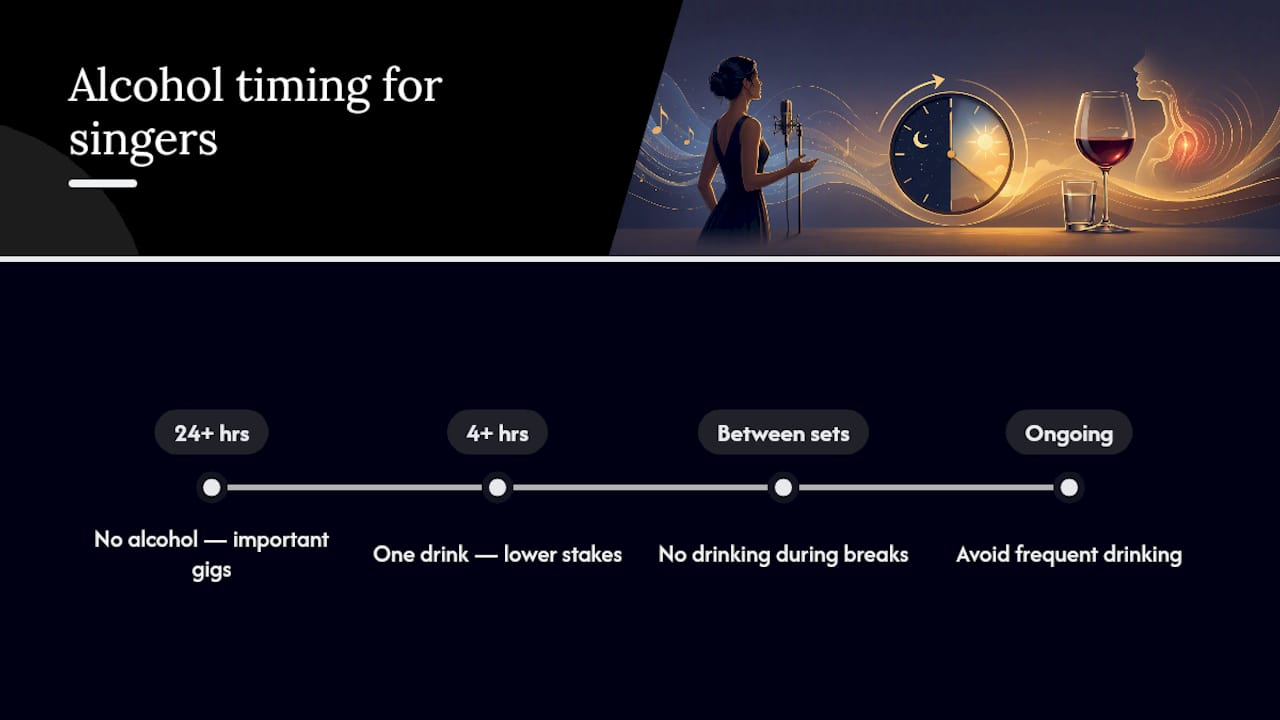
Recording sessions deserve even stricter treatment than live shows. Live audiences forgive small imperfections that a microphone and playback will expose mercilessly. If you’re tracking vocals, treat the 24 hour rule as a floor, not a suggestion.
Frequency matters as much as quantity. A singer who has one drink twice a month is in a very different position than one who drinks lightly four or five nights a week, even if the per-night amount looks similar. Cumulative exposure, not any single night, is what tends to produce the chronic dryness and reflux issues that shorten careers.
Plenty of singers swear a small drink before going on stage makes them sing better. The honest answer is that it doesn’t improve your voice. It reduces the anxiety that was making you feel like it sounded worse than it did.
That distinction matters practically. Reduced nervousness can loosen a tight jaw or an overly cautious approach to a difficult phrase, which sometimes does translate into a looser, more confident sound. But the same dose that eases nerves also dulls the sensory feedback loop that tells you when you’re pushing too hard, going flat, or straining a note. Vocal coaches consistently describe this as removing the internal checks that prevent forceful, damaging singing, not adding any real vocal benefit.
The trade-off is the problem. You’re swapping a controllable, learnable skill, managing stage nerves through breath work, preparation, and experience, for a chemical shortcut that also degrades the exact motor control and pitch accuracy that make a performance land. Singers who lean on alcohol for nerves often plateau on stage presence skills they’d otherwise be forced to develop, because the drink papers over the anxiety instead of resolving it.
If anxiety is a recurring issue, treating the anxiety directly, through preparation routines, breathing techniques, or working with a vocal coach, solves the actual problem. Alcohol only hides it for the length of one show, and it hides it at a real cost to your instrument.
Singing culture often treats a drink as harmless ritual. Your instrument doesn’t see it that way. The trade-off is simple: a little short-term ease for nerves against real, measurable losses in control, range, and stamina.
My rule is blunt. Skip it entirely before anything career-critical, and if you drink otherwise, do it early, lightly, and track how your own voice responds. Not every singer reacts the same way, but every singer has a limit worth learning before a bad night teaches it the hard way.
— Golan
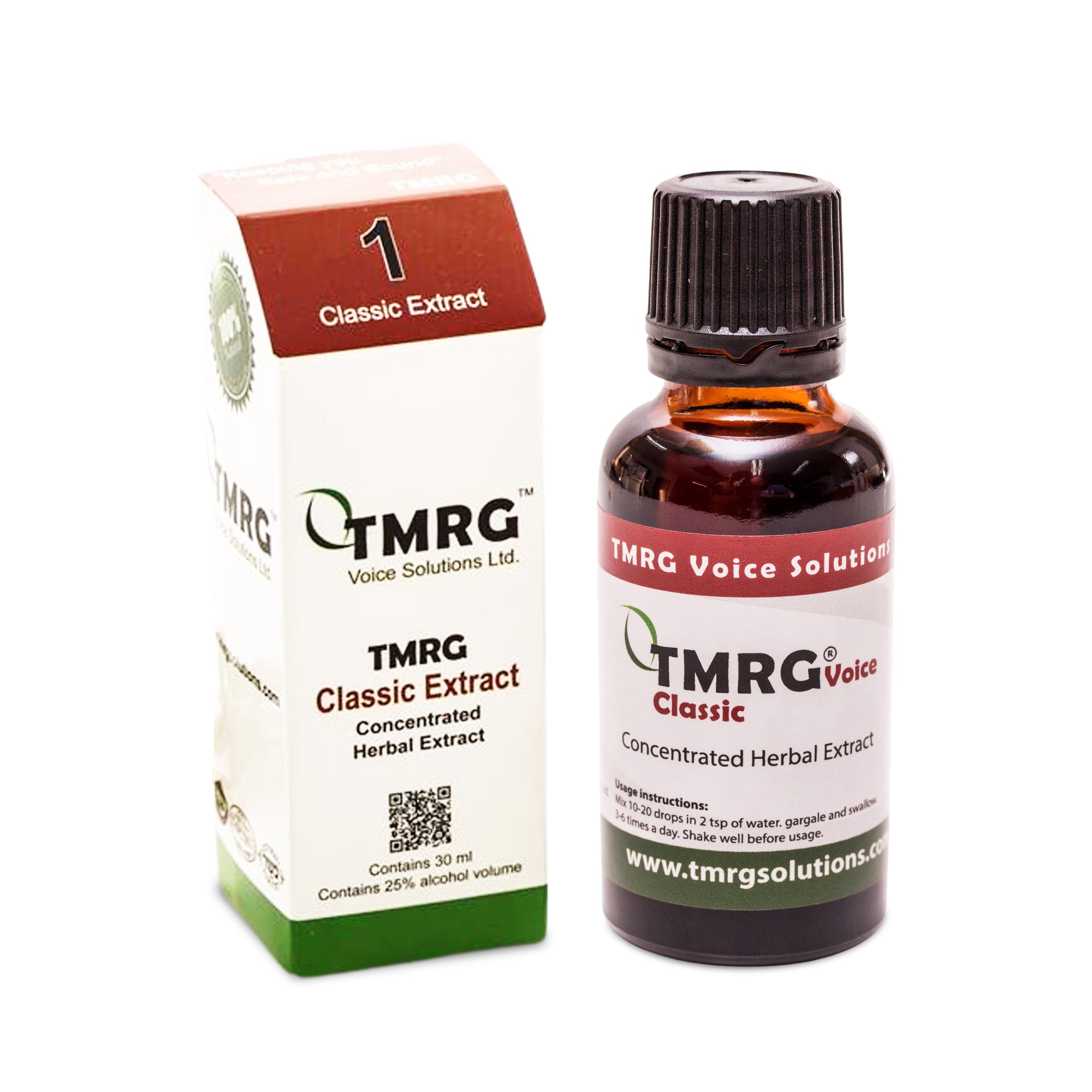
Damage to your voice from alcohol is manageable once you know what to reach for, and some recovery products are formulated to support the critical period this article covers. Certain voice recovery drops are designed for symptomatic relief when your voice feels rough or strained the morning after, fitting directly into the rehydrate-and-rest sequence covered above.
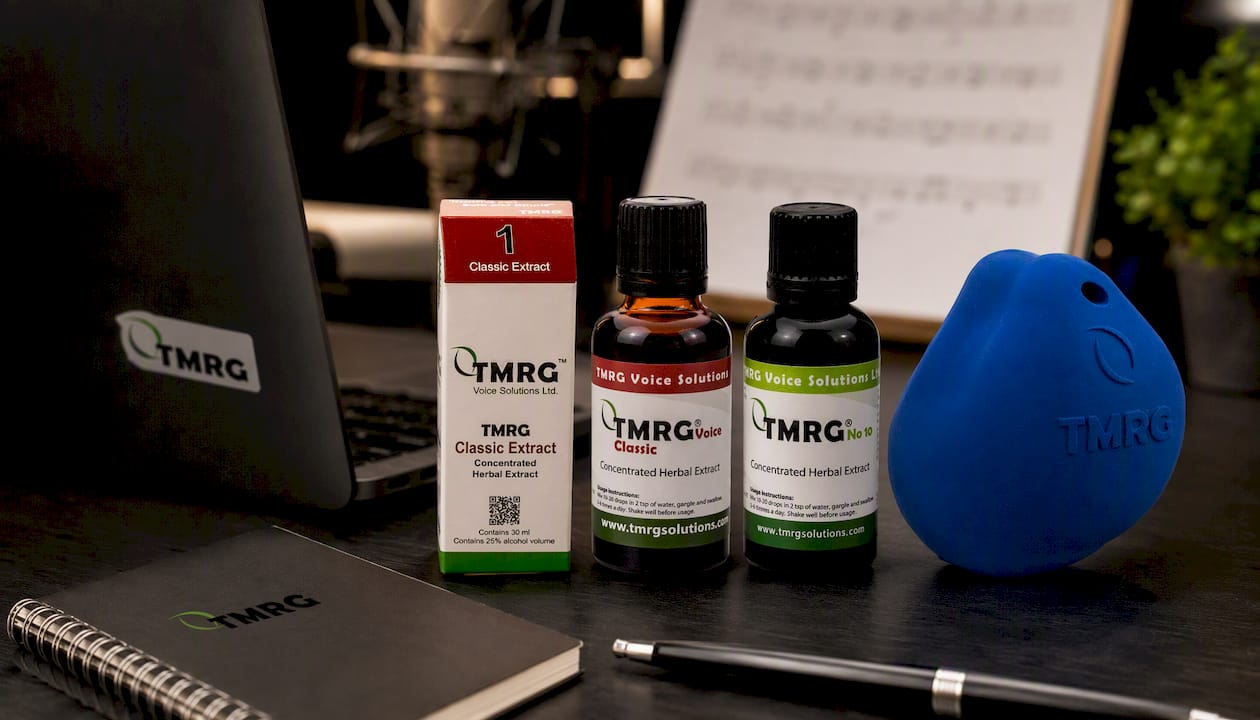
For warm-up support before a show where you’re managing lingering dryness, some voice enhancement drops offer targeted assistance without replacing the fundamentals of hydration and rest. If your exposure risk comes more from loud rehearsal rooms than from drinking itself, some attenuation masks reduce vocal strain from having to project over noise, adjuncts worth pairing with the habits already outlined here.
None of these replace clinical care for persistent issues, but they support the routine singers actually need between shows. Browse the full TMRG Voice Therapy Kits collection to find a bundle that matches your recovery and routine care needs, and check individual product pages for current details before your next big night.
Persistent morning hoarseness, a shrinking comfortable range, frequent throat clearing, and reflux symptoms after drinking nights are the clearest warning signs. If these patterns repeat across multiple weeks rather than clearing up after a day or two, that’s a signal to cut back and consider seeing an ENT.
The improvement is almost always about reduced anxiety, not better vocal function. Alcohol dulls nervousness and self-critical feedback, which can loosen tension, but it also degrades the fine motor control and sensory feedback that keep pitch and phrasing accurate.
Room-temperature water, taken consistently over hours rather than right before a show, does the most for vocal fold hydration. Warm, noncaffeinated tea can soothe throat discomfort, but it works on comfort, not on the systemic hydration your vocal folds actually need, as detailed in Vocal Cord Hydration: A Complete Guide.
Rehydrate with water and electrolytes, avoid throat clearing and whispering, and give your voice real rest for the first 24 hours. Gentle humming and light warm-ups can resume gradually after that, and products like TMRG Loud & Clear recovery drops can support symptomatic relief during that window, though persistent rasp past two weeks needs clinical evaluation per NIDCD guidance.
