Your Cart is Empty


Second-generation antihistamines and intranasal corticosteroid sprays are usually the voice-friendlier choices for singers managing allergies, while first-generation sedating antihistamines and oral decongestant combinations are the ones to avoid before performing. Drying and sedation reduce vocal fold lubrication, shrink your usable range, and speed up fatigue during a set. If you’re trying something new, test it in rehearsal first, and loop in a laryngologist before a medication becomes a permanent fixture in your case.
TL;DR:
- Second- and third-generation antihistamines cause less drying and sedation, making them safer choices for singers compared to first-generation drugs.
- Intranasal corticosteroid sprays and saline irrigation offer effective, local allergy relief with minimal systemic drying risk, ideal for voice preservation.
- Avoid first-generation antihistamines and combination decongestants before performances, as they significantly dry out vocal cords and increase fatigue risk.
- Testing any new allergy medication during rehearsal weeks is critical, as individual responses to antihistamines vary widely.
- Chronic use of drying antihistamines over months can lead to vocal fatigue and technique adjustments, emphasizing the importance of local treatments for long-term voice health.
Congestion doesn’t just clog your nose. It changes the resonance chambers you rely on for tone. When nasal passages swell shut, sound loses its natural forward placement, and singers often compensate by pushing more air pressure through a narrower space, which taxes breath support and shortens phrase length.
Post-nasal drip creates a different problem. Mucus dripping down the back of the throat irritates the larynx directly, triggering coughing, frequent throat clearing, and localized swelling around the vocal folds. That irritation shows up as pitch instability, a rougher tone at the top of the range, and a voice that tires faster than usual mid-rehearsal.
A cohort study on choral and choir singers found that seasonal allergic rhinitis correlates with self-reported vocal difficulty, including reduced range and more effortful singing, although the study stops short of pinning specific medications as the cause. The inflammation itself, not just what you take for it, is doing a lot of the damage.
That distinction matters when you’re deciding whether to treat symptoms aggressively. Untreated allergic inflammation can be harder on your voice than a well-chosen medication. Singers often avoid antihistamines out of fear of drying effects, then perform through weeks of swollen, irritated vocal folds instead, which is usually the worse trade.
What allergy inflammation typically does to a singing voice:
Not all antihistamines behave the same way in your body, and the differences matter enormously for anyone relying on a clear, hydrated voice.
First-generation antihistamines (diphenhydramine and similar drugs) cross into the central nervous system and carry strong anticholinergic activity. That means they suppress mucus-producing glands throughout the body, including the ones that keep your vocal folds lubricated. Less lubrication means more friction between the folds during vibration, which raises the effort required to sing and can leave your voice feeling scratchy after even a short set. Sedation compounds the problem by dulling breath coordination and reaction time on stage.
Second- and third-generation antihistamines (loratadine, cetirizine, fexofenadine, and similar formulas) were built specifically to reduce that central nervous system crossover. They tend to cause less sedation and less systemic drying, though individual response still varies quite a bit. Some singers report zero noticeable effect on tone; others still feel dryness, just less severe than with older formulas.
Combination “D” products (loratadine D, cetirizine D, and similar pairings) add a decongestant, typically pseudoephedrine, into the mix. That decongestant constricts blood vessels throughout the nasal passages and beyond, which reduces swelling but also reduces blood flow to mucosal tissue, drying it further. ENT commentary describes these combination products as “doubly drying” because they stack a decongestant’s vasoconstriction on top of an antihistamine’s anticholinergic effect, and that combination also nudges heart rate and blood pressure upward.
Quick comparison of how each class tends to affect the voice:
Statistic callout: A registered clinical trial protocol is currently tracking objective voice measurements before and after use of a first-generation OTC antihistamine, a signal that clinicians take the drying and vocal-function question seriously enough to measure it directly rather than rely on anecdote.
Never debut a new oral antihistamine on a show night. Take it during a rehearsal week first, note how your voice feels at hour two and hour four, and only carry it into a paid gig once you know your own response.
Intranasal corticosteroid sprays are generally the first-line recommendation from voice specialists, and for good reason, as explained in this formation coach vocal certifié guide. They work locally, reducing inflammation directly in the nasal tissue rather than circulating through your whole system. Because the drug stays mostly confined to the nose, systemic drying is much less of a concern than with oral antihistamines. Expect a few days to a week of consistent daily use before you feel the full anti-inflammatory benefit, so don’t wait until the morning of a show to start one.
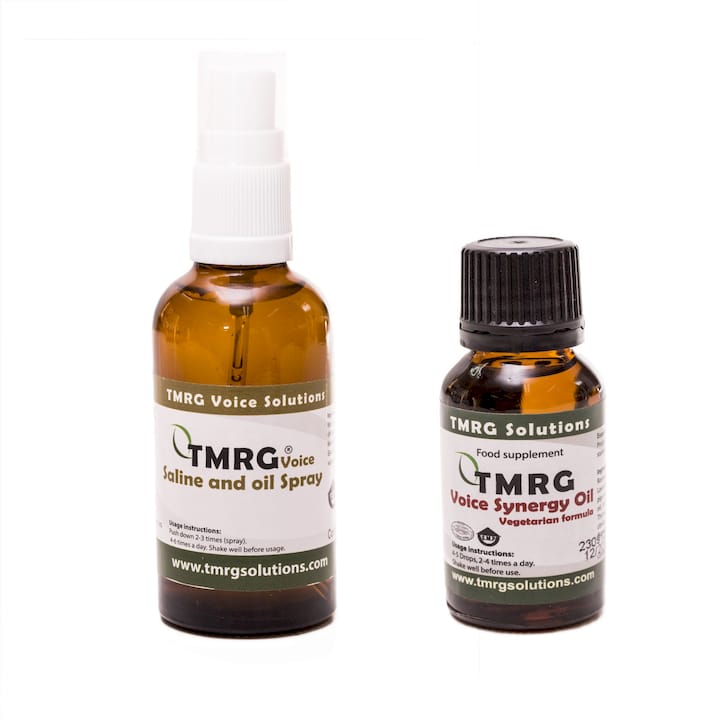
Topical nasal antihistamine sprays and saline irrigation offer targeted relief without the systemic exposure of a pill. Saline rinses in particular flush allergens and thin mucus mechanically, with essentially no drying risk to the larynx.
Second-generation oral antihistamines remain a reasonable daytime option when a singer needs broader symptom control and tolerates them well, especially for symptoms saline and nasal sprays don’t fully address, like itchy eyes or hives.
Here is a practical order of operations for symptom control that protects your voice:
Clinical guidance from voice centers backs this order, noting that topical nasal therapy reduces inflammation with far less systemic drying than oral medications carry. For a deeper walk-through of allergy management built around singers’ specific needs, Tmrgsolutions has a field guide on allergies and singing worth bookmarking.
Pro Tip: Keep a simple log for two weeks: symptom severity, what you took, and how your voice felt at rehearsal. Patterns show up fast, and you’ll know your personal drying threshold before it costs you a gig.
First-generation OTC antihistamines like diphenhydramine are the clearest offenders. Their anticholinergic effect suppresses saliva and mucus production throughout your airway, and clinical resources on medications that affect voice consistently flag this class alongside decongestants as having a drying effect on vocal cords strong enough to hurt a singing performance. Sedation on top of that dulls your breath control and stage reflexes.
Oral decongestants, alone or in “D” combination products, constrict blood vessels to shrink nasal swelling, and that constriction reduces moisture delivery to mucosal tissue across your airway. They can also raise heart rate and blood pressure, which is worth flagging if you already manage a cardiovascular condition.
Nighttime and sleep formulas are a trap many singers walk into unknowingly. Multi-symptom cold medicines marketed for nighttime use frequently bundle a sedating first-generation antihistamine with a cough suppressant or pain reliever, and the sedative dose is often higher than what’s in a standalone daytime antihistamine. A broader review of medications known to affect voice quality lists these combination formulas among the more common hidden culprits.
Formulations and situations to plan around before you sing:
As a conservative rule of thumb, give first-generation antihistamines and nighttime formulas at least 24 hours to clear your system before a performance you care about. If you’re unsure how a drug affects you specifically, don’t find out on a show night.
Test any new medication no less than five to seven days before a paid performance, and always during a rehearsal, never cold on show day. That window gives you enough data to know whether a drug dries you out, sedates you, or does nothing noticeable at all.
Hydration and humidification do more heavy lifting than most singers give them credit for. Aim for steady water intake throughout the day rather than a last-minute chug before curtain, since systemic hydration takes hours to reach vocal fold tissue. Run a humidifier in your bedroom, especially in dry climates or heated winter air, and use saline spray every few hours on demanding performance days to keep mucosal surfaces from drying out between sips of water.
Build a small kit you carry to every gig:
Air travel deserves its own plan. Cabin air runs drier than almost any environment you’ll perform in, so use saline spray preemptively before boarding and again mid-flight rather than waiting until your throat already feels raw. Skip systemic decongestants for flight-related congestion unless a doctor has specifically prescribed one for you, since altitude changes combined with vasoconstricting drugs can compound dehydration. A written entry on post-nasal drip management from Tmrgsolutions covers immediate relief tactics worth reviewing before a travel-heavy tour.
Pro Tip: Pack a travel humidifier or a hydrating face mask for red-eye flights. The few extra ounces in your carry-on are cheaper than losing your top notes on arrival day.
Persistent hoarseness lasting more than two to four weeks is not something to medicate through indefinitely. Neither is a sudden loss of range, repeated bouts of laryngitis in a single season, or any visible swelling you can feel when you swallow.
A specialist workup typically starts with a detailed history of your symptoms, vocal demands, and medication use, followed by laryngoscopy or stroboscopy to directly visualize vocal fold movement. Acoustic and aerodynamic testing can quantify what you’re already sensing: reduced range, increased effort, or breathiness that wasn’t there a year ago. If allergies are suspected as a root cause, an allergy referral for testing often follows.
Red flags that warrant a visit rather than another round of home remedies:
Treatment from there can include targeted medical therapy for the underlying allergy, immunotherapy for singers with confirmed environmental triggers, and voice therapy tailored to rebuild efficient technique around whatever irritation remains.
A trusted vocal health company has spent more than 25 years focused specifically on vocal health, working alongside singers, actors, and voice professionals navigating exactly this kind of medication question. That work informs the ongoing research and development behind the product line, which centers on natural, adjunctive support rather than pharmaceutical replacement.
Every product Tmrgsolutions makes is designed to sit alongside medical care, not instead of it. If an ENT or allergist has you on a specific regimen, that regimen stays the priority. Voice care tools work best as the supporting layer underneath a plan a physician has already reviewed, particularly when allergy symptoms are moderate to severe or when a prescription medication is already doing the primary work. If you haven’t had allergy symptoms evaluated by a doctor, that conversation should happen before you build a self-managed routine around any product, ours included.
Vocal folds depend on a thin, even layer of mucus to vibrate efficiently. That layer reduces friction between the folds hundreds of times per second during phonation, and even a modest reduction in that lubrication changes how the voice feels and sounds.
Anticholinergic antihistamines suppress secretions from glands throughout the body, including the minor salivary and mucous glands lining the airway. Less secretion means a drier mucosal surface on the vocal folds themselves, which increases the mechanical effort needed to produce the same pitch and volume. Singers describe this as their voice feeling “stuck” or requiring more air pressure than usual to get moving, particularly in the lower range where fold contact is heaviest.
Background clinical understanding suggests that first-generation antihistamines carry a stronger anticholinergic load than second-generation formulas, which is the mechanistic reason their vocal impact tends to be more pronounced. The vocal folds also swell slightly when irritated or dehydrated, and that swelling can subtly shift pitch perception, making a singer feel like they’re singing slightly out of tune even when pitch accuracy hasn’t actually changed.
This is why a drying antihistamine and an untreated allergy can sometimes produce a similar sensation onstage: both leave the vocal folds working harder than they should for the same output. The difference is that a medication choice is within your control, while allergic inflammation on its own is not.
Occasional antihistamine use for a bad allergy week is a different situation than reaching for the same medication every day for months or years, which many singers with chronic allergic rhinitis end up doing without much thought.
Chronic drying, even at a mild level, can compound over time. A vocal fold that never quite gets fully lubricated between doses is a fold that’s working slightly harder on every single phrase, every single day. That cumulative effort can contribute to vocal fatigue becoming your new normal rather than an occasional bad night, and some singers adjust their technique unconsciously to compensate, sometimes in ways that create tension habits that outlast the allergy season entirely.
There’s also a masking effect worth understanding. If a first-generation antihistamine’s sedation and drying make you feel generally “foggy” and low energy, you may not clearly notice your voice getting worse in isolation, since everything feels a little duller. That makes long-term chronic users more likely to normalize a decline rather than flag it early.
The practical takeaway is that a medication choice that seems fine for a single performance is not automatically fine as a daily habit across an entire allergy season. If you know you’ll be treating symptoms for months rather than days, that’s exactly the scenario where switching to intranasal corticosteroids or a second-generation formula, discussed earlier, tends to matter most for protecting your voice over the long haul.
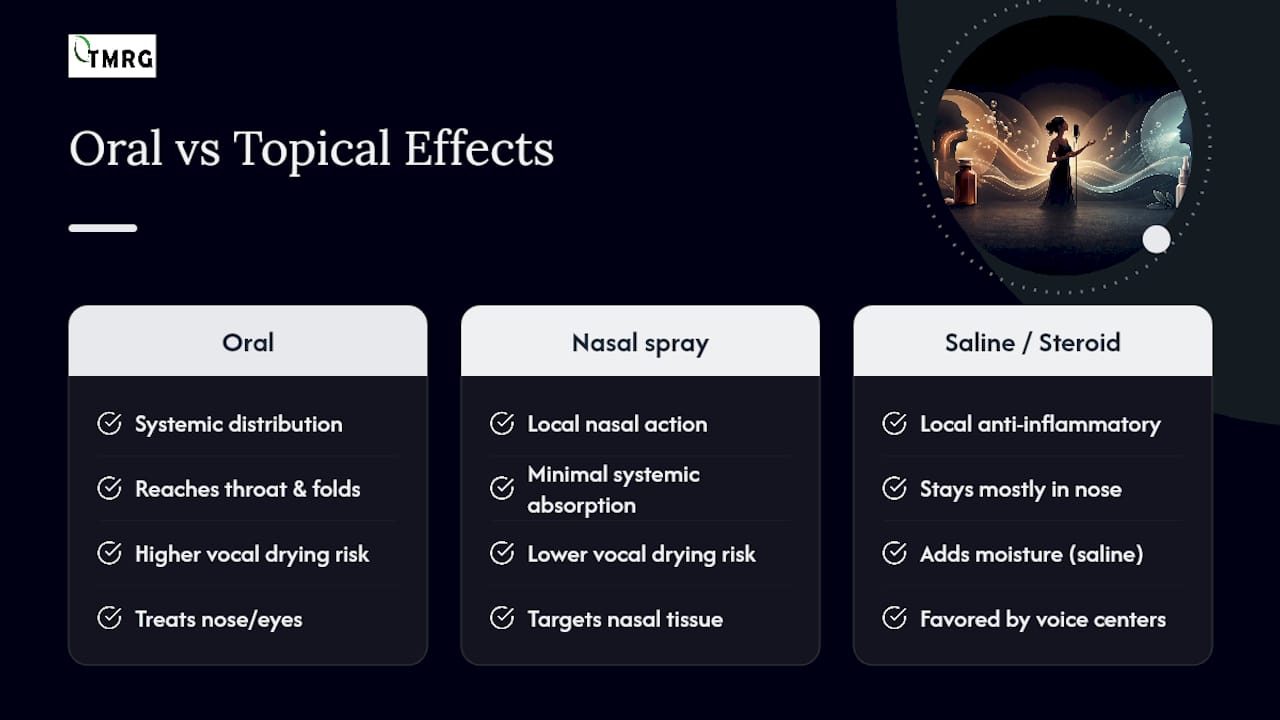
The delivery method changes how much of the drug reaches tissue it doesn’t need to affect, and that distinction is bigger than most singers realize.
Oral antihistamines travel through your bloodstream to reach every mucous membrane in your body, nasal passages included, but also your mouth, throat, and vocal fold lining along the way. That systemic reach is exactly why oral drying effects show up in the voice even though the medication’s job is to treat your nose or eyes. It’s a side effect of distribution, not of intent.
Topical antihistamine nasal sprays work differently. They act locally, in the nasal tissue where they’re applied, with only a small fraction absorbed into general circulation. That localized action is the core reason topical options carry a lower drying risk for the vocal folds specifically, since far less of the drug ever reaches laryngeal tissue in the first place.
The same logic applies to intranasal corticosteroids, which is part of why voice centers favor them. A spray that stays mostly in the nose does its anti-inflammatory job without pulling moisture out of tissue several inches away. Saline sprays go a step further, adding moisture rather than removing it, which is why they pair so well with either topical or oral antihistamine use as a counterbalance.
If you’re choosing between an oral tablet and a nasal spray for the same symptom, topical usually wins for voice preservation, provided your symptoms are localized enough to the nose for a topical approach to actually work.
Most advice on antihistamines and singing treats every drug in the category the same way, which is the core mistake. The real divide isn’t “antihistamines versus no antihistamines.” It’s systemic versus topical, and sedating versus non-sedating, and that distinction gets lost in generic warnings that tell singers to simply avoid allergy medication altogether.
That advice backfires. A singer who avoids all treatment out of fear of drying effects often ends up performing through weeks of untreated congestion and post-nasal drip, which research on choral singers ties to real, self-reported vocal difficulty. Inflammation left alone is not the safe choice it’s sometimes assumed to be.
What deserves more attention than it gets is individual variability. Two singers on the same second-generation antihistamine can report completely different vocal experiences, and there’s no way to know your own response without testing it deliberately, away from a performance, the way you’d break in a new pair of stage shoes before a tour rather than opening night.
Prioritize the low-risk local treatments first: saline, intranasal steroids, environmental control. Reserve oral medication for what those can’t manage, and treat any oral antihistamine as an experiment to run in rehearsal, not a given to trust blindly on a show date.
— Golan
Even with the right medication choices, allergy season puts real, cumulative strain on your instrument. The product line is built for exactly those in-between moments: not a substitute for your allergist, but a supportive layer for the dryness and fatigue that show up even on a well-managed regimen.
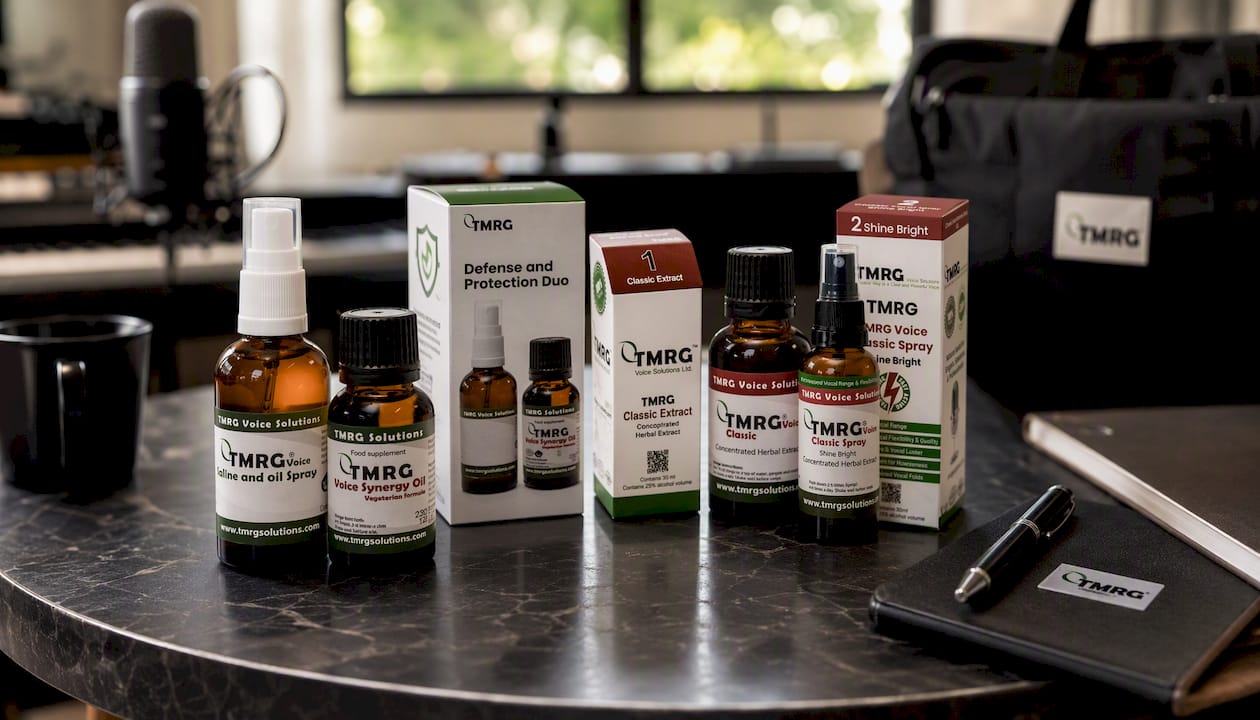
The TMRG Defense and Protection Duo pairs two formulas designed to support vocal resilience during high-exposure periods, useful for singers heading into a demanding rehearsal week or tour stretch. For acute dryness after a long set, the TMRG Loud & Clear Classic Voice Recovery Drops offer a fast, on-the-road recovery option you can keep in a gig bag. And when you need lightweight mucosal relief between numbers without reaching for another pill, the TMRG Shine Bright Classic Voice Recovery Spray fits into the gap saline alone doesn’t always close.
None of these replace a physician-directed allergy plan. They’re built to work alongside one. If allergy symptoms are already under a doctor’s care, ask how a natural adjunct like this fits your routine, then explore the full lineup on the Tmrgsolutions product pages to find what matches your specific performance schedule.
Yes. Allergic rhinitis causes nasal congestion, post-nasal drip, and mild vocal fold swelling, and a cohort study on choral and choir singers found that seasonal allergic rhinitis correlates with self-reported vocal difficulty, including reduced range and more effortful singing.
First-generation antihistamines like diphenhydramine cause the most pronounced drying and hoarseness because of their strong anticholinergic effect, and combination decongestant “D” products compound that drying with vasoconstriction, according to ENT expert commentary.
Start with saline nasal irrigation and an intranasal corticosteroid spray to reduce inflammation locally, add a humidifier for overnight hydration, and switch away from any first-generation oral antihistamine if you’re currently using one. Persistent hoarseness beyond two to four weeks warrants an ENT evaluation rather than continued self-treatment.
Intranasal corticosteroid sprays and second-generation oral antihistamines are generally considered the voice-friendlier options, since topical nasal therapy delivers anti-inflammatory benefit with far less systemic drying than older oral drugs. Always test a new medication during rehearsal, never for the first time before a paid performance.
Generally yes, because topical nasal sprays act locally and only a small fraction reaches general circulation, limiting drying effects on the vocal folds compared with oral antihistamines that travel through the whole body.
