Your Cart is Empty


TL;DR:
- Professional singers should prioritize daily vocal practices like hydration, warm-up routines, and gentle vocal recovery. Proper hydration, steam inhalation, and avoiding dehydrating substances protect the vocal folds from damage and fatigue. Regular use of vocal warm-up, cool-down, and seeking medical support when necessary maintain long-term vocal health.
Professional singer throat care is the deliberate set of practices and techniques designed to protect and enhance the vocal folds for sustained, optimal performance. Your voice is a physical instrument made of muscle, tissue, and mucosa. It responds to hydration, rest, warm-up protocols, and technique exactly the way a marathon runner’s legs respond to training. Clinical voice specialists recognize Semi-Occluded Vocal Tract (SOVT) exercises, diaphragmatic breath support, and structured hydration as the three pillars of evidence-based vocal maintenance. Singers who treat these as non-negotiable daily procedures consistently outperform those who rely on reactive remedies.
Hydration is the single most controllable variable in vocal fold health. The vocal folds are covered in a thin mucous layer that must stay moist to vibrate freely and resist mechanical damage. When that layer dries out, friction increases, and the risk of hemorrhage, nodules, and chronic hoarseness rises sharply.
Drink 8–10 glasses of water daily and maintain room humidity between 40–50% for optimal laryngeal hydration. Systemic hydration takes hours to reach the vocal folds, so drinking water right before a show is not enough. Build consistent intake throughout the day, every day.
Steam inhalation works differently from drinking water. Direct steam inhalation provides immediate mucosal hydration, thinning mucus without causing mechanical damage to the folds. Use a personal steam inhaler for 5–10 minutes before and after heavy performance days. This is especially useful when you are performing in dry venues or traveling through air-conditioned airports.
Two substances actively work against your vocal health near performance time:
The table below summarizes the key hydration and environmental targets every singer should track.
| Factor | Target |
|---|---|
| Daily water intake | 8–10 glasses throughout the day |
| Room humidity | 40–50% |
| Steam inhalation | 5–10 minutes pre and post performance |
| Caffeine and alcohol | Avoid within 4–6 hours of performing |
| Dairy intake | Minimize on performance days |
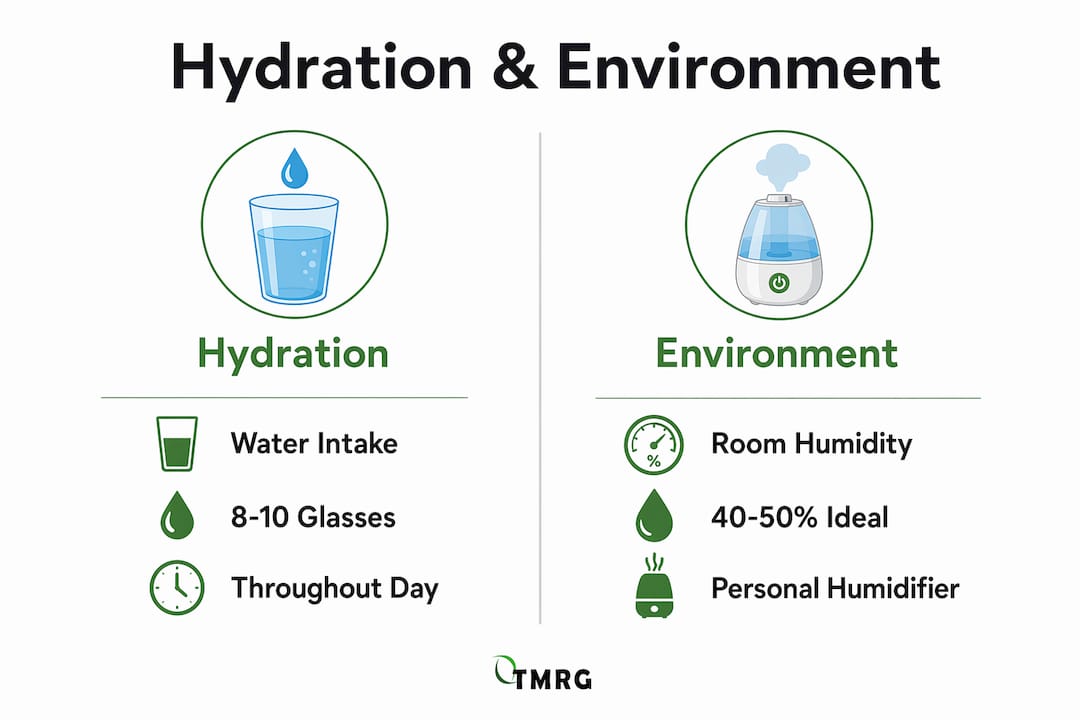
Pro Tip: Carry a small personal humidifier when touring. Hotel rooms often run at 20–30% humidity, which can dry your folds overnight and leave you hoarse by morning.
For a deeper look at how fluid intake affects fold function, the hydration and vocal health guide from Tmrgsolutions covers the clinical reasoning behind each recommendation.
Warming up your voice is not optional. Cold vocal folds are stiff, poorly lubricated, and far more vulnerable to strain and micro-tears during phonation. A proper warm-up sequence moves from passive tissue release to active phonation, giving the laryngeal muscles time to increase blood flow and pliability.

Start every session with laryngeal massage. Use two fingers to gently release tension in the muscles around the larynx before you make a single sound. This reduces the baseline tension that accumulates from speaking, swallowing, and stress throughout the day.
SOVT exercises like straw phonation are the gold standard for reducing vocal fold collision forces and aiding rehabilitation. A typical SOVT session lasts 5–10 minutes of gentle bubbling through a straw. The back pressure created by the straw widens the vocal tract, reduces fold impact stress, and helps you find efficient phonation with minimal effort. This makes straw phonation ideal as both a warm-up tool and a recovery exercise after heavy vocal use.
The cool-down is just as critical as the warm-up, and most singers skip it entirely. Performing 10 minutes of aspirated ‘ee’ exercises immediately post-performance reduces vocal fatigue significantly. The aspirated ‘ee’ sound keeps airflow moving across the folds while reducing collision force, allowing the tissue to decompress gradually rather than shutting down abruptly after intense use.
Pro Tip: Ritualize your warm-up at the same time before every show. The body responds to routine. A consistent pre-show sequence also reduces performance anxiety because it signals to your nervous system that you are prepared.
Tmrgsolutions offers a detailed vocal warm-up guide that walks through each phase of preparation with timing and technique notes.
The habits you carry between performances shape your vocal health as much as anything you do on stage. Chronic strain rarely comes from one bad show. It builds from repeated small injuries: aggressive throat clearing, speaking over noise, poor posture, and acid reflux left unmanaged.
Forceful throat clearing damages vocal folds. The impact of the folds slamming together during a hard clear is comparable to repeated blunt trauma. Replace it with a three-step reset: sip water, swallow, and perform a gentle silent cough. This clears the throat without the mechanical damage.
Diaphragmatic breath support is the technical foundation of safe singing. When you sing from the throat rather than from the breath, the laryngeal muscles compensate by gripping and tensing. Over time, this creates chronic muscle tension dysphonia, a condition that requires voice therapy to reverse. Every note should feel like it is riding on a column of air, not being squeezed out by the throat.
Vocal naps of 5–10 minutes throughout the day prevent laryngeal muscle tension from accumulating during heavy schedules. These are short periods of complete silence, not whispering. Whispering actually increases fold tension and is not a substitute for rest.
Pro Tip: Treat your voice like a surgeon treats their hands. A surgeon would not grip a steering wheel aggressively before an operation. You should not shout at a sports bar the night before a show.
Misinformation about vocal health is widespread, and some of it is genuinely harmful. The most persistent myths give singers false confidence in remedies that either do nothing or actively delay recovery.
Myth: Hot tea heals your vocal folds. Heat does not heal the folds directly. Nothing you swallow touches the vocal folds, because the epiglottis closes during swallowing to protect the airway. Warm water with honey soothes mild throat irritation better than hot beverages, but the benefit is to the throat lining, not the folds themselves. Steaming works because it reaches the mucosal surface directly through inhalation, not ingestion.
Myth: Supplements are necessary for vocal health. Supplements are not generally necessary for singers with a balanced diet and adequate hydration. No supplement replaces systemic hydration, proper technique, and rest. Some singers benefit from specific supplements when deficiencies exist, but self-prescribing without clinical guidance adds cost without guaranteed benefit.
Myth: Pushing through hoarseness builds vocal strength. Singing on damaged folds does not build resilience. It compounds injury. Hoarseness signals that the folds are swollen or irritated. Continuing to perform on a hoarse voice risks turning a minor issue into a lesion that requires months of therapy or surgical intervention.
| Myth | Evidence-based truth |
|---|---|
| Hot tea heals vocal folds | Nothing swallowed touches the folds; steam inhalation hydrates directly |
| Supplements fix vocal problems | Hydration, technique, and rest are the primary drivers of vocal health |
| Pushing through hoarseness builds strength | Hoarseness signals injury; continued use risks permanent damage |
| Whispering rests the voice | Whispering increases fold tension more than normal speech |
| Throat clearing clears mucus safely | Forceful clearing causes mechanical fold damage |
For a broader look at safe home remedies that are actually supported by evidence, the distinction between soothing the throat and healing the folds is a critical one to understand.
Daily vocal hygiene keeps healthy voices healthy. It does not fix structural problems, retrain faulty muscle coordination, or diagnose underlying conditions. Knowing when to escalate to a medical professional is one of the most important skills a professional singer can develop.
Vocal fold lesions not resolving within 2 weeks of rest and hygiene require assessment by an ENT specialist using laryngoscopy or stroboscopy. Stroboscopy is particularly valuable because it captures the vibratory pattern of the folds in slow motion, revealing asymmetries and lesions that standard laryngoscopy misses.
Red flags that require prompt evaluation:
Resonant Voice Therapy and vocal function exercises are the two most evidence-supported approaches in clinical voice rehabilitation. Resonant Voice Therapy trains singers to place resonance forward in the face, reducing laryngeal tension and fold collision forces. Vocal function exercises target breath support, pitch range, and fold closure in a structured progression. Both require guidance from a licensed speech-language pathologist who specializes in professional voice.
Tmrgsolutions has a detailed resource on managing vocal fold ailments that explains the clinical pathway from symptom recognition to therapy, written specifically for professional voice users.
Consistent, procedural throat care that combines daily hydration, structured warm-ups, gentle vocal technique, and timely clinical support is the most reliable path to long-term vocal health for professional singers.
| Point | Details |
|---|---|
| Hydration is systemic | Drink 8–10 glasses of water daily; pre-show sipping alone does not reach the folds in time. |
| SOVT exercises are gold-standard | Straw phonation for 5–10 minutes reduces fold collision and supports both warm-up and recovery. |
| Cool-downs prevent next-day fatigue | Aspirated ‘ee’ exercises for 10 minutes post-performance significantly reduce next-day vocal strain. |
| Forceful throat clearing causes damage | Use the three-step reset (sip, swallow, silent cough) to protect fold tissue. |
| Seek ENT care after two weeks | Hoarseness or lesions persisting beyond two weeks require laryngoscopy, not more rest. |
After working with professional singers for more than two decades, the pattern I see most often is not overuse. It is inconsistency. Singers who protect their voices during heavy touring seasons but abandon their routines during “quiet” periods are the ones who show up with chronic problems. The voice does not take breaks from needing care just because the schedule does.
The singers I have seen maintain the longest careers treat their vocal routines the way a surgeon treats pre-operative prep. Voice care must be procedural and non-negotiable, not aspirational. That means warm-ups happen even on days off. Hydration targets are met even when traveling. Cool-downs happen before the post-show conversation at the bar, not after.
The most common mistake I see is confusing symptom management with maintenance. A singer will use a soothing spray when hoarse and call it “throat care.” Real throat care happens before the hoarseness, not in response to it. The spray is useful. The daily routine is what makes the spray rarely necessary.
Your voice is not separate from your body. Sleep quality, stress levels, reflux, and posture all affect how your folds function. Singers who address those variables alongside their vocal technique consistently recover faster and perform more reliably than those who focus only on what happens in the rehearsal room.
Treat your voice like the instrument it is. Instruments that are maintained daily last for generations. Instruments that are only serviced when broken rarely survive a full career.
— Golan
Tmrgsolutions brings 25+ years of vocal health expertise into a product line built specifically for professional singers and voice performers. Whether you are managing post-show recovery or building a daily maintenance routine, the right support products make a measurable difference.

The TMRG Loud & Clear Voice Recovery Drops and TMRG Shine Bright Voice Recovery Spray are formulated to complement the hydration and recovery practices covered in this guide. For singers who want a complete system, the TMRG Voice Therapy Kit Standard combines clinically effective tools into one structured kit. Each product is built around natural herbal formulations and endorsed by vocal coaches and medical professionals who understand what professional performers actually need.
Professional singers should drink 8–10 glasses of water daily to maintain optimal laryngeal hydration. Systemic hydration takes several hours to reach the vocal folds, so consistent intake throughout the day is more effective than drinking large amounts right before a performance.
A complete vocal warm-up typically takes 15–20 minutes, beginning with laryngeal massage and progressing through SOVT exercises like straw phonation before moving to full-voice singing. Rushing this sequence increases the risk of fold strain during the first songs of a set.
Hoarseness lasting more than two weeks, sudden voice loss, pain during phonation, or a noticeable change in your upper register are all red flags that require laryngoscopy by an ENT specialist. Voice therapy from a licensed speech-language pathologist often complements medical treatment to prevent recurrence.
Hot tea soothes the throat lining but does not directly affect the vocal folds, because nothing swallowed contacts the folds during normal swallowing. Warm water with honey provides similar soothing benefits. Steam inhalation is the more effective method for directly hydrating the mucosal surface of the folds.
Vocal naps are short periods of complete silence lasting 5–10 minutes, taken throughout the day to prevent laryngeal muscle tension from accumulating. They are particularly useful on heavy rehearsal or performance days and should not be replaced with whispering, which increases fold tension rather than reducing it.
