Your Cart is Empty


TL;DR:
- Maintaining consistent hydration and ambient humidity protects vocal folds from injury.
- Gentle warm-ups, vocal rest, and amplification reduce vocal strain during daily use.
- Persistent hoarseness warrants professional evaluation beyond self-care routines.
Vocal strain doesn’t just silence your voice. It can quietly derail your career, strip your confidence mid-performance, and turn everyday communication into an exhausting effort. Singers lose high notes. Actors lose projection. Educators lose the stamina to finish a school day. If you’ve felt that familiar scratchiness, tightness, or sudden hoarseness creeping in, you already know how disruptive it is. This guide walks you through a practical, evidence-backed vocal care routine built for performers, educators, and voice professionals who need their instrument working at full strength, every single day.
| Point | Details |
|---|---|
| Hydration matters most | Drinking enough water is the single most important step for vocal health. |
| Follow daily routines | Consistently warming up, resting, and humidifying your voice yields lasting benefits. |
| Avoid vocal extremes | Whispering, screaming, and throat clearing can harm your voice—stick to healthy habits. |
| Track your progress | Use voice benchmarks and self-assessments to monitor improvement and know when to seek help. |
| Seek help if needed | Persistent issues require professional evaluation, not just home remedies. |
Let’s start by setting up everything you’ll need for your step-by-step vocal care routine.
Before you can protect and restore your voice, you need the right foundation. Think of this as stocking your vocal health toolkit. Just as a musician wouldn’t perform on an untuned instrument, you shouldn’t push through your day without the basics in place. A daily vocal care routine begins with preparation, not performance.

A practical step-by-step routine for voice users focuses on vocal hygiene basics: hydration, humidification, vocal rest, and avoiding extremes like whispering or screaming, while also protecting against irritants and acid reflux. These aren’t optional extras. They’re the structural pillars that hold everything else up.
Here’s what you need to have ready:
| Item | Purpose | Optional alternative |
|---|---|---|
| Water (64 oz/day) | Hydrates vocal folds from within | Herbal tea (caffeine-free) |
| Humidifier | Maintains ambient moisture for tissue health | Steam bowl with towel |
| Herbal tea with honey | Soothes irritated throat tissue | Warm water with lemon and honey |
| Microphone or amplification | Reduces vocal load during extended use | Portable PA speaker |
| Saline nasal spray | Keeps upper airway moist | Neti pot rinse |
Each item plays a specific role. Water works systemically, meaning it hydrates your vocal folds from the inside out, not by coating them directly. Your humidifier protects the mucosal lining of your throat by keeping ambient humidity in the safe range. Herbal tea with honey offers surface-level soothing for inflamed tissue. And a microphone? That’s your best friend if you teach, lecture, or perform in large spaces.
ASHA voice care tips consistently reinforce that voice professionals, especially educators, underestimate how much vocal load accumulates over a single day. A teacher who speaks for six hours without amplification is putting enormous strain on their larynx (the structure housing the vocal folds).
Common setup mistakes to avoid:
When to seek medical attention vs. when to self-care:
With your materials assembled, here’s how to put them into practice, step by step.
A reliable daily routine doesn’t need to be complicated. What it does need is consistency. Even on days when your voice feels fine, maintaining these steps protects you from the cumulative damage that builds silently over weeks and months. ASHA recommends a routine for educators and high-use voice professionals centered on warm-ups, hydration, and vocal breaks, along with microphone use and humidification to reduce overall vocal load.
Here’s your complete daily sequence:
Hydrate before you speak. Drink at least 64 ounces (8 cups) of water throughout the day, starting before you use your voice heavily. Your NIDCD vocal hygiene basics confirm that systemic hydration is one of the most protective things you can do for your vocal folds. Don’t wait until you feel thirsty. Thirst is already a sign of mild dehydration, and dehydrated vocal folds are stiffer, less flexible, and more prone to injury.
Warm up gently. Begin with gentle humming at a comfortable pitch, then slide slowly up and down your range. Avoid jumping into full-volume singing or speaking cold. Think of your vocal folds like any other muscle group: they need gradual activation to perform safely. Lip trills (blowing air through loosely closed lips while vocalizing) are especially effective because they reduce collision force between the folds.
Set your humidifier. Aim for 30% to 50% relative humidity in your primary workspace. This range keeps your vocal mucosa (the moist lining of the throat and larynx) functioning properly. Below 30%, tissue dries out and becomes vulnerable. Above 50%, you risk mold growth and respiratory irritants. A basic digital hygrometer costs very little and takes the guesswork out of monitoring.
Take vocal naps. A vocal nap is a short period of complete silence, no speaking, no whispering, no humming. Aim for at least one 10 to 15 minute vocal rest for every 90 minutes of heavy voice use. If you teach back-to-back classes, use passing periods or lunch breaks intentionally. Your vocal folds recover faster from fatigue when given genuine silence.
Soothe your throat as needed. Warm herbal tea with honey is a time-tested option for surface-level throat comfort. Steam inhalation (leaning over a bowl of hot water with a towel draped over your head) can also temporarily increase moisture to the vocal folds. Use these as supportive tools, not replacements for hydration and rest.
Warning: Whispering feels gentle, but it actually creates significant tension in the larynx and can worsen vocal strain. Screaming or pushing your voice through hoarseness causes direct trauma to the vocal folds. Both extremes should be avoided completely during any recovery period.
Pro Tip: If you regularly speak to groups of more than 15 people, use a microphone. Even a modest amplification system dramatically reduces the force your vocal folds need to produce, cutting cumulative strain over a full workday. This single habit has extended the vocal careers of countless educators and performers.
Following this sequence consistently, especially the vocal recovery process during periods of illness or overuse, gives your voice the best chance to stay strong and resilient. Pair it with the strategies in our performer voice care routine for performance-specific guidance.
Even the best routine can falter without awareness of pitfalls. Here’s how to troubleshoot issues and dodge common mistakes.
You’ve set up your toolkit and you’re following the steps. But your voice is still struggling. This is where most people make their second round of errors: they double down on the wrong remedies or ignore signals that need professional attention. Natural and self-care approaches for acute hoarseness, including voice rest, hydration, and steam, are effective supportive measures. But they are not replacements for medical evaluation when symptoms persist.
Common mistakes that undermine your routine:
Pro Tip: If your symptoms don’t improve after two to three days of consistent self-care, don’t wait. Schedule an evaluation with an ENT or speech-language pathologist (SLP). An SLP specializes in voice function and can identify problems that home remedies simply cannot address. Explore vocal longevity strategies and our hoarse voice prevention guide to build a longer-term protective framework.
One of the most important things to recognize is individual variability. What works beautifully for one singer may do nothing for another. A classroom teacher’s vocal demands differ entirely from a Broadway performer’s. Your routine should be calibrated to your specific load, environment, and vocal history, not copied wholesale from a generic protocol.
A common myth worth addressing: many people believe that drinking milk causes excess mucus and should be avoided before singing. The evidence for this is weak. What matters far more is overall hydration and avoiding known irritants like alcohol, caffeine in excess, and acid reflux triggers.
To finish, let’s discuss how you can verify your progress and stay proactive about your vocal health.
Following a routine is only half the work. Knowing whether it’s actually helping is the other half. Tracking your vocal health doesn’t require clinical equipment. It requires consistent observation and a few practical benchmarks. For more structured self-assessment, the Acoustic Voice Quality Index (AVQI) is a validated tool used in clinical settings. Research on AVQI assessment reliability suggests that approximately 50 words or 20 seconds of connected speech provides enough material for consistent measurement. You can use this as a self-check: record yourself reading aloud for 20 seconds daily and listen for changes in tone, clarity, and fatigue.
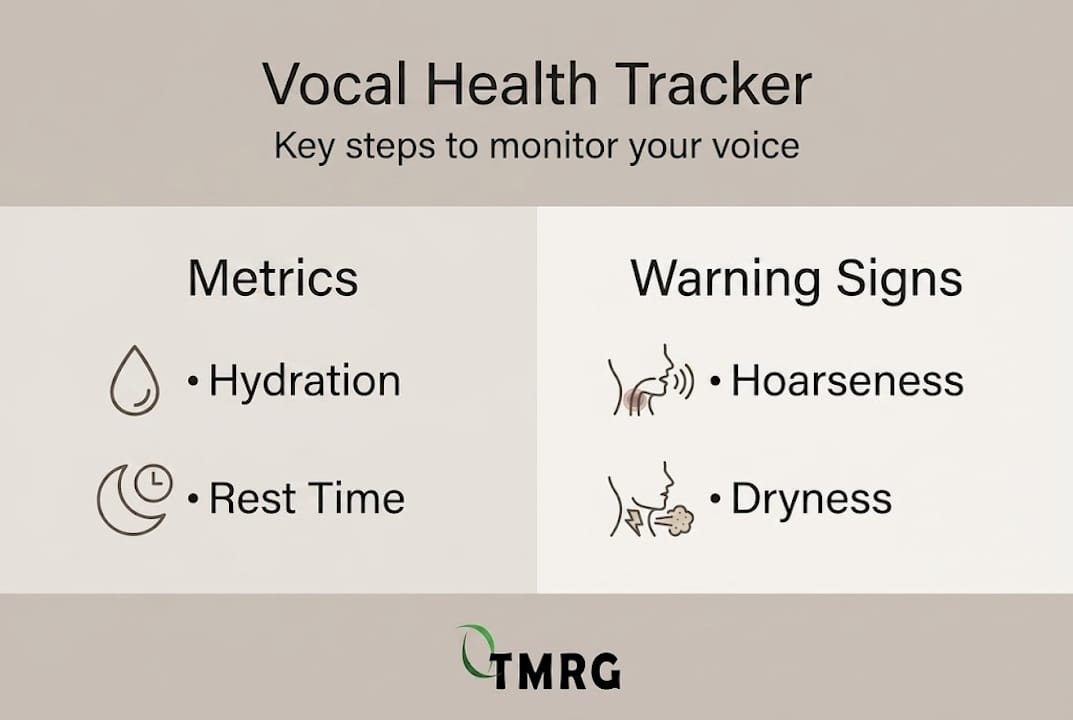
Key metrics to track daily:
| Metric | Target | Warning sign |
|---|---|---|
| Daily water intake | 64 oz (8 cups) minimum | Below 48 oz consistently |
| Ambient humidity | 30% to 50% | Below 25% or above 60% |
| Vocal rest periods | 1 per 90 min of heavy use | No rest in a full workday |
| Morning voice quality | Clear, comfortable onset | Persistent morning roughness |
| Recovery time after use | Voice settles in 30 min | Hoarseness lasting hours |
Use a simple journal or phone app to log these metrics. Patterns become visible over one to two weeks. If your hydration is consistent but your morning voice quality is declining, that’s a signal to look at your sleep environment’s humidity or possible acid reflux affecting your larynx overnight.
Signs you need professional help:
Research consistently shows that professional evaluation is recommended when hoarseness extends beyond two weeks, regardless of how well you’ve been managing self-care. Vocal fold lesions, nodules, or polyps require clinical diagnosis and, in many cases, voice therapy with an SLP.
Tracking also helps you see what’s working. If you add humidification and notice your morning voice quality improves within a week, that’s meaningful data. If you start using a microphone at work and your end-of-day fatigue drops noticeably, that’s your routine telling you something important. Support your vocal recovery steps with the science-backed approaches detailed in our vocal remedies and routines resource.
Most vocal care guides hand you a checklist and call it a day. Drink water. Rest your voice. Use a humidifier. That advice isn’t wrong, but it misses something critical: your voice responds to mechanics, not just comfort measures.
We’ve worked with voice professionals for over 25 years, and the pattern is consistent. The people who recover fastest and perform longest are not the ones who soothe symptoms most aggressively. They’re the ones who understand how their voice works and adjust their technique accordingly. Soothing an irritated throat is useful. But if your vocal production technique is inefficient, you’ll keep re-injuring the same tissue no matter how much tea you drink.
The myth of a universal vocal recovery procedure is outdated. Vocal fatigue and response to loading vary significantly between individuals, meaning a protocol that works for a mezzo-soprano may be entirely wrong for a high school drama teacher.
“Individual response patterns to vocal loading are heterogeneous. One-size-fits-all recovery advice does not reflect the evidence.”
Adapt your routine to your voice, your load, and your goals. Our essential vocal care steps can help you build a personalized framework that actually fits your life.
If you need extra support or want to take your vocal care further, explore these tailored resources.
Following a daily routine is a strong start, but some vocal challenges need more than self-care basics. Whether you’re managing persistent hoarseness, recovering from vocal overuse, or preparing for a demanding performance season, specialized support can make a measurable difference.

At TMRG Solutions, we’ve developed targeted kits built specifically for voice professionals. The Basic Voice Therapy Kit is ideal for those just starting structured vocal recovery, while the Standard Voice Therapy Kit offers a broader range of natural herbal formulations and tools for more complex or ongoing vocal needs. Browse our full range of vocal problems resources to find solutions matched to your specific situation. Your voice is your instrument. Treat it accordingly.
Aim for a vocal nap of 10 to 15 minutes for every 90 minutes of heavy voice use, especially when your voice feels tired or hoarse. Vocal naps and avoiding overuse are recommended for all voice users, not just those with existing problems.
Keep your environment between 30% and 50% relative humidity to protect your vocal tissue from drying out. A humidifier targeting 30% humidity is a practical starting point for most indoor environments.
No. Natural remedies support symptom relief but cannot diagnose or treat structural vocal problems. Hoarseness lasting longer than two weeks should be evaluated by an ENT or speech-language pathologist without delay.
Drink at least 64 ounces (8 cups) of water daily to maintain adequate hydration for your vocal folds. 64 oz per day is the standard recommendation to support vocal tissue health and flexibility.
