Your Cart is Empty


TL;DR:
- Vocal health routines incorporating hydration, rest, and proper technique are essential for performers.
- Consistent warm-ups, environmental controls, and early symptom management prevent long-term damage.
- Monitoring and adjusting routines based on feedback help maintain optimal vocal performance.
Picture this: you’re two songs into a headline set, your voice starts thinning out, and by the third number, the power is gone. Vocal fatigue doesn’t announce itself politely. It shows up mid-performance and takes everything with it. For singers, actors, and voice professionals, a structured vocal health routine isn’t optional — it’s the foundation your career is built on. This guide walks you through exactly what to do, when to do it, and how to protect your most valuable instrument so you can perform at your best, night after night.
| Point | Details |
|---|---|
| Daily routines prevent issues | Sticking to a daily vocal health routine greatly reduces your risk of vocal injury. |
| Hydration and rest are crucial | Consistent hydration and regular rest are foundational to a strong and flexible voice. |
| Track your progress | Monitoring changes in your voice helps you adapt your routine for ongoing improvement. |
| Address problems early | Early attention to vocal fatigue or strain prevents chronic, performance-limiting damage. |
Your voice is a physical instrument. Like any instrument, it responds to consistent care and breaks down under neglect. The stakes for voice professionals are especially high because the vocal folds (the two bands of muscle tissue inside your larynx that vibrate to produce sound) are under repeated mechanical stress every time you sing, act, or speak for extended periods.
Voice professionals face higher risk for vocal injuries precisely because of that frequency of use. A single strained performance can sideline you for days. Repeated strain without recovery leads to chronic conditions like nodules, polyps, or hemorrhages — all of which require medical intervention and extended rest.
“The voice is not just a tool. It is the performer’s identity. When it fails, confidence, income, and opportunity fail with it.”
Here are the most common risk factors for singers and actors:
The three core principles that protect your voice long-term are hydration, rest, and technique. Hydration keeps the mucosal lining of the vocal folds supple. Rest allows micro-tears in the tissue to heal. Technique ensures you’re not compensating with tension that damages surrounding muscles.
| Risk factor | Consequence | Prevention |
|---|---|---|
| Overuse | Nodules, hemorrhage | Schedule vocal rest daily |
| Dehydration | Increased friction, hoarseness | Drink 8+ glasses of water daily |
| Poor technique | Muscle strain, fatigue | Work with a vocal coach regularly |
| Environmental irritants | Inflammation, swelling | Use a humidifier, avoid smoke |
| Acid reflux | Chronic hoarseness | Adjust diet, elevate head during sleep |
Now that we’ve set the stage for why vocal health can make or break your career, let’s dig into the foundational elements you need for a solid routine.
Understanding why you need a vocal health routine makes it easier to adopt the right tools and habits — here’s what you’ll need every day.
A daily vocal care routine built around warm-ups and consistent hydration produces measurably healthier and stronger voices over time. The tools you use matter, but only if the habits behind them are consistent.
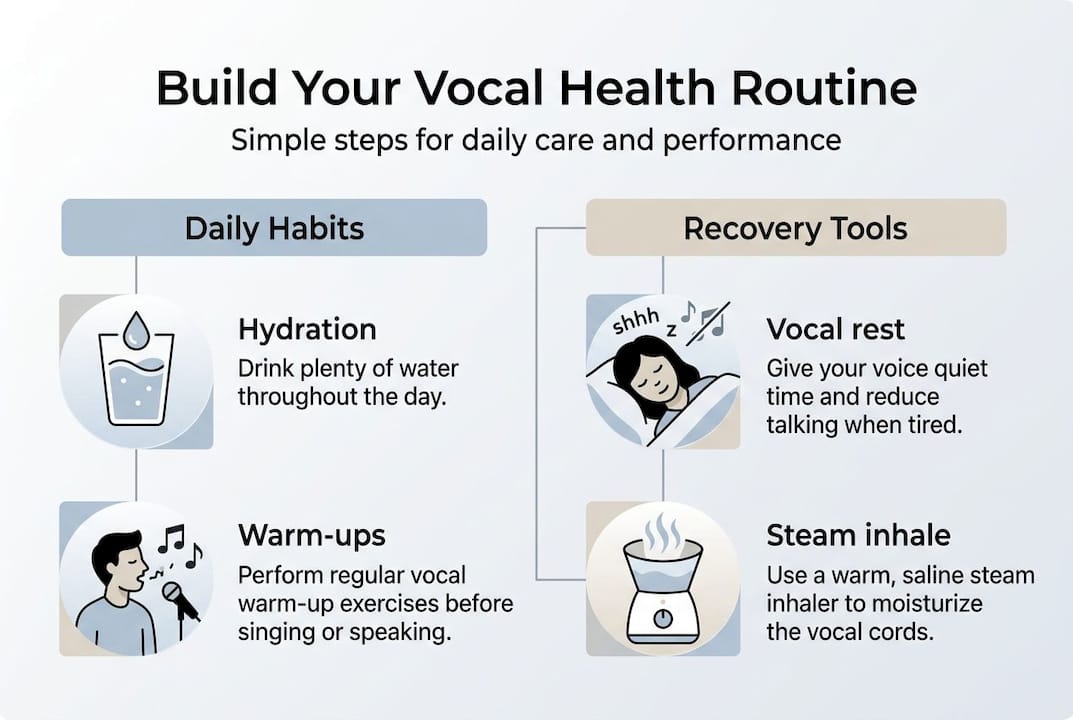
| Tool or habit | Purpose | When to use |
|---|---|---|
| Warm water with honey and lemon | Soothes and hydrates the vocal tract | Morning, before performing |
| Personal steam inhaler | Adds moisture directly to vocal folds | Morning, after long performances |
| Herbal vocal spray | Reduces inflammation, coats the throat | Before and during performances |
| Humidifier | Maintains optimal room humidity (40-60%) | Overnight, in rehearsal spaces |
| Vocal warm-up exercises | Prepares the folds for full use | 15-20 minutes before any vocal activity |
| Vocal cool-down exercises | Reduces post-performance tension | Immediately after performing |
Beyond tools, your environment plays a significant role. Dry air forces your vocal folds to work harder. Aim to keep indoor humidity between 40 and 60 percent. Avoid air conditioning vents blowing directly at your face, and steer clear of spaces with heavy dust or chemical fumes.
Building vocalist daily habits that protect your voice means thinking beyond the stage. What you do in the hours before and after a performance matters just as much as what you do on it.
Pro Tip: Schedule at least 30 minutes of complete vocal silence each day. Think of it as a reset for your instrument. Even professional athletes build rest days into their training — your voice deserves the same.
With tools and good habits in place, you’re ready to follow a daily routine that top professionals rely on.
A great routine isn’t complicated. It’s consistent. The goal is to bring your voice online gradually, use it efficiently, and bring it back down safely. Here’s a sequence that works for both rehearsal and performance days.
Following a systematic vocal routine significantly reduces the risk of vocal strain. On performance days, shorten your technique practice and add extra hydration breaks. On rest days, skip the full warm-up and focus on light humming and steam.
Statistic callout: Consistent vocal routines help prevent up to 80% of common vocal issues that sideline performers. That number isn’t luck — it’s the result of preparation.
Pro Tip: Record yourself during warm-ups once a week. You’ll catch early signs of fatigue — like a slightly rough tone or reduced upper range — before they become real problems. A solid voice care routine gives you a baseline to compare against.
Even the best routines can falter; here’s how to recognize trouble and act fast.
Most vocal problems don’t appear suddenly. They build quietly through repeated small mistakes. Recognizing those patterns early gives you the best chance to correct course before real damage sets in.
Common mistakes that undermine your routine:
Warning: Never ignore these symptoms. Persistent hoarseness lasting more than two weeks, pain or discomfort while speaking or singing, sudden loss of vocal range, or a feeling of something stuck in your throat — these require immediate evaluation by a laryngologist (a physician who specializes in voice disorders).
If you notice early strain, take these steps immediately. Stop all non-essential voice use. Drink warm water and use your steam inhaler. Rest your voice completely for 24 hours if possible. Avoid vocal damage by treating early warning signs seriously rather than waiting for them to resolve on their own.

For vocal health maintenance during recovery, reduce your routine intensity by 50 percent. Focus on hydration and steam rather than active exercises until your voice feels fully recovered.
Pro Tip: Keep a small notebook with you during performances. Note any moments of strain, fatigue, or tonal change. Patterns in that data will tell you exactly where your routine needs adjustment.
Once you know how to spot and fix mistakes, it’s equally important to measure your progress and evolve.
Regular self-monitoring helps performers detect problems early and tailor their approach for long-term voice vitality steps. A vocal journal is your most practical tool for this.
In your journal, track the following each day:
| Week | Morning voice quality | Symptoms noted | Routine completed | Adjustments made |
|---|---|---|---|---|
| Week 1 | 6/10 | Mild dryness | 80% | Added steam session |
| Week 2 | 7/10 | None | 100% | Extended warm-up by 5 min |
| Week 3 | 8/10 | None | 100% | Added cool-down exercises |
| Week 4 | 9/10 | None | 100% | Maintained current routine |
Signs you’re improving:
Red flags to watch for:
Adjust your routine every four weeks based on what your journal shows. If you’re improving, you can gradually increase intensity. If red flags appear, scale back and prioritize rest and hydration.
After working with voice professionals for over 25 years, one pattern is unmistakable: the performers who protect their voices long-term are not the ones with the most expensive equipment or the latest vocal gadgets. They’re the ones who show up for their routine every single day, even when they don’t feel like it.
Here’s the contrarian truth most people don’t want to hear. Miracle sprays, trendy supplements, and high-tech devices are only as effective as the foundation beneath them. Without consistent hydration, proper warm-ups, and scheduled rest, no product will save your voice from chronic misuse.
The performers who struggled most with vocal issues and recovered successfully all had one thing in common: they stopped chasing shortcuts and committed to the basics. They also learned to manage intense vocal effort with the same discipline an athlete brings to training loads. Consistency isn’t glamorous. But it is what works.
Your voice is irreplaceable, and a daily routine is your best investment in protecting it. But sometimes, even a solid routine needs extra support, especially during heavy performance schedules, recovery from illness, or when early symptoms appear.

TMRG Solutions offers a voice therapy kit designed specifically for voice professionals who need targeted recovery and maintenance support. With 25+ years of expertise behind every formulation, these kits complement your daily routine with natural, clinically informed solutions. If you’re navigating specific vocal challenges or want to explore a broader range of options, the vocal problems resources page is a practical starting point. Your routine builds the foundation — TMRG helps you reinforce it.
Aim for a daily routine to prevent long-term damage, especially on days with heavy vocal demands. Even on rest days, light hydration and steam support recovery.
Consistent hydration, proper warm-ups, and adequate vocal rest have the greatest impact. Hydration and warm-ups directly enhance vocal fold function and reduce injury risk.
Persistent hoarseness, pain while speaking or singing, and reduced vocal range may indicate damage. Ignoring warning signs can lead to serious, long-term vocal health issues that require medical treatment.
Yes, when used correctly alongside a daily routine. Voice therapy kits aid in recovery and maintenance by providing targeted natural support for the vocal folds and surrounding tissue.
