Your Cart is Empty


Singing with a cold is usually safe when your symptoms stay above the neck: stuffy nose, mild sore throat, no fever. It becomes risky, and you should cancel, once you notice hoarseness, chest congestion, a productive cough, or any sign of laryngitis. If you do perform, drop your volume, lean on steam and hydration, and stop the moment your voice feels like it’s fighting you.
TL;DR:
- Singing with a cold is generally safe if symptoms are confined above the neck, such as nasal congestion or mild sore throat, without hoarseness or chest congestion.
- Performance should be canceled if signs of laryngitis appear, including hoarseness, productive cough, chest tightness, or if there is a fever.
- Hydration, steam inhalation, and gentle warm-ups are crucial if you must perform while mildly symptomatic, along with lowering volume and using amplification.
- Avoid pushing volume, clearing your throat repeatedly, or taking unprescribed steroids, as these actions can worsen inflammation and risk injury.
- Recovery after performing or illness involves gentle vocal activity, continuous hydration, and consulting a specialist if hoarseness persists beyond two weeks.
The clearest tool for making this call fast is the above-the-neck versus below-the-neck rule that voice clinicians use to sort manageable colds from performance-ending ones. Symptoms confined to your sinuses and throat surface usually leave your vocal folds untouched. Symptoms that reach your chest or your voice box are a different story entirely.
Usually manageable (above the neck):
Cancel and rest (below the neck or laryngitis signs):
This above-the-neck heuristic exists because it maps directly to where the infection is doing damage. A stuffy nose changes your resonance and makes you sound nasal, but it doesn’t touch the folds themselves. Laryngitis does. Once your vocal folds swell, they vibrate less efficiently, which means you naturally push more air and more muscular effort to hit the same pitch you’d normally reach with ease.
Pro Tip: Test your speaking voice before you decide anything. If a two-minute phone call leaves you hoarse, your singing voice will fare worse under stage demands.
That extra effort is where the real damage happens. Singing on swollen vocal folds forces compensatory technique, uneven pressure, and in worse cases, vocal fold hemorrhage. A cold you’d shake off in a week can turn into a vocal injury that sidelines you for months if you sing through the wrong symptoms.
Cancellation isn’t always an option. If you’re staring down a paid gig, a recital, or a performance with no understudy, here’s the order of operations that gives your voice the best chance.
On medication, acetaminophen is generally the safer choice for pain and fever compared to options that carry bleeding risk. Antihistamines and topical decongestants can dry out your vocal tract, which works against everything your hydration plan is trying to do, and topical nasal sprays used more than three days risk rebound congestion. If someone suggests a steroid to get you through a show, that decision belongs to a clinician, not a green room conversation. For more on where the congestion itself comes from, see why a cold makes you lose your voice in the first place.
Some instincts feel helpful in the moment and quietly do the opposite. Knowing what not to do matters as much as knowing what helps.
Whispering can put more strain on inflamed vocal folds than speaking softly at a normal pitch, because the forced, breathy production it requires actually increases tension in the muscles around the larynx.
If you catch yourself whispering to “save your voice” before a show, switch to relaxed, quiet speech instead. For managing drainage without resorting to throat clearing, these post-nasal drip tips cover the alternatives worth trying.
The 48 to 72 hours after a performance, or any acute flare of cold symptoms, set the tone for how fast you bounce back.
For a broader recovery routine, this hoarseness and vocal care guide walks through the same staged approach in more depth.
The clinical picture here is consistent across sources. The above-the-neck/below-the-neck heuristic is widely used by voice clinicians because it reliably predicts which symptoms touch the vocal folds. Hydration research backs the practical advice directly.
| Intervention | What the evidence shows |
|---|---|
| Systemic + surface hydration | Reduces phonation threshold pressure, improves perceived ease of singing |
| Saline nebulization | May improve glottic closure and subjective phonation ease |
| Steroids | Can reduce swelling fast but mask symptoms; clinician supervision required |
| Persistent hoarseness (2+ weeks) | Warrants laryngologist evaluation, per Mayo Clinic guidance |
Saline nebulization shows promise for glottic closure specifically, while steroid use remains a tool reserved for high-stakes situations under direct medical guidance, never a self-managed fix.
Most advice singers get from peers boils down to two extremes: cancel everything at the first sniffle, or grit your teeth and belt anyway because the show must go on. Both miss the point. The above-the-neck/below-the-neck distinction exists precisely because it replaces gut feeling with an anatomic answer, and that answer changes depending on what’s actually inflamed.
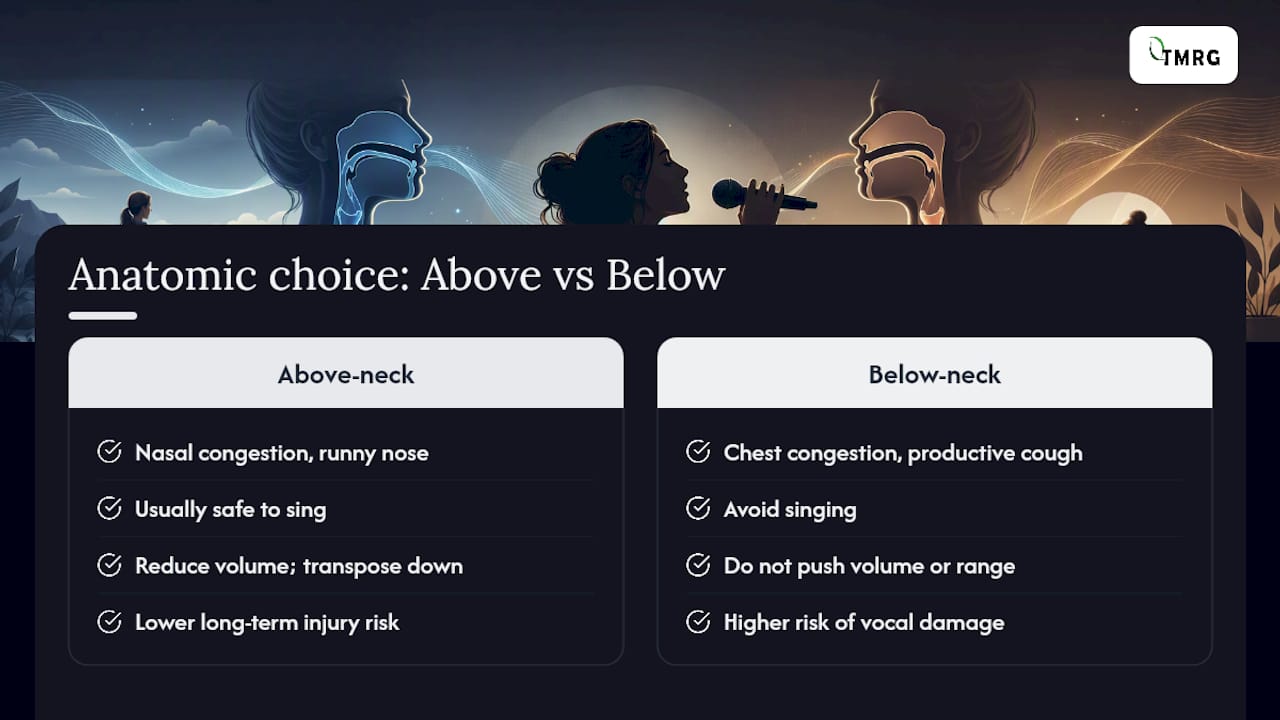
What gets underestimated is how much technique, not willpower, determines whether a sick performance costs you a week or costs you a season. Singers who drop volume, transpose down, and let amplification carry the load walk away with a cold. Singers who try to sound identical to their healthy selves, at full volume and full range, walk away with damaged tissue that no amount of rest fully reverses. Twenty five years of watching vocal injuries unfold has made one thing clear: the folds don’t care how important the gig is.
The other underrated piece is aftercare. Performers treat the show as the finish line, then go silent on hydration and rest the moment the lights go down. Recovery in the following 48 to 72 hours matters as much as anything done before curtain, and it’s the step most often skipped.
— Golan
A certain vocal health company offers product options designed to support performers who are between cancelling shows and singing without any protection. If you’re rehearsing or teaching while mildly symptomatic, the Sound Shield Singing Attenuation Mask reduces aerosol spread so you can keep working without pushing volume to compensate for reduced projection.
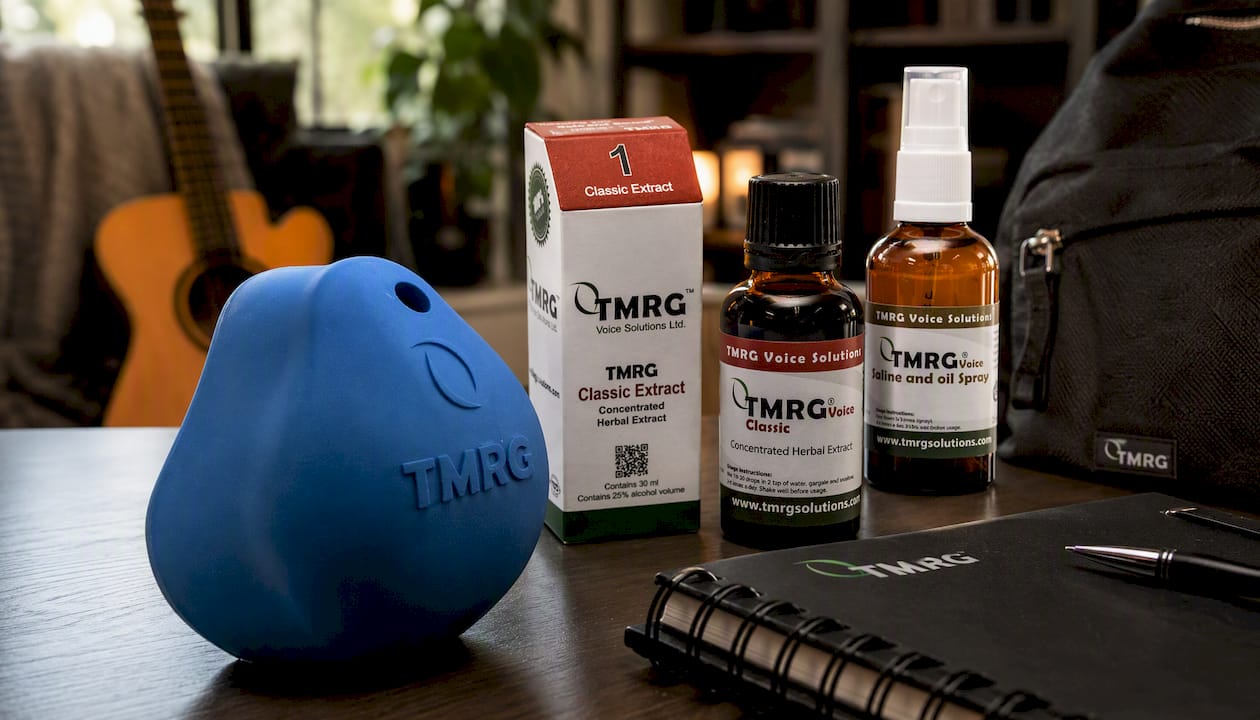
For surface comfort before and after a set, the TMRG Loud & Clear Classic Voice Recovery Drops soothe and lubricate a throat that’s already working harder than usual, and the TMRG Defense Oils and Saline Voice and Throat Spray adds the kind of surface hydration this article’s own evidence points to as genuinely useful backstage. None of these replace a clinician when your symptoms cross into laryngitis or chest congestion. Used within the above-the-neck window, they’re adjuncts that support what your body is already trying to do. Visit Tmrgsolutions to browse the full lineup and find what fits your next rehearsal or show.
This article is general information, not a substitute for advice from a qualified doctor. Consult a qualified healthcare professional about your own circumstances before acting on anything here.
Steady hydration throughout the day, steam or saline nebulization for surface moisture, and relative vocal rest speed recovery more reliably than any single remedy alone.
Expectorants that thin mucus are generally considered less drying than antihistamines, but check with a clinician before combining any medication with performance demands, especially if you have reflux or other conditions.
A mild, dry cough tied to a stuffy nose is usually manageable, but a productive cough bringing up mucus signals lower-respiratory involvement and means you should cancel and rest.
Often, yes, as long as your voice sounds normal when you speak and you have no hoarseness, chest congestion, or reduced range; drop your volume and warm up longer than usual.
See a laryngologist if hoarseness lasts more than two weeks, or immediately if you experience sudden voice loss, pain, or blood, rather than waiting for symptoms to resolve on their own.
