Your Cart is Empty


Ginger, licorice root (Glycyrrhiza glabra), slippery elm, marshmallow root, chamomile, turmeric, and Sisymbrium officinale are the anti-inflammatory herbs for voice with the strongest track record for calming an irritated larynx. If your voice feels raw or strained right now, steep a single-serving infusion of slippery elm or marshmallow root and sip it warm, not hot, over the next 20 to 30 minutes. That mucilage coating starts working almost immediately.
One caution before you reach for the kettle: skip licorice root if you’re pregnant or manage high blood pressure, since its glycyrrhizin content can raise blood pressure and disrupt potassium levels. And if hoarseness has lasted more than two weeks, herbs are not the answer. That’s a signal to see a clinician, according to guidance from the NHS on laryngitis.
Quick fact: In a clinical and cellular study, patients with vocal fold nodules treated with a combination of Glycyrrhiza glabra and Platycodon grandiflorus saw their VHI-C10 disability scores drop from 17.6 to 6.6, a statistically significant improvement that also showed up at the cellular level.
Anti-inflammatory herbs for voice work through two distinct mechanisms: mucilage herbs provide fast physical coating, while phytochemical herbs like licorice reduce inflammation over several days.
| Point | Details |
|---|---|
| Start with demulcents | Slippery elm or marshmallow root infusions give the fastest perceived relief, often within minutes. |
| Build with pharmacologic herbs | Licorice and Sisymbrium officinale need 3 to 7 days of consistent use to show measurable improvement. |
| Watch licorice interactions | Avoid licorice root if pregnant, hypertensive, or on cardiac medication. |
| Know the two-week rule | Hoarseness lasting beyond two weeks needs medical evaluation, not more tea. |
| Pair herbs with targeted products | Tmrgsolutions’s Loud & Clear drops and Voice Therapy kits are designed to complement, not replace, herbal teas in a recovery routine. |
Not every herb marketed for “throat health” does the same job. Some coat and cushion. Others work at the molecular level to quiet inflammation in vocal fold tissue. Knowing the difference changes how you use them.
Ginger (Zingiber officinale) Evidence level: traditional use plus mechanistic and consumer-health data. Ginger’s gingerol and shogaol compounds have documented anti-inflammatory and antimicrobial activity, which is why ginger for sore throat shows up constantly in home-remedy guides. For singers, ginger for voice work usually means a fresh-root tea, steeped 10 minutes, sipped warm. Concentrated ginger can irritate sensitive throats, so start mild.
Licorice root (Glycyrrhiza glabra) Evidence level: strong clinical and cellular evidence. This is the standout among anti-inflammatory spices for voice recovery. In the Glycyrrhiza and Platycodon study, the extract inhibited p65 and MAPK inflammatory proteins in vocal-fold epithelial cells with no cytotoxicity at tested doses. Prepare as a short decoction, five minutes at a low simmer. Avoid if you have hypertension, cardiac medication, or are pregnant.
Platycodon grandiflorus (balloon flower root) Evidence level: clinical and in vitro, almost always paired with licorice in the research. This root is harder to find in Western markets but appears in traditional Chinese medicine throat formulas. It works synergistically with Glycyrrhiza, and the combination is what produced the VHI-C10 improvement cited above.
Slippery elm (Ulmus rubra) Evidence level: long traditional use, limited controlled human data. The inner bark’s mucilage swells in water and coats the throat lining, offering some of the fastest perceived relief of any herb on this list. Pilot research on slippery elm for laryngeal irritation shows a soothing trend without strong statistical backing yet. Stir powdered bark into warm water until it thickens slightly, then sip.

Marshmallow root (Althaea officinalis) Evidence level: traditional demulcent, mechanism well understood, human voice-specific trials scarce. Chemically similar to slippery elm in its mucilage content. Cold-infuse it overnight for maximum extraction, since heat can slightly degrade the polysaccharides.
Chamomile (Matricaria chamomilla) Evidence level: traditional and mild anti-inflammatory data. Best as a gentle evening tea rather than a targeted vocal-cord treatment. Its apigenin content has documented calming and anti-inflammatory properties, though not vocal-fold-specific.
Turmeric (Curcuma longa) Evidence level: broad anti-inflammatory research, limited voice-specific trials. Curcumin is the active compound behind turmeric for voice claims, but it absorbs poorly without fat or black pepper. A warm turmeric milk decoction with a pinch of black pepper is the traditional delivery method.
Sisymbrium officinale (“singer’s plant”) Evidence level: small clinical cohort plus long-standing traditional use, with a European Medicines Agency traditional-use monograph. A clinical report on Sisymbrium officinale documented meaningful Voice Handicap Index improvements in singers with vocal strain, echoing centuries of use by European vocalists.
Thyme and sage Evidence level: traditional and antimicrobial, less anti-inflammatory-specific. Useful as gargles when throat irritation has an infectious component alongside inflammation.
Pro Tip: Keep dried slippery elm bark and marshmallow root on hand as your “immediate relief” pair, and reserve licorice or turmeric decoctions for a multi-day regimen when you have time to let the anti-inflammatory compounds accumulate.
Two distinct mechanisms are doing the work here, and confusing them leads to disappointment.
The first is mucilage, a demulcent action. Slippery elm, marshmallow root, and to a lesser extent licorice contain polysaccharides that swell in water and form a soft gel-like film. That film physically coats irritated vocal mucosa, which reduces the friction and dryness that make vibration painful. This is why demulcent herbs for soothing voice feel effective within minutes: the relief is mechanical, not chemical.
The second mechanism is pharmacologic, and it’s slower but potentially more durable. A database analysis published in the Journal of Voice cataloged 44 plants and 101 phytocompounds used in voice care, and identified TRPA1, a sensory receptor involved in irritation and pain signaling, as one of the most frequently targeted pathways. Herbs that modulate TRPA1 can desensitize the nerve endings that register throat discomfort. Separately, the Glycyrrhiza and Platycodon research showed direct inhibition of the MAPK and NF-κB inflammatory signaling cascades inside vocal-fold epithelial cells, the same pathways implicated in nodule formation and chronic swelling.
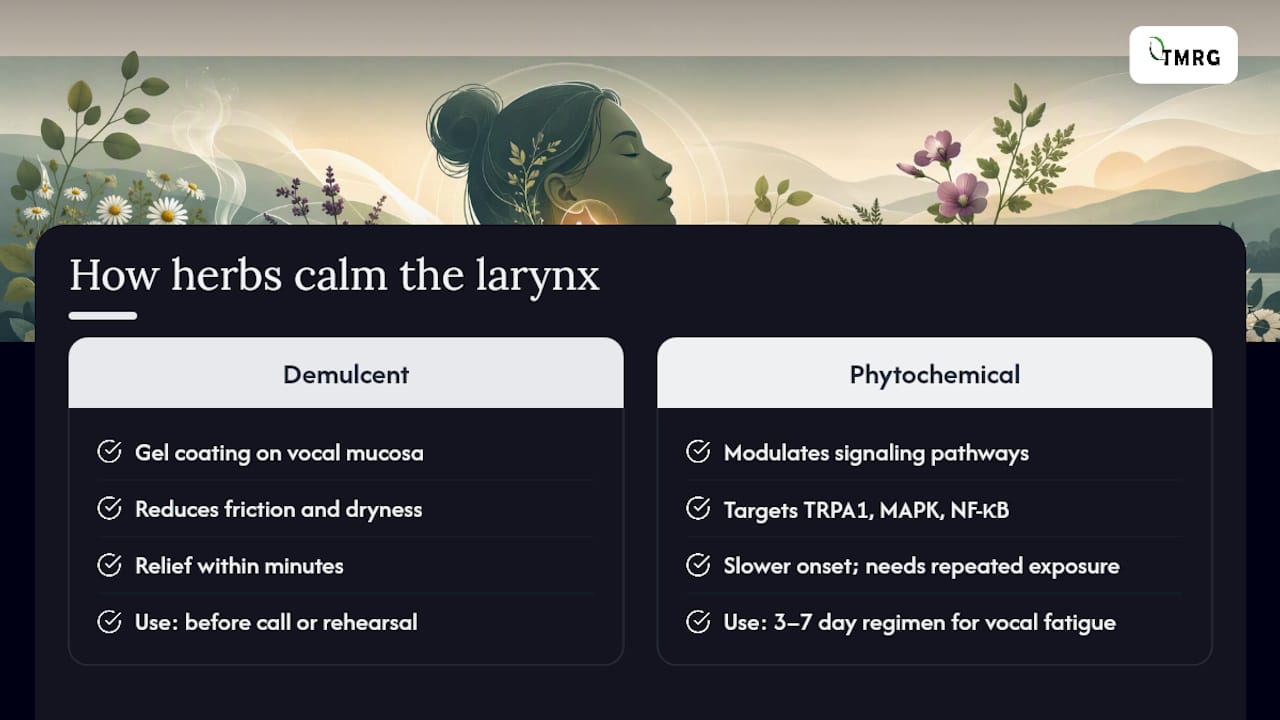
Pro Tip: Reach for mucilage-rich herbs like slippery elm when you need relief before a call time or rehearsal. Save phytochemical anti-inflammatories like licorice and turmeric for a standing 3 to 7 day regimen when vocal fatigue is building over a run of shows, since those pathways need repeated exposure to make a measurable difference.
Preparation method changes how much active material actually reaches your throat. Here’s how to do it right for each category.
Infusion (for mucilage herbs: slippery elm, marshmallow root, chamomile)
Decoction (for roots: licorice, ginger, turmeric)
Throat syrup (honey base) Combine a strong infusion or decoction, cooled slightly, with raw honey at a 1:1 ratio and store refrigerated. A tablespoon before rehearsal coats the throat and delivers the herb’s compounds in a thicker, longer-contact form than tea alone.
Lozenges and gargles Commercial slippery elm lozenges dissolve slowly, extending demulcent contact time. For a gargle, use a cooled infusion of sage or thyme, swish for 30 seconds, and spit rather than swallow if antimicrobial action is the goal.
Most anti-inflammatory herbs for throat use are safe in normal culinary or infusion quantities, but a few carry real risk for specific people.
Seek medical evaluation, not another cup of tea, if you notice any of the following: hoarseness lasting more than two weeks, coughing up blood, difficulty breathing or swallowing, or a sudden dramatic voice change following vocal trauma or a scream. Clinical guidance is consistent on this point: home remedies soothe symptoms, they don’t diagnose or treat underlying pathology like nodules, polyps, or more serious lesions, as outlined in the NHS laryngitis guidance. Our guide to persistent hoarseness walks through that escalation path in more detail.
The evidence base for herbs to reduce throat inflammation ranges from rigorous clinical trials down to centuries of traditional use with no controlled human data at all. Knowing where each herb sits on that spectrum keeps your expectations realistic.
| Herb/Treatment | Evidence type | Key outcome |
|---|---|---|
| Glycyrrhiza glabra + Platycodon grandiflorus | Clinical + cellular study | VHI-C10 scores fell from 17.6 to 6.6 |
| Flurbiprofen spray/lozenge (NSAID) | Randomized clinical trial | Over 80% reported relief by 1 hour |
| Sisymbrium officinale | Small clinical cohort | Meaningful VHI improvement, consistent with traditional use |
| Ginger | Mechanistic + consumer health data | Anti-inflammatory compounds confirmed; limited controlled trials |
The gap between a topical NSAID and a cup of licorice tea isn’t just about strength, it’s about speed. A randomized trial of flurbiprofen spray found more than half of participants reported moderate relief within one minute, and over 80% by the one hour mark. Herbal anti-inflammatories rarely move that fast; the Glycyrrhiza and Platycodon study measured its dramatic VHI-C10 improvement over a full treatment course, not a single dose.
That contrast matters for how you plan. If you need relief before you walk on stage in twenty minutes, a demulcent tea or a clinically studied topical option is your realistic bet, not a licorice decoction you started sipping ten minutes ago. If you’re managing recurring vocal strain across a multi-week run, herbs like licorice and Sisymbrium have real data behind sustained use, but they’re building toward a result measured in days, not minutes.
Here’s a stepwise approach that reflects both the mucilage and pharmacologic research above, structured for someone dealing with acute vocal irritation rather than a diagnosed disorder.
This general information is not a substitute for professional medical advice, and if you have underlying conditions or take regular medication, confirm any herbal regimen with your doctor first. Tmrgsolutions has built its formulations around more than 25 years of applied vocal health practice, and that stepwise, escalate-when-needed structure is the same logic behind our product design, detailed further in our research and development overview.
Ask around backstage and you’ll find most working singers have a herbal ritual, but it’s rarely the elaborate multi-step routine sold online. It’s usually one or two things, done consistently.
The common pattern is a warm, non-caffeinated tea an hour or more before a call time, often ginger or a mild licorice blend, followed by plain water closer to stage time to avoid coating the throat right before singing. Coaches tend to warn against very hot liquids immediately pre-performance, since heat can trigger reflexive throat tightening and doesn’t actually improve tone.
The cautionary pattern is just as common: performers who load up on multiple herbs and heavy honey syrups right before going on, only to find their voice feels thick or coated rather than clear. Mucilage that helps at rest can dull resonance if you overdo it fifteen minutes before you need to project. Timing and moderation matter more than which specific herb you choose.
If you’ve read this far, you know herbs work best as part of a system, not a single miracle cup of tea. That’s exactly the gap Tmrgsolutions built its products to close: a way to pair fast, targeted relief with the slower anti-inflammatory work herbs like licorice and turmeric are doing in the background.

For the immediate, before-a-show relief that mucilage herbs provide, TMRG Loud & Clear Classic Voice Recovery Drops are formulated for short-term soothing you can use alongside a slippery elm infusion, not instead of it. If you’re managing a longer recovery, like the 3 to 7 day regimen outlined above, the TMRG Voice Therapy Kit Standard gives you a structured multi-step approach that complements daily herbal teas rather than replacing them. For a lighter entry point, the TMRG Voice Therapy Kit Basic covers the essentials for occasional performers, and the TMRG Voice Clarity Trio bundles three complementary products for readers who want a ready-made routine.
These are Tmrgsolutions’s own formulations, and we’re upfront about that. Use them alongside the herbal preparations in this guide, and if hoarseness persists past two weeks despite both, see a clinician rather than adding another product. Browse the full Voice Therapy Kit lineup to find the option that matches where you are in recovery.
Combine vocal rest with a demulcent herb like slippery elm or marshmallow root for immediate soothing, then add an anti-inflammatory herb like licorice root over 3 to 7 days for sustained relief; seek medical care if hoarseness persists beyond two weeks.
Based on clinical and cellular evidence, Glycyrrhiza glabra (licorice root), especially combined with Platycodon grandiflorus, has the strongest documented anti-inflammatory effect on vocal fold tissue, with one study showing VHI-C10 scores fall from 17.6 to 6.6.
Licorice root, Sisymbrium officinale, slippery elm, marshmallow root, and ginger each have some form of clinical, cellular, or traditional-use evidence supporting vocal cord recovery, though the strength of that evidence varies significantly by herb.
Nothing heals vocal cords instantly, but demulcent teas like slippery elm provide fast perceived relief through mucilage coating within minutes, while a topical option like flurbiprofen spray showed relief in most users within an hour in clinical trials; pairing a soothing product like TMRG Loud & Clear drops with rest supports faster recovery than herbs alone.
Most combinations, like ginger with slippery elm, are safe, but avoid stacking licorice with turmeric if you take blood-thinning medication, and always separate mucilage herbs from other oral medications by two hours to avoid absorption interference.
