Your Cart is Empty


TL;DR:
- Herbal vocal cord support uses plant-based remedies to soothe and restore vocal function. Proper hydration enhances herbal effectiveness and speeds recovery for voice professionals.
Herbal vocal cord support is the practice of using plant-based remedies to soothe, protect, and restore vocal cord function. Clinically, this falls under the broader category of phytotherapy for laryngeal health, and it covers everything from anti-inflammatory teas to demulcent lozenges. Herbs like Sisymbrium officinale (commonly called “singer’s herb”) and slippery elm have documented roles in reducing vocal fatigue and mucosal inflammation. Hydration remains the non-negotiable foundation, and when you combine it with the right botanical support, recovery is measurably faster. Tmrgsolutions has spent over 25 years working with singers, lecturers, and voice professionals on exactly this kind of care.
The most effective herbs for vocal cord health work through three mechanisms: reducing inflammation, thinning mucus, and coating the mucosal lining. Each mechanism addresses a different layer of vocal strain, which is why combining herbs often outperforms using a single remedy.
Sisymbrium officinale, known as the singer’s herb, is the most clinically recognized plant for acute hoarseness. The standard adult dosage is 50 drops in water, three times daily. That level of specificity matters because under-dosing produces little effect, while overuse can irritate sensitive tissue.
Licorice root (Glycyrrhiza glabra) contains glycyrrhizin, a compound with both anti-inflammatory and expectorant properties. It thins mucus secretions so your vocal folds vibrate more freely. Marshmallow root (Althaea officinalis) works differently. It forms a gel-like coating over the throat lining, reducing friction and protecting inflamed tissue from further damage.
Chamomile and sage are best delivered as warm gargles. Sage and chamomile decoctions reduce mucosal swelling and calm throat inflammation, making them practical tools before and after vocal use. Slippery elm, typically found in lozenge form, acts as a demulcent that quiets irritation at the surface level.
Here is a quick reference for the most effective herbs and their primary functions:
Pro Tip: Combine marshmallow root tea with a few drops of Sisymbrium officinale tincture for a two-mechanism approach. The marshmallow coats while the Sisymbrium works deeper on inflammation.
For singers and lecturers who want a deeper look at selecting herbal supplements for performance, Tmrgsolutions provides detailed guidance tailored to vocal professionals.
Hydration is not a passive background condition. It is the primary mechanism through which herbal remedies reach their full effect. Maintaining mucosal moisture lowers the mechanical force required for vocal cord vibration, which directly reduces fatigue and the risk of tissue damage. When your vocal folds are dry, they have to work harder to produce sound, and that extra effort accelerates wear.
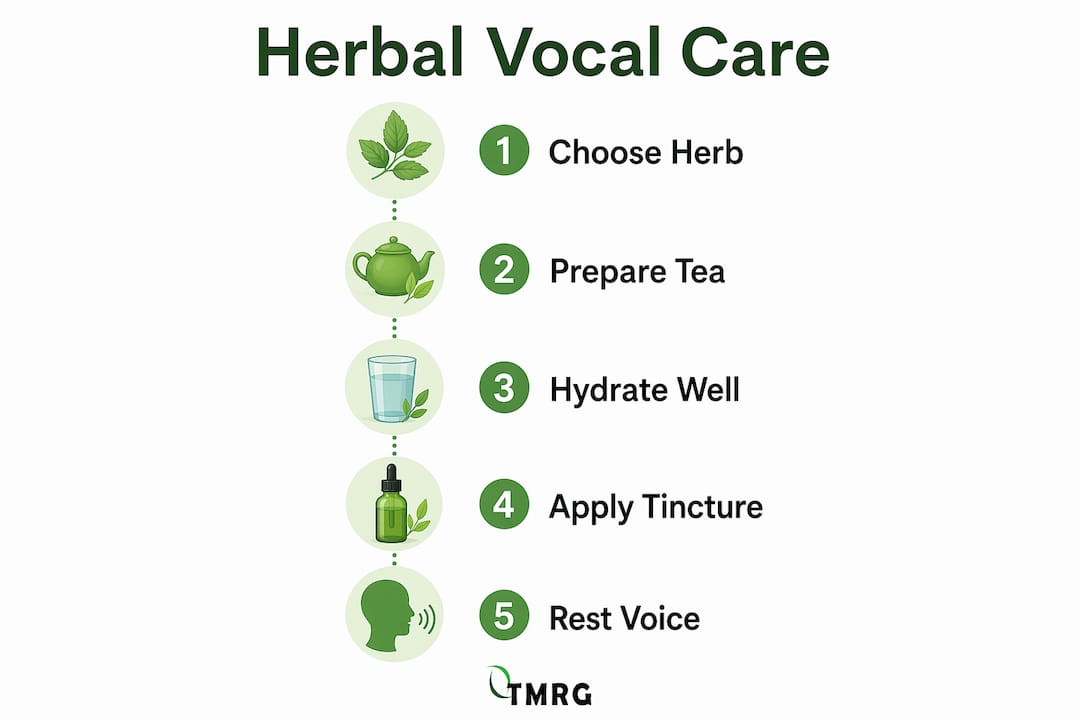
Dr. Giorgia Cazzolli identifies hydration as the single most important first step in preventing vocal fatigue and long-term damage. That is not a general wellness claim. It reflects the physiology of the vocal folds, which are covered in a thin mucous layer that must stay fluid for efficient vibration.
Warm liquids amplify this effect. Pineapple juice contains bromelain, an enzyme with active anti-inflammatory properties that rehydrates tissue while reducing swelling. Honey acts as a protective emollient, coating the throat and slowing moisture loss. Both are practical, evidence-backed additions to a pre-performance hydration routine.
“True vocal health requires days of consistent hydration, not just a glass of water before you go on stage. Local soothing from teas and gargles provides immediate relief, but systemic hydration is what rebuilds the mucosal layer over time.”
Substances that dry the mucosa work against every herbal remedy you take. Alcohol and caffeine both reduce mucosal moisture. Timing your herbal teas and water intake strategically around performance is as important as the herbs themselves.
Pro Tip: Keep a thermos of warm marshmallow root or licorice tea nearby during rehearsals. Consistent sipping maintains mucosal moisture far better than drinking a large volume right before you perform.
For a full breakdown of hydration strategies for vocal health, Tmrgsolutions covers timing, volume, and the specific liquids that support vocal cord recovery.
The delivery method determines how quickly and how deeply an herbal remedy acts. Teas and warm gargles provide immediate local soothing but do not penetrate deeply. Tinctures absorb faster and can have systemic effects, but they carry a significant risk for vocal performers.
Alcohol-based tinctures containing 18–23% alcohol or menthol can dry the vocal mucosa, directly counteracting your hydration efforts. This is a common mistake among performers who reach for a tincture right before going on stage. If you use a tincture, dilute it well in warm water and avoid menthol-heavy formulas entirely.
Herbal gargles using Phytolacca and Calendula provide local antiseptic and soothing effects. They work well for surface-level irritation but require the same caution around alcohol content. Lozenges with slippery elm or pectins act as demulcents and are among the safest options for use during a performance because they release slowly and do not dry the tissue.
| Product form | Onset | Duration | Best use case | Key caution |
|---|---|---|---|---|
| Herbal tea | 10–15 min | 30–60 min | Daily maintenance, pre-performance | Avoid too hot; no caffeine |
| Tincture | 5–10 min | 1–2 hours | Acute hoarseness, systemic support | Dilute well; avoid high-alcohol formulas |
| Lozenge | 5–10 min | 20–40 min | During performance, surface soothing | Check for menthol content |
| Gargle | Immediate | 15–30 min | Post-performance, antiseptic relief | Alcohol content; do not swallow |
| Spray | Immediate | 15–30 min | Quick pre-performance relief | Avoid menthol; check ingredients |
Pro Tip: For pre-performance use, choose alcohol-free herbal sprays or slippery elm lozenges. Save tinctures for recovery days when you are not about to use your voice.
Herbal remedies work best inside a broader vocal care routine. Without the right lifestyle habits, even the most effective botanical formula will underperform. The following practices directly support the conditions herbs need to work.
Practice complete vocal rest during acute strain. Whispering strains the laryngeal muscles more than normal speech does. Many performers fall into the “whisper trap,” believing they are resting their voice when they are actually increasing muscle tension. True vocal rest means no speaking, no singing, and no whispering.
Use a humidifier in dry environments. Dry air pulls moisture from the vocal mucosa even when you are not speaking. A room humidifier set to 40–60% relative humidity maintains the mucosal layer between uses. This is especially relevant for performers who travel or work in air-conditioned spaces.
Avoid throat clearing. Forceful throat clearing creates a sharp impact between the vocal folds. Over time, this causes micro-trauma to the mucosal surface. If you feel the urge to clear your throat, swallow instead or take a sip of water.
Manage reflux. Gastroesophageal reflux deposits acid on the vocal folds during sleep. This is one of the most underrecognized causes of chronic hoarseness in professional voice users. Avoid eating within two hours of lying down.
Build herbal routines into your daily schedule. A morning cup of licorice or marshmallow tea, consistent water intake throughout the day, and a post-performance gargle with sage and chamomile create a rhythm that protects the voice over time. Sporadic use of herbal remedies produces sporadic results.
Tmrgsolutions covers preventing vocal fatigue with specific strategies for performers who need consistent, reliable vocal output across demanding schedules.
Effective herbal vocal cord support combines targeted botanical remedies, consistent hydration, and smart product selection to protect and restore the vocal folds.
| Point | Details |
|---|---|
| Sisymbrium officinale is the lead herb | Use 50 drops in water, three times daily, for acute hoarseness and vocal loss. |
| Hydration is the foundation | Mucosal moisture lowers mechanical stress on vocal folds and makes herbal remedies more effective. |
| Avoid alcohol-based tinctures pre-performance | High-alcohol formulas dry the vocal mucosa and counteract hydration efforts. |
| Whispering is not vocal rest | True rest means no speaking or whispering; both increase laryngeal muscle tension. |
| Combine delivery methods strategically | Use lozenges or sprays during performance and teas or tinctures for daily maintenance and recovery. |
After working with singers, lecturers, and voice actors for a long time, the pattern I see most often is not a lack of effort. It is misplaced effort. Performers spend real money on herbal products and then undermine them with a cup of coffee before the show or a whispered conversation backstage.
The herb that surprises people most is Sisymbrium officinale. It is not glamorous, it does not have a strong flavor, and it is not widely marketed. But it is the one remedy I return to consistently for acute hoarseness because the evidence behind it is specific and the dosage is clear. Most herbal products for voice are vague about what they contain and how much. That vagueness is where results get lost.
The other thing I push back on is the idea that herbal care is a quick fix. A gargle before you walk on stage is a band-aid. Real vocal protection comes from days of hydration, consistent herbal routines, and knowing when to stop using your voice entirely. Practitioners distinguish between local soothing and systemic hydration for good reason. One gives you relief in the moment. The other actually rebuilds the tissue.
My honest advice: start with hydration, add one or two well-chosen herbs in the right form, and treat vocal rest as a non-negotiable tool rather than a last resort. If you are selecting herbal solutions for voice and you are not sure where to begin, start with the simplest option that addresses your specific symptom. Complexity does not equal effectiveness.
— Golan
Tmrgsolutions brings over 25 years of vocal health expertise into every product it formulates. Its approach combines herbal ingredients with hydration strategies and professional-grade delivery methods designed for singers, actors, and lecturers who cannot afford downtime.

The TMRG Voice Clarity Trio integrates herbal formulations targeting inflammation, mucosal coating, and vocal fatigue in a single coordinated kit. For performers dealing with more significant strain, the TMRG Voice Therapy Kit provides a structured recovery program built around the same botanical principles covered in this article. Both products reflect the brand’s commitment to evidence-backed, natural vocal care without shortcuts.
Sisymbrium officinale is the most clinically recognized herb for acute hoarseness. The standard adult dosage is 50 drops in water, three times daily.
Yes. Warm teas made from marshmallow root, licorice, or chamomile soothe the mucosal lining and support hydration, both of which reduce mechanical stress on the vocal folds.
Whispering increases tension in the laryngeal muscles more than normal speech does. Complete silence is the only form of vocal rest that allows inflamed tissue to recover.
Tinctures containing 18–23% alcohol or menthol can dry the vocal mucosa. Dilute them well in warm water and avoid using them immediately before vocal performance.
Local soothing from teas and gargles takes effect within 10–15 minutes. Systemic recovery through consistent hydration and herbal routines requires several days of sustained practice.
