Your Cart is Empty


TL;DR:
- Singer-specific throat sprays maintain hydration and reduce inflammation without drying or numbing the delicate vocal tissues.
- Using herbal, alcohol-free formulas with ingredients like Yerba Mansa, Licorice, and Honey supports long-lasting vocal performance safely.
You’ve probably tried a generic throat spray before a show, hoping it would carry you through two sets, only to find your voice still fading by the third song. Not all throat sprays are created equal, and for singers, choosing the wrong one can actually make things worse. This guide breaks down exactly why singer-specific formulas work better, which ingredients to seek out or avoid, and how to build a practical routine around the right spray so your voice stays clear, resilient, and powerful when the pressure is highest.
| Point | Details |
|---|---|
| Singer-focused sprays work | Products made for vocalists offer better relief and protection than generic throat remedies. |
| Natural ingredients matter | Herbs like Yerba Mansa and Licorice build lasting vocal comfort and hydration. |
| Smart routines maximize results | Integrate sprays with hydration, warm-ups, and moderation for the best vocal health. |
| Short-term vs. long-term care | Sprays solve immediate issues, but sustainable vocal strength comes from holistic habits. |
A standard over-the-counter throat spray is designed for one thing: reducing discomfort from a cold or minor infection. A singer’s needs are entirely different. You need your vocal folds (the two muscular bands inside your larynx that vibrate to produce sound) to stay supple, well-hydrated, and free from excess mucus so tone and projection remain consistent across a full performance.
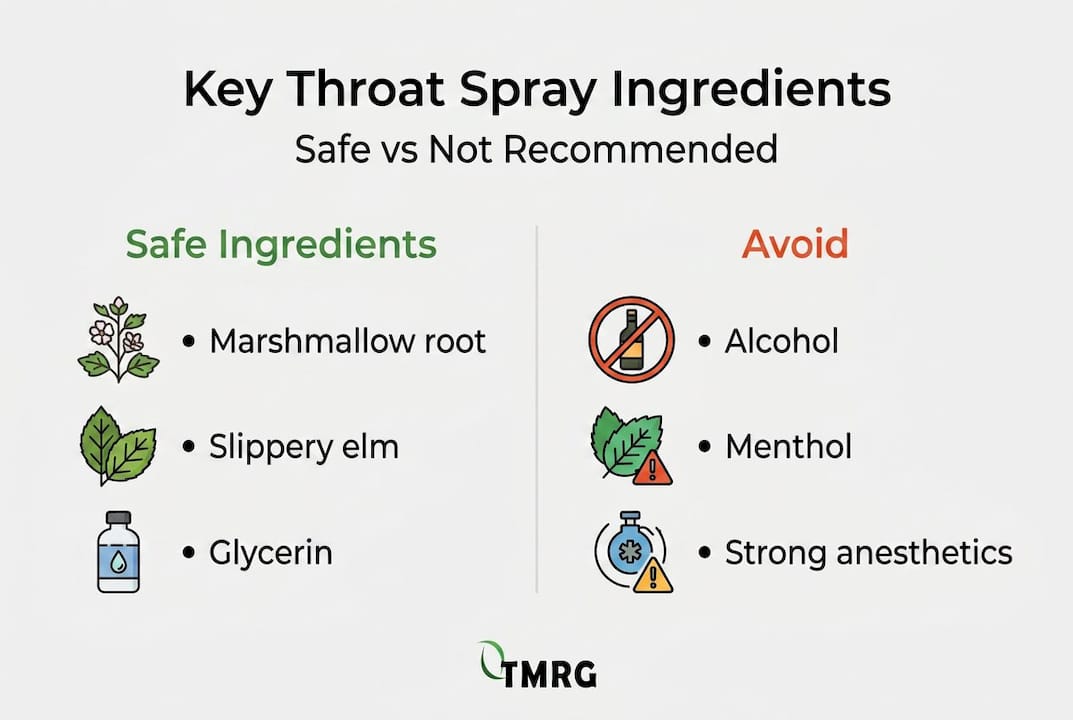
General sprays often contain alcohol, artificial menthol, or harsh numbing agents that may temporarily dull discomfort but actually dry out the delicate mucosal lining of your throat. That dryness creates friction, and friction is the enemy of a smooth, sustained tone. Singer-specific formulas are built around a very different goal: keeping tissue moist, reducing inflammation without masking it, and allowing you to feel your instrument while you perform.
The key benefits you should expect from a purpose-built vocal spray include:
“A throat spray designed for singers should support the voice, not silence it. If you can’t feel your instrument, you can’t control it.”
Reviewing the best throat sprays comparison reveals a clear pattern: the sprays that singers return to consistently are herbal, alcohol-free, and built around ingredients with a long history in vocal care. You can also explore vocal spray health explained to understand the science behind why mucosal hydration is so critical for performance.
Common problems arise when singers overuse any spray or rely on one with the wrong ingredients. Overuse of numbing agents can mask a developing strain, allowing you to push your voice past its safe limit. Alcohol-based sprays create a cycle of dryness, irritation, and repeated reapplication that weakens the tissue over time. Paying attention to what you are putting near your vocal folds is not optional — it is a fundamental part of vocal preservation.
Once you understand why singer-specific formulas work differently, the next step is learning to read labels with confidence. Certain ingredients have earned their place in the best throat sprays through both traditional use and real-world performance results.
Ingredients that genuinely support singers:
Herbal solutions for vocal care offers a broader look at how these plant-based ingredients interact with vocal tissue for longer-term benefits.
A product like Singer’s Saving Grace by Herbs Etc. has built a strong following among vocalists because it specifically combines Yerba Mansa, Licorice, and Lemon and Honey to address the full range of singer concerns — soothing, moisturizing, and mucus-thinning effects in a single spray.
Ingredients to avoid entirely:
Pro Tip: When evaluating any throat spray, flip the bottle and check for alcohol listed in the first three inactive ingredients. If it’s there, set the product down and keep looking. Your vocal folds deserve better.
With a clear understanding of ingredients, it helps to see how leading products compare side by side. The table below reflects key features that matter most to singers in real performance conditions.
| Product | Key ingredients | Moisturizing | Anti-inflammatory | Alcohol-free | Price range |
|---|---|---|---|---|---|
| Singer’s Saving Grace Professional Strength | Yerba Mansa, Licorice, Lemon, Honey | Strong | Yes | Yes | $15-$20 |
| Singer’s Saving Grace Extra Strength | Yerba Mansa, Licorice, Lemon, Honey | Very strong | Yes | Yes | $20-$25 |
| Entertainer’s Secret | Carrageenan, Aloe Vera, Glycerin | Strong | Mild | Yes | $12-$18 |
| Bee Propolis Throat Spray | Bee propolis, honey | Moderate | Yes | Varies | $10-$16 |
| Thayers Dry Mouth Spray | Aloe Vera, Xylitol | Moderate | Mild | Yes | $8-$12 |
Singers consistently report that the Singer’s Saving Grace variants have lasting effects during performances, particularly through long rehearsals and back-to-back shows where other products fade quickly. The Professional Strength version suits regular use, while the Extra Strength formula is better reserved for heavy performance schedules or early signs of vocal fatigue.
Entertainer’s Secret is a well-regarded option with a thicker, glycerin-based consistency that coats the throat effectively. It lacks the herbal depth of Singer’s Saving Grace but works well for singers who need straightforward moisture support without strong herbal flavor. Bee propolis sprays offer genuine immune-boosting benefits alongside anti-inflammatory action, making them a smart choice during cold and flu season.

What real singers say: User feedback patterns consistently point to two factors above all others. First, whether the spray lasts through an entire performance without reapplication becoming necessary every 20 minutes. Second, whether it leaves a residue or flavor that interferes with tone or breath. The natural, herbal formulas score strongly on both counts because their active ingredients are absorbed quickly and work at the tissue level rather than sitting on the surface.
You can find a detailed expert throat spray comparison that examines additional products and digs further into performance duration data.
Having the right spray in your bag only matters if you use it correctly. Many singers either underuse their spray (a few puffs right before walking onstage) or overuse it (spraying every few minutes as a nervous habit). Neither approach gives you the full benefit.
Here is a practical routine that aligns with both preventative care and urgent support:
Hydrate first. Drink 16 to 20 ounces of room-temperature water at least 30 minutes before you reach for any spray. Topical moisture from a spray works best when your body’s systemic hydration is already solid. Water acts from the inside, sprays act from the outside — you need both.
Spray 10 to 15 minutes before your warm-up. This gives active ingredients time to coat mucosal tissue before you ask your voice to work. Direct the spray toward the back of your throat and breathe in gently through your mouth after spraying to help it reach deeper tissue.
Complete a gentle warm-up. Humming softly, lip trills, and gentle siren exercises (sliding your pitch slowly from low to high and back) prepare your vocal folds for the full range you’ll use in performance without forcing them cold.
Reapply during breaks, not mid-performance. If you have a song break or interval, a single application is appropriate. Repeated spraying mid-song can coat the vocal folds with residue that actually muffles tone.
Use a recovery application after your performance. One application after your final song, followed by warm water and vocal rest, supports faster tissue recovery overnight.
Avoid spraying immediately before high-pressure notes. The extra coating can temporarily alter your kinesthetic sense of the throat, making it harder to gauge how much pressure you’re applying.
Pro Tip: Pair your spray routine with a warm steam inhalation (a bowl of hot water with a towel over your head) for five minutes before your warm-up. This adds systemic humidity that even the best topical spray cannot fully replicate on its own.
Singers who use Singer’s Saving Grace to last through performances report the biggest gains when they combine it with full pre-show hydration and a consistent warm-up, not as a standalone fix. You can pair these habits with specific voice spray and vocal exercises to make your preparation routine more complete, or explore natural remedies for stronger vocals for additional support strategies.
Here is something vocal coaches say quietly in lessons but rarely publish: throat sprays are a tool for management, not a solution for vocal health. The singers who rely on them most heavily are often the ones who have neglected the foundational habits that make reliance unnecessary.
Think about what a throat spray is actually doing. It is moisturizing tissue that should already be hydrated through consistent water intake. It is soothing inflammation that could have been prevented through proper warm-up and cool-down. It is clearing mucus that often builds up in response to dairy intake, acid reflux, or shallow breathing. The spray treats the symptom efficiently, but the cause remains untouched.
The dangerous pattern we see with experienced and amateur singers alike is using a good-quality spray as permission to push harder, stay out later, skip rest days, and skip the boring fundamentals. That approach works short-term and fails catastrophically long-term. Nodules, hemorrhage, and chronic dysphonia (hoarseness that persists beyond a few days) often trace back not to a single incident but to months of managed neglect.
Our perspective is this: use throat sprays as the intelligent, targeted tools they are, but never mistake them for a substitute for sleep, systemic hydration, gentle technique, and honest recovery time. Explore natural remedies for vocal pros to build a broader support framework around your voice. The sprays will serve you far better as one layer of care among many, rather than your entire safety net.
You now have a clear roadmap for choosing, using, and thinking about throat sprays in a way that actually protects your instrument for the long term.

When you are ready to go further, the TMRG Basic Voice Therapy Kit gives you a structured starting point for daily vocal care, while the TMRG Standard Voice Therapy Kit adds more comprehensive support for singers with heavier performance schedules. For targeted performance enhancement, TMRG Impact Voice Enhancement Drops work at the tissue level to keep your voice resilient through demanding seasons. These tools are built around the same natural, holistic philosophy this article is grounded in. Your voice is worth the investment.
The best sprays use natural ingredients that soothe, moisturize, and thin mucus without harsh chemicals or drying alcohol. Formulas built around Yerba Mansa, Licorice, and Lemon and Honey address all three needs in one application.
Yes, but experts recommend combining them with proper hydration, gentle warm-ups, and moderation to avoid dependency. A spray used alongside these habits will outperform one used as a standalone fix every time.
Herbal sprays with well-established ingredient profiles are generally safe when used as directed, though you should monitor for any sensitivity to specific botanicals. Herbal options like Singer’s Saving Grace are widely praised for their natural, non-irritating formulations that hold up well over extended use.
A soothing spray may offer real comfort and help you finish a commitment, but always treat fatigue as a signal to investigate root causes rather than cover them. Prioritize vocal rest, gentle humming exercises, and extra hydration before reaching for any product.
