Your Cart is Empty


TL;DR:
- A clear voice support formula combines herbal ingredients and vocal care practices to protect and strengthen the voice. It addresses the direct needs of the vocal folds and promotes healthy habits like hydration, rest, and proper breathing. Consistent use and good habits help prevent fatigue and long-term damage for voice professionals.
Vocal health means keeping your vocal cords hydrated, rested and free of strain so your voice stays clear and strong. The basics are simple: drink plenty of water, warm up before singing or long periods of speaking, breathe from your diaphragm, rest your voice when it feels tired, and avoid shouting, smoking and too much caffeine or alcohol. If hoarseness lasts more than 2–3 weeks, see a doctor or ENT. Below, we explain each habit, the natural ingredients that soothe the throat, and the daily exercises singers, teachers and speakers use, drawing on Tmrgsolutions’ 25+ years of vocal care experience.
A clear voice support formula combines two pillars: natural ingredient blends and disciplined vocal care habits. Neither pillar works as well alone. An herbal throat spray without proper breath technique still leaves your vocal folds vulnerable to strain. Consistent vocal hygiene without nutritional support leaves the throat tissues dry and irritated.

The formula targets the vocal folds directly. These two small bands of muscle and mucous membrane vibrate hundreds of times per second to produce sound. When they are dry, inflamed, or overworked, the voice becomes hoarse, thin, or fatigued. The formula’s goal is to keep those folds lubricated, reduce inflammation, and build the muscular stamina needed for sustained performance.
Vocal health specialists and speech-language pathologists use the term “vocal hygiene” to describe the behavioral side of this formula. Vocal hygiene covers hydration, rest, breath support, and avoiding harmful habits. The natural ingredient side covers herbal extracts and supplements that soothe and coat throat tissues. Together, they form a complete system for anyone who depends on their voice professionally.
Common herbal ingredients in vocal sprays and supplements include slippery elm, licorice root, aloe vera, marjoram, osha root, and tylophora. Each brings a specific benefit to the formula, and their combined effect is greater than any single ingredient alone.
Slippery elm contains mucilage, a gel-like substance that coats the throat lining and reduces friction during phonation. Singers often use it before performances to create a protective layer over irritated tissue.
Licorice root carries anti-inflammatory compounds called glycyrrhizins that calm swollen throat tissue. It also has mild expectorant properties, helping clear mucus without the mechanical damage of throat clearing.
Aloe vera provides cooling hydration to inflamed mucosal surfaces. Its polysaccharide content supports tissue repair, making it particularly useful after periods of vocal overuse.
Marjoram acts as a mild antispasmodic, reducing involuntary muscle tension in the laryngeal area. Tension in those muscles is a primary driver of vocal fatigue.
Osha root has been used in traditional herbal medicine to open airways and reduce respiratory inflammation. For voice professionals, clearer airways mean less effort to project sound.
Tylophora supports immune function and reduces bronchial inflammation, which matters because respiratory health directly affects vocal fold vibration quality.
These ingredients work through ingredient synergy. Slippery elm coats while licorice root calms inflammation, and aloe vera repairs. No single herb does all three. A well-formulated natural voice support product sequences these actions so the throat receives layered protection throughout the day.
Pro Tip: Take herbal vocal supplements 30 minutes before a performance or heavy voice use session, not during. Coating the throat in advance gives the mucilage time to form a protective layer before the folds face stress.
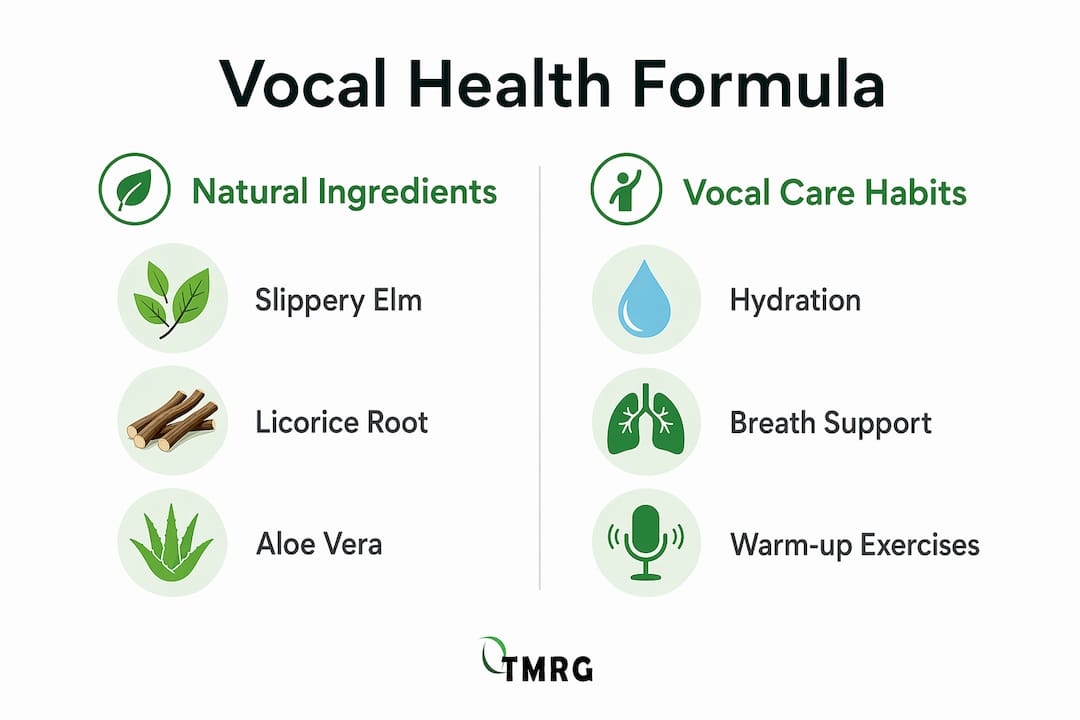
Natural ingredients support the throat, but daily habits determine whether that support holds. Hydrated vocal folds vibrate smoothly and efficiently. Dehydration increases friction between the folds, accelerating wear and raising the risk of nodules or hemorrhage. Drink water consistently throughout the day, not just before you sing or speak.
The following practices form the behavioral core of any effective vocal care routine:
Hydrate continuously. Aim for consistent water intake across the full day. Caffeinated drinks and alcohol dehydrate the mucous membranes, so offset each cup of coffee with an equal volume of water.
Schedule vocal rest. Voice professionals benefit from at least 10 minutes of rest per 60 minutes of intensive voice use. That 1:6 ratio prevents cumulative fatigue from building into injury.
Use diaphragmatic breath support. True vocal power comes from efficient, resisted airflow managed by the diaphragm, not from force generated at the throat. Engaging the diaphragm reduces the mechanical load on the vocal folds with every phrase.
Stop clearing your throat. Throat clearing forces the vocal folds to slam together repeatedly, causing micro-trauma. Replace the habit with a gentle swallow or a soft, breathy “h-h-h” sound to clear mucus without impact.
Avoid whispering when tired. Whispering forces the vocal folds into a strained semi-closed position that worsens inflammation. Silent rest or quiet, fully voiced speech is always the better option.
Avoid shouting in noisy environments. Competing with background noise pushes the voice beyond its sustainable range. Use a microphone or move closer to your listener instead.
Speech-language pathologists consistently rank breath support as the single most impactful habit change for voice professionals. When the diaphragm does its job, the laryngeal muscles stop compensating. That compensation is what causes the tight, strained feeling that singers and speakers recognize as the early warning sign of fatigue. For a deeper look at protecting high-demand voices, Tmrgsolutions covers professional voice care strategies in detail.
Pro Tip: Record yourself speaking or singing for two minutes, then listen back. If you hear strain or breathiness in the first 30 seconds, your breath support is failing before your technique does. Fix the breath first.
Semi-occluded vocal tract exercises are the gold standard for daily vocal maintenance among professional vocal coaches. These exercises partially block the front of the vocal tract, creating back-pressure that reduces the collision force between the vocal folds during vibration. The result is stronger, more efficient phonation with less wear.
The most effective exercises in this category include:
Lip trills. Blow air through loosely closed lips while phonating a pitch or a scale. The vibration massages the lips and creates the back-pressure that protects the folds. Start with a comfortable mid-range pitch and expand gradually.
Straw phonation. Phonate through a narrow cocktail straw into a glass of water. The resistance from the water amplifies the back-pressure effect. This exercise is widely used in voice therapy for post-injury recovery and daily conditioning.
Humming. Hum with relaxed jaw and lips barely touching. Humming activates resonance in the facial bones and sinuses, reducing the work the larynx must do to project sound.
Sirens. Slide smoothly from your lowest comfortable pitch to your highest and back, like a siren sound. Sirens stretch and warm the full range of the vocal folds without the abrupt transitions that cause strain.
Controlled exhale with phonation. Exhale slowly on a sustained “sss” sound, then switch to a voiced “zzz.” The contrast trains the diaphragm to regulate airflow precisely.
The physiological benefit of these exercises is measurable. Reduced collision force means less inflammation after a long rehearsal or lecture. Over weeks of consistent practice, the vocal folds build stamina the same way any muscle does: through progressive, controlled loading followed by adequate rest.
Voice therapy with a licensed speech-language pathologist adds a layer that self-directed exercise cannot. A therapist identifies inefficient phonation patterns, such as glottal attacks or pressed phonation, that cause damage even during technically correct exercises. For singers and speakers who use their voice professionally, one or two therapy sessions per year functions as a vocal check-up, catching problems before they become injuries. Pairing therapy with effective speaking techniques accelerates progress for anyone who relies on voice for communication.
| Exercise | Primary benefit |
|---|---|
| Lip trills | Reduces fold collision force, warms up range |
| Straw phonation | Builds stamina, supports post-injury recovery |
| Humming | Activates facial resonance, reduces laryngeal effort |
| Sirens | Stretches full pitch range without strain |
| Controlled exhale | Trains diaphragm to regulate airflow precisely |
Natural support formulas and vocal hygiene handle most day-to-day strain. They do not fix structural or neurological problems. Knowing when to stop self-managing and see a specialist protects you from permanent damage.
Watch for these warning signs:
Hoarseness or vocal fatigue lasting beyond 2–3 weeks. Medical guidelines as of mid-2026 recommend ENT evaluation after persistent symptoms exceeding that window. Hoarseness that does not resolve with rest and hydration signals a problem that natural support alone cannot address.
Pain during or after speaking or singing. Phonation should never hurt. Pain indicates tissue damage or muscle tension that requires clinical assessment.
Sudden pitch breaks or complete voice loss. Acute loss of voice without an obvious cause like illness warrants prompt evaluation, not watchful waiting.
Chronic mucus or post-nasal drip that does not respond to hydration. This can indicate allergic or reflux-related irritation that requires targeted treatment.
An ENT specialist uses laryngoscopy, a camera-assisted view of the vocal folds, to identify nodules, polyps, cysts, or hemorrhage. A speech-language pathologist then assesses phonation patterns and designs a therapy plan. Mayo Clinic guidelines emphasize that chronic voice disorders require individualized treatment, often combining vocal hygiene, voice therapy, and medical intervention when structural or nerve-related dysfunction is present. Early detection consistently produces better outcomes than delayed care. For guidance on managing long-term vocal issues, Tmrgsolutions covers persistent hoarseness prevention in depth.
A clear voice support formula works only when natural ingredients and disciplined vocal habits operate together as a single, consistent system.
| Point | Details |
|---|---|
| Formula definition | Combines herbal ingredients with vocal hygiene practices for sustained vocal clarity. |
| Key ingredients | Slippery elm, licorice root, aloe vera, marjoram, osha root, and tylophora each serve a specific protective role. |
| Hydration and rest | Drink water consistently and rest at least 10 minutes per 60 minutes of intensive voice use. |
| Best daily exercises | Lip trills, straw phonation, and sirens build stamina while reducing vocal fold collision force. |
| When to see a specialist | Hoarseness or fatigue lasting beyond 2–3 weeks requires ENT evaluation, not continued self-management. |
After years of working with singers, lecturers, and voice professionals, the pattern I see most often is this: people invest in a good natural supplement and then undermine it with one bad habit. The most common offender is throat clearing. A performer will take a well-formulated herbal spray before a show, then spend the warm-up period repeatedly slamming their vocal folds together trying to clear mucus. The supplement cannot protect against that kind of mechanical damage.
The second thing I have learned is that consistency matters more than intensity. A singer who does five minutes of straw phonation every morning for three months builds more resilience than one who does a 45-minute vocal workout twice a week. The folds respond to regular, moderate stimulus. They do not respond well to feast-and-famine training cycles.
The third insight is about rest. Most voice professionals underestimate how much recovery time the vocal folds need after a demanding performance. The folds are muscle and mucous membrane. They swell slightly after heavy use, just like a bicep after a hard set. Trying to rehearse the morning after a two-hour concert is the vocal equivalent of lifting heavy on sore arms. Silent rest, good hydration, and a gentle herbal supplement the day after a performance will serve you better than any amount of extra practice.
The formula works. The obstacle is almost never the formula itself. The obstacle is the habits you carry into the day alongside it.
— Golan
Tmrgsolutions brings over 25 years of vocal health expertise to a product range built specifically for singers, speakers, and voice professionals who need reliable daily support.

The TMRG Voice Clarity Trio combines three natural formulations designed to work together across your full vocal care routine, from morning warm-up through post-performance recovery. For acute throat relief, the Classic Voice Recovery Drops deliver fast-acting herbal support when your voice needs it most. Both products integrate directly with the vocal hygiene practices covered in this guide. Visit Tmrgsolutions to review full ingredient lists, usage instructions, and guidance from vocal health professionals.
A clear voice support formula typically contains herbal ingredients like slippery elm, licorice root, aloe vera, marjoram, osha root, and tylophora, combined with vocal hygiene practices such as hydration, rest, and breath support. Each ingredient targets a specific aspect of throat health, from coating and lubrication to inflammation reduction.
Voice professionals should drink water consistently throughout the entire day rather than in large amounts before performing. Hydrated vocal folds vibrate smoothly; dehydration increases friction and accelerates wear on the tissue.
Semi-occluded vocal tract exercises like lip trills and straw phonation are safe for beginners because they reduce, rather than increase, the collision force on the vocal folds. Start with five minutes daily and increase duration gradually as stamina builds.
Hoarseness or vocal fatigue lasting beyond 2–3 weeks requires ENT evaluation to rule out nodules, polyps, or other structural issues. Natural support and rest are appropriate for short-term strain, not for symptoms that persist past that window.
Whispering does not help recovery. It forces the vocal folds into a strained semi-closed position that worsens inflammation. Silent rest or quiet, fully voiced speech is the correct approach when the voice is fatigued.
How can I improve my vocal health?
A: Drink water throughout the day, warm up before using your voice heavily, breathe from your diaphragm, take short voice breaks, and avoid shouting, whispering and smoking. Getting enough sleep and using a humidifier in dry rooms also helps.
How do I heal vocal damage?
A: Mild strain usually improves with voice rest, hydration and steam over a few days. Avoid clearing your throat and whispering. If your voice doesn't improve within 2–3 weeks, or you feel pain or lose your voice completely, see an ENT.
Why is my voice hoarse but my throat doesn’t hurt?
A: Painless hoarseness is often caused by vocal overuse, dryness, acid reflux or allergies. It usually clears with rest and hydration, but hoarseness that lasts more than 2–3 weeks should be checked by a doctor.
