Your Cart is Empty


TL;DR:
Whispering worsens vocal strain; humming is a safer alternative for tired voices.
Consistent hydration, nutrition, and structured exercises are key to preventing vocal fatigue.
Professional voice therapy and early intervention outperform surgery in managing vocal issues.
Most voice professionals assume that whispering saves their voice when it feels tired. It does not. Whispering actually forces your vocal folds into an abnormal position that increases friction and strain, sometimes more than normal speech. If you are a singer, actor, or lecturer dealing with recurring vocal fatigue, you need strategies grounded in evidence, not habit. This article covers hydration, herbal support, therapeutic exercises, and professional voice therapy approaches that genuinely work, so you can protect your instrument and perform with confidence, night after night.
| Point | Details |
|---|---|
| Vocal rest isn’t enough | Active exercises and therapies support true voice recovery and maintenance. |
| Hydration is critical | Adequate daily water and avoiding irritants keep vocal folds functioning and prevent fatigue. |
| Natural remedies help | Evidence-backed herbs like slippery elm and licorice root can soothe inflammation if used wisely. |
| Therapy outperforms surgery | Voice therapy is often more effective long-term than surgical or injection interventions. |
| Early intervention pays off | Seeking professional support quickly prevents minor issues from becoming chronic problems. |
Vocal support is not just about taking a break. It involves three interconnected pillars: breath control and technique, lifestyle habits, and consistent care routines. When any of these breaks down, fatigue follows. For professional voice users, the risks compound quickly.
The term vocal support refers to the coordinated effort of the respiratory system, laryngeal muscles, and resonance cavities working together to produce a clear, sustainable sound. Your diaphragm drives airflow. Your vocal folds shape it. Your throat, mouth, and nasal cavities color the tone. When this system is overworked or under-supported, your voice loses its “full” quality and starts to feel thin, scratchy, or unreliable.
A common mistake many professionals make is treating forced whisper rest as safe recovery. It is not. Whispering engages the arytenoid cartilages differently, creating tension that is comparable to, or worse than, regular phonation. If your voice is tired, quiet humming is a safer and more therapeutic alternative.
Risk factors for vocal fatigue include:
Overuse without scheduled vocal rest periods
Poor hydration leading to dry, friction-prone vocal folds
Acid reflux, which irritates the larynx even when you do not feel heartburn
Mouth breathing in dry or air-conditioned environments
Lack of professional guidance, especially early in a career
The stakes are real. Professional voice users face significantly higher dysphonia risk than the general population, and early intervention by a speech-language pathologist (SLP) is one of the most effective prevention tools available. Dysphonia is the medical term for any abnormal change in voice quality.
Note: Core vocal challenges, including nodules, chronic hoarseness, and muscle tension dysphonia, share one common thread: they all develop gradually and worsen without attention.
Understanding protecting your speaking voice early is far less costly than recovering from a serious injury. Building good daily habits to prevent vocal strain is the most sustainable path forward for any voice professional.
Now that we know why professionals frequently struggle with their voices, let’s explore how everyday habits play a role in vocal health.
Your vocal folds are covered by a thin mucous membrane. That membrane needs moisture to vibrate freely. When it dries out, the phonation threshold pressure, the force required to start vibration, goes up. Your body compensates by recruiting more muscle effort, which leads directly to fatigue.

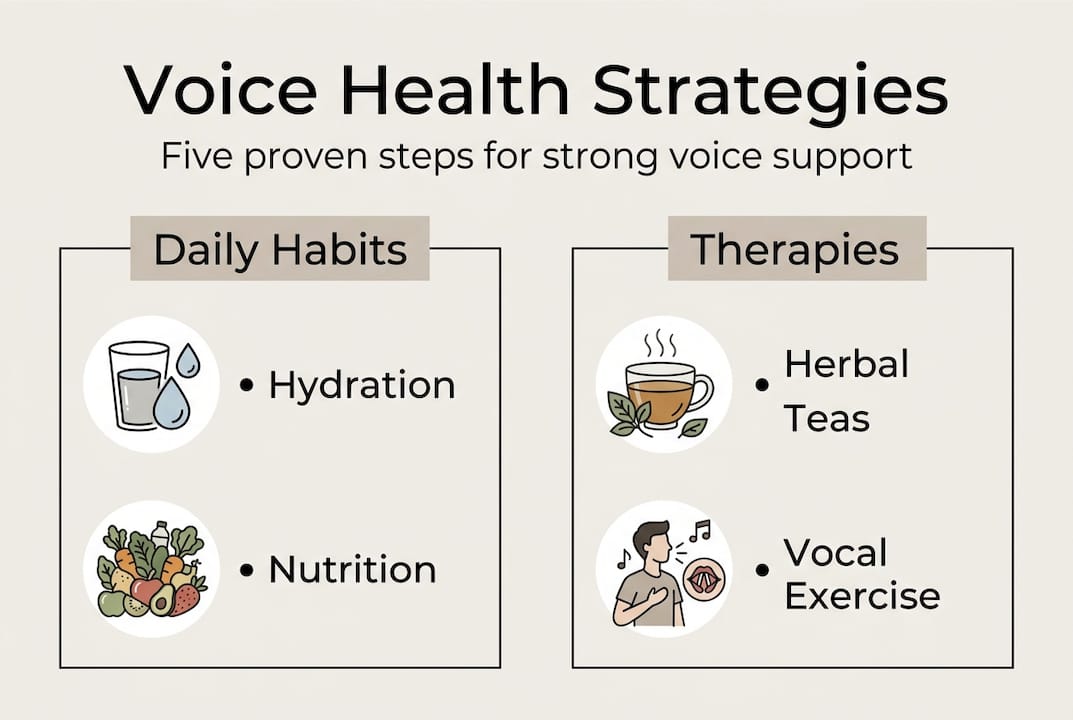
Vocal fold health depends on drinking 8 to 10 glasses of water daily, supplementing with herbal teas, and using a humidifier in dry spaces. Pale yellow urine is your best real-time indicator. Daily fluid intake should fall between 2.7 and 3.7 liters, depending on your size, activity level, and climate.
| Habit | Benefit | Notes |
|---|---|---|
| 8-10 glasses water daily | Maintains fold moisture | Spread throughout the day |
| Herbal teas (chamomile, ginger) | Soothe inflammation | Avoid very hot temperatures |
| Humidifier at night | Prevents overnight drying | Clean weekly to avoid mold |
| Avoiding caffeine | Reduces diuretic effect | Replace with warm water |
| Avoiding alcohol | Prevents mucosal drying | Especially before performance |
Nutrition matters too. Some foods actively support vocal health while others work against it:
Support: Warm broths, honey, ginger, leafy greens, and omega-3 rich foods all reduce inflammatory load.
Avoid: Spicy foods can trigger reflux, dairy increases mucus in some individuals, and highly processed foods tend to increase systemic inflammation.
Timing: Avoid eating large meals within two hours of a performance to reduce reflux risk.
Pro Tip: Room temperature water is absorbed faster than cold water. Keep a bottle at your side during rehearsals, not just before and after. Small, frequent sips do more for your vocal folds than large amounts consumed infrequently.
Explore hydration strategies for the voice and build a consistent routine using voice maintenance tips you can apply daily.
With hydration and nutrition in mind, it’s important to understand what natural therapies can further enhance vocal recovery.
Herbal remedies have been used for centuries to support throat and voice health. Today, several have enough clinical backing to be worth your attention, provided you use them appropriately.
Evidence-based herbs including slippery elm, licorice root, chamomile, and ginger each address different aspects of vocal inflammation and irritation. Their mechanisms are distinct and, when combined thoughtfully, they can offer meaningful support.
| Herb | Primary benefit | Caution |
|---|---|---|
| Slippery elm | Coats and soothes mucosal lining | Avoid if taking oral medications (delays absorption) |
| Licorice root | Anti-inflammatory, reduces swelling | Avoid with high blood pressure or heart conditions |
| Chamomile | Gentle relaxant, mild anti-inflammatory | Rare allergy in ragweed-sensitive individuals |
| Ginger | Reduces nausea, anti-inflammatory | High doses may thin blood |
The most well-studied product in this category is Throat Coat tea, a blend containing slippery elm, licorice root, and marshmallow root. Clinical trials have shown it reduces perceived throat discomfort and improves ease of swallowing compared to placebo.
Key guidelines for smart herbal use:
Do not replace water with herbal teas. Use them as a supplement to your daily fluid intake, not a substitute.
Check for interactions if you are on medications, especially blood pressure drugs or blood thinners.
Use consistently, not just on performance days. Herbal support builds over time.
Serve teas warm, not hot. Very hot liquids can cause mucosal irritation, which is the opposite of what you want.
Pro Tip: A daily cup of chamomile or ginger tea after your last vocal session of the day can reduce next-morning stiffness. Think of it as a cool-down for your voice.
Learn more about herbal effects on the vocal system and browse herbal solutions for vocal care to find formulations tailored to your specific needs.
In addition to herbal remedies, structured exercises and therapy offer critical benefits for sustainable vocal support.
Exercise is one of the most powerful and underused tools in vocal recovery. The right exercises do not strain your voice. They actually reduce the effort your vocal folds need to produce sound.
Semi-Occluded Vocal Tract Exercises (SOVTEs) such as straw phonation, lip trills, and humming create back pressure inside the vocal tract. This back pressure reduces the phonation threshold pressure, meaning your folds can vibrate more freely with less muscular effort. The result is improved efficiency and reduced fatigue.
Here is a safe, structured routine you can follow at home:
Straw phonation (5 minutes): Blow through a thin cocktail straw while producing a steady hum. Vary pitch slowly from low to high and back.
Lip trills (3 minutes): Relax your lips and allow them to flutter as you exhale with voice. This warms up the entire vocal tract without strain.
Sustained humming (3 minutes): Hum a comfortable note and feel the vibration in your lips and forehead. This engages resonance without forcing the folds together.
Gliding scales (5 minutes): Slide gently up and down your range on a /m/ or /n/ consonant. Do not push into extremes of range.
Breath pacing (2 minutes): Inhale for four counts, hold for two, exhale on a steady /s/ for eight counts. This reinforces diaphragmatic airflow.
For more complex or persistent vocal issues, professional voice therapy is proven to outperform surgery as a first-line option. Resonant voice therapy and ABCLOVE protocols have demonstrated strong results in reducing nodules, improving voice quality, and restoring function without surgical risk.
Key reminder: Do NOT whisper when your voice is fatigued. Whispering creates abnormal fold tension. Gentle humming is always the safer option.
Review proven steps to prevent vocal fatigue and apply expert strategies for preventing vocal fatigue consistently to build a resilient vocal instrument.
Building sustainable vocal health is not just about intervention. It is also about putting these findings into practical everyday routines.
After 25 years working with singers, actors, and professional speakers, one pattern stands out clearly: most people wait too long. They treat vocal care as something you do after a problem appears, not before.
Resting your voice completely is not the same as healing it. Passive rest reduces irritation temporarily, but it does not rebuild the neuromuscular patterns that keep your voice strong and flexible. Active recovery through SOVTEs, hydration, and structured herbal support creates lasting change. Passive rest alone does not.
Another overlooked issue is consistency. Most voice professionals do their best work in the weeks before a big performance and then drop every good habit immediately after. This cycle creates a damaging pattern of stress and neglect.
Voice therapy consistently outperforms surgical or injection-based interventions for nodules over the long term, and surgery lacks strong randomized controlled trial (RCT) evidence compared to non-surgical approaches. That is a fact that should shift how you think about your first line of action.
If you use your voice professionally, ongoing support is not optional. Regular check-ins with an SLP, daily vocal hygiene, and consistent practice around vocal effort maintenance are the habits that separate a 20-year career from a 5-year one.
You now have a clear picture of what actually supports a healthy, resilient voice. The next step is putting these strategies to work with tools designed specifically for voice professionals.

At TMRG, we have spent more than 25 years developing natural formulations and vocal problem solutions for the exact challenges covered in this article. Whether you are managing recurring fatigue or preparing for an intense performance season, our basic voice therapy kit gives you a structured starting point with everything you need for daily vocal care. Singers dealing with more demanding performance schedules will find the therapy kit for singers especially well-suited to their needs. Take the next step today.
Gentle straw phonation and vocal rest, with a strict no-whispering rule, are the safest immediate recovery options. Humming is an equally low-strain alternative that keeps the voice gently active.
Aim for 8 to 10 glasses of fluid daily, roughly 2.7 to 3.7 liters, adjusting for your activity level, climate, and body size. Pale yellow urine is the most practical daily indicator.
Yes, with nuance. Throat Coat tea containing licorice root, slippery elm, and marshmallow root has shown measurable improvement in throat comfort versus placebo in clinical trials. Use warm, not hot, and check for any contraindications with your health provider.
No. Whispering increases strain on the vocal folds by placing them in a tense, partially abducted position. Gentle humming is the safest option when your voice is tired or hoarse.
Seek a specialist if your hoarseness persists beyond two weeks, or if you experience pain, significant pitch changes, or loss of range. Voice professionals face elevated dysphonia risk, and early SLP consultation consistently leads to better outcomes than delayed treatment.
7 Essential Voice Care Tips for Vocal Health in 2025 - TMRG Solutions
Preventative vocal health: 5 proactive steps for singers - TMRG Solutions
7 Essential Examples of Voice Exercises for Vocal Health - TMRG Solutions
Hydration and vocal health: proven strategies for stronger voices - TMRG Solutions
