Your Cart is Empty


Yes, dry air commonly dehydrates and irritates the vocal folds, leaving you hoarse, scratchy, or working harder than usual to be heard. The fastest relief comes from raising indoor humidity, inhaling steam, sipping water steadily, and giving your voice short breaks instead of pushing through. If hoarseness lingers past two weeks, or you notice breathing trouble, pain, or a lump in your throat, that’s your cue to see an ENT rather than wait it out.
TL;DR:
- Dry air causes subtle, gradual vocal irritation that worsens with habitual mouth breathing, dehydration, and environmental factors, especially during winter and heating seasons.
- Using steam, humidifiers, and steady water intake helps quickly restore surface moisture and reduce vocal effort during episodes of dryness.
- Long-term vocal health depends on consistent indoor humidity, vocal rest, and avoiding drying substances such as alcohol, caffeine, and menthol lozenges.
- Professional evaluation is needed if hoarseness persists beyond two weeks, involves swallowing or breathing difficulties, or is accompanied by lumps or pain.
- Heavy voice users should prioritize daily environmental control, structured vocal rest, and targeted hydration routines to prevent chronic dry-air damage.
Dry air rarely announces itself with a single, obvious symptom. It shows up as a cluster of small annoyances that build over hours or days of low-humidity exposure, and once you know the pattern, it’s easy to recognize in yourself.
The most common complaints tied to dry air and voice trouble include:
Clinical guidance from UAB’s voice health team confirms this exact symptom cluster as the hallmark of dry-air vocal distress, particularly during winter months and heavy indoor heating season.
Timing tells you a lot. If your voice feels worse right after waking in a heated bedroom, after a long flight, or during a stretch of furnace-running winter weather, dry air is a likely culprit. Symptoms that fade within a day of humidifying or resting your voice point the same direction.
Not every rough voice is a dry-air problem, though. Fever, body aches, or a sore throat that worsens instead of improving suggest infection. A burning sensation after meals, especially at night, points toward reflux. And any hoarseness that persists regardless of humidity, or comes with swallowing trouble, unexplained weight loss, or a neck lump, needs medical evaluation rather than a humidifier.
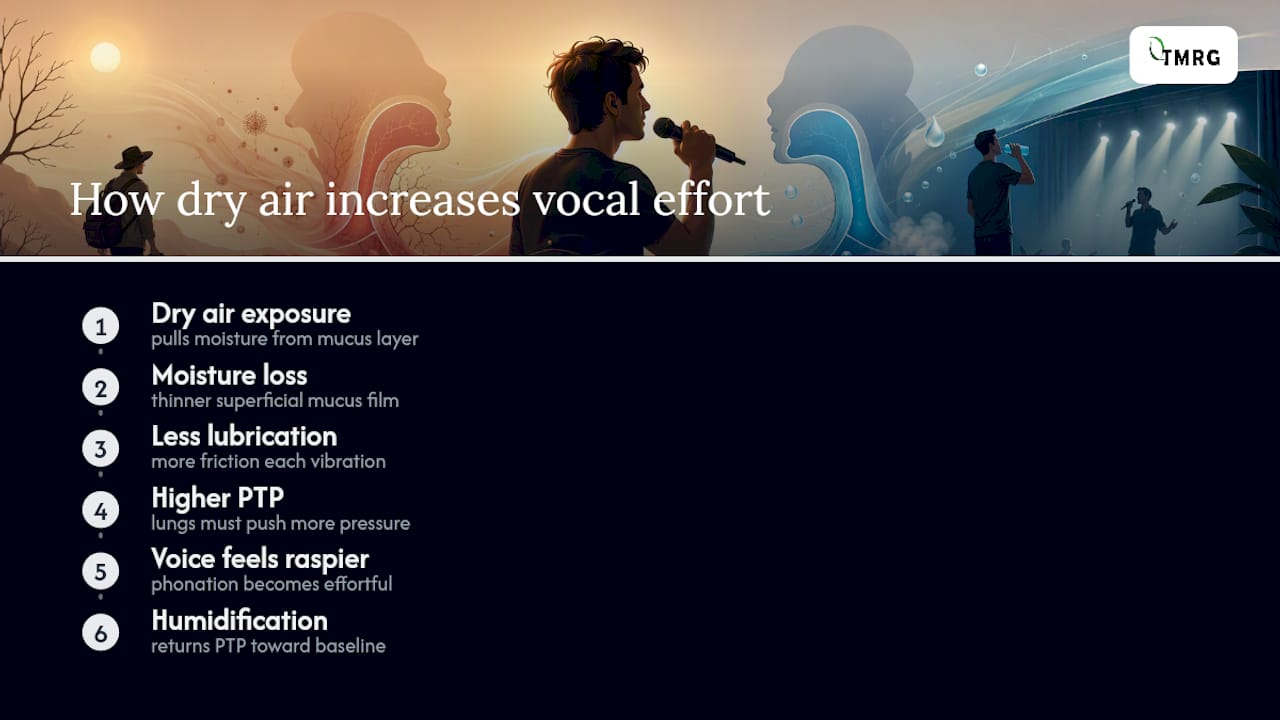
Your vocal folds vibrate hundreds of times per second, and that motion depends on a thin, slippery layer of mucus riding on top of the tissue. Dry air pulls moisture from that surface layer faster than your body can replace it. Less lubrication means more friction with every vibration cycle, and more friction means more effort just to make sound.
Researchers measure that added effort with something called phonation threshold pressure, or PTP: the minimum air pressure your lungs need to push before the vocal folds start vibrating at all. Think of PTP as the “cost of entry” for making a sound. A controlled study that put people through a low-humidity mouth-breathing challenge found PTP rose measurably afterward.
Humidification returned phonation threshold pressure back toward baseline levels, supporting inhaled moisture as an effective countermeasure for superficial laryngeal dehydration.
That finding, published through the National Center for Biotechnology Information, is one of the clearest experimental links between environmental dryness and the physical effort of speaking or singing.
A quick way to picture PTP: if a well-hydrated voice needs, say, one unit of air pressure to start vibrating cleanly, a dehydrated one might need noticeably more. That gap is exactly why a dry throat feels like work.
Several everyday habits accelerate this drying process. Mouth breathing during exercise or sleep bypasses the nose’s natural humidifying function entirely, and research on obligatory mouth breathing links it directly to measurable increases in vocal fold dryness. Antihistamines and decongestants dry mucous membranes throughout the body, including the larynx. Smoking, prolonged loud talking, and pressurized airplane cabins all compound the effect.
People with a prior history of vocal fatigue don’t just feel this more; they measure worse on it. Research on airway dehydration found this group showed larger PTP increases under low or moderate humidity than people without a fatigue history, suggesting their compensation mechanisms are already working closer to their limit.
When your throat feels tight and scratchy, the order of operations matters. Some fixes work in minutes; others take hours. Here’s the sequence worth following:
If you have access to nebulized isotonic saline, evidence from the same humidification research cited above shows it can measurably ease phonatory effort after a drying episode, making it a solid acute option for performers who need relief before a show rather than the next day.
For your living space, aim your humidifier at a relative humidity range that most voice clinics recommend for supporting healthy vocal tissue. Cool-mist units are generally preferred for bedrooms, and they need weekly cleaning to prevent mold and bacterial growth, which can undo the benefit entirely and introduce new respiratory irritants.
Pro Tip: *Keep a small hygrometer near your humidifier.
A few substances work against you here. Menthol lozenges can feel soothing but dry the mucosa with repeated use. Alcohol and heavy caffeine intake both have a drying effect on the body’s mucous membranes. If you’re traveling, pack a travel-sized humidifier or saline spray, set the hotel thermostat with humidity in mind, and increase your water intake starting the night before a flight rather than after you land. Our guide to hotel room humidity for performers walks through the exact setup touring voice professionals use.
Acute fixes matter, but the readers who avoid recurring problems are the ones who build prevention into their week rather than reacting after symptoms hit.
Internal hydration and external hydration solve different problems. Drinking water throughout the day maintains overall tissue moisture but works slowly, sometimes taking hours to show up as improved vocal comfort. Steam and nebulized saline hit the vocal fold surface directly and faster. You need both, not one instead of the other.
Vocal conservation is the habit most people skip. A reasonable target: for every two hours of heavy vocal use, such as teaching back-to-back classes or a long rehearsal block, take roughly 10 minutes of genuine vocal rest. That’s not a hard clinical rule, but it mirrors how muscle recovery works elsewhere in the body, and voice professionals who build it into their schedule report fewer bad-voice days.
A few habits worth locking in to support vocal health include monitoring indoor humidity, positioning humidifiers properly and cleaning them regularly to prevent mold, reducing mouth breathing during sleep and exercise, consulting a clinician about medications that might dry out your throat, and pre-humidifying hotel rooms before arrival if traveling. Our step-by-step vocal hygiene guide offers a practical daily checklist to build these habits.

Humidification is supportive care. It eases the friction dry air causes, but it cannot fix a vocal problem that isn’t caused by dryness in the first place, and it won’t catch something more serious.
See an ENT if you notice any of the following:
A typical workup starts with a detailed history of your symptoms and habits, followed by laryngoscopy, a direct look at the vocal folds using a small scope. This is how clinicians distinguish dry-air irritation from reflux, vocal nodules, or in rarer cases, neurologic causes of voice change. One evidence review on humidifier use makes the point plainly: humidifiers are a reasonable comfort measure for dryness-related irritation, but persistent hoarseness that does not improve with supportive care warrants a professional evaluation.
Twenty-five years of working with singers, teachers, and speakers has shown a consistent pattern: the people who avoid dry-air voice trouble treat environmental control as routine, not an afterthought. Our guidance on hotel humidity, echoed in the clinical literature’s 45 to 55% target range, reflects that same principle applied to travel.
Different products suit different moments in the dry-air cycle:
None of this replaces the checklist earlier in this article: humidify first, steam second, rest your voice, and see an ENT if hoarseness outlasts two weeks. Products support that routine; they don’t substitute for it. Always follow label instructions, and if you’re combining a new product with medication or an existing condition, check with your clinician first. Full details on formulations and usage sit on each product page, along with our broader vocal problems resource if you want more background before choosing.
What you eat and drink shows up in your voice days before it shows up anywhere else. Systemic hydration, meaning your overall fluid intake, feeds the mucus layer that coats your vocal folds and keeps them gliding smoothly against each other during vibration. Chronic under-hydration leaves that layer thinner and stickier, and it takes longer than most people expect for the tissue to recover once you start drinking more.
Caffeine and alcohol both have a mild diuretic effect, pulling more fluid out of the body than you take in with the drink itself. That doesn’t mean cutting them out entirely, but it does mean compensating with extra water if you’re a regular coffee drinker heading into a heavy voice-use day.
Salty and highly processed foods can also work against you by drawing fluid away from tissues, while foods with high water content, think fruits, soups, and vegetables, contribute to overall hydration in a way that’s easy to overlook. Dairy doesn’t dry the voice the way folklore suggests, but it can thicken mucus in some people, making throat clearing feel more necessary even though clearing is exactly what you want to avoid.
The practical takeaway is unglamorous but reliable: steady water intake spread across the day beats a large amount consumed all at once, since your body can only absorb and use fluid at a certain rate before the excess simply passes through.
Dry air rarely operates alone. If you already deal with seasonal allergies or asthma, low humidity tends to make both conditions worse, and the voice ends up caught in the middle of that overlap.
Allergic postnasal drip forces more mouth breathing and more throat clearing, and both behaviors independently dry and irritate the vocal folds beyond what dry air alone would cause. Add antihistamines into the mix, and you’ve stacked another drying mechanism on top of an already dry throat, since these medications reduce mucus production throughout the airway, not just in the nose.
Asthma introduces a different complication. Inhaled corticosteroids, a common asthma treatment, can settle on the vocal folds during use and cause local irritation or a mild drying effect if inhaler technique isn’t precise. Rinsing your mouth after each use and using a spacer device when prescribed helps limit that contact.
For readers managing either condition, the humidity target doesn’t change, but the margin for error shrinks. A bedroom sitting at 30% humidity might irritate a healthy voice mildly; the same room can trigger a more pronounced flare in someone whose airway is already reactive from allergies or asthma. If you fall into this group, treat the 45 to 55% humidity range less as a comfort preference and more as a baseline worth protecting consistently, and loop in your allergist or pulmonologist if medication timing seems to be tracking with worse vocal days.
A single dry day causes temporary irritation that clears up once you rehydrate. Months or years of repeated exposure without correction is a different story, and it’s the pattern that concerns voice clinicians most.
Repeated cycles of dehydration and mild trauma, especially from habitual throat clearing, create a cumulative effect on vocal fold tissue. The mucosa doesn’t fully reset between episodes if the drying conditions never really go away, whether that’s a permanently arid climate, a home heated all winter without a humidifier, or a job that demands constant talking in a dry office environment.
Over time, this pattern is associated with the kind of chronic hoarseness that no longer resolves with a weekend of rest, along with a heightened risk of vocal fold lesions like nodules in people who also use their voice heavily. The tissue essentially never gets a full recovery window, and each new dry-air exposure lands on top of incomplete healing from the last one.
This is exactly why the two-week rule for seeking ENT evaluation matters so much. Chronic low-grade irritation is often painless and easy to normalize, since it never feels acute enough to seem urgent. People adapt to a slightly rougher voice as their new normal instead of recognizing it as a signal. Breaking that cycle usually requires deliberate environmental correction, sustained over weeks rather than days, paired with an honest look at whether an underlying issue like reflux or allergies has been quietly driving the pattern the whole time.
Professional and heavy voice users don’t get to simply rest through a bad voice week the way an occasional talker can, and that changes how seriously dry-air prevention needs to be taken.
Singers face the added demand of pitch precision on top of basic speech, and a dehydrated vocal fold doesn’t just sound rougher, it becomes harder to control at the top of a range where the margin for error is already thin. Many touring performers now travel with a portable humidifier and saline spray as standard kit, treating environmental control with the same seriousness as warming up before a set.
Teachers face a different problem: extended, often loud speaking in classrooms that are frequently climate-controlled and dry, five days a week, with minimal built-in vocal rest between classes. The 10-minutes-per-two-hours conservation guideline mentioned earlier isn’t a luxury for this group; it’s often the only recovery window the job allows, and skipping it repeatedly is a common path toward chronic hoarseness.
Public speakers and lecturers who work in convention centers and hotel conference rooms deal with some of the driest indoor air around, thanks to industrial HVAC systems built for comfort, not vocal health. Pre-humidifying a hotel room and hydrating heavily the day before a talk isn’t overcautious for this group; it’s a reasonable response to a genuinely harsh acoustic and environmental setting.
If you fall into any of these categories, the general prevention routine outlined earlier still applies. The difference is margin: professional voice users have less room to absorb a bad dry-air week before it turns into a bad month, so the daily habits matter more, not less.
The pattern that shows up again and again in dry-air voice cases isn’t dramatic. It’s small, ignored habits compounding quietly: a dry bedroom, a habit of throat clearing that feels helpful but isn’t, a hotel room nobody thought to humidify. Fixing those three things resolves most of what people bring in as a mystery voice problem.
My working checklist stays simple: humidify first, steam second, rest the voice, and stop clearing your throat the moment you notice you’re doing it. Readers who want the fuller framework behind this can look at our hydration guide for vocal folds or pair environmental fixes with technique work through a resource like Complete Vocal Technique.
Pro Tip: Set any hotel room to 45–55% humidity the moment you check in, not the night before a performance. Air takes hours to correct.
— Golan
Matching the product to the moment makes the biggest difference here. For acute symptomatic relief after a dry flight or a long dry spell indoors, the TMRG Loud & Clear Classic Voice Recovery Drops and TMRG Shine Bright Classic Voice Recovery Spray are built for fast, on-the-spot use, no prep required.
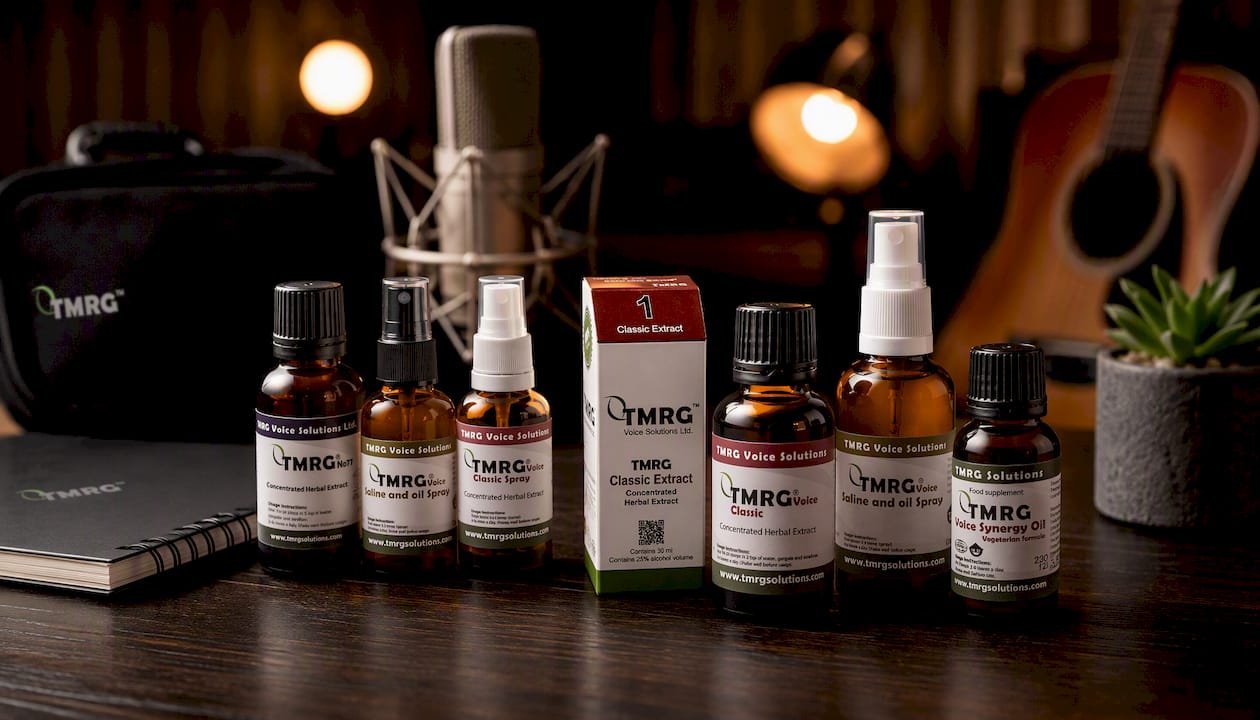
For readers managing recurring dryness as part of a heavier performance or teaching schedule, the TMRG Voice Therapy Kit Standard provides a structured routine rather than a one-off fix, while singers pushing into demanding ranges may prefer the TMRG Deeper Singer’s Performance Drops alongside the TMRG Voice Clarity Trio for a fuller maintenance set. If you’re still narrowing down which fits your situation, our FAQ page walks through usage, pricing, and return details for each option so you can choose with confidence before checkout.
This article is general information, not a substitute for advice from a qualified doctor. Consult a qualified healthcare professional about your own circumstances before acting on anything here.
Steam and nebulized saline hydrate the vocal fold surface fastest, while drinking water supports tissue moisture over several hours; using both together works better than either alone.
Dry air, allergies, mouth breathing, or vocal overuse can all cause hoarseness without infection, since none of these require a virus or bacteria to irritate the vocal folds.
Start with humidification and steam for surface relief, rest your voice for short periods, and avoid drying substances like alcohol and excess caffeine; see an ENT if hoarseness lasts beyond two weeks.
