Your Cart is Empty


TL;DR:
- Hoarseness results from irritation or inflammation of the vocal folds and usually recovers within one to two weeks. Resting the voice, staying hydrated, and eliminating irritants are the fastest ways to heal, while persistent symptoms require medical attention. Avoiding harmful remedies like decongestants, menthol lozenges, and unnecessary antibiotics supports quicker recovery and long-term vocal health.
Hoarseness is defined as a rough, strained, or weakened voice caused by irritation or inflammation of the vocal folds, the two small tissue bands inside your larynx that vibrate to produce sound. The fastest way to recover from hoarseness involves three core actions: resting your voice, staying well hydrated, and removing throat irritants. According to the Cleveland Clinic, acute laryngitis resolves in 1–2 weeks with proper voice rest and hydration in most people. If your symptoms worsen after a few days or persist beyond two weeks, that signals a need for professional evaluation. Yale Medicine and Mayo Clinic both confirm that most hoarseness cases are self-limiting, but red flags like pain, difficulty swallowing, or breathing trouble require prompt medical attention.

The fastest recovery from hoarseness works the same way injured muscle healing does: reduce strain and restore hydration simultaneously. Your vocal folds are tissue. They swell when irritated, and they heal when rested and kept moist. Voice rest and hydration are the two non-negotiable cornerstones of fast recovery, confirmed by StatPearls clinical literature.
Recovery speed depends directly on the cause. Viral infections, voice overuse, acid reflux, and environmental irritants each affect the vocal folds differently. Knowing your cause helps you choose the right response and avoid wasting time on the wrong remedies.
Acute laryngitis is the most common cause of sudden hoarseness. It typically follows a viral upper respiratory infection, and the vocal folds become swollen and inflamed as a result. Most people recover within 1–2 weeks with supportive care alone.
Other causes require different approaches:
Hoarseness lasting beyond 4 weeks always warrants a visit to an ENT specialist or laryngologist. The cause determines the treatment timeline. Treating reflux-related hoarseness the same as viral laryngitis will delay your recovery significantly.
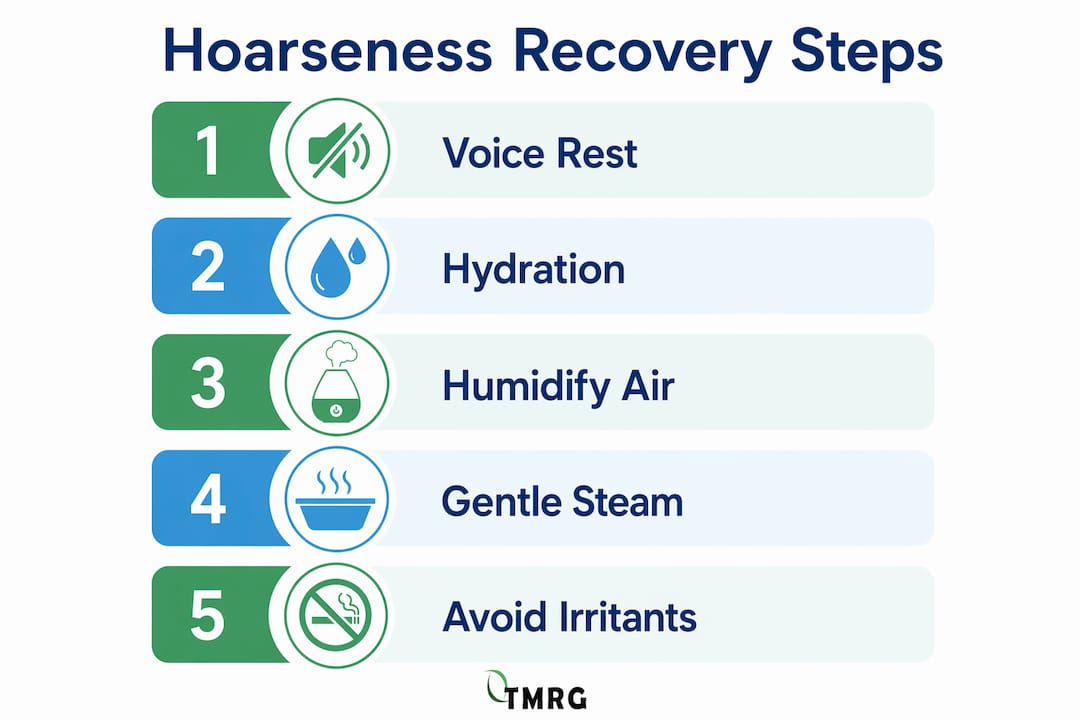
The most effective approach combines mechanical strain reduction with active vocal fold hydration. These two processes must run in parallel for recovery to accelerate. Follow these steps in order:
Pro Tip: Combine a humidifier running overnight with a large glass of warm water first thing in the morning. This two-step approach addresses both external and internal hydration at the same time, giving your vocal folds the best environment to heal while you sleep.
You can also recover from hoarseness naturally by pairing these steps with gentle steam inhalation. Lean over a bowl of hot water with a towel over your head for 10 minutes. This delivers moisture directly to the larynx.
Several common remedies actively slow healing. Knowing what to skip is just as important as knowing what to do.
Note: Medical treatment for hoarseness aims to moisturize the vocal folds and reduce inflammation, not to eliminate a viral cause with medication. Supportive care is the treatment. Unnecessary drugs are not a shortcut.
The 3-step treatment for hoarseness outlined by Tmrgsolutions reinforces this point: conservative care consistently outperforms medication-heavy approaches for standard acute laryngitis.
Most hoarseness clears on its own within 1–2 weeks. When it does not, or when additional symptoms appear, professional evaluation becomes necessary.
Seek medical attention if you experience any of the following:
These red flags help rule out more serious conditions including vocal fold lesions, laryngeal cancer, nerve damage, or severe reflux laryngitis. An ENT specialist will typically use a laryngoscope, a thin camera inserted through the nose or mouth, to view the vocal folds directly. This procedure is quick, minimally uncomfortable, and gives a definitive picture of what is happening. Persistent hoarseness with pain or breathing issues always signals the need for a thorough medical examination.
Recovering from one episode of hoarseness is only part of the picture. Preventing recurrence requires consistent vocal hygiene and, where relevant, managing underlying conditions like acid reflux.
| Lifestyle Factor | What to Do | Why It Helps |
|---|---|---|
| Acid reflux management | Avoid eating 2–3 hours before bed; elevate the head of your bed | Reduces acid reaching the larynx overnight |
| Hydration | Drink 6–8 glasses of water daily | Keeps vocal fold mucosa moist and resilient |
| Voice use habits | Take regular speaking breaks; avoid shouting | Reduces mechanical strain on the vocal folds |
| Smoking and alcohol | Eliminate both | Both dry and inflame the laryngeal lining |
| Professional voice training | Work with a speech-language pathologist | Builds technique that prevents future strain |
Gastroesophageal reflux is a frequently overlooked cause of chronic hoarseness. Proton pump inhibitors, taken twice daily in some cases, can be effective when reflux is confirmed as the driver. Voice rest alone will not resolve reflux-related laryngitis.
Voice therapy with a speech-language pathologist is the most effective long-term intervention for singers, actors, teachers, and anyone who uses their voice professionally. It builds technique, corrects harmful habits, and reduces the likelihood of nodule formation. Tmrgsolutions has supported voice professionals for over 25 years with natural formulations and therapy kits designed to complement this kind of structured care.
Pro Tip: If you are a singer or performer, work with a vocal coach on breath support and resonance placement. Proper technique reduces the load on the vocal folds by distributing sound production across the chest and head resonance cavities, not just the larynx.
You can also review proven ways to get your voice back for a structured approach to reducing inflammation and rebuilding vocal strength after strain.
Fast hoarseness recovery requires voice rest, consistent hydration, and the removal of irritants, applied together from the first day symptoms appear.
| Point | Details |
|---|---|
| Voice rest is non-negotiable | Avoid all unnecessary phonation, including whispering, for at least 24–48 hours. |
| Hydration works inside and out | Drink warm water regularly and run a humidifier to keep vocal folds moist from both directions. |
| Avoid counterproductive remedies | Skip decongestants, menthol lozenges, and antibiotics unless a doctor prescribes them. |
| Know your cause | Reflux-related hoarseness needs lifestyle changes and possibly medication, not just rest. |
| Seek help after 4 weeks | Hoarseness lasting beyond 4 weeks, or paired with pain or breathing trouble, requires an ENT evaluation. |
The most common mistake I see is people treating hoarseness like a minor inconvenience and pushing through it. A singer performs with a strained voice. A teacher lectures all day while hoarse. A speaker whispers to “save” their voice. Every one of these choices extends recovery time.
The second most common mistake is reaching for the wrong remedy. Menthol lozenges feel soothing. Decongestants seem logical. But both dry out the very tissue that needs moisture to heal. The vocal folds are not a sore muscle you can stretch through. They are delicate tissue that responds to one thing above all else: rest combined with hydration.
What actually works is boring. Drink water. Use a humidifier. Stop talking. Gargle with warm salt water twice a day. Avoid alcohol, caffeine, and smoke. That is the full protocol for most cases of acute hoarseness, and it works reliably within 3–7 days when followed consistently.
The cases that concern me most are the ones where people wait too long to seek help. Hoarseness that lingers for weeks, especially with any pain or throat tightness, needs a laryngoscopy. Catching a lesion or early laryngeal pathology early makes treatment far simpler. Do not wait it out indefinitely.
— Golan
When rest and hydration alone need support, Tmrgsolutions offers a range of natural formulations built specifically for vocal recovery.

The TMRG Loud & Clear Classic Voice Recovery Drops and the TMRG Shine Bright Classic Voice Recovery Spray are designed to soothe and hydrate the vocal folds directly, complementing the rest and hydration protocol described throughout this article. For more complex or recurring vocal issues, the TMRG Voice Therapy Kit Standard provides a structured recovery program used by singers, actors, and speakers. All formulations are natural and developed over 25 years of clinical vocal health experience. They are not a replacement for medical care, but they work well alongside it.
Acute laryngitis caused by a viral infection typically resolves within 1–2 weeks with voice rest and hydration. Hoarseness lasting beyond 4 weeks requires a medical evaluation.
Whispering actually strains the vocal folds more than relaxed, quiet speech because it forces the folds into a tense, partially closed position. Write notes or use text-to-speech tools instead.
Warm salt water gargles, consistent water intake, and humidified air are the most effective home remedies for voice loss. Avoid menthol lozenges and decongestants, which can dry out the throat.
Yes. Gastroesophageal reflux allows stomach acid to reach the larynx, causing chronic irritation of the vocal folds. This type of hoarseness requires lifestyle changes and sometimes proton pump inhibitors, not just voice rest.
See a doctor if hoarseness lasts longer than 4 weeks, or if you experience pain, difficulty swallowing, breathing trouble, or repeated unexplained voice loss. These symptoms may indicate a condition that needs direct laryngoscopic examination.
