Your Cart is Empty


When your voice is suddenly rough, weak, or unreliable, focus first on safe recovery habits: reduce voice use, hydrate, avoid whispering or shouting, limit throat clearing, use steam or humidification when appropriate, and avoid irritants. Do not push through pain or severe symptoms.
TMRG voice-care products may support comfort and routine maintenance, especially for singers, teachers, cantors, speakers, and performers with demanding schedules. They should not replace medical care when symptoms are severe, recurring, or persistent.
Shop by need: Hoarseness Voice Support, Winter Voice Protection, and Vocal Load Support.
TL;DR:
- Vocal rest, hydration, and gentle exercises are essential for recovering from voice loss, with early steps reducing the risk of chronic issues. Whispering strains the vocal folds more than quiet speech and should be avoided during recovery in favor of written communication or low-volume speech. Environmental factors like dry air, smoke, and reflux can hinder healing, so managing these conditions accelerates vocal recovery.
Voice loss, clinically called dysphonia or acute laryngitis, is the inflammation or irritation of the vocal folds that disrupts normal vibration and reduces or eliminates your ability to produce clear sound. The most effective ways to get your voice back combine immediate vocal rest, consistent hydration, and controlled gentle exercises that allow the vocal folds to heal without additional strain. Most cases resolve within 1 to 2 weeks, but only when you take the right steps early. This guide draws on 2026 voice therapy recommendations and natural remedies for voice loss to give you a clear, step-by-step path back to full vocal health.
Vocal rest, hydration, and gentle rehabilitation exercises form the three-pillar foundation of voice recovery. Each pillar addresses a different aspect of how the vocal folds heal. Skipping any one of them slows the process and increases the risk of developing a chronic voice disorder. Understanding why each step works makes it far easier to follow through, especially when you feel the urge to push through the hoarseness and keep talking.
Complete vocal rest means zero phonation. No talking, no whispering, no humming, and no throat clearing. Partial vocal rest means limiting speaking to short, necessary exchanges at a comfortable volume. Both have their place in recovery, but the distinction matters because many people believe whispering is a safe middle ground.
Whispering strains the voice more than normal quiet speech. The vocal folds are forced into an abnormal position during a whisper, creating mechanical stress comparable to yelling. If you need to communicate during recovery, write a note, use a text-to-speech app, or speak softly at your natural pitch rather than dropping to a whisper.
Pro Tip: Set a phone alarm every hour as a reminder to observe silence. Treat each silent period as active therapy, not passive waiting.
The recommended ratio from voice therapists is 10 minutes of complete silence for every hour of speaking. That ratio may feel extreme, but it reflects how much recovery time the vocal folds need to reduce swelling and restore normal mucosal wave function. Think of it the way a sprained ankle needs elevation and rest between short walks.
The vocal folds are covered by a thin mucus layer that allows them to vibrate smoothly at up to 220 times per second during normal speech. When that layer dries out, the folds produce thick, sticky mucus that impairs vibration and makes the voice sound rough, thin, or completely absent. Hydration is not a comfort measure. It is a direct mechanical requirement for vocal fold function.

Adults need approximately 64 ounces of water daily to maintain the mucosal health of the vocal folds. That baseline rises if you are in a dry environment, traveling by air, or using your voice professionally. Sipping water consistently throughout the day is more effective than drinking large amounts at once, because systemic hydration takes time to reach the vocal fold tissue.
Steam inhalation delivers moisture directly to the larynx, bypassing the digestive system entirely. Steaming twice daily, once in the morning and once before bed, thins mucus, hydrates the vocal folds, and prepares the voice for daily use while supporting overnight healing. You can use a bowl of hot water with a towel over your head, a personal steam inhaler, or a facial steamer for 10 to 15 minutes per session.
Maintaining indoor humidity between 40 and 50 percent prevents the ambient air from pulling moisture away from the vocal folds. That range is the sweet spot where the air is moist enough to protect the larynx without creating conditions for mold or dust mites. A basic hygrometer costs under $15 and tells you exactly where your room stands.
Pro Tip: Keep a 32-ounce water bottle on your desk and finish it before noon. Refill and finish it by evening. This simple habit removes the guesswork from daily hydration targets.
What you put in your throat matters as much as how much water you drink. Several common remedies actually work against recovery:
Vocal rehabilitation exercises, specifically semi-occluded vocal tract exercises (SOVTEs), are the clinical standard for restoring voice function after strain or illness. These exercises work by partially blocking the front of the vocal tract, which creates back-pressure that travels back to the vocal folds. That back-pressure reduces the contact force between the folds during vibration, allowing them to phonate with significantly less effort. Think of it as physical therapy for the larynx.
Straw phonation creates back-pressure that facilitates vocal fold vibration with less mechanical stress, making it one of the most effective exercises to regain voice strength during recovery. You can find detailed vocal recovery exercises that build on this principle progressively.
Pro Tip: Never perform these exercises if your voice produces pain. Mild fatigue is normal. Pain is a signal to stop and rest for another 24 hours before trying again.
A licensed speech-language pathologist can design a personalized SOVTE protocol based on your specific diagnosis, vocal demands, and recovery stage. If your voice has not improved after 7 days of consistent home care, a professional assessment is the right next step.
The air around you and the habits you maintain during recovery either accelerate or undermine everything else you do. Dry air, airborne irritants, and poor sleep all extend recovery time in ways that are easy to overlook when you are focused on drinking water and resting.
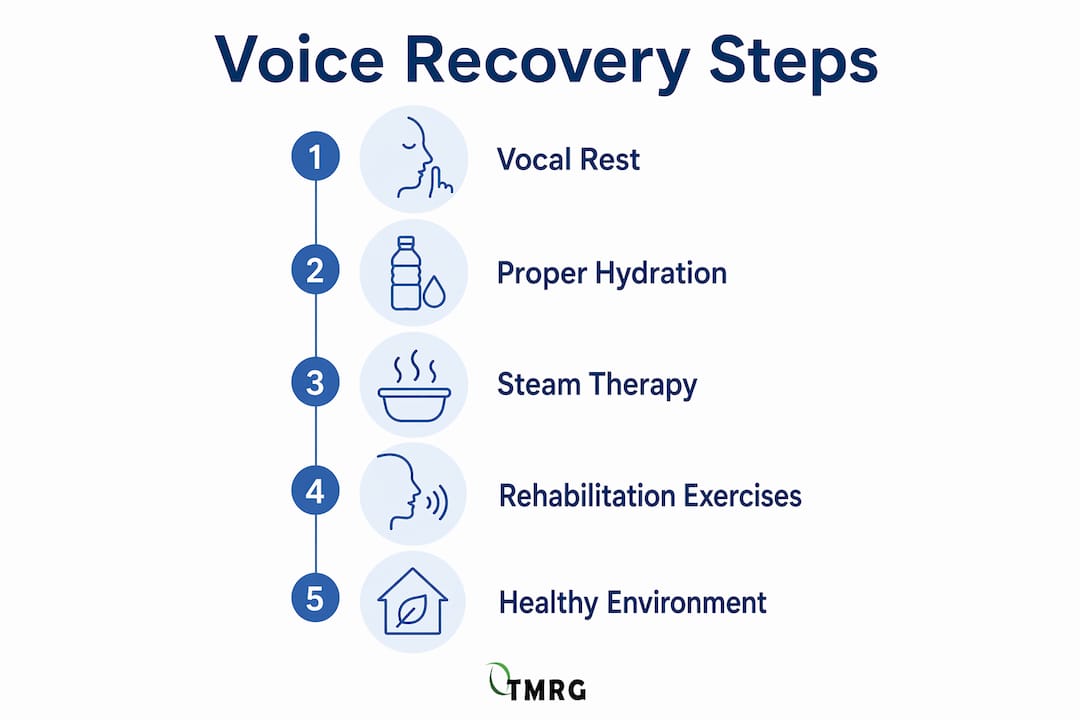
Smoke is the single most damaging environmental factor for inflamed vocal folds. Both direct smoking and secondhand smoke cause immediate mucosal irritation and reduce blood flow to the laryngeal tissue. Air purifiers with HEPA filters remove particulates, allergens, and pollutants that would otherwise settle on already-irritated vocal folds. Pair an air purifier with your humidifier for a controlled recovery environment.
Gastroesophageal reflux disease (GERD) and laryngopharyngeal reflux (LPR) are underrecognized contributors to prolonged hoarseness. Stomach acid that reaches the larynx burns the vocal fold mucosa and prevents healing. To manage reflux during recovery, avoid spicy foods, citrus, tomatoes, caffeine, and large meals within three hours of bedtime. Sleeping with your head elevated by 6 to 8 inches reduces overnight acid exposure significantly.
Sleep is when the immune system does its most intensive repair work. Seven to nine hours of quality sleep per night accelerates tissue healing throughout the body, including the larynx. Reducing vocal strain during waking hours also means avoiding noisy environments where you would naturally raise your voice, such as crowded restaurants, loud offices, or sports events. If you must be in a noisy space, use written communication or step outside rather than competing with background noise.
For singers, actors, and speakers managing vocal maintenance during heavy use, these environmental controls are not optional. They are the foundation that makes every other recovery strategy work.
Recovering your voice requires vocal rest, sustained hydration, targeted exercises, and a controlled environment working together. No single step is sufficient on its own.
| Point | Details |
|---|---|
| Start rest immediately | Begin vocal rest within 24 to 48 hours of voice loss to prevent chronic damage. |
| Hydrate systemically and topically | Drink 64 ounces of water daily and steam twice a day to maintain mucosal health. |
| Avoid whispering | Whispering strains the vocal folds as much as yelling and delays healing. |
| Use SOVTEs for rehabilitation | Straw phonation, lip trills, and humming reduce fold tension and rebuild voice strength safely. |
| Control your environment | Keep indoor humidity at 40 to 50 percent, use air purifiers, and manage reflux to protect healing tissue. |
After working with singers, actors, and professional speakers for over two decades, the pattern I see most often is this: people do everything right except one thing, and that one thing undoes the rest. The most common mistake is not whispering or skipping water. It is returning to full voice use too soon because the voice feels “mostly better.”
The vocal folds can feel functional before they are fully healed. Swelling may have reduced enough to restore basic phonation, but the mucosal tissue is still fragile. Pushing back to full volume or extended speaking at that stage is exactly how a two-week recovery becomes a two-month problem. I have seen professional singers lose an entire performance season because they trusted how their voice felt on day five instead of following a structured step-by-step recovery process.
The second thing I want to address directly is the instinct to reach for menthol lozenges and antihistamines. These products feel soothing, and that sensation is real. But the drying effect they produce on the mucosa is also real, and it works against you. Manuka honey and pectin-based lozenges give you the comfort without the cost.
My honest recommendation is to treat voice recovery the way a physical therapist treats a muscle injury: structured rest, controlled progressive loading, and no shortcuts. If your hoarseness persists beyond four weeks or comes with pain, difficulty swallowing, or blood, see a laryngologist. Those symptoms require a scope, not a home remedy.
— Golan
If you are serious about restoring your voice safely and efficiently, Tmrgsolutions has developed therapy kits built specifically for this process.

The TMRG Voice Therapy Kit Basic gives you the core tools to support hydration, reduce inflammation, and begin gentle vocal rehabilitation at home. For singers and performers with higher demands, the Professional Vocal Recovery Kit includes advanced herbal formulations, recovery drops, and a structured protocol designed for faster, safer restoration. With 25 years of vocal health expertise behind every product, Tmrgsolutions makes it straightforward to integrate professional-grade care into your daily routine without needing a clinic visit.
Most voice loss cases resolve within 1 to 2 weeks with proper rest and hydration. Seek medical evaluation if hoarseness persists beyond four weeks or is accompanied by pain or difficulty swallowing.
Whispering is not safe during recovery. Whispering places high mechanical stress on the vocal folds, comparable to yelling, and delays healing. Use written communication or text-to-speech tools instead.
Drinking 64 ounces of water daily, steaming twice a day, and using manuka honey or pectin-based lozenges are the most evidence-supported natural remedies for voice loss. Avoid menthol lozenges and antihistamines, which dry out the vocal mucosa.
Semi-occluded vocal tract exercises, including straw phonation in water, lip trills, and nasal humming, are the clinical standard for vocal rehabilitation. These exercises reduce vocal fold tension and rebuild vibration efficiency without overloading healing tissue.
See a laryngologist if hoarseness lasts more than four weeks, if you experience pain when speaking, if you notice blood, or if you have difficulty swallowing. These symptoms indicate a condition beyond standard laryngitis that requires professional diagnosis.
