Your Cart is Empty


The fastest way to reduce vocal fold swelling is to stop talking and singing as much as possible, hydrate from the inside out, breathe humidified air, and remove irritants like smoke, decongestants, and throat clearing from your routine. These four moves work because inflamed vocal folds heal the same way a sprained ankle does: less friction, more moisture, more time. Mechanical rest lowers the number of times your vocal folds collide with each other every time you speak, and fewer collisions mean less irritation on tissue that is already inflamed.
Here’s what to do in the first 24 to 72 hours:
Pro Tip: If you absolutely must speak, such as during a scheduled lecture or a short performance obligation, use a portable amplifier or microphone rather than pushing your voice louder. Projecting over a room multiplies the force of vocal fold collision, and amplification lets you speak at a near-whisper volume while still being heard clearly.
Most acute swelling from overuse or a mild viral illness starts improving within about a week of consistent home care. If your voice hasn’t returned to normal within several weeks, a medical evaluation is recommended.
Reducing vocal fold swelling comes down to strict voice rest, systemic hydration, humidified air, and removing irritants, with medical evaluation reserved for symptoms past three weeks or any red-flag sign.
| Point | Details |
|---|---|
| Rest comes first | Stop talking, singing, and whispering for at least 24 to 48 hours to cut collision trauma. |
| Hydrate inside and out | Drink water steadily, eat water-rich foods, and run a humidifier near 30% humidity. |
| Remove irritants | Skip decongestants, menthol lozenges, smoking, and throat clearing during recovery. |
| Watch the three-week rule | See a doctor if hoarseness lasts past three weeks or breathing becomes difficult. |
| Support recovery with TMRG | Glycerin-based drops, a recovery spray, and a therapy kit complement rest without replacing it. |
Vocal fold swelling almost always traces back to one of a handful of culprits, and figuring out which one is yours changes what you should do next. Guessing wrong wastes recovery time.
A one-night screaming match at a concert calls for aggressive voice rest and hydration. Reflux after a heavy, late dinner calls for meal timing and possibly an antacid. Persistent allergy symptoms call for allergen control before your voice will fully settle. Matching the cause to the fix, rather than treating every case the same way, is what separates a three-day recovery from a three-week one. If overuse from your job or performance schedule is the recurring theme, our guide on dealing with vocal fold ailments walks through targeted strain-reduction strategies.
Once you know roughly what triggered the swelling, the home-care sequence below applies almost universally, whether the cause was a rowdy karaoke night or a lingering cold.
For fluids, plain water and electrolyte drinks without caffeine are your best options; caffeine and alcohol both have a mild diuretic and drying effect that works against you here. On the lozenge question, glycerin-based lozenges hydrate the throat without the drying side effects of menthol, which makes them the better short-term choice over minty cough drops that can leave tissue feeling drier afterward.
A few things to actively avoid during this window:
Pro Tip: If you’re a performer with a gig you can’t cancel, cut your set list down to the songs that sit comfortably in your range, skip the sound check chatter, and lean on a handheld mic or in-ear monitor setup so you never have to push volume to compensate for a room.
Home care resolves most cases of vocal fold swelling, but there’s a real place for medication and clinical treatment when swelling is severe, persistent, or tied to an underlying condition. Here’s what a doctor is likely to reach for and why.
Do pain relievers actually help vocal fold swelling? They ease general discomfort and any accompanying sore throat pain, but they don’t accelerate the tissue-level healing that rest, hydration, and humidification provide.
Are steroids safe for singers before a big show? They can be appropriate in a true emergency, like a scheduled performance a singer can’t miss, but repeated use to power through recurring swelling ignores the underlying cause and risks worse injury down the line.
A clinician is most likely to prescribe medication when there’s urgent airway compromise, inflammation that hasn’t budged after a week or more of diligent home care, or a reflux-dominant pattern that isn’t responding to lifestyle changes alone.
Recovering once is one thing. Staying out of this situation again requires changing a few daily habits, especially if you use your voice professionally.
Build a simple daily checklist: drink water steadily through the day rather than in one big dose, protect your sleep since fatigue lowers your vocal stamina, keep smoke and heavy fragrance out of your rehearsal or work space, and run a humidifier in your bedroom if you live somewhere dry.
Patients who consistently practice these habits, especially amplification and resting at the first sign of hoarseness, see meaningfully fewer repeat injuries than those who push through symptoms.
If your voice keeps giving out despite following this checklist, or if you notice your speaking technique itself seems to be working against you, a speech-language pathologist can assess your breath support, resonance, and habitual tension patterns and build a targeted correction plan. A vocal coach can do similar work for singing-specific technique.
Pro Tip: Keep a small voice log for two weeks: note when your voice feels strained, what you were doing beforehand, and how much water you drank that day. Patterns show up fast, and most people are surprised by how directly their symptoms track back to specific habits.
Acid reflux, whether it shows up as classic GERD or the quieter laryngopharyngeal reflux (LPR) variant, is one of the more overlooked causes of chronic vocal fold swelling because it doesn’t always come with heartburn. Stomach acid that reaches the throat chemically burns the delicate mucosal lining covering your vocal folds, and that chemical irritation compounds whatever mechanical swelling you’re already dealing with from overuse.
A few red flags mean this isn’t a self-manage-forever situation:
In these cases, a trial of prescription-strength medication under a doctor’s guidance, or a referral to an ENT or gastroenterologist, is the appropriate next step rather than continuing to self-treat indefinitely.
Most acute swelling from overuse or a mild viral infection starts resolving within about a week when you stick with conservative care: rest, hydration, humidification, and avoiding further strain. That timeline assumes you’re actually resting your voice, not just cutting back a little.
Here’s where the line gets drawn on when to stop waiting and start calling a doctor:
A referral to an ENT or a speech-language pathologist makes sense any time you’re dealing with recurrent injuries (three or more episodes in a year is a reasonable personal threshold), suspected nodules or polyps that a mirror exam or scope could confirm, or dysphonia that persists well past the typical recovery window despite doing everything right at home.
The clinical consensus on this is more consistent than the internet’s flood of home remedies would suggest. Voice rest, hydration, humidification, and reflux control sit at the top of every legitimate treatment protocol, while medication plays a supporting, situational role rather than a starring one.
“Vocal folds are delicate bands of tissue that vibrate hundreds of times per second during speech. When they’re inflamed, mechanical rest reduces the collision forces driving that inflammation and gives the tissue the room it needs to recover.” This is the core mechanism behind why voice rest outperforms almost every other intervention for acute swelling.
A few persistent myths deserve a direct correction:
The through line across every credible source is simple: hydrate from the inside and the outside, rest mechanically, and remove whatever is chemically or physically irritating the tissue.
I’ve spent enough time around working singers, teachers, and pastors to notice a pattern: the people who recover fastest aren’t the ones with access to the best specialists. They’re the ones who stop talking the moment their voice feels off, instead of pushing through one more class or one more set “just to get through the week.” That single behavior change does more for swelling than any lozenge, spray, or supplement on the market.
Where I disagree with a lot of casual advice online is the framing that this is mostly about finding the right remedy. It isn’t. It’s about discipline during an uncomfortable 48 to 72 hours when your job or your art wants you to keep performing. Products can support that window, glycerin lozenges, hydration aids, gentle warm-up tools, but none of them substitute for actually resting the mechanism that’s inflamed. If your voice isn’t back to normal within three weeks, or if you notice a pattern of this happening every few months, that’s not a sign to try a different home remedy. It’s a sign to get evaluated by someone who can look directly at your vocal folds. Most acute swelling resolves on its own. The ones that don’t are usually the ones where someone kept talking anyway.
Everything above works without spending a dollar. Rest, water, and a humidifier are free, and they should always be your first move. But if you’re a singer, teacher, or presenter managing recurring vocal strain, a few targeted tools can make the hydration and comfort side of recovery easier to sustain day after day.
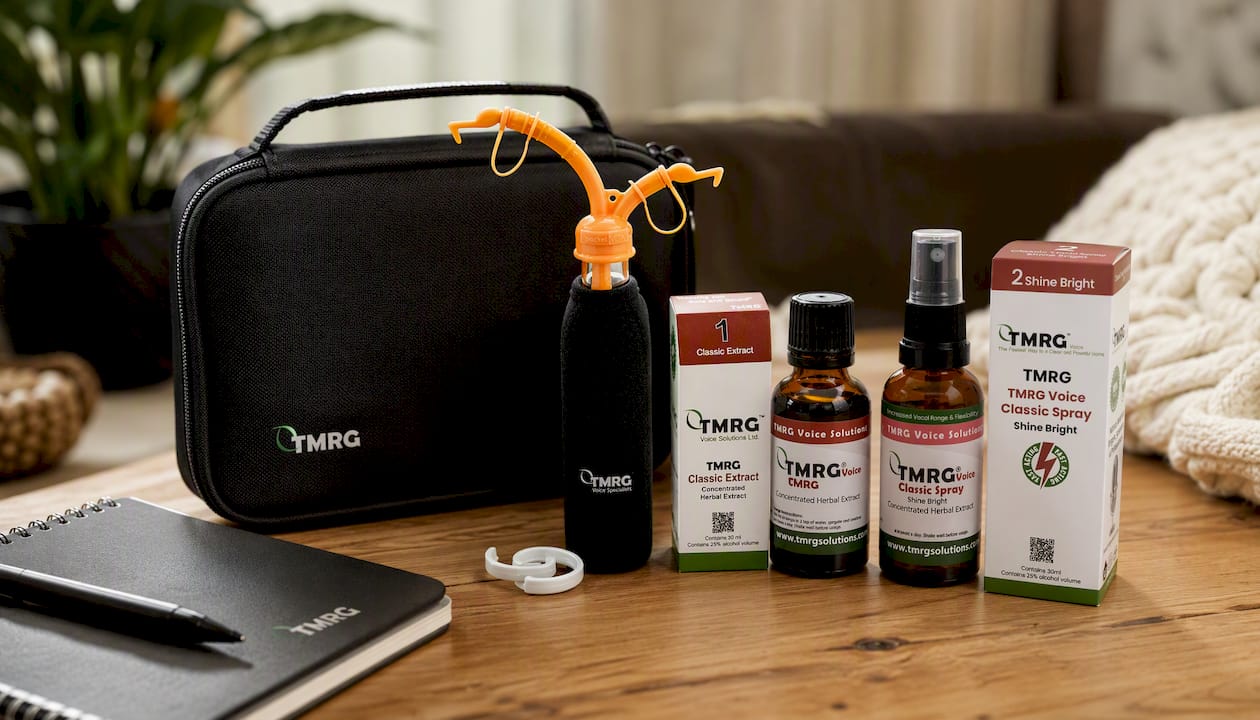
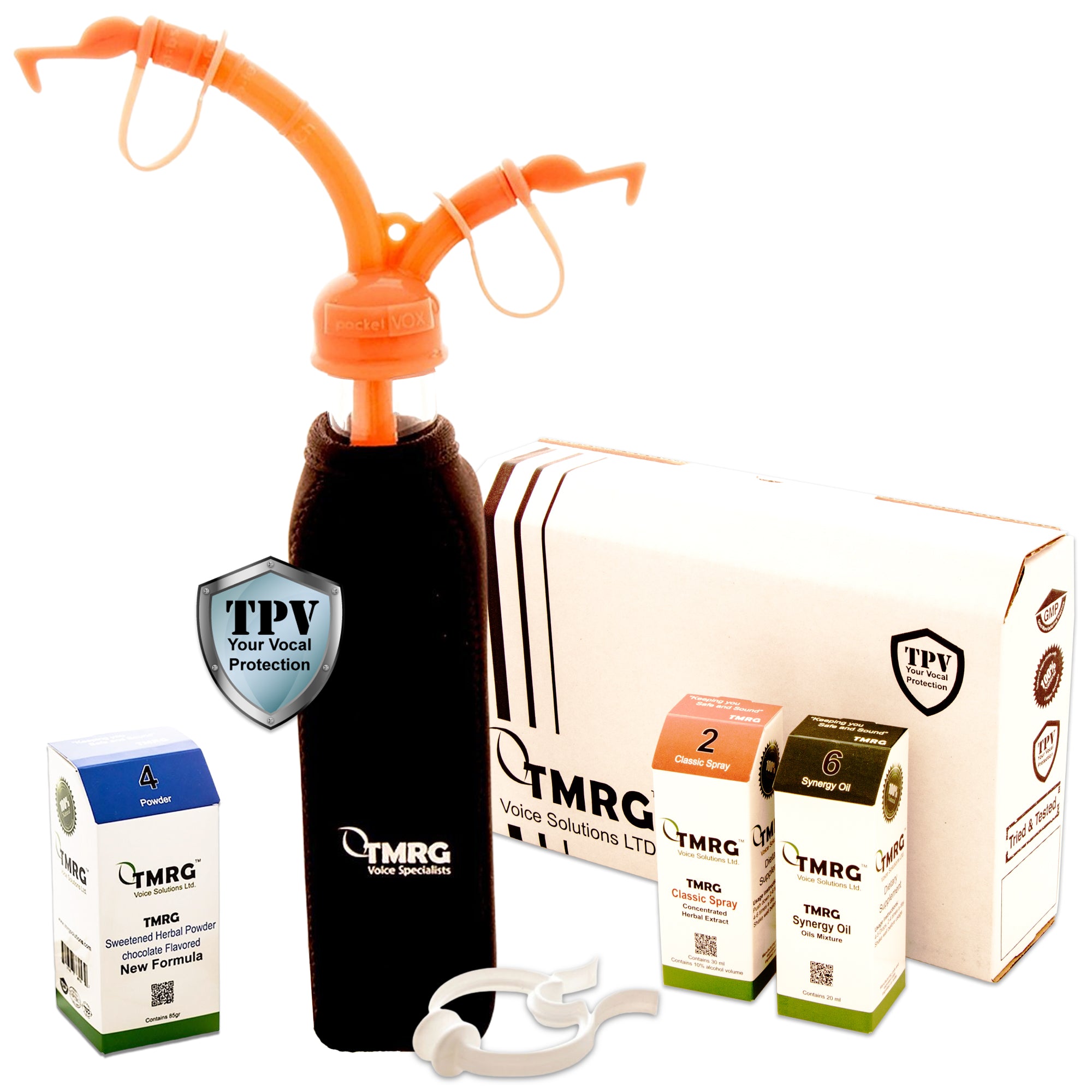
The TMRG Voice Therapy Kit - Standard bundles guided exercises and support tools designed to complement, not replace, the rest and hydration steps covered earlier, useful for anyone easing back into vocal use after an episode of swelling. For on-the-go hydration between rehearsals or classes, TMRG Loud & Clear glycerin-based recovery drops offer the same moisture-first approach clinicians favor over drying menthol lozenges. And when you need quick mucosal comfort right before you have to speak or perform, the TMRG Shine Bright recovery spray provides short-term lubrication without interrupting your voice rest.
None of these products treat an underlying medical condition, and none replace a clinician’s evaluation if your swelling persists past three weeks or you notice any red-flag symptom described above. Think of them as support for the recovery you’re already doing, not a shortcut around it. If you’re rebuilding your routine after an episode, our guide to getting your voice back quickly is a useful next stop, or browse the recovery kit directly to see what fits your situation.
This article is general information, not a substitute for advice from a qualified doctor. Consult a qualified healthcare professional about your own circumstances before acting on anything here.
Most acute swelling improves within about a week of consistent voice rest, hydration, and humidification. If hoarseness lasts longer than three weeks, it needs a professional evaluation.
Ibuprofen or acetaminophen can ease general discomfort from an inflamed throat, but they don’t replace voice rest as the primary way to reduce the swelling itself.
The most common causes are mechanical overuse from shouting or prolonged talking, viral or bacterial infections, smoking or airborne irritants, and acid reflux (GERD or LPR).

Systemic hydration, humidified air, and avoiding irritants like decongestants and menthol lozenges support tissue recovery; products like TMRG’s glycerin-based recovery drops can help sustain hydration between rest periods.
