Your Cart is Empty


TL;DR:
- Singing without strain involves efficient use of breath, posture, and vocal fold coordination to minimize tension.
- Consistent practice of diaphragmatic breathing, warm-ups, and targeted SOVT exercises helps prevent vocal fatigue and injury.
Singing without strain is defined as the efficient use of breath, posture, and vocal fold coordination to produce sound with minimal tension in the throat or surrounding muscles. The industry term for this is “efficient phonation,” and it sits at the core of every sustainable vocal technique. Singers who master efficient phonation protect their vocal folds from fatigue, extend their performing careers, and access a fuller, more resonant sound. The key practices are diaphragmatic breath support, structured vocal warm-ups, correct posture, and steady airflow management. Tmrgsolutions has worked with vocalists for over 25 years and consistently finds that technique, not talent, determines who sings long and who burns out early.
Proper breath support is the single most important factor in strain-free singing. The diaphragm, a dome-shaped muscle beneath the lungs, drives airflow when engaged correctly. Singers who rely on shallow chest breathing force the throat muscles to compensate, which creates the squeezing sensation that leads to hoarseness and fatigue. Diaphragmatic breathing with rib expansion and a firm abdominal wall reduces the vocal efficiency loss seen in shallow, chest-based breathers, directly lowering throat tension.

Posture shapes the entire vocal tract. Standing tall with a relaxed neck, open chest, and feet shoulder-width apart creates the physical conditions for optimal airflow. Slouching compresses the diaphragm and forces the larynx into an unnatural position. Think of your spine as the foundation of your instrument. When the foundation is solid, every other part of the voice functions with less effort.
Vocal warm-ups prepare the vocal folds for the demands of singing, much like stretching prepares muscles for exercise. A 10–15 minute daily warm-up that includes lip trills, humming, and sirens prevents strain and builds long-term vocal resilience. Skipping this step is the most common reason singers develop chronic tension.
Key foundational habits for strain-free singing:
Pro Tip: If your throat feels tight after just a few minutes of singing, reduce your volume by half. Singing at lower volume reveals compensatory tension that volume was masking.
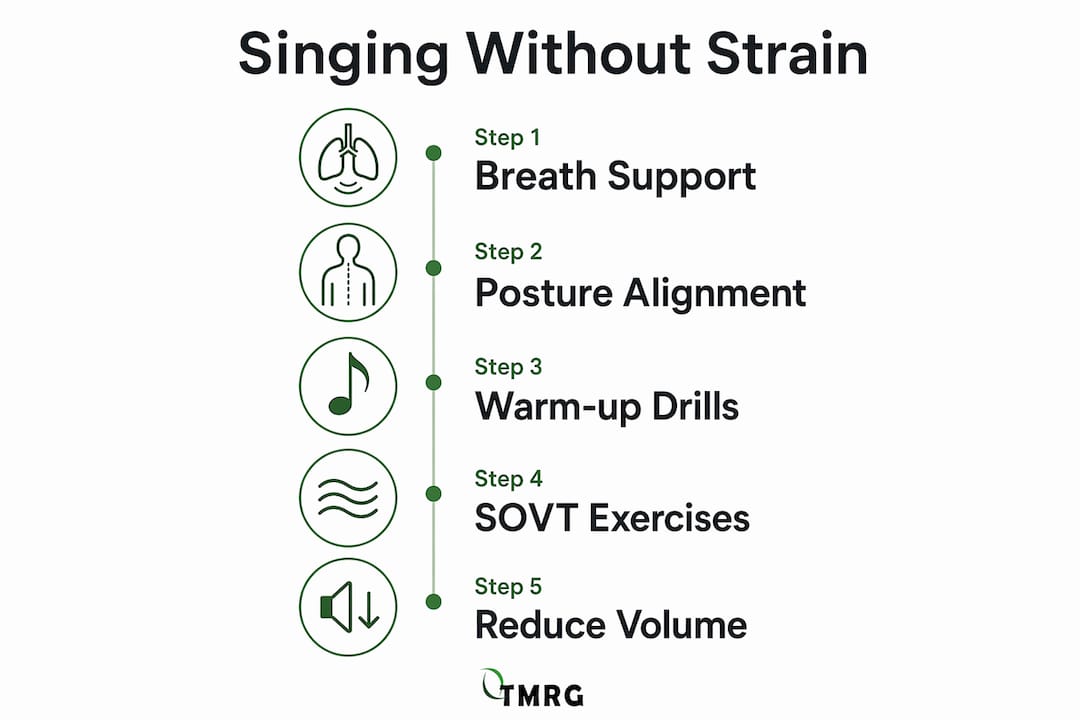
Semi-occluded vocal tract (SOVT) exercises are the most effective tools for building strain-free vocal coordination. SOVT exercises partially close the front of the vocal tract, which creates back pressure that supports the vocal folds from the outside. This reduces the physical effort the folds need to vibrate efficiently. SOVT exercises like straw phonation and lip trills improve vocal fold closure efficiency and reduce pressure on the vocal cords during high-register singing.
The best exercises to build into your daily practice:
Pro Tip: Singing is more about coordination than strength. Treat these exercises as precision drills, not cardio. Slow, deliberate repetition builds the neuromuscular patterns that make strain-free singing automatic.
Vocal exercises that target specific coordination problems yield better long-term results than simply running scales. Focused breath pacing and register work deliver real vocal development, while repetitive song rehearsal without technique work often reinforces existing tension patterns.
Breath support is not about how much air you take in. It is about how steadily and efficiently you release that air during phonation. Airflow management matters more than maximizing air intake for vocal power and strain avoidance. Singers who over-inhale often create shoulder and neck tension, which causes the vocal folds to clamp down or leak air, both of which increase strain.
The difference between diaphragmatic and chest breathing is measurable in the throat. Chest breathers run out of supported air quickly and begin recruiting throat muscles to sustain volume. Diaphragmatic breathers maintain a steady column of air that keeps the vocal folds vibrating freely. The goal is a smooth, continuous release, not a burst followed by a squeeze.
Practical breath control techniques:
“Treat your breath like a faucet, not a pump. Stop-start breathing creates glottal squeeze and tension. Fluid, continuous airflow from inhalation to phonation is what keeps the throat open and the voice free.”
Singers who build breath control through daily drills find that high notes become easier, not harder. The voice does not need to push when the breath is doing its job. For additional guidance on vocal health maintenance, structured daily routines make the biggest difference over time.
Most vocal strain comes from a small set of repeatable errors. Recognizing them is the first step to correcting them.
Healthy singing habits also extend beyond the practice room. Avoiding alcohol and caffeine before performances, sleeping with adequate humidity in the bedroom, and protecting your vocal cords from environmental irritants all reduce the baseline tension your voice carries into every session. Singers who treat vocal care as a full-time commitment, not just a pre-show ritual, build the most durable voices. You can also explore professional music care practices from other performance disciplines for useful parallels in instrument maintenance and longevity.
Singing without strain requires efficient phonation built on diaphragmatic breath support, structured warm-ups, and targeted SOVT exercises practiced consistently every day.
| Point | Details |
|---|---|
| Breath support is foundational | Diaphragmatic breathing reduces throat tension and sustains vocal fold efficiency across your full range. |
| SOVT exercises build coordination | Lip trills, straw phonation, and humming improve vocal fold closure with less muscular effort than forced singing. |
| Warm up every session | A 10–15 minute warm-up with sirens, lip trills, and humming prepares the vocal folds and prevents cold-start damage. |
| Half-volume practice reveals tension | Singing at reduced volume exposes compensatory throat muscle use that full volume masks. |
| Avoid repetitive scales for strain | Laryngeal massage and SOVT exercises address tension at its source; scales alone reinforce existing problems. |
Most singers I work with arrive believing their strain problem is a strength problem. They think they need a bigger voice, more power, more range. The real issue is almost always coordination. The throat is doing work the breath should be doing.
The shift that changes everything is learning to trust the breath. When you stop pushing and start supporting, the voice opens up in a way that feels almost effortless. That feeling is not a fluke. It is what efficient phonation actually feels like. The voice was designed to work this way.
My strongest advice is to practice exercises, not just songs. Focused vocal exercises build the neuromuscular patterns that songs cannot. Songs reward you for getting through them. Exercises force you to confront exactly where the coordination breaks down. That is where the real growth happens.
Listen to your body every single day. A voice that feels tight before you even start singing is telling you something. Rest, hydrate, and run through gentle SOVT work before pushing into full-voice practice. The singers who last decades are the ones who treat their voice like a precision instrument, not a tool to be forced.
— Golan
Technique builds the foundation, but your vocal folds also need physical care to stay healthy under the demands of regular performance.

Tmrgsolutions offers a range of professional-grade vocal health products developed over 25 years of working with singers, actors, and voice professionals. The TMRG Loud & Clear Classic Voice Recovery Drops are formulated to soothe and protect vocal cords after intense use, making them a practical addition to any post-performance routine. For singers who need a complete care system, the TMRG Voice Therapy Kit Standard combines targeted recovery tools in one package. These products work alongside your technique practice, not as a replacement for it, giving your voice the physical support it needs to recover and perform at its best.
Reduce your volume by half and check whether the tension disappears. If it does, the cause is insufficient breath support, not a vocal fold problem. Rebuild the phrase using diaphragmatic breathing and steady airflow.
A daily vocal warm-up of 10–15 minutes using lip trills, humming, and sirens is sufficient to prepare the voice and prevent strain. Longer is not always better. The goal is ease and flexibility, not fatigue.
Semi-occluded vocal tract exercises, such as straw phonation and lip trills, partially close the front of the vocal tract to create back pressure that supports the vocal folds. This reduces the muscular effort needed to produce sound and lowers the risk of strain.
Singing through any level of strain risks worsening the underlying tissue irritation. Rest, hydration, and gentle SOVT recovery exercises are the correct response to early strain signals. Continuing to sing forces the surrounding muscles to compensate, which deepens the problem.
Siren exercises that slide smoothly between chest and head voice build register flexibility over time. Forcing range through volume or muscular effort creates strain. Consistent, gentle register work across several weeks produces durable range expansion.
