Your Cart is Empty


Yes, a humidifier helps a singer’s voice. It restores surface moisture to the vocal folds and lowers phonation threshold pressure, meaning there is less effort to produce sound. Keep indoor humidity between 40% and 60%, clean the unit regularly, and drink enough water. A humidifier eases dryness and fatigue, but it will not fix nodules, reflux, or infection. Those need a real evaluation.
TL;DR:
- Humidifiers must be maintained properly, using distilled water and cleaning regularly to prevent bacteria and mold growth that can worsen throat irritation.
- To be effective, humidifiers should keep indoor humidity between 40% and 60%, avoiding lower levels that dry out tissues or higher levels that promote mold and dust mites.
- Short-term benefits include easier vocal warm-ups, reduced morning scratchiness, and less throat clearing during long performances or rehearsals.
- Different types of humidifiers suit various needs: cool-mist for nightly use, warm-mist for soothing heat, ultrasonic for quiet operation, and nebulizers for targeted pre-show relief.
- Humidifiers support surface tissue hydration but do not treat underlying vocal issues like nodules, and medical evaluation is necessary for persistent or severe symptoms.
Your vocal folds vibrate hundreds of times per second, and that motion depends on a thin, slippery mucus layer riding on their surface. When that layer dries out, the folds stick slightly with each cycle, and you have to push more air pressure through to get them moving. Voice scientists call this phonation threshold pressure, or PTP. It’s the minimum breath pressure needed to start and sustain vocal fold vibration, and it climbs when the surface tissue is dehydrated.
A controlled study on reducing the negative vocal effects of superficial laryngeal dehydration with humidification found that PTP rose after subjects were dehydrated, then dropped back toward baseline once they breathed humidified air. That’s the mechanism behind every “steam helps my voice” observation singers have made for generations. It’s not folklore. It’s fluid dynamics at the cellular surface.
A separate review on hydration and voice production draws a distinction worth remembering: systemic hydration (drinking water) and superficial hydration (moist air, steam, saline mist) work through different pathways, and neither fully substitutes for the other. Systemic hydration affects tissue over hours. Superficial hydration acts fast, sometimes within minutes, because it’s hitting the surface directly.
Statistic Callout: In the humidification study cited above, PTP values that had climbed following induced dehydration moved back toward baseline after subjects were exposed to humidified air, a direct, measurable link between ambient moisture and vocal effort.
This is why clinicians commonly recommend keeping indoor relative humidity between 40% and 60%. Below that range, surface drying accelerates. Above it, you invite mold and dust mites, which bring their own respiratory irritation. The sweet spot balances both risks:
The lab findings translate into real, noticeable changes in how your voice feels day to day. Singers who add a bedroom humidifier during dry months consistently report an easier warm up and less morning scratchiness, because the vocal folds spend seven or eight hours recovering in air that isn’t pulling moisture off their surface all night.
The benefits break down into three practical windows:
That third point matters more than singers usually realize. Throat clearing feels like relief, but it’s a hard, sudden closure of the vocal folds, essentially a small controlled collision. Reducing how often you need to clear your throat by keeping the air around you moist is a quiet way to protect the folds from repetitive impact stress across a long set or teaching day.
Pro Tip: Set your room humidifier running an hour before you go to sleep, not right when you lie down. Vocal fold tissue responds better to a stable, already-humidified environment than to a device still working its way up to target humidity.
Not every humidifier suits every situation, and the device that works for a bedroom is often wrong for a tour bus or a hotel room.
On the road, keeping hotel room humidity in a protective range beats relying on a hot shower with the bathroom door open. Shower steam is a short, uneven burst, not a sustained environment. A compact travel humidifier or a portable nebulizer packs easily and gives you control over the actual air you sleep in.
Use distilled water in every device you own. Tap water minerals get aerosolized along with the moisture, leaving fine white dust on furniture and, more importantly, in the air you’re breathing directly into your throat.
A dirty humidifier undoes its own purpose. Standing water breeds bacteria and mold within days, and running that through a mist chamber sends it straight into the room you’re breathing, which can irritate the throat more than dry air ever did.
Follow a simple maintenance rhythm:
Statistic Callout: Clinical guidance on humidifiers and vocal health points out that poorly maintained units can aerosolize mold and bacteria, which is why cleaning and distilled water use are standard recommendations alongside the 40% to 60% RH target.
A practical nightly schedule: fill the tank with distilled water before bed, run the unit through the night, empty it in the morning, and let it air dry during the day before refilling. That single habit prevents most of the contamination risk that gives humidifiers a bad reputation among people who never learned to maintain one.
Humidifiers ease surface symptoms. They do not treat vocal fold nodules, polyps, neuropathies, reflux, or infections, all of which need direct medical evaluation, not more moisture. Medical guidance on voice loss is clear that humidified air supports comfort but doesn’t address an underlying cause.
Get evaluated by an ENT or laryngologist if you notice any of these:
Humidification belongs alongside medical care when these symptoms appear, never instead of it.
Clinical guidance on combining hydration strategies consistently favors a layered approach over any single fix. Some vocal health guidance emphasizes that no one product or habit does the whole job.
A workable nightly and performance-day routine looks like this:
Start with one change tonight: set a humidifier running in your bedroom and check the reading with a hygrometer in the morning. Small, consistent habits outperform occasional heroics.
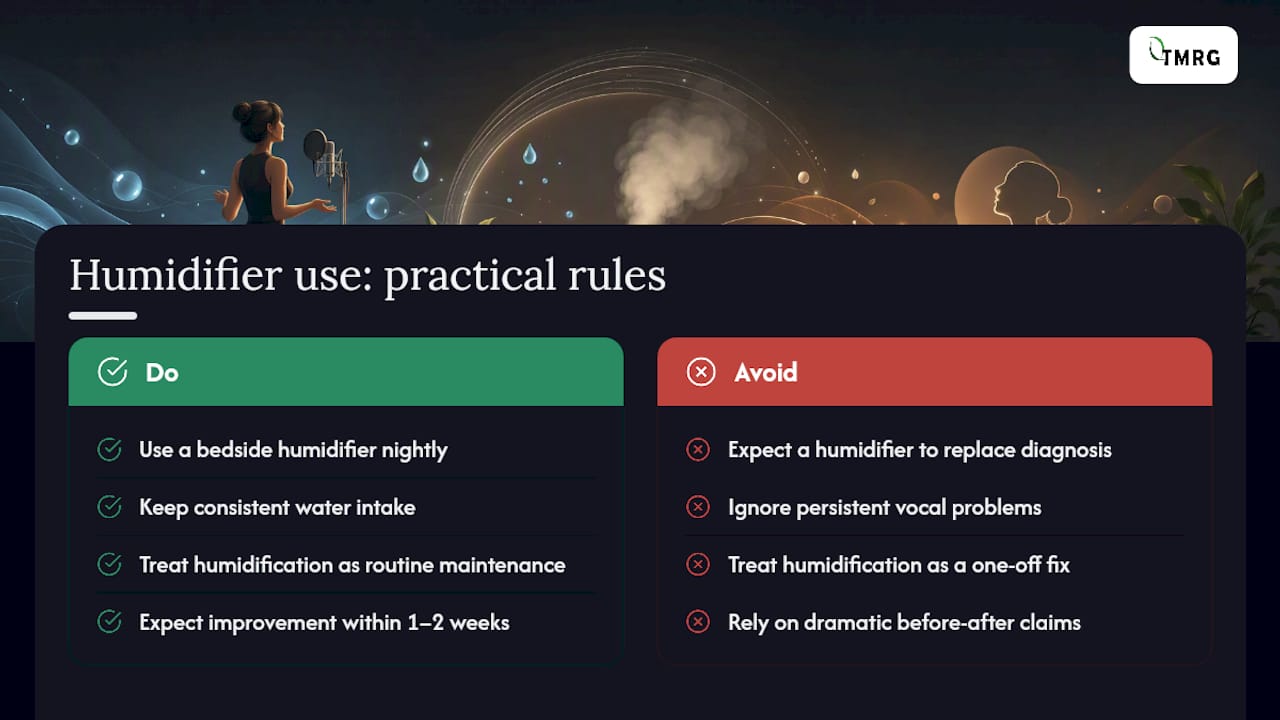
Ask any working singer touring through a dry winter climate what happens to their voice by week three without a humidifier, and you’ll hear the same story: increasing morning tightness, more throat clearing, a warm up that takes longer every day. Add a bedside humidifier and a consistent water intake habit, and that same singer usually reports the warm up shortening back to normal within a week or two.
What convinces me the evidence holds up isn’t the dramatic before-and-after story. It’s how boring the fix is. Humidification works because it addresses a simple physical fact about tissue and moisture, not because it’s a secret technique. The singers who get the most out of it are the ones who treat maintenance as part of the routine, not an afterthought, and who never expect a humidifier to replace a real diagnosis when something feels genuinely wrong.
— Golan
A humidifier handles the room. Your throat still needs something for the moments in between, backstage, mid rehearsal, on a plane where no humidifier is running at all. That’s the gap Tmrgsolutions built its spray and oil formulations to fill.
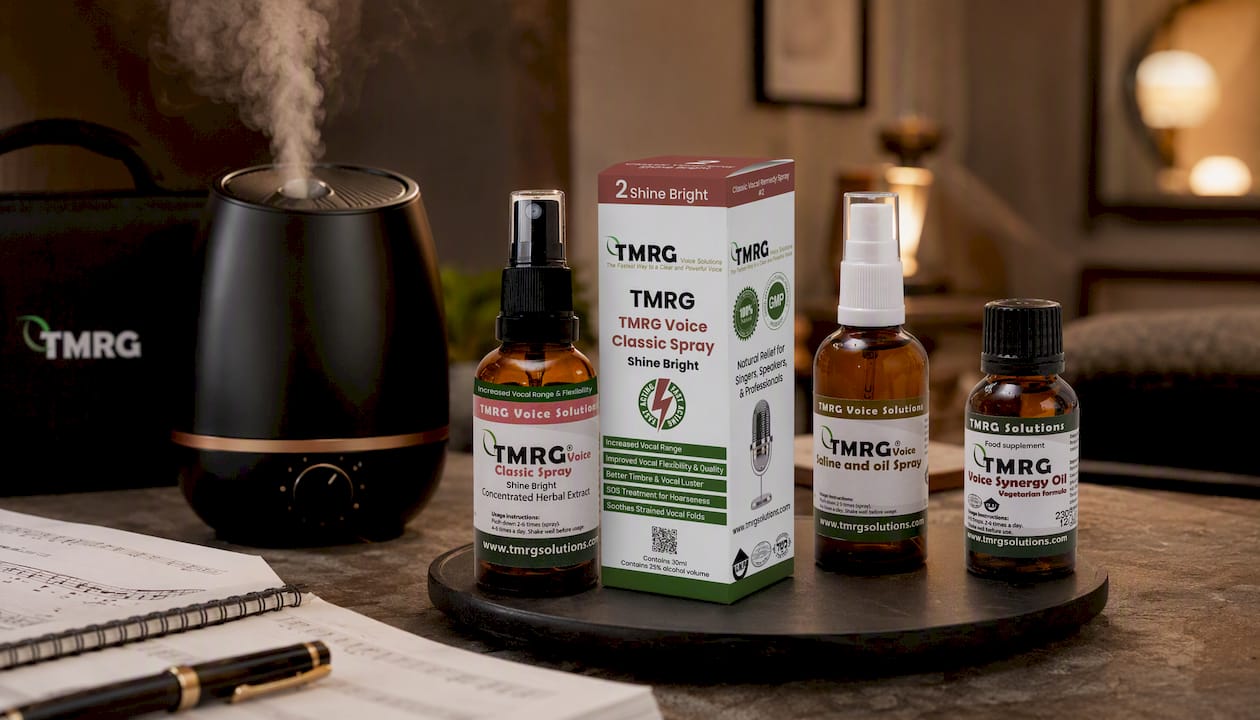
The TMRG Shine Bright Classic Voice Recovery Spray gives you a fast surface moisture boost when you can’t step away for a full steam session, useful right before you walk on stage after a dry flight or a long day of talking. For ongoing protection, the TMRG Defense and Protection Duo pairs recovery support with preventive care, built for singers who want a consistent routine rather than a one-off fix. And for on-the-go superficial relief between sets, the TMRG Defense Oils and Saline Voice and Throat Spray delivers targeted moisture without needing an outlet or a water tank nearby.
None of these replace a humidifier, and none replace a doctor’s visit if something feels genuinely wrong. They fill the hours a humidifier can’t reach. Browse the full lineup at Tmrgsolutions and build a routine that covers your room, your travel bag, and the ten minutes before you walk on stage.
This article is general information, not a substitute for advice from a qualified doctor. Consult a qualified healthcare professional about your own circumstances before acting on anything here.
Singers commonly combine steady water intake, bedroom humidifiers set to 40% to 60% humidity, and targeted tools like steam sessions or a saline throat spray for surface moisture right before performing.
Yes, a five to fifteen minute steam session delivers concentrated moisture directly to the vocal fold surface and is often recommended as a fast pre-show addition to regular room humidification.
Humidification and hydration support comfort and surface tissue health, but actual vocal fold damage such as nodules or lesions requires evaluation and treatment from an ENT or voice specialist, not home remedies alone.
Yes. Low humidity dries the vocal fold surface and raises phonation threshold pressure, meaning more breath effort is needed to produce sound, while humidified air moves that pressure back toward baseline.
Humidifiers act on the vocal fold surface directly by keeping the surrounding air moist enough to slow surface fluid loss, which is a distinct mechanism from soothing the throat lining alone.
