Your Cart is Empty


TL;DR:
- Steam inhalation provides rapid surface hydration for vocal folds by delivering warm, moist air directly to the mucosa, easing mucus buildup and tissue irritation. It should be used safely with proper technique, post-inhalation voice rest, and as part of a layered vocal care strategy including systemic hydration and technique. Over-reliance on steam alone may not improve long-term vocal durability, so integrating it with broader habits and professional guidance optimizes vocal health.
Many singers pour water down their throats between sets and assume their vocal folds are covered. They are not. The lining of your vocal folds is not directly reached by water you swallow—systemic hydration takes time, and surface hydration works differently. Steam inhalation has become one of the most popular tools in a singer’s home care routine because it delivers warm, moist air directly to the vocal tract, offering targeted relief that a glass of water simply cannot replicate in the short term. This guide examines what steam actually does, how to use it safely, and how to fit it into a broader vocal care strategy.
| Point | Details |
|---|---|
| Fast vocal relief | Steam inhalation soothes hoarseness and vocal fatigue by hydrating and relaxing the voice. |
| Safety is crucial | Use warm (not hot) steam and include voice rest to avoid injury or burns. |
| Complementary care | Combine steam inhalation with systemic hydration and professional guidance for best results. |
| Temporary effect | Steam benefits are short-lived and should be part of a broader voice care routine. |
| Professional assessment | Persistent vocal problems require expert evaluation beyond home remedies. |
Your vocal folds (the thin bands of muscle and tissue in your larynx that vibrate to produce sound) depend on a thin layer of surface mucus to function smoothly. When that layer dries out, the folds lose their ability to vibrate efficiently. The result? A voice that feels heavy, rough, and unpredictable—exactly what no performer wants on stage.
Steam inhalation works by delivering warm, moist air directly along the walls of your airway. Unlike water you drink, which is absorbed systemically and must travel through your bloodstream before reaching vocal tissue, steam contacts the mucosal surface almost immediately. This means faster surface relief, especially when you are dealing with post-performance fatigue, mild irritation from illness, or environmental dryness.
Here is what steam inhalation provides for your vocal folds:
The science backs this up. Warm moist inhalation reduces phonation threshold pressure (the minimum air pressure needed to set the vocal folds vibrating), improves acoustic quality, enhances glottic closure (how completely the folds meet during sound production), and increases self-rated voice ease. In practical terms: your voice works with less effort and feels less strained.
“Steam inhalation is not a replacement for professional care, but it is one of the most accessible and evidence-supported tools a singer can use between voice therapy sessions and performances.” — TMRG Voice Specialist
For singers who want to read more about layered approaches, our hydration strategies article breaks down the full picture. You can also check out practical hydration advice for singers from the Barbershop Harmony Society, which underlines how consistent hydration forms the foundation of vocal longevity.
Understanding the mechanics helps you use steam more precisely. When you inhale warm steam, microscopic water droplets coat the inner walls of your nasal passage, throat, and upper airway. The warmth gently relaxes tight tissues while the moisture reduces friction along the vocal tract. Think of it as giving your vocal folds a warm, calming mist bath before or after the demands of performance.
Here is a safe, step-by-step method you can follow at home:
The three most common steam methods used by singers are:
| Method | Equipment needed | Best for |
|---|---|---|
| Purpose-built steam inhaler | Handheld personal inhaler | Controlled, consistent delivery |
| Bowl and towel | Bowl, hot water, towel | Accessible home use |
| Hot shower | Standard shower | Mild ambient steam, whole-body relaxation |
Research on vocal loading (the cumulative stress placed on vocal folds during extended use) shows acoustic and vocal effort benefits from steam, though professional voice users may find that nebulization (delivering saline mist via a medical nebulizer) provides superior depth of hydration. We cover complementary approaches in our vocal support tips and in our complete guide to vocal cord hydration.

Pro Tip: Never add essential oils or menthol to your steam water unless specifically directed by a voice therapist. These substances can irritate the delicate mucosal lining rather than soothe it, and the research supporting their use for vocal health is thin.
Steam is one tool. It is not the only one. To protect your voice over time, you need to understand how steam compares to the other hydration strategies that vocal health professionals recommend.
| Method | How it works | Main benefit | Key limitation |
|---|---|---|---|
| Steam inhalation | Warm moist air, surface contact | Fast surface relief, mucus thinning | Superficial; requires voice rest after |
| Saline nebulizer | Fine saline mist, deeper penetration | Safer, deeper hydration, no heat risk | Requires a device; no warming effect |
| Systemic hydration (water) | Absorbed through digestion and bloodstream | Full-body hydration, long-term benefit | Slow to reach vocal folds |
| SOVT exercises | Semi-occluded vocal tract phonation | Reduces phonation threshold pressure | Technique dependent, not topical |
The key differences matter for your decision-making. Avoid hot steam to prevent scalds or epithelial (surface tissue) damage, and recognize that steam is less targeted than saline nebulization, which hydrates the vocal tract without any heat risk and without requiring post-steam voice rest.
For professional voice users, saline nebulizers are preferred by many experts because they deliver hydration safely and more deeply without the burn risk that improperly used steam carries. That said, steam still has a meaningful role, especially for singers who do not have access to a nebulizer or who want a low-cost, immediately available option.
A few important points to keep in mind when choosing between methods:
For a structured look at integrating all of these into your week, our effective voice care routine is worth bookmarking. For additional respiratory guidance, respiratory support guidelines offer a useful reference point.
Knowing the theory is one thing. Applying it consistently is what actually protects your voice. Here is a sample routine you can adapt based on your schedule and performance demands:
For vocal professionals, pre- and post-performance steaming measurably reduces vocal strain, but monitoring for overuse is essential. If hoarseness persists for more than two weeks, this is a clear signal to consult an ENT physician. Hoarseness that lingers is not always simple fatigue—it can indicate nodules, polyps, or other conditions that require professional assessment.
Pro Tip: Pairing steam with SOVT exercises (semi-occluded vocal tract exercises such as straw phonation, where you phonate through a narrow straw to reduce vocal fold collision force) is one of the most effective combinations for vocal recovery. Steam first, then SOVT, then silence.
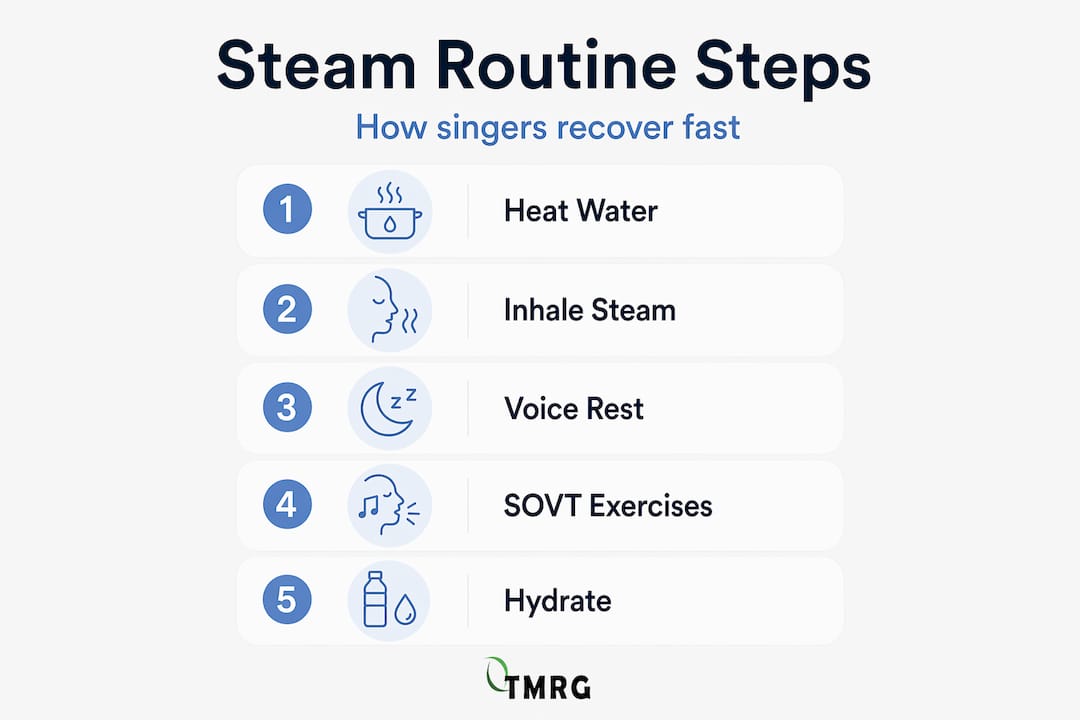
Our proven vocal support strategies and vocal recovery strategies articles give you more detail on building this kind of layered, consistent recovery plan.
Even the most well-intentioned singers make errors with steam. These mistakes can neutralize the benefits—or worse, cause harm. Here is what to watch for:
“Steam inhalation is a simple, low-cost natural remedy for singers experiencing hoarseness and vocal fatigue. It is supported by ENT and singer organizations alike, but it must be used cautiously with proper protocols—and works best as part of a layered hydration approach.” — Vocal Fatigue and Hydration, Barbershop Harmony Society
For additional ways to protect your voice across different performance scenarios, our voice-saving techniques resource offers practical, performer-tested guidance.
Here is something we observe repeatedly in over 25 years of vocal health work: singers who rely heavily on steam inhalation as their primary recovery tool often hit a plateau. Their voice feels better after steaming, they sing, they strain it again, they steam again. The cycle continues without any real improvement in vocal durability.
Steam is genuinely useful. We are not dismissing it. But it provides surface-level, temporary relief—and that distinction matters enormously. If you are steaming regularly but still experiencing hoarseness, vocal fatigue, or inconsistent tone quality, steam is not failing you. Something deeper in your vocal care picture is missing. That could be inadequate systemic hydration, poor vocal technique, insufficient sleep, unaddressed reflux, or the absence of structured vocal rest.
The singers and voice professionals who build enduring vocal strength are not the ones chasing quick fixes between performances. They are the ones who treat steam as one layer in a purposeful system: drink enough water all day, warm up and cool down intentionally, rest their voice on off days, get their technique assessed regularly, and use tools like steam and nebulizers to support recovery rather than rescue a neglected voice.
It is tempting—especially under performance pressure—to reach for the fastest remedy available. Steam feels good. It works quickly. That immediate feedback is rewarding. But vocal health always circles back to consistency, respect for your instrument’s limits, and honest self-assessment. Our prevention tips for vocal health are a good place to examine where gaps might exist in your current approach.
Steam inhalation is a strong starting point, but the most effective vocal care routines are built with purpose-designed support tools alongside it.

At TMRG Solutions, our basic voice therapy kit is built specifically for singers and voice professionals who want a structured, evidence-informed approach to home care. If you are dealing with persistent hoarseness or vocal fatigue that steaming alone does not resolve, our voice enhancement drops offer natural herbal support formulated for vocal recovery. You can also explore our resource on understanding vocal problems to better identify what your voice may be telling you. With 25 plus years of expertise behind every product, we are here to support your voice at every stage of your performing life.
No. Steam provides temporary surface hydration and mucus-thinning relief, but persistent hoarseness lasting more than two weeks should be evaluated by an ENT specialist to rule out structural vocal issues.
You should allow at least 20 to 30 minutes of voice rest after steaming. Singing too soon after steam exposure increases the risk of vocal fold hemorrhage because the tissue is temporarily softened and more vulnerable.
Neither replaces the other. Steam hydrates the surface of the vocal folds directly, while drinking water provides systemic hydration that supports the whole body over time. Combining both approaches, along with SOVT exercises, gives you the most complete protection.
The main risks include scalds from water that is too hot, epithelial damage from heat exposure, and vocal fold injury from singing too soon after steaming. Using warm rather than hot steam and observing post-steam voice rest minimizes all of these risks.
Most guidelines support 1 to 3 sessions daily of up to 10 minutes each, timed before or after vocal use. Always follow each session with a period of voice rest rather than immediately returning to singing or speaking.
